3D Mammogram in China: What to Know Before You Book
Key Takeaways
- 3D mammography (digital breast tomosynthesis) at a top-tier Chinese hospital typically runs $150–$400 for the scan itself — a fraction of the $400–$900 common in the United States.
- China’s largest cancer centers read thousands of breast images annually, and several sit in the Fudan specialist reputation rankings for oncology.
- You cannot usually book a public-hospital imaging slot from overseas without help — walk-in registration is the norm, and that is the single biggest practical hurdle.
- Bring prior films and pathology reports, and confirm in writing whether the report will be issued in English before you pay.
The Problem: Screening Gaps, Costs, and the Dense-Breast Question
Roughly 40% of women have dense breast tissue, and in that group a standard 2D mammogram can miss cancers that 3D imaging picks up. That is not a marketing claim. It comes from years of comparative studies, including research summarized by the American College of Radiology, showing that tomosynthesis improves cancer detection rates while reducing false-positive callbacks.
So the technology matters. The problem is access and price.
In the United States, a screening mammogram averages a few hundred dollars, and a diagnostic 3D study with a radiologist read can climb past $900 before insurance. In the UK and Canada, the scan may be free — but the wait for a diagnostic slot after an abnormal finding can stretch weeks. For a woman who felt a lump on a Tuesday, three weeks of waiting is not a neutral experience.
That gap is why a growing number of international patients look at China. The equipment is current-generation. The radiologists at major centers are experienced. And the price sits well below Western private rates.
Why China Delivers Strong Breast Imaging at Lower Cost
The case rests on three structural facts, not on slogans.
Volume Builds Radiologist Experience
A major Chinese cancer hospital may interpret tens of thousands of breast studies each year. High volume does not automatically mean better care — but it does mean the readers have seen the subtle cases, the asymmetric densities, the architectural distortions that less-exposed readers miss. Several of these centers appear in the Fudan University specialist reputation rankings, which list the top hospitals by department rather than by overall position. If breast oncology is your concern, that department-level list is the one worth reading. Our specialty rankings by department break it down by field.
Equipment Is Not the Bottleneck
Tomosynthesis units from GE, Hologic, Siemens and Fujifilm are standard in tier-one hospitals and private international clinics. A 3D mammogram in Shanghai at a private international hospital will feel familiar to anyone who has used a Western imaging center: English-speaking staff, appointment times that hold, and a report delivered digitally. A public tertiary hospital offers the same core technology at a lower price, with more crowding and less English.
The Cost Difference Is Structural, Not a Quality Signal
Lower prices in China reflect labor economics, patient throughput, and public-hospital subsidies — not corner-cutting on the machine or the read. A hospital that performs 200 studies a day spreads its fixed equipment cost across far more patients than a clinic doing 20. That arithmetic, not inferior care, is what shows up on the bill.
| Setting | Typical 3D Mammogram Price (USD) | English Report | Booking From Abroad |
|---|---|---|---|
| US private imaging center | $400–$900 | Yes | Yes, direct |
| UK private hospital | $350–$700 | Yes | Yes, direct |
| China — public tertiary hospital | $150–$300 | Often, on request | Rarely without assistance |
| China — private international hospital | $250–$400 | Yes, standard | Yes, direct |
Prices vary by hospital and case complexity. A screening study costs less than a diagnostic workup that adds ultrasound, a second read, or a biopsy. Treat any figure here as a starting range, not a quote.
How a 3D Mammogram Visit Actually Works in China
This is where expectations meet reality, and where most overseas patients get surprised.
Step one — registration. At a public hospital, you register on the day, in person, with your passport. There is no online slot you can reserve from another continent. You take a number, you wait, you pay at a cashier window. Appointments for imaging are typically assigned within the same day or the next.
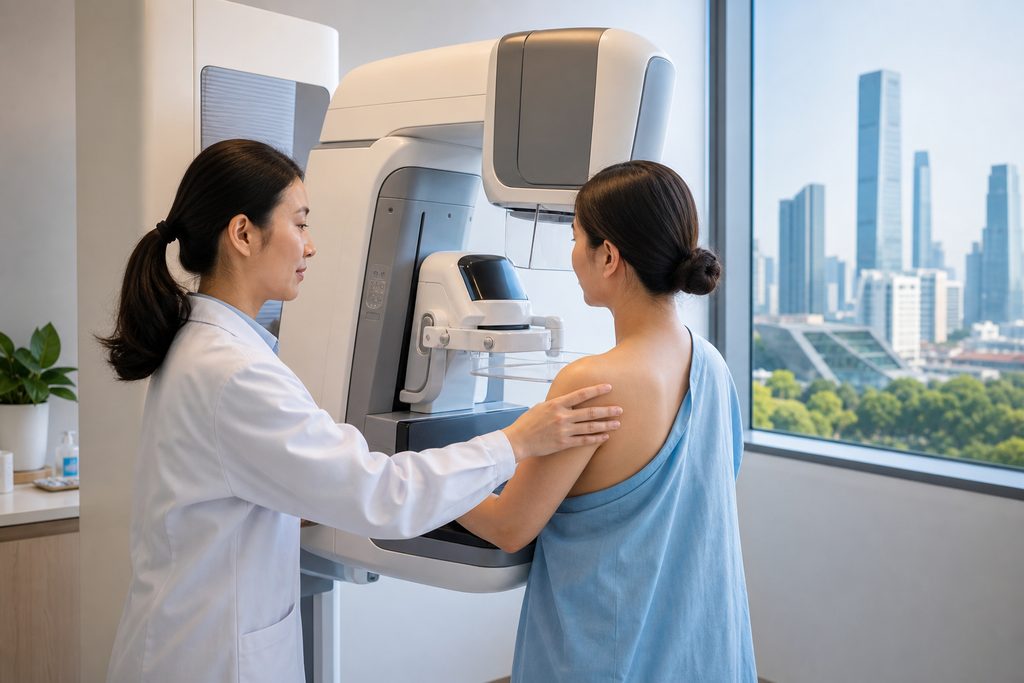
Step two — the scan. The technologist positions you, the machine sweeps an arc over the breast, and the whole acquisition takes under 15 minutes. Compression is the same as any mammogram anywhere. Expect four views for a standard screening.
Step three — the read. A radiologist interprets the images and issues a report, usually within 24 to 72 hours. At a public hospital the report is in Chinese. Ask upfront whether an English version can be produced — many large centers can, but it is not automatic.
Step four — the follow-up. If something needs a closer look, you may be sent for a targeted ultrasound or a biopsy, often on a separate day and a separate payment.
Judging Accuracy, Safety, and Whether This Is Right for You
Is a 3D mammogram in China safe? The radiation dose from tomosynthesis is comparable to — and in many modern systems only slightly higher than — a standard 2D mammogram. The technology itself carries no country-specific risk. What varies is the reading environment, the report language, and the continuity of care after you fly home.
On accuracy for dense breasts: 3D imaging consistently outperforms 2D in detection and callback rates across multiple international studies. That finding is not China-specific. It is why tomosynthesis has become the default in many Western screening programs.
Where the decision gets personal is here — this route suits you if you want a fast, affordable, high-volume imaging center and you are comfortable navigating a large hospital. It suits you less if you need a single physician to own your case across months, or if you cannot travel and would rather have a remote review of existing films first.
A written second opinion from a Chinese specialist, based on images and reports you already have, often answers the real question — do I need to travel at all? — before anyone buys a plane ticket. That is a service we arrange, and it is usually the smarter first move.
Practical Considerations: Records, Visas, Payment, and Follow-Up
Documentation. Carry your passport, prior imaging, and a list of medications. If you have a family history of breast cancer or a known BRCA variant, bring that documentation — it changes how the images are read.
Visa. For short medical travel, the applicable category is the S2 visa, which covers medical treatment and private affairs, subject to the latest embassy or consulate requirements and supporting hospital documents. Family members accompanying you apply under the same category. Note that the M visa is for commercial and trade activity and has nothing to do with medical treatment. Confirm current rules with your nearest Chinese embassy before applying.
Payment. Public hospitals require prepayment, and you settle the bill on site. International cards are accepted at private hospitals and at many public hospital international departments, but not everywhere. Foreign insurance is usually reimbursed after the fact rather than billed directly — private international hospitals with direct billing arrangements are the exception. Keep itemized receipts.
Language. In a hospital that sees thousands of outpatients a day, English signage is limited outside international wings. If you do not speak Mandarin, plan for interpretation rather than hoping for it.
Follow-up at home. Ask for your images on disc before you leave. Your home radiologist will want the raw files, not just the report, for future comparison.
Frequently Asked Questions
Expect roughly $150–$300 at a public tertiary hospital and $250–$400 at a private international hospital. Diagnostic workups that add ultrasound or biopsy cost more. Final pricing varies by hospital and case complexity, so confirm before you commit.
At private international hospitals, often yes — directly. At public hospitals, generally no, because registration happens in person on the day. This is the practical reason many international patients use a coordination service for public-hospital imaging.
The imaging technology is the same generation of equipment, and major Chinese cancer centers read high volumes of breast studies. Accuracy depends far more on the individual radiologist and image quality than on the country. Ask who will read your study and whether prior films will be compared.
You will likely be referred for ultrasound or biopsy, often on a separate visit and payment. This is normal workflow, not a red flag. Plan buffer days into your trip so a follow-up does not force a rebooked flight.
Not automatically at public hospitals. Request it at registration, and confirm the answer in writing. Private international hospitals issue English reports as standard.
Your Next Step
The core message is simple: 3D mammography in China offers current-generation technology at a fraction of Western private prices, with the main trade-offs being language, booking logistics, and continuity of care. If your priority is a fast, affordable, well-read study, the option is real.
We are China Medical Services — a coordination team, not a hospital, and we do not diagnose or treat. We help international patients match with appropriate hospitals, arrange appointments, and provide bilingual support on the ground. If you would like to talk through whether this makes sense for your situation, you can start with a free consultation — no pressure, just a clear conversation about your options.
This article is for general information only and is not medical advice. Screening decisions should be made with a qualified physician who knows your history. Prices and policies cited here may change; always confirm details directly with the hospital.
For more medical information and treatment options in China, visit chinamedservices.com (China Medical Services).
