3D Printed Chest Wall Reconstruction China: Titanium Rib Cage After Tumor Resection
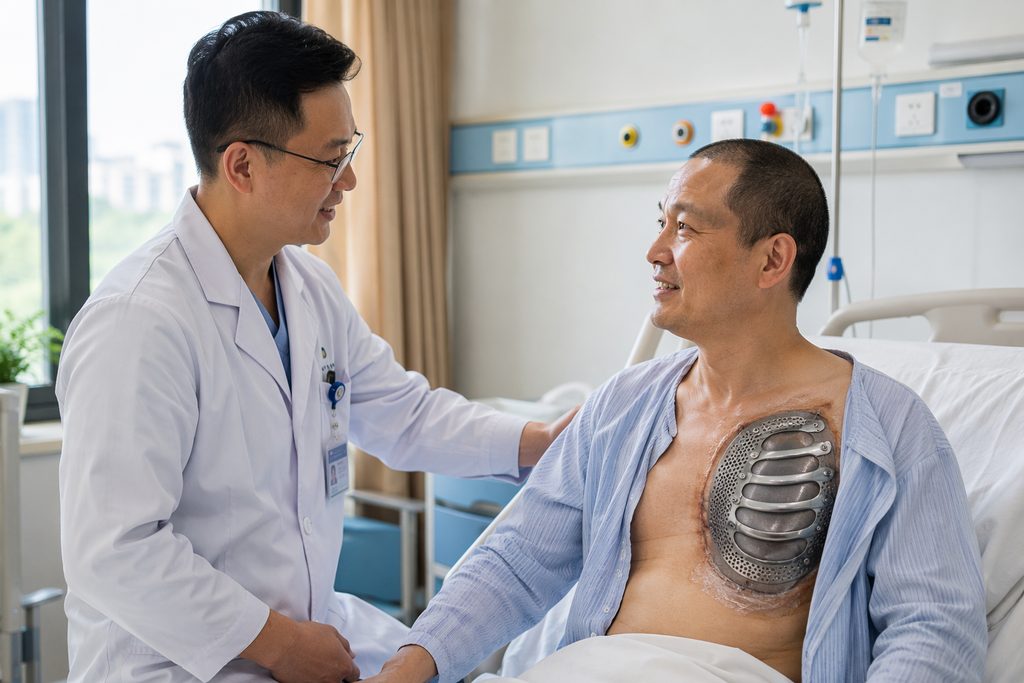
What does it feel like to lose part of your rib cage to cancer, and then learn that rebuilding it with a custom titanium implant could cost more than your house?
That question sits at the center of one of the most remarkable — and emotionally charged — intersections of oncology and engineering. Chest wall tumors are rare. Primary chest wall sarcomas affect approximately 1 in 100,000 people. But when they occur, the surgical solution is radical: resect the tumor with wide margins, removing sections of ribs, sternum, and surrounding soft tissue. Then rebuild. The reconstruction has to protect the heart and lungs. It has to allow breathing. It has to look as normal as possible. For decades, surgeons used bone cement, mesh, or cadaver bone. Those methods work. But they are not precise. They do not match the patient’s exact anatomy. A 3D printed titanium rib cage changes everything.
Our team at China Medical Services has guided patients through this exact procedure. We are not surgeons. We do not provide medical treatment. We handle the logistics — hospital matching, appointment coordination, bilingual medical companions, visa guidance — so you can focus entirely on recovery. We have seen the titanium rib cage implant cost in China transform from an intimidating unknown into a transparent, manageable figure. And we have watched patients breathe normally again after a surgery that, in many Western countries, would have been financially devastating or logistically impossible to schedule quickly.
Key Takeaways
- A custom 3D printed titanium rib cage implant in China costs $20,000–$40,000 for the implant and surgical procedure, compared to $150,000–$250,000 in the United States.
- Chinese thoracic surgery teams at top-ranked hospitals now routinely use patient-specific 3D printed implants, with design-to-surgery turnaround times as short as 2–3 weeks.
- Language barriers, visa requirements, and hospital registration systems make independent navigation extremely difficult — professional coordination is not a luxury, it is a practical necessity.
- You must understand that 3D printed implant surgery is still a major open procedure with real risks. No coordinator can eliminate surgical risk. We can only remove the logistical obstacles so you face those risks with the right surgical team.
The Problem: A Rare Cancer, an Extreme Surgery, and a Crushing Bill
Chest wall tumors — chondrosarcomas, Ewing’s sarcomas, osteosarcomas, and aggressive desmoid tumors — do not give you time to shop around. Once diagnosed, the clock starts. Resection requires removing enough bone and tissue to achieve clean margins. For a tumor involving three or four ribs and part of the sternum, that means a gaping structural defect. The chest wall becomes unstable. Paradoxical breathing sets in: the unprotected lung moves inward when you inhale, outward when you exhale. It is terrifying to experience and dangerous to leave unrepaired.
In the United States, a patient facing this surgery confronts two brutal realities. First, the implant itself. A custom 3D printed titanium rib cage prosthesis, designed from CT data and manufactured via electron beam melting, costs $50,000–$80,000 for the device alone. Add the surgical procedure, hospital stay, and anesthesia, and the total bill easily reaches $150,000–$250,000. Insurance may cover a portion. It may not. Prior authorization for a custom implant can take weeks. Second, finding a surgical team with meaningful experience in 3D printed chest wall reconstruction is genuinely hard. The procedure is new enough that most thoracic surgeons have done fewer than ten cases. Some have done none. You want a team that has done dozens.
Wait times compound the problem. In the UK, NHS wait times for sarcoma surgery can stretch past 62 days from urgent referral. In Canada, the median wait for thoracic oncology surgery exceeds three weeks — and that is for standard procedures, not custom implant cases requiring design and manufacturing lead time. A tumor does not politely pause while you navigate authorizations and queues.
Who We Are
China Medical Services is a medical concierge organization connecting international patients with China’s top-tier hospitals. We maintain a database of 340+ top-ranked hospitals across 37 cities — institutions that represent the top 5% of China’s 35,000+ hospitals, ranked by Fudan University‘s hospital evaluation system and JCI accreditation. We are not a hospital. We do not diagnose, treat, or prescribe. We are your logistical architects. We translate medical records, coordinate with hospital international departments, arrange bilingual medical companions, and guide you through visa applications, travel logistics, and post-operative recovery planning. Our role is to remove every non-medical barrier between you and the surgical expertise you need.
Why 3D Printed Titanium Rib Cage Reconstruction in China Delivers Results
Surgical Volume Creates Expertise You Can Trust
Here is a number that matters: a top thoracic surgery department at a major Chinese hospital — think Shanghai Chest Hospital or Peking University People’s Hospital — performs over 2,000 thoracic surgeries annually. Within that volume, chest wall reconstruction cases number in the dozens per year, not dozens per career. When you ask a surgeon how many custom titanium rib cage implantations they have done, you want a number that reflects repetition and refinement. Chinese thoracic surgeons operating at this level have moved past the learning curve. They have seen the complications. They have refined the fixation techniques — how the titanium prosthesis anchors to the remaining ribs and sternum, which screw trajectories work best, how to manage soft tissue coverage over metal. Volume drives competence. Competence drives outcomes.
Is 3D printed titanium rib cage after tumor removal safe? The data says yes — when performed by experienced teams. A 2020 study published in the Journal of Thoracic Disease reviewed 3D printed titanium implant reconstructions and reported excellent functional outcomes with low complication rates. Implant-related complications — loosening, fracture, infection — occur in approximately 5–10% of cases, comparable to or lower than traditional mesh-cement reconstructions. The key variable is not the technology. It is the surgical team.
Technology Integration That Cuts Wait Times
The process sounds like science fiction but has become clinical routine. After your CT scan, the DICOM data goes to an engineering team that segments the tumor and surrounding anatomy. They design a patient-specific implant that mirrors your contralateral rib curvature exactly. The design goes through finite element analysis to simulate breathing stresses. Then an electron beam melting printer fuses titanium powder layer by layer into a solid prosthesis with porous surfaces that encourage bone ingrowth. The implant is sterilized, packaged, and delivered to the operating room.
In China, this entire workflow — from CT to implant delivery — can be compressed into 14–21 days. Why? Because the design and manufacturing teams are often co-located with the hospitals or work under institutional partnerships that prioritize clinical cases. There is no transoceanic shipping delay. No customs clearance for a medical device. The engineer and the surgeon speak the same language and often work in the same building. For a patient with an aggressive tumor, those saved weeks are not a convenience. They are oncologically meaningful.
The Titanium Rib Cage Implant Cost in China: A Structural Advantage, Not a Quality Tradeoff
Let us address the obvious question directly. Why does the titanium rib cage implant cost in China run $20,000–$40,000 for the implant and procedure combined, while the same surgery in the US costs $150,000–$250,000? The answer has nothing to do with inferior materials or compromised safety. It is structural economics.
Chinese hospital systems operate at enormous scale. A single thoracic surgery ward may have 80–100 beds and run at near-full occupancy year-round. Fixed costs — imaging equipment, sterilization systems, operating room infrastructure — are amortized across vastly more procedures. Surgeon and nursing labor costs are lower, reflecting China’s overall wage structure, not a discount on skill. The titanium powder and printing equipment cost roughly the same as in the West. The savings come from system efficiency, not corner-cutting. Clinical outcomes for chest wall reconstruction at top Chinese centers are comparable to those reported by leading Western institutions. The difference is the price tag, not the prognosis.
| Cost Component | China (USD) | United States (USD) |
|---|---|---|
| Custom 3D printed titanium implant | $8,000–$15,000 | $50,000–$80,000 |
| Surgical procedure & hospital stay | $12,000–$25,000 | $100,000–$170,000 |
| Total estimated cost | $20,000–$40,000 | $150,000–$250,000 |
These figures are estimates. Final costs vary by hospital, implant complexity, length of stay, and whether any complications arise. But the order-of-magnitude difference is real and consistent.
Can I Get a Custom 3D Printed Chest Implant in China? Yes — Here Is How
The short answer is yes. The longer answer involves understanding that this is not an off-the-shelf product you order. It is a surgical workflow that begins with your medical data and ends in an operating room. The pathway works like this.
First, you need a qualified thoracic surgeon to review your case and confirm that 3D printed reconstruction is appropriate. Not every chest wall defect requires a custom titanium implant. Smaller defects — two ribs or fewer — may be adequately reconstructed with mesh or non-custom plates. The decision depends on defect size, location, and the patient’s overall condition. A surgeon at a top Chinese hospital will make that call based on your imaging and history.
Second, once the surgical plan is confirmed, your CT data is sent for implant design. The engineering team creates a 3D model of your chest wall, designs the prosthesis, and sends it back to the surgeon for approval. This iterative process takes about a week. Manufacturing takes another week. The implant is then sterilized and prepared for surgery.
Third, you travel to China. The surgery itself is a major open procedure lasting 4–8 hours depending on the extent of resection and reconstruction. Hospital stay typically runs 10–14 days. Post-operative recovery continues for several months, with gradual return to normal activity.
Can you book chest wall reconstruction surgery through China medical tourism channels? You can — but the term “medical tourism” undersells what this actually requires. This is not a dental holiday. It is major thoracic oncology surgery. The coordination demands are significant: medical record translation, hospital selection, implant design coordination, surgical scheduling, visa processing, travel logistics, in-hospital interpretation, and post-discharge follow-up. Attempting to arrange this independently, without Chinese language skills and institutional relationships, borders on impossible.
What You Need to Know Before Going Alone
We want to be completely direct about the barriers. Patients who understand these challenges make better decisions.
- Visa Requirements Are Specific and Strict: Medical treatment in China requires an S2 visa with the purpose annotated as medical treatment. Your accompanying family members also need S2 visas. The application requires an invitation letter from the Chinese hospital, proof of appointment, and documentation of the medical necessity. Processing times vary by country. Getting this wrong — applying for a tourist L visa or a business M visa — will result in denial. M visas are for commercial activities only and have no connection to medical treatment.
- Hospital Registration Is Not Online Shopping: Chinese public hospitals do not allow overseas patients to book surgeries through a website. You cannot browse a calendar and pick a date. You must first have an in-person consultation. The surgeon must examine you, review your imaging, and agree to take your case. Only then can a surgical slot be scheduled. The hospital’s international department or VIP channel is the only pathway for pre-arranged surgical bookings for foreign patients. General outpatient clinics cannot be pre-booked from abroad.
- Language Is a Hard Wall, Not a Soft Barrier: A top Chinese hospital may see 10,000 outpatient visits in a single day. Registration kiosks have Chinese-language interfaces. Lab results come back in Chinese. Nurses give discharge instructions in Chinese. Surgeons may speak some English during consultation but will document everything in Chinese. Without a bilingual companion who understands both the language and the hospital workflow, you will be lost — literally and medically.
- Payment Is Upfront: Public hospitals in China require prepayment for surgical procedures. You deposit funds at admission, and charges are deducted daily. Final settlement occurs at discharge. International insurance is rarely accepted for direct billing at public hospitals; you pay first and seek reimbursement later. Private international hospitals like United Family or Jiahui do offer direct insurance billing, but they may not have the specific 3D printed chest wall reconstruction expertise you need. The best surgical teams are typically at major public hospitals.
How We Help You Navigate This
These barriers exist for structural reasons, not because anyone wants to exclude international patients. Chinese hospitals are designed to serve a domestic population of 1.4 billion people. Adapting that system for foreign patients requires institutional relationships and local expertise. That is what we provide.
Before you travel, we translate and format your medical records according to Chinese hospital submission standards. We identify the thoracic surgery departments with the strongest track record in 3D printed chest wall reconstruction — hospitals ranked among China’s top 10 for thoracic surgery by the Fudan specialty reputation rankings. We coordinate with the hospital’s international department to schedule your initial consultation and subsequent surgery. We guide you through the S2 visa application, providing the invitation documentation you need.
During your treatment, a bilingual medical companion accompanies you to every appointment. They handle registration, queue for tests, translate conversations with your surgical team, explain discharge instructions, and manage pharmacy pickups. They are not interpreters on a screen. They are physically present, walking the hospital corridors with you. For patients recovering from major thoracic surgery, having someone who can communicate with nurses about pain management or ask clarifying questions about wound care is not a comfort — it is a safety measure.
After discharge, we help coordinate follow-up imaging and consultations, either in China or with your home physician. We remain available throughout your recovery period. Our coordination fee structure is transparent: bilingual medical companion services start from $200 per day, hospital appointment coordination from $300, and comprehensive VIP end-to-end coordination from $5,000. Any consultation or coordination fees paid are credited in full toward on-the-ground coordination services if you proceed with treatment within 90 days.
Frequently Asked Questions
The safety profile is well-established when the procedure is performed by an experienced team. Published complication rates for implant-related issues — fracture, loosening, infection — range from 5–10%, which is comparable to or better than traditional mesh-cement reconstruction. The titanium alloy used (typically Ti-6Al-4V) is biocompatible and has decades of clinical use in orthopedic and craniofacial implants. The porous surface structure promotes osseointegration, meaning your own bone grows into the implant over time, creating a biological fixation that supplements the mechanical screws. The primary risk is not the implant material but the surgery itself: this is a major open procedure with risks including bleeding, infection, respiratory complications, and anesthetic events. No implant technology eliminates those baseline surgical risks.
Patients report that the implant feels firm and protective, not painful. The titanium prosthesis restores chest wall rigidity, which eliminates paradoxical breathing and protects the underlying organs. Most patients return to normal daily activities within 3–6 months. High-impact contact sports are generally discouraged due to the risk of trauma to the implant site, but swimming, running, cycling, and weight training are typically possible after full recovery. Your surgeon will provide specific activity guidelines based on the extent of your reconstruction.
This is the hardest question, and we will not sugarcoat it. Implant infection, though uncommon, is serious. Treatment may require implant removal, debridement, and eventual re-reconstruction. Mechanical failure — screw loosening or implant fracture — can occur due to trauma or material fatigue over many years. Revision surgery is possible but complex. The advantage of being treated at a major Chinese thoracic center is that the team that performed your original reconstruction has the expertise to manage complications. We recommend establishing a follow-up relationship with a thoracic surgeon in your home country who can monitor the implant with periodic imaging and coordinate with your Chinese surgical team if issues arise.
Look at thoracic surgery volume and 3D printed implant experience specifically — not just general hospital reputation. The Fudan University hospital rankings publish a thoracic surgery specialty reputation list. Hospitals consistently ranked in the top 10 for thoracic surgery, particularly those affiliated with major medical universities in Shanghai, Beijing, and Guangzhou, have the case volumes and research output that indicate deep experience with complex chest wall reconstruction. Ask directly: how many custom 3D printed titanium rib cage reconstructions has this surgeon performed? A number above 20–30 cases suggests meaningful experience. Our team at China Medical Services can help you identify the right surgical team based on your specific case requirements and the implant complexity involved.
Your Next Step
A chest wall tumor diagnosis forces impossible choices under time pressure. The titanium rib cage implant cost in China removes the financial impossibility. The surgical expertise at top Chinese thoracic centers addresses the clinical one. What remains is the logistical challenge — and that is solvable.
If you are considering 3D printed chest wall reconstruction, start by gathering your medical records: CT scans in DICOM format, pathology reports, and your oncologist’s treatment summary. Then speak with someone who understands both the medical and logistical dimensions of receiving care in China. Our team is available for a free initial consultation at our patient coordination page. We will review your case, discuss hospital options, and give you a clear picture of timelines and costs — no pressure, no commitment. Just clarity, so you can make the best decision for your health.
For more medical information and treatment options in China, visit chinamedservices.com (China Medical Services).
