5G Ambulance China: Pre-Hospital Stroke & Heart Attack Diagnosis with Remote Specialists
Key Takeaways
- China’s 5G-enabled ambulances function as mobile stroke units and cardiac catheterization labs, bringing CT scanners and specialist neurologists to the patient’s doorstep. Treatment can begin within the “golden hour” — often under 30 minutes — instead of after a 60-90 minute emergency department bottleneck.
- The structural advantage is speed, not just technology. By eliminating the physical distance between a specialist and a patient, these systems cut the median door-to-needle time for stroke thrombolysis to approximately 20 minutes, compared to 60-75 minutes in many Western hospitals.
- A major barrier for international patients is access. These are public emergency response systems, not bookable tourist services. You cannot schedule a 5G ambulance for a pre-planned medical trip. Understanding how to integrate into China’s broader emergency and VIP medical infrastructure is the real challenge.
- Before considering any medical travel, understand that the 5G ambulance is an emergency triage tool. It gets you to the right hospital fast. It does not replace the need for a coordinated hospital admission, visa strategy, or bilingual care navigation afterward.
The Problem: Brain Cells Die in Minutes, Systems Move in Hours
Every minute a large-vessel stroke goes untreated, a patient loses roughly 1.9 million neurons. That is not a metaphor. The figure comes from a landmark study published in Stroke, the journal of the American Heart Association. For an acute myocardial infarction — a severe heart attack — the mantra is “time is muscle.” Delay means irreversible cardiac tissue death.
Yet the global standard of care has a cruel bottleneck built into it. A patient collapses. An ambulance arrives. The crew stabilizes them and drives to the nearest emergency room. At the ER, registration happens. A CT scan is ordered. A neurologist or cardiologist is paged. They arrive, review the images, and only then is a decision made to administer thrombolytics or rush the patient to a catheterization lab. In major US cities, the median door-to-needle time for stroke is still around 66 minutes. In rural areas, it is far longer. For heart attacks, door-to-balloon times can stretch past 90 minutes.
The patient is inside a hospital. But no treatment is happening. The specialist is somewhere else. That gap is where lives are lost.
China’s answer to this problem is radically simple. Put the specialist inside the ambulance. Not physically — virtually. This is where the 5G ambulance China stroke diagnosis cost equation becomes a question of value, not just price. What is it worth to start brain-saving treatment before you ever see a hospital door?
Who We Are
We are not a hospital. We do not provide medical treatment or clinical diagnoses. China Medical Services is your logistical architect — we bridge the gap between you and China’s top-tier medical expertise. Our team connects international patients with a network of over 340 top-ranked hospitals across 37 cities. We handle the friction that stops people from accessing advanced systems like China’s 5G emergency response network. That means coordinating bilingual medical companions, navigating hospital international departments, and structuring a journey where the technology actually becomes accessible to you. We are the human link in a high-tech chain.
Why a 5G Ambulance China Stroke Diagnosis Cost Structure Delivers Results
When people search for a mobile stroke unit with remote specialist China price, they often imagine a luxury service they can book. The reality is more nuanced and, in many ways, more impressive. These are public-private partnership models integrated into municipal emergency medical services. The cost structure is not a retail price tag. It is a systemic efficiency gain that translates into dramatically better clinical outcomes. Here is how the system works and why it matters.
Clinical Volume Drives Diagnostic Speed
Chinese emergency departments in major cities like Shanghai and Beijing handle volumes that are almost incomprehensible to Western administrators. A single top-tier public hospital can see over 10,000 outpatient visits daily. This pressure cooker environment has forced innovation. Hospitals cannot afford to have specialists stuck in traffic or walking between buildings. The 5G ambulance is a direct response to volume-induced delay.
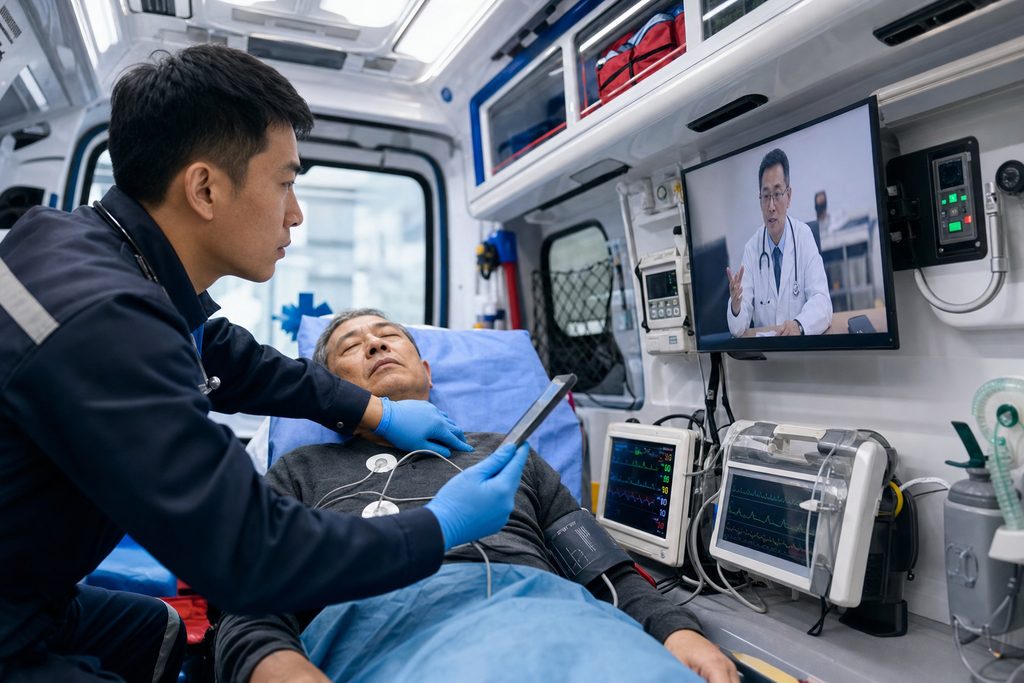
A standard 5G ambulance in cities like Shenzhen or Hangzhou is essentially a mobile CT lab. It carries a small-bore computed tomography scanner, point-of-care lab testing equipment, and a high-definition video conferencing suite. When paramedics suspect a stroke, they can perform a CT scan on the street. The images are transmitted via 5G — with its ultra-low latency of under 20 milliseconds — to a neurologist sitting in a command center at West China Hospital or Huashan Hospital. The specialist sees the scan in real-time, assesses the patient via video, and directs the paramedics to administer tissue plasminogen activator (tPA) on site if an ischemic stroke is confirmed. The patient arrives at the hospital with treatment already underway.
This is not theoretical. A 2021 study in the Journal of NeuroInterventional Surgery analyzed a mobile stroke unit program in China and found a median alarm-to-thrombolysis time of just 39 minutes. The traditional pathway? Often over 80 minutes.
How Does 5G Ambulance Work for Heart Attack in China?
The cardiac application follows a similar logic but with a different endgame. For ST-segment elevation myocardial infarction (STEMI), the most lethal heart attack type, the goal is to open the blocked artery in a catheterization lab as fast as possible.
In a 5G-enabled cardiac ambulance, paramedics perform a 12-lead ECG. The trace is transmitted instantly to an on-call interventional cardiologist. The specialist activates the cath lab while the ambulance is still en route. This is a concept called “pre-hospital cath lab activation.” It means the patient bypasses the ER entirely. The ambulance pulls up, and the patient goes straight to the table. A study published in The Lancet regional health journal showed that this workflow can reduce door-to-balloon times to under 60 minutes in systems where the baseline was previously over 100 minutes.
The remote specialist ambulance China medical tourism packages concept is a bit of a misnomer. These are emergency vehicles. You cannot book one for a scheduled procedure. But understanding this infrastructure is crucial for any international patient considering high-risk cardiac or neurological care in China. It means the emergency response system surrounding the hospital you choose is likely faster than what you are accustomed to at home.
Pre-Hospital Stroke Care China Telemedicine Ambulance: Breaking the ER Bottleneck
The real innovation is not the 5G signal. It is the clinical workflow redesign. A traditional ambulance is a transport vehicle. A 5G ambulance is a mobile emergency department. It shifts the point of diagnosis from the hospital to the scene.
For international patients, this changes the risk calculus. If you are traveling to China for a complex surgery and have a post-operative complication, or if you are a business traveler who experiences a sudden cardiac event, the emergency infrastructure that responds to you in Shanghai or Guangzhou is arguably more technologically integrated than what you would find in London or Los Angeles. The pre-hospital stroke care China telemedicine ambulance system is designed to compress the time between symptom onset and definitive treatment to an absolute minimum.
This efficiency is not free. The cost of equipping and staffing these units is high. But the cost is absorbed by the hospital system or municipal health budgets, not charged directly to the patient as a line-item “telemedicine fee.” When patients search for a 5G ambulance China stroke diagnosis cost, they are often trying to understand the bill. The reality is that the ambulance transport fee plus emergency treatment costs will be billed through the hospital’s international department. For a foreign patient, the total emergency episode cost — including the ambulance, CT, thrombolysis, and initial ICU stabilization — might range from $8,000 to $25,000, depending on the hospital and complexity. At a top-tier public hospital’s international wing, this remains a fraction of the $50,000 to $100,000+ that a similar stroke emergency would cost in the US.
| Cost Comparison: Stroke Emergency Episode | China (Public Hospital International Dept.) | United States | United Kingdom (Private) |
|---|---|---|---|
| Emergency Transport (Advanced Life Support) | $500 – $1,200 | $2,500 – $5,000 | £800 – £1,500 |
| CT Scan & Telemedicine Interpretation | $300 – $800 | $1,500 – $3,000 | £600 – £1,200 |
| Thrombolysis (tPA Administration) | $1,500 – $3,000 | $8,000 – $15,000 | £4,000 – £7,000 |
| ICU Admission (First 24 Hours) | $1,500 – $4,000 | $10,000 – $20,000 | £5,000 – £10,000 |
| Total Estimated Episode | $8,000 – $25,000 | $50,000 – $100,000+ | £20,000 – £40,000+ |
Note: Costs vary by hospital and case complexity. The figures above are estimates for uninsured international patients based on our coordination experience and do not constitute a binding quote.
What You Need to Know Before Going Alone
Accessing this system as a foreigner is not as simple as dialing 120 — China’s equivalent of 911. The emergency response will work. The ambulance will come. But what happens after the acute event is where the real complexity begins. The 5G ambulance gets you into a hospital bed fast. It does not solve the language barrier, the payment system, or the visa status that becomes critical the moment you are stabilized.
- Visa Requirements: The 5G ambulance is an emergency service. It does not care about your visa. But if you survive a stroke or heart attack in China and need extended rehabilitation, you will need an S2 visa for medical treatment. You cannot simply stay in the country without one. Applying for this while hospitalized is a bureaucratic challenge that requires hospital invitation letters and coordination with the local Public Security Bureau. Our team handles this before it becomes a crisis.
- Payment Systems: Chinese public hospitals operate on a prepayment model. Even in an emergency, the international department will require a deposit to be loaded onto a hospital card before major procedures continue. International credit cards are not universally accepted. WeChat Pay and Alipay dominate, and linking a foreign card to these platforms often fails due to international transaction limits. A deposit of $10,000 to $20,000 may be required upfront. We facilitate this process, ensuring funds are in the right place so treatment never pauses for administrative reasons.
- Post-Acute Coordination: The 5G ambulance delivers you to the nearest capable hospital. That hospital may not be the best one for your long-term recovery. A stroke patient might be taken to a general emergency center when they really need a specialized neurosurgical unit at a hospital like Fuwai Hospital or Xuanwu Hospital. Transferring between hospitals as a foreign patient is not a simple ambulance ride. It requires acceptance from the receiving hospital, medical records translation, and a new deposit. We manage this transition.
How We Help You Navigate This
These barriers are structural, not malicious. The Chinese healthcare system is optimized for speed and scale. It is not optimized for a foreigner who does not speak Mandarin and whose insurance works on a reimbursement model. That is where we step in.
If you are considering traveling to China for planned cardiac or neurological care — perhaps a complex ablation procedure or a cerebral aneurysm repair — you are implicitly relying on this same emergency infrastructure for your post-operative safety net. We make sure the safety net catches you properly.
Our process starts with a consultation. We learn your medical history and your objectives. We then match you with the right specialist at the right hospital from our network of over 340 top-ranked institutions. We do not just book an appointment. We coordinate a bilingual medical companion who meets you at the airport, accompanies you to every consultation, translates your medical records before you arrive, and stays with you through discharge. If an emergency occurs — and you encounter a 5G ambulance — our companion ensures the emergency team knows your history, your drug allergies, and your specialist’s direct contact information. The technology saves your brain. The human coordination saves your sanity.
For patients who want to assess their options before traveling, we arrange video consultations with top specialists. The initial written second opinion from a leading expert ranges from $300 to $500. A live video consultation with a top-tier neurologist or cardiologist typically costs between $500 and $800. If you later decide to come to China for treatment, every dollar of that consultation fee is credited in full toward our on-the-ground coordination service. The evaluation is a step toward a decision, not a sunk cost.
Frequently Asked Questions
No. You cannot book a 5G ambulance for a scheduled event. These are municipal emergency response vehicles integrated into the 120 system. They are dispatched when a bystander or family member calls the emergency number and describes stroke or heart attack symptoms. If you are in Shanghai and have an emergency, the system will respond to you. But you cannot reserve one in advance. For planned care, we coordinate private medical transport and direct admission to the international department of your chosen hospital, bypassing the chaotic public ER queue.
There is no separate “5G fee.” The cost is embedded in the hospital’s emergency billing. As a foreign patient, you will be transported to a hospital with an international department. The total bill for the acute episode — ambulance, CT, specialist telemedicine interpretation, and emergency treatment — will likely fall between $8,000 and $25,000. This is significantly less than the $50,000+ you would face in the US. The exact amount depends on the hospital tier and the complexity of your case. We provide a detailed cost estimate during our initial consultation based on your specific situation and preferred hospital.
The telemedicine consultation is a triage and early-treatment tool, not a final verdict. The specialist’s goal is to rule out hemorrhage and initiate thrombolysis if appropriate. Once you arrive at the hospital, a full in-person team takes over. The 5G system is designed to start treatment faster, not replace comprehensive hospital care. The liability and clinical governance follow the same strict protocols as in-hospital care. The hospitals in our network, such as those ranked on the Fudan Hospital Rankings, maintain internationally recognized quality standards. If you have concerns about a specific hospital’s track record, we can help you review their published outcome data and JCI accreditation status during your evaluation process.
The technology is real and deployed at scale. China’s three major telecom operators have built dedicated 5G network slices for emergency medical services in over 50 cities. The latency is low enough to support real-time robotic surgery, let alone a video call. The bottleneck is not the technology. It is the human coordination afterward. A fast ambulance does not guarantee a smooth hospital stay. That is the part we manage.
Your Next Step
A 5G ambulance is not a product you purchase. It is a signal of a system’s priorities. China has invested heavily in compressing the deadliest gap in emergency medicine: the time between symptom and specialist. For a patient considering complex care, this infrastructure is a layer of protection you cannot see but will be grateful for if you ever need it.
What you can plan is the rest of the journey. The hospital choice, the visa, the language support, the payment logistics. That is where we come in. If you want to understand which hospitals combine this level of emergency sophistication with world-class planned cardiac or neurological care, reach out for a free consultation. We will help you build a plan that makes sense — with no pressure, just clarity.
For more medical information and treatment options in China, visit chinamedservices.com (China Medical Services).
