African Patients Treatment in China: Complete Companion Guide
Key Takeaways
- China’s top-ranked hospitals perform complex procedures at 20–50% of US or European prices — a cardiac bypass that costs $120,000+ in America typically runs $12,000–20,000 at leading Chinese public hospitals.
- 340+ top-ranked hospitals across 37 Chinese cities are covered in our database, including Fuwai Hospital, which performs over 14,000 cardiac surgeries annually — the highest volume globally.
- Language barriers and unfamiliar hospital workflows are the biggest practical hurdles for African patients — but both are manageable with proper preparation and on-the-ground support.
- You cannot book surgery from overseas through standard public hospital channels. A face-to-face outpatient consultation is mandatory before any surgical admission, which makes planning your first trip strategically critical.
The Problem: Medical Care at Home Is Often Out of Reach
What would you do if a family member needed a procedure your local hospital simply could not perform?
Across much of Africa, this is not a hypothetical. According to the World Health Organization, sub-Saharan Africa carries approximately 24% of the global disease burden yet has only 3% of the world’s health workforce. Nigeria, with a population exceeding 220 million, has fewer than 5 physicians per 10,000 people. Kenya fares slightly better at around 2 per 10,000. Compare that to China’s 25 per 10,000, or Germany’s 45. The gap is structural, not incidental.
For cancer patients, the numbers are starker. The International Agency for Research on Cancer projects that cancer deaths in Africa will nearly double by 2040, reaching 1.4 million annually, driven partly by late diagnosis and partly by limited radiotherapy and surgical oncology capacity. A patient in Accra or Lagos needing a precision liver resection or a complex cardiac repair often faces a choice: wait months for an overseas referral that may never materialize, or travel abroad without a clear plan.
And travel abroad usually means one destination in the patient’s mind: the West. But Western care comes with Western pricing. A single oncology consultation in London can cost £250–400 before any imaging. An MRI in the United States averages $1,300–3,000. For many African families, these numbers are not just expensive — they are disqualifying. So patients stay home. And conditions worsen.
Why China Delivers Results for African Patients
Clinical Volume Drives Better Outcomes
Surgeons get better by operating. It is not a slogan; it is a statistical reality. Multiple studies, including a landmark 2015 analysis in The Lancet, have shown that hospitals performing higher volumes of complex procedures report lower mortality rates and fewer complications. China’s top-tier hospitals operate at volumes unmatched anywhere on earth.
Take cardiac surgery. Fuwai Hospital in Beijing completes more than 14,000 cardiac operations per year — the highest volume of any heart center globally. A typical high-volume US center performs 2,000–3,000. The surgeon you see at Fuwai may have performed more valve replacements in a single year than a Western surgeon does in a decade. For African patients seeking complex interventions, that repetition translates into precision.
Oncology tells the same story. Cancer hospitals in Beijing, Shanghai, and Guangzhou treat patient volumes that would overwhelm most Western institutions — and they have built workflows around that scale. Radiation oncology departments run extended hours. Surgical oncology teams operate six days a week. The system is built for throughput, and throughput builds expertise.
Technology and Efficiency at Scale
China’s top hospitals have invested heavily in diagnostic and therapeutic technology over the past decade. PET-CT scanners, robotic surgical systems, proton therapy centers, and advanced genomic sequencing are now standard at leading institutions. The difference is not the machines themselves — Western hospitals have these too. The difference is how many patients flow through them.
A patient at a top Chinese cancer hospital can typically get a CT, MRI, and full blood panel within 48–72 hours of arrival. In many Western systems, scheduling those same three tests takes two to four weeks. For a patient traveling internationally, that time compression matters enormously. You are not paying for a hotel room while waiting for a scan. You are not burning leave from work. You arrive, you get answers, you move forward.
Cost Advantage Without Quality Compromise
Let us address the elephant in the room directly: lower cost does not mean lower quality. The structural reasons Chinese care costs less are economic, not clinical.
Labor costs are lower across the board — from surgeons to nurses to administrative staff. Hospitals are built at scale, with construction costs per bed far below Western benchmarks. Malpractice insurance premiums are a fraction of US levels. Pharmaceutical and device pricing is negotiated nationally, not fragmented across thousands of private insurers. None of these factors reduce the quality of a surgeon’s hands or a pathologist’s eyes. They simply reduce the bill.
For African patients, this is the difference between treatment and no treatment. A complex cancer surgery that costs $80,000–150,000 in the United States typically runs $15,000–35,000 at a top Chinese hospital. That is not a discount on quality — it is a different economic reality.
Cancer Treatment Cost in China for Foreigners: What the Numbers Actually Look Like
Let us get specific. The search phrase “cancer treatment cost in China for foreigners” suggests you want real figures, not vague promises. Here they are — with the caveat that every case is different and these are reference ranges, not quotes.
| Procedure | China (Top Public Hospital) | United States (Average) | United Kingdom (Private) |
|---|---|---|---|
| Radical prostatectomy (robotic) | $12,000 – $20,000 | $40,000 – $70,000 | $25,000 – $45,000 |
| Liver resection (partial hepatectomy) | $10,000 – $18,000 | $50,000 – $90,000 | $35,000 – $60,000 |
| Breast cancer surgery + reconstruction | $8,000 – $15,000 | $35,000 – $65,000 | $25,000 – $45,000 |
| Radiation therapy (full course) | $5,000 – $12,000 | $30,000 – $60,000 | $20,000 – $40,000 |
| Chemotherapy (6 cycles, standard regimen) | $8,000 – $20,000 | $50,000 – $120,000 | $35,000 – $80,000 |
These figures vary by hospital and case complexity. International department pricing at top-tier public hospitals runs 1.5–2 times standard public rates — but still lands far below Western benchmarks. Private international hospitals like United Family or Jiahui cost more than public international departments but offer Western-style service and direct insurance billing. For a detailed breakdown of hospital tiers, see our guide to the top-ranked hospitals in China.
Best Hospitals in China for African Patients: How to Choose Without Guesswork
Choosing a hospital from 12,000 kilometers away feels impossible. But there is a systematic way to do it. Do not start with Google reviews. Start with rankings and accreditation.
The Fudan University Hospital Rankings are China’s most authoritative hospital quality assessment. Updated annually, they evaluate hospitals across 45 specialties — oncology, cardiac surgery, orthopedics, neurosurgery, and more. The comprehensive top-100 list is grouped into tiers (A++++ through A), while specialty rankings name the top 10 hospitals in each field. A hospital ranked among China’s top 10 for oncology has earned that position through peer review, publication volume, and clinical outcomes — not marketing.
JCI accreditation is the second signal to look for. JCI (Joint Commission International) certifies hospitals against international patient-safety and quality standards. For African patients unfamiliar with Chinese institutions, JCI accreditation provides a recognizable benchmark. Several Shanghai hospitals hold JCI status, alongside international private facilities. If you are comparing JCI accredited hospitals in Shanghai, our directory lists them with accreditation details.
For African patients specifically, three practical factors matter beyond rankings: English-speaking staff, experience with international patients, and proximity to an international airport. Beijing and Shanghai score highest on all three. Guangzhou is a strong third, with direct flights from across Africa and a large African expatriate community that has normalized cross-cultural medical travel. For oncology, consult our specialty-specific hospital rankings to see which institutions lead in your exact diagnosis.
Medical Visa China for African Citizens: The Process in Plain Language
Here is what the Chinese embassy will not tell you in one place — but you need to know before you book a flight.
For medical treatment in China, the correct visa category is S2. Not M. M visas are for commercial and trade activities. An S2 visa covers short-term private affairs, including medical treatment, when supported by documentation from a Chinese hospital. If your treatment requires a stay beyond 180 days, you apply for an S1 visa instead. Accompanying family members also apply for S2.
The application requires an invitation letter or medical treatment confirmation from the Chinese hospital where you have an appointment. This is where the process loops back: you cannot get the visa without a hospital appointment, and you cannot get most hospital appointments without being in China. The practical solution is a written second opinion or video consultation first — using your existing medical records — which generates the documentation needed for both the visa application and the in-person visit.
Requirements vary by country. Nigerian, Kenyan, Ghanaian, and South African passport holders should check with the Chinese embassy or consulate in their home country for current document lists. Processing typically takes 4–10 working days. Never book non-refundable flights before the visa is in your passport.
How the Treatment Journey Actually Works: Step by Step
You have decided to explore treatment in China. What happens next? The process is not mysterious, but it is sequential. Skipping steps causes delays.
Step 1: Gather your medical records. Every scan, every biopsy report, every blood test, every discharge summary. These must be in English or Chinese. If they are in French, Portuguese, or Arabic, get certified translations. Incomplete records are the number one reason remote consultations stall.
Step 2: Get a written second opinion or video consultation. This is the highest-value step you can take before traveling. A Chinese specialist reviews your records and tells you whether they can help, what treatment they recommend, and whether travel is warranted. Our written second opinion service costs $300–500 and typically takes 5–10 working days. Video consultations run $100–300 for standard international department sessions, or $500–800 for top-specialist sessions. If you later proceed to in-person treatment, these consultation fees are credited in full toward coordination services within 90 days.
Step 3: Apply for your S2 visa. With the hospital’s confirmation letter in hand, submit your visa application. Plan for 4–10 working days of processing.
Step 4: Travel and attend your first outpatient consultation. This is non-negotiable. Chinese public hospitals require a face-to-face consultation before any surgery or hospital admission. You will meet the specialist, undergo any additional testing they require, and receive a definitive treatment plan.
Step 5: Proceed with treatment. After the consultation, if surgery or admission is indicated, the hospital schedules it — typically within days to weeks, depending on urgency and bed availability. Public hospitals require prepayment. International departments and private hospitals may accept direct insurance billing.
Step 6: Recovery and follow-up. For surgical patients, plan for 1–4 weeks in China depending on the procedure. Before departure, you receive a discharge summary, medication plan, and instructions for follow-up care at home. Many hospitals offer remote follow-up consultations.
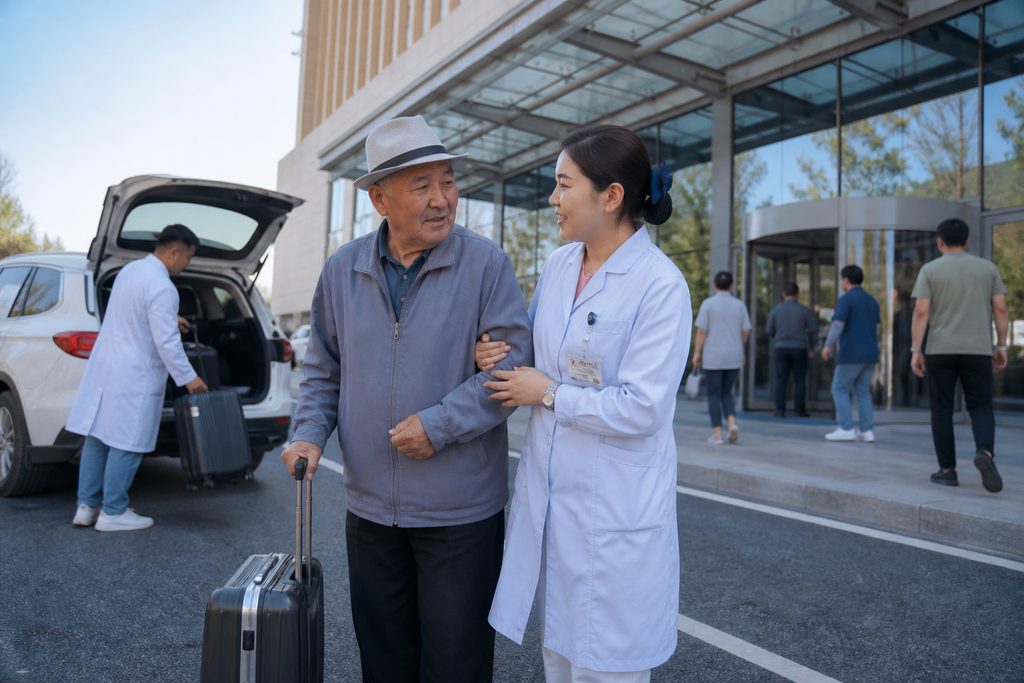
Practical tip: Bring a family member or companion. Chinese hospitals are massive — a single-day outpatient volume can exceed 10,000 patients at top institutions. Having someone to navigate queues, handle payments, and translate conversations reduces stress dramatically. If you cannot bring someone, a bilingual medical companion can fill that role.
What African Patients Get Wrong About Chinese Hospitals: Three Costly Mistakes
The patients who have smooth experiences in China share one trait: they adjusted their expectations before arriving. The ones who struggle usually made the same three mistakes.
Mistake 1: Assuming the hospital will handle everything. Chinese public hospitals provide excellent clinical care. They do not provide concierge service. No one will meet you at the airport. No one will translate for you at registration. No one will remind you which floor the CT scanner is on. The hospital’s job is medicine. Everything else is your responsibility — or the responsibility of someone you hire.
Mistake 2: Expecting Western-style bedside manner. Chinese specialists are direct. They may not soften bad news. They may not spend 20 minutes explaining every option. This is not rudeness — it is a different communication culture, compounded by language barriers. Patients who prepare for this adjust quickly. Patients who expect Western-style rapport may feel dismissed. Bring a list of questions. Insist on answers. The doctors will respond.
Mistake 3: Underestimating the importance of documentation. You cannot arrive with a vague description of your condition and expect a top specialist to diagnose you from scratch. Chinese hospitals move fast, and they expect complete records. Missing pathology slides or imaging files can delay your treatment by weeks. Digitize everything. Bring originals and copies. Send them ahead.
Practical Considerations: Money, Language, and What to Bring
We do not provide pricing or coordination for solid-organ transplants, including kidney transplants, for foreign patients. China’s organ allocation system prioritizes Chinese citizens under national law, and foreign nationals face significant restrictions. If you are seeking kidney transplant information, consult your home country’s transplant registry or a recognized international transplant center outside China.
No. Solid-organ transplantation in China is not available as a bookable “package” for foreign patients. Organ allocation is governed by national law and medical urgency, not commercial booking. Any service offering a “liver transplant package” for foreigners should be treated with extreme caution. For non-transplant liver procedures — such as tumor resection or ablation — remote consultation and planning are possible.
Chinese hospitals have standard protocols for complications, and top-tier institutions have ICU capacity and specialist coverage that rival any Western center. That said, medical complications abroad are stressful. You should have travel insurance that covers medical evacuation if you need to return home urgently. You should also designate a local contact — a companion, a relative, or a coordination service — who can advocate for you if you are incapacitated.
Is it safe for African patients to receive treatment in China?
China’s top-ranked hospitals are safe, regulated institutions with rigorous quality standards. The clinical risk is comparable to any high-volume international center. The practical risks — language barriers, unfamiliar processes, cultural differences — are manageable with preparation. Thousands of African patients receive treatment in China each year
Frequently Asked Questions
Yes. The hospitals used for international patients are JCI-accredited and follow the same international safety standards as top hospitals in the US and Europe. Surgical teams perform high volumes of procedures — often more than their Western counterparts — which studies show leads to better outcomes.
Costs vary by procedure and hospital, but international patients typically save 40-80% compared to US prices — even when factoring in travel and accommodation. A consultation with our team will give you an exact, all-inclusive quote with no hidden fees.
Send us your existing medical reports to get started. We handle everything from hospital selection and appointment scheduling to visa assistance and post-operative recovery planning. Your medical records are reviewed by the specialist before you even book a flight.
For more medical information and treatment options in China, visit chinamedservices.com (China Medical Services).
