Peking Union Medical College Hospital International Patients: Costs, Booking, and What to Know
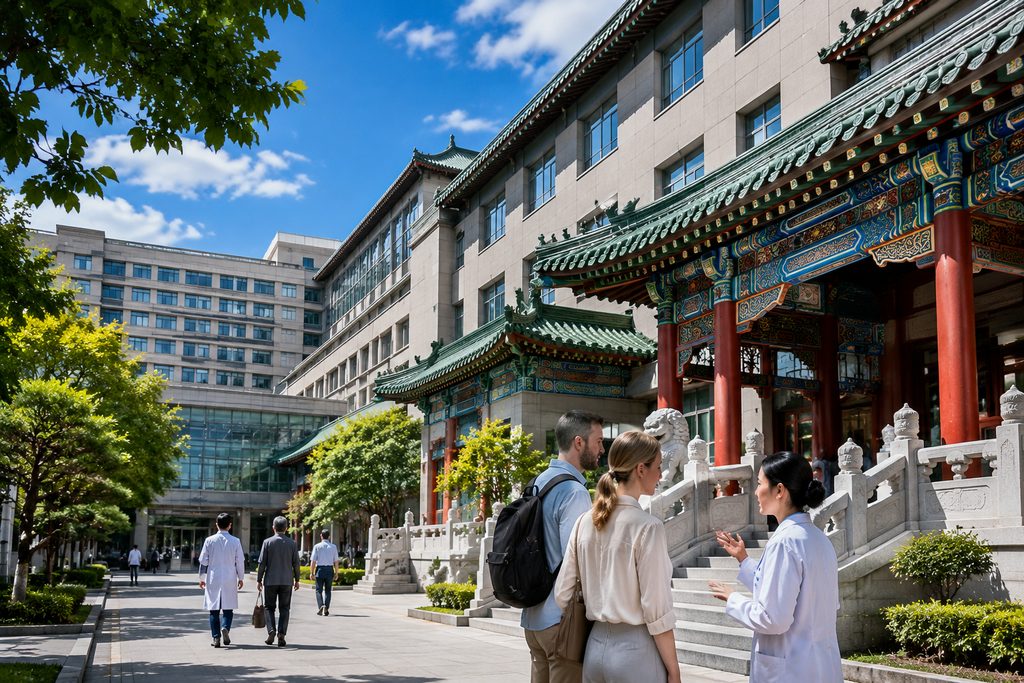
Peking Union Medical College Hospital for Foreign Patients: The Short Answer
If you are a foreign patient researching the Peking Union Medical College Hospital international patients price, the honest range is roughly 1.5 to 2 times the standard public hospital rate — typically $100 to $300 for an initial specialist consultation, with imaging, lab work, and procedures billed separately. PUMCH, as the hospital is commonly known, operates a dedicated International Medical Department that provides English-speaking coordination, priority scheduling, and a significantly calmer environment than the main public floors. But the real complexity is not the cost. It is the booking pathway. You cannot simply call the main hospital switchboard and reserve a slot. The International Medical Department has its own registration process, its own fee schedule, and its own limitations on which specialists are available on any given day.
So the short answer is yes — foreigners can absolutely receive care at PUMCH. The longer answer is that doing it well requires understanding how the system actually works, what documents you need, and where the hidden friction points are.
Who This Is Right For — and Who It Isn’t
PUMCH’s International Medical Department serves a specific profile of patient. Knowing whether you fit that profile before you book a flight will save you real money and frustration.
Typically a good fit:
- Patients with complex or rare conditions who want a second opinion from one of China’s most respected general hospitals. PUMCH is consistently ranked among the top comprehensive hospitals in the Fudan University hospital rankings.
- Expats already living in Beijing who need ongoing care for chronic conditions and want an English-speaking clinical team.
- International patients who have existing medical records, imaging, and a clear diagnostic question — and who are prepared for a consultation-first model.
- Patients who value continuity: PUMCH is known for internal medicine, rheumatology, endocrinology, and gynecology, among other specialties.
Probably not a good fit:
- Patients seeking a guaranteed surgery date before ever stepping foot in Beijing. PUMCH, like every public hospital in China, requires an in-person consultation before any surgical booking. No remote promise of a surgical slot exists.
- Travelers with minor, self-limiting conditions. A common cold does not require PUMCH. A private international clinic in Beijing will be faster and cheaper.
- Patients who need direct insurance billing at the point of care. PUMCH’s international department generally operates on a pay-first, reimburse-later model. If your insurer requires direct billing, a private hospital like United Family or Raffles may be a better match.
- Anyone expecting Western-style appointment spacing. Even the international department runs on a tighter, faster schedule than many Western patients are used to.
Being honest about who should not come is what makes the rest of this guide useful. PUMCH is an extraordinary institution. It is not the right answer for every foreign patient.
The Options, Compared
Foreign patients in Beijing have three realistic tiers of care. Here is how they stack up against each other.
| Factor | PUMCH International Medical Dept. | Private International Hospital (e.g., United Family) | Standard Public Outpatient |
|---|---|---|---|
| Initial specialist consult | $100–$300 | $150–$400 | $10–$50 |
| English-speaking staff | Yes — dedicated team | Yes — core model | Rarely |
| Direct insurance billing | Usually no | Yes | No |
| Wait time for specialist | Days to 2 weeks | Same day to 3 days | Same day queue, hours-long wait |
| Clinical depth for complex cases | Very high — top-tier subspecialists | Good for routine care | High, but no language support |
| Environment | Calm, dedicated floor | Hotel-like | Crowded, fast-paced |
If your priority is clinical depth — particularly for a difficult diagnosis — the PUMCH international department is hard to beat in Beijing. If your priority is convenience, insurance simplicity, and a Western-style experience, a private international hospital wins. The standard public outpatient route is the cheapest but effectively unusable for a foreigner without fluent Mandarin and local navigation skills.
How to Book an Appointment at PUMCH International Department
This is the section most foreign patients actually need. The booking process for the International Medical Department is not published in a single clean page. Here is what it looks like in practice.
First, you gather your records. The department expects existing medical documentation: prior imaging reports, lab results, pathology slides if relevant, and a summary of your current medications. These documents should be in English or Chinese. If they are in another language, translation is your responsibility before submission.
Second, you contact the international department directly. This can be done by phone or email, and the department does have English-speaking administrative staff. You describe your condition, your diagnostic question, and the specialty you believe you need. The staff will then advise which department is appropriate and what the next available consultation slots look like.
Third, you pay a deposit or consultation fee to confirm the appointment. This is typically paid by bank transfer or credit card. The exact amount depends on the specialty and the seniority of the physician.
Fourth, you attend the consultation in person. Bring your passport, your original medical records, and any imaging on CD or film. The consultation itself usually lasts 20 to 40 minutes — longer than the standard public outpatient visit, but shorter than many Western patients expect.
And here is the part that surprises most people: after the consultation, any further steps — additional imaging, lab work, hospital admission, surgery — are scheduled through the same international department channel. You do not get handed a slip and sent to the general queue. That is the value of the international pathway.
But there is a hard limitation. The international department does not guarantee that a specific named specialist will be available on your preferred date. Some of PUMCH’s most famous professors have consultation slots booked out weeks in advance, and some only see international patients on specific days of the week.
What It Costs at PUMCH for Foreign Patients
The Peking Union Medical College Hospital international patients price structure is transparent once you understand the tiers. But the total cost depends heavily on what you actually need.
An initial specialist consultation runs $100 to $300. A follow-up visit is usually less. Blood work panels range from $50 to $400 depending on complexity. A standard MRI is roughly $300 to $600. A CT scan is $150 to $400. These are international department prices — meaning they are 1.5 to 2 times the standard public rate.
For inpatient care, the daily room rate in the international ward typically starts around $200 to $500 per night, depending on room type. Surgical procedures vary enormously. A complex general surgery case might run $15,000 to $40,000 in total — still far below US prices for equivalent care, but not pocket change.
What is not included: medications dispensed outside the hospital, any care received in the main public wings, translation of your existing records, and post-discharge follow-up once you leave China. Also not included: your flight, visa, accommodation, and local transport.
One more cost factor that is easy to overlook. PUMCH is a public hospital with a prepayment model. You pay for each step as you go — consultation, then imaging, then lab work, then treatment. There is no single bundled quote upfront for complex cases. You build the bill incrementally.
Practical Considerations: Documentation, Visa, and Language
Let’s talk about the logistics that actually determine whether your trip goes smoothly.
Visa. For medical treatment in China, the applicable short-stay category is the S2 visa, which covers private affairs including medical treatment. Your accompanying family members also apply for S2 visas. You will need supporting documentation from the hospital — typically an appointment confirmation letter or treatment invitation from the International Medical Department. The M visa is for commercial and trade activities and is not appropriate for medical travel. Visa requirements change, so check with your nearest Chinese embassy or consulate before booking anything.
Payment methods. The international department accepts credit cards, but do not assume all cards work. UnionPay is ubiquitous. Visa and Mastercard are generally accepted at the international department, but bring a backup card. Cash in RMB is still useful for small expenses. Wire transfers are standard for larger deposits.
Insurance. PUMCH’s international department does not typically bill international insurers directly. You pay, you get itemized receipts, you submit to your insurer. If your policy requires direct billing, check with your insurer before you commit. Some patients use a medical concierge service to handle the paperwork, but that is a choice, not a requirement.
Language. The international department has English-speaking staff. That covers registration, nursing, and most consultations. But do not assume every technician in radiology or every pharmacist speaks fluent English. For complex explanations, the consulting physician will usually speak English well. For everything else, patience helps.
Follow-up after returning home. PUMCH can provide written summaries and treatment plans in English. But you will need a local physician in your home country to continue care. Chinese prescriptions are not automatically valid abroad, and some medications dispensed in China may not be available or approved elsewhere.
Frequently Asked Questions
For expats with complex medical needs, yes. PUMCH is one of the most respected general hospitals in China, and its International Medical Department is specifically designed for non-Chinese-speaking patients. The trade-off is cost — expect to pay 1.5 to 2 times the standard public rate — and the fact that you will still need to navigate a Chinese public hospital system at the edges.
You contact the International Medical Department directly by phone or email, provide your medical records and diagnostic question, and the staff will match you with an appropriate specialty and available consultation slot. You cannot book through the main hospital registration system, and you cannot book a specific named specialist on a specific date with certainty.
An initial consultation runs $100 to $300. Imaging and lab work are billed separately, typically $150 to $600 per study. Inpatient rooms start around $200 to $500 per night. Surgical procedures range from a few thousand dollars for minor cases to $40,000 or more for complex operations. All prices vary by specialty and case complexity.
At PUMCH’s International Medical Department, yes. The consulting physicians generally speak English, and the nursing and administrative staff are trained for English-language service. That said, some subspecialists may have stronger English than others, and you may occasionally encounter a technician or pharmacist with limited English. Having a bilingual companion or coordinator helps for the in-between moments.
This happens. Some of PUMCH’s most sought-after professors have limited international consultation slots. The department will offer an alternative specialist within the same department, or a different date. If your travel window is rigid, confirm availability before booking flights — or be prepared to see a senior associate rather than the department head.
Your Next Step
PUMCH is a serious option for foreign patients who need deep clinical expertise and are willing to pay international department rates for it. The booking process is manageable if you have your records organized and your expectations set correctly. China Medical Services maintains a curated database of 340+ top-ranked hospitals across 37 cities, including PUMCH and other leading institutions in Beijing. We help international patients coordinate appointments, arrange bilingual medical companions, and navigate the logistics of receiving care in China. We are not a hospital, and we do not provide diagnoses or treatment. If you want help sorting out whether PUMCH is the right fit for your case — or whether another hospital would serve you better — start with a free consultation. We will talk through your situation first. No commitment, no pressure.
Getting care at one of China’s top hospitals is not as simple as booking a flight. But with the right preparation and the right information, it is entirely within reach.
For more medical information and treatment options in China, visit chinamedservices.com (China Medical Services).
