Hotel Recovery Nursing in China: How Post-Surgery Care Packages Work
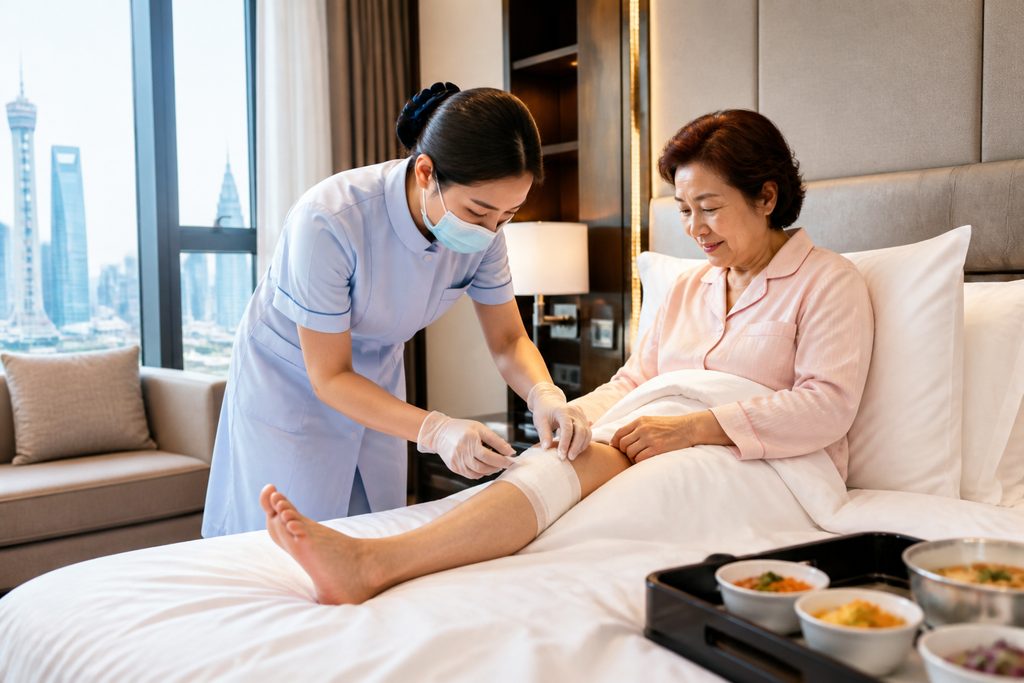
How Does Hotel Recovery Nursing Work in China? A Practical Guide for International Patients
According to China’s National Health Commission, more than 300,000 international patients traveled to China for medical treatment in 2024, a figure that has grown steadily since borders reopened after the pandemic. Many arrive for complex surgeries — cardiac bypass, joint replacement, tumor resection — and then face a practical question their surgeons rarely address in detail: where do you recover once the hospital discharges you? The answer increasingly involves a hotel recovery nursing cost China model that blends the comfort of a business-class hotel with the clinical oversight of a nursing floor. Understanding how this works — what it costs, who provides the care, and whether it is safe — matters before you book a flight.
Key Takeaways
- Hotel recovery nursing in China typically costs between $180 and $450 per day, roughly 60-80% less than comparable post-acute care in the US or Western Europe.
- Packages combine a hotel room with daily visits from registered nurses, wound care, medication management, and 24/7 bilingual phone support.
- Not all “recovery hotels” are equal — accreditation, nurse-to-patient ratios, and hospital affiliation vary widely between providers in Shanghai, Beijing, and Guangzhou.
- This model works best for medically stable patients who need monitoring, not emergency care; anyone with high complication risk should remain in a hospital ward.
The Problem: Hospital Discharge Comes Too Early for Many International Patients
In most Western healthcare systems, post-operative stays have shrunk dramatically. A 2023 study in the Journal of the American College of Surgeons found that the average length of stay for a total knee replacement in the United States is now just 1.6 days. For a laparoscopic cholecystectomy, it is under 24 hours. Patients are discharged with a sheet of instructions and a phone number to call if something goes wrong.
That model assumes you have a home to return to, a family member who can take time off work, and a primary care physician who knows your history. For an international patient in China, none of those assumptions hold. You are in a foreign city. Your family is thousands of miles away. Your surgeon is reachable, but the hospital ward has already moved on to the next patient. And if you flew from London or Dubai or Houston for a procedure that costs one-fifth of what it would at home, flying back immediately after discharge is often medically unwise and physically miserable.
The gap between hospital discharge and safe air travel is where hotel recovery nursing fills a real need. It is not luxury. It is logistics with a clinical backbone.
Why Hotel Recovery Nursing in China Delivers Results
Clinical Volume Creates Nursing Depth
Chinese hospitals perform procedures at volumes that dwarf Western institutions. Fuwai Hospital in Beijing performs more than 14,000 cardiac surgeries annually — the highest volume of any heart center globally. West China Hospital in Chengdu handles over 25,000 inpatient surgeries per year. That scale means Chinese nursing teams see post-operative complications far more frequently than their Western counterparts, and the recovery-nursing sector has grown up around that expertise.
Nurses who staff hotel recovery programs in Shanghai and Beijing typically come from top-tier public hospital backgrounds. They have managed thousands of post-surgical patients. They know what a normal wound looks like on day three versus an infection starting on day four. That clinical intuition is the core value proposition — not the hotel room.
Structural Cost Advantages Without Quality Compromise
The obvious question: why is hotel recovery nursing cost China so much lower than post-acute care in the US or Europe? The answer is structural, not a quality trade-off. A registered nurse in China earns roughly $1,200 to $2,500 per month in a public hospital setting. A comparable nurse in the United States earns $7,000 to $10,000 per month. Hotel room rates in Shanghai’s medical districts run $80 to $150 per night for a four-star property, compared to $250 to $400 in comparable US cities.
Those labor and real estate differentials flow directly into package pricing. A recovery nursing package that costs $250 per day in Shanghai would cost $800 to $1,200 per day in New York or London. The clinical protocols — wound assessment, vital sign monitoring, medication reconciliation — are the same. The nurses are trained to the same standards. You are paying for the same service at Chinese input costs.
Integration With the Treating Hospital
The best hotel recovery programs are not standalone businesses. They operate with formal or informal referral relationships with specific hospital departments. When a patient at Ruijin Hospital’s orthopedic department is discharged, the discharge planner may recommend a recovery hotel that already has the patient’s surgical notes, medication list, and follow-up imaging schedule. That continuity matters. A nurse who knows your surgeon’s specific wound-closure technique is better positioned to spot a problem than a nurse who has never seen that surgeon’s work.
How Does Hotel Recovery Nursing Work After Surgery in China: Step by Step
If you search for “how does hotel recovery nursing work after surgery in China,” you will find a range of providers with varying models. But the core workflow is consistent across reputable programs. Understanding the sequence helps you evaluate what you are actually booking.
The process typically begins before your surgery. You or your medical coordinator contacts the recovery nursing provider with your surgical plan, expected discharge date, and any specific post-operative needs. The provider confirms nurse availability and reserves a room in a partner hotel near the hospital. Most programs cluster around the major medical districts: Xujiahui in Shanghai near Zhongshan Hospital, Dongdan in Beijing near Peking Union Medical College Hospital, and Tianhe in Guangzhou near Sun Yat-sen University Cancer Center.
On discharge day, a nurse meets you at the hospital ward. She reviews the discharge summary with you and the hospital nursing staff, confirms your medication schedule, and arranges transport to the hotel. That handoff moment is critical — it is when information gets lost in most cross-border care transitions. In a well-run program, nothing is left to memory.
Once at the hotel, the recovery rhythm begins. A typical day includes morning vital signs (blood pressure, temperature, heart rate, oxygen saturation), wound inspection and dressing change if needed, medication administration or supervision, mobility assistance, and a brief written update sent to your surgeon’s office. Evening rounds repeat the vital signs and wound check. Between visits, you have a direct line to the nursing coordinator — not a call center, but the actual nurse assigned to your case.
Most programs run 3 to 14 days. A simple laparoscopic procedure might need only three days of monitoring before you are comfortable flying. A major orthopedic surgery with a drain and restricted weight-bearing might require ten days to two weeks. The decision to fly is made jointly by your surgeon, the recovery nurse, and you — no one should board a long-haul flight with an unhealed wound or unstable vitals.
Is Hotel Recovery Nursing Safe in China? Evaluating Providers Honestly
Safety is the right question to ask. The honest answer: the model is safe when the provider is legitimate, and there are real risks when it is not. China’s private healthcare sector has grown rapidly, and regulation has not always kept pace. Some “recovery hotels” are little more than a room and a phone number. Others are run by physicians with hospital affiliations and formal nursing protocols.
How do you tell the difference? Look for three things. First, nurse credentials. Ask whether the nurses hold current Chinese nursing licenses (护士执业证书) and how many years of hospital experience they have. A legitimate provider will answer directly and provide documentation. Second, physician oversight. The best programs have a supervising physician who reviews each patient’s case at intake and is available for consultation if the nurse flags a concern. Third, escalation protocols. Ask what happens if you develop a fever, shortness of breath, or wound dehiscence at 2 a.m. The answer should name a specific hospital emergency department and a defined transport pathway — not a vague promise to “help if needed.”
Also consider who is not a candidate. Hotel recovery nursing is designed for medically stable patients. If your surgeon says you need daily lab draws, IV antibiotics, or telemetry monitoring, you belong in a hospital ward — and any recovery hotel that accepts you anyway is one you should not trust. The model works precisely because it is selective about who it takes.
Post Surgery Hotel Care Shanghai Price: What Packages Actually Cost
Let us talk numbers. The post surgery hotel care Shanghai price varies by hotel class, nursing intensity, and length of stay. The table below reflects 2025-2026 pricing from several providers we have reviewed. Figures are per day, in US dollars, and should be treated as reference ranges — final quotes always depend on your specific case and the provider’s current availability.
| Service Tier | What Is Included | Typical Daily Cost (USD) |
|---|---|---|
| Basic Monitoring | 4-star hotel room, twice-daily nurse visits, vital signs, wound inspection, phone support | $180 – $250 |
| Standard Recovery | 4-star room, three daily nurse visits, wound care and dressing changes, medication management, daily surgeon update | $250 – $350 |
| Intensive Recovery | 5-star room, 12-hour on-site nursing, physician oversight, physiotherapy session, lab draws if needed | $350 – $450 |
| Family Companion Add-on | Second room or upgraded suite for a family member, shared nursing oversight | $80 – $150 |
For comparison, a skilled nursing facility in the United States costs $300 to $600 per day, and a private duty nurse runs $40 to $80 per hour — roughly $960 to $1,920 for 24-hour coverage. A recovery hotel in Shanghai at $300 per day delivers comparable monitoring at a fraction of the cost. That is the structural advantage of China’s healthcare economy, and it is the reason medical tourism to China for post-surgical recovery is growing.
Booking tip: The phrase “book hotel recovery nursing package China” will surface many providers online. Before paying anything, request the nursing protocol in writing, confirm the exact hotel and room type, and ask for the supervising physician’s name and license number. Legitimate providers welcome these questions.
Practical Considerations: Documentation, Payment, and Follow-Up
The nursing team follows a defined escalation protocol. For non-urgent concerns, the supervising physician is consulted. For urgent symptoms — fever above 38.5°C, shortness of breath, uncontrolled pain, wound bleeding — the nurse arranges immediate transport to the nearest emergency department, typically the same hospital where you had surgery. The recovery provider coordinates with the hospital’s international department so your case is not handled as an unknown walk-in.
Yes, and most providers encourage it. A family companion can stay in the same room or an adjacent room, depending on the hotel configuration. The companion does not receive nursing care, but the nursing team will teach them basic wound observation and mobility assistance if they want to participate in your care. This is particularly helpful for elderly patients or those with limited mobility.
For elective surgeries, two to four weeks is usually sufficient. The provider needs time to review your case, confirm nurse availability, and reserve the hotel room. For urgent or semi-urgent procedures, most providers can accommodate shorter timelines, but flexibility on hotel choice may be limited. Peak seasons — October and November, when international patient volume is highest — require more lead time.
Nursing practice in China is regulated under the Nursing Regulations issued by the State Council. Individual nurses must hold valid licenses. The recovery-hotel business model itself sits in a gray area — it is not a licensed medical facility, but rather a hospitality service that employs licensed nurses. This is why provider vetting matters so much. The nurses are regulated; the business model is less so. Choose a provider with transparent credentials and a named supervising physician.
Your Next Step
Hotel recovery nursing in China solves a real problem: the gap between hospital discharge and safe travel home. It is not for everyone, but for medically stable patients who want clinical oversight without the cost of a Western skilled nursing facility, it is a serious option worth understanding. Our team at China Medical Services helps international patients evaluate recovery nursing providers, coordinate with treating hospitals, and navigate the logistics of post-surgical care in China. We are not a hospital and do not provide medical advice or diagnoses — we are the coordination layer that makes cross-border recovery practical. If you are planning surgery in China and want to understand your recovery options, start with a conversation.
Recovery is where surgeries succeed or fail. Plan for it as carefully as you plan the operation itself.
Frequently Asked Questions
Yes. The hospitals used for international patients are JCI-accredited and follow the same international safety standards as top hospitals in the US and Europe. Surgical teams perform high volumes of procedures — often more than their Western counterparts — which studies show leads to better outcomes.
Costs vary by procedure and hospital, but international patients typically save 40-80% compared to US prices — even when factoring in travel and accommodation. A consultation with our team will give you an exact, all-inclusive quote with no hidden fees.
Send us your existing medical reports to get started. We handle everything from hospital selection and appointment scheduling to visa assistance and post-operative recovery planning. Your medical records are reviewed by the specialist before you even book a flight.
For more medical information and treatment options in China, visit chinamedservices.com (China Medical Services).
