How We Verify Medication Authenticity in China: A Patient Safety Guide
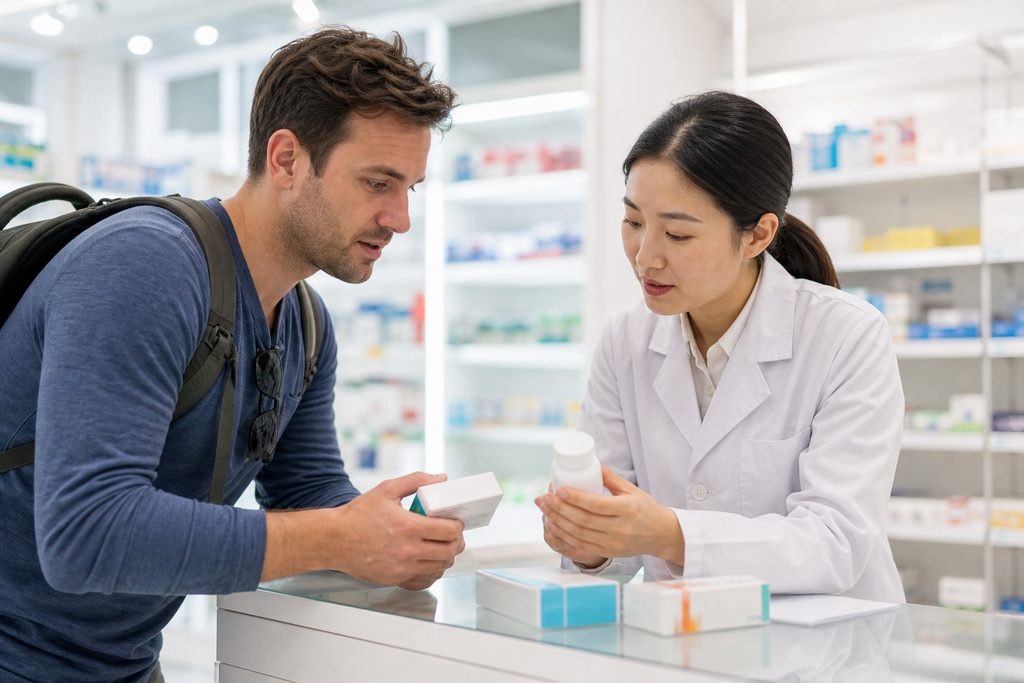
How We Verify Medication Authenticity in China: The Short Answer
Have you ever held a pill bottle in your hand and wondered whether what’s inside matches the label? For foreign patients in China, that question carries extra weight. The short answer: we only source medications through hospital-affiliated pharmacies and licensed retail chains that participate in China’s national drug traceability system. Every box gets scanned. Every scan gets checked against the National Medical Products Administration (NMPA) database. No exceptions.
But the longer answer matters more. Counterfeit medication China hospital risks are real but manageable if you know which pharmacies to use, which verification codes to look for, and which red flags signal trouble. This guide walks through the exact process we follow for every patient.
Who This Is Right For — and Who It Isn’t
This verification protocol serves patients who fill prescriptions inside China, whether after a hospital consultation or during ongoing treatment. It also applies to patients buying over-the-counter medication from Chinese pharmacies.
You should use this approach if:
- You received a prescription from a Chinese hospital and need to fill it locally
- You’re buying medication in China for a chronic condition during an extended stay
- You want to bring medication back to your home country and need authenticity documentation
- You’re comparing prices between hospital pharmacies and retail chains
This may not be necessary if:
- You’re bringing your own medication from home with proper documentation
- You’re only in China for a short stay and won’t need local prescriptions
- Your home country prohibits importing certain drug classes regardless of authenticity
And a hard truth: if a deal on medication seems too good to be true, it probably is. No verification protocol can rescue a purchase from an unlicensed seller.
The Options, Compared
Not all pharmacy channels in China carry the same risk profile. Here’s how they stack up for foreign patients concerned about counterfeit medication China hospital risks and general drug safety.
| Channel | Verification Method | Risk Level | Typical Price Premium | Insurance Receipt |
|---|---|---|---|---|
| Hospital-affiliated pharmacy (公立医院药房) | NMPA traceability code + hospital dispensing record | Very low | Baseline | Yes, itemized |
| Licensed chain pharmacy (e.g., LBX, Yifeng, Guoda) | NMPA traceability code + pharmacy license check | Low | 5–15% above hospital | Yes, on request |
| Private international hospital pharmacy | NMPA code + JCI accreditation of the facility | Very low | 20–50% above hospital | Yes, English-friendly |
| Online pharmacy platforms (e.g., JD Health, AliHealth) | NMPA code + platform seller verification | Moderate | Often discounted | Sometimes |
| Unlicensed vendors, WeChat sellers, street markets | None reliable | High | Discounts that signal danger | No |
If you’re a foreign patient navigating this alone, the hospital-affiliated pharmacy is your safest default. It sits inside the same system that wrote your prescription. The dispensing record links directly to your patient file. Private international hospital pharmacies offer English-speaking staff and insurance-friendly receipts, but you pay for that convenience. Online platforms can be legitimate, but they require you to verify the seller’s license separately — a step most foreign patients skip.
How to Verify Drug Authenticity Chinese Pharmacy: The 4-Step Protocol
This is the exact process our team follows for every medication purchase made on behalf of a patient in China. You can replicate it yourself, or you can let us handle it. Either way, the steps don’t change.
Step 1: Check the pharmacy license before anything else. Every licensed pharmacy in China must display a “药品经营许可证” (Drug Business License) issued by the local Medical Products Administration. The license number is printed on the certificate and can be verified through the NMPA website. If a pharmacy won’t show you this, leave.
Step 2: Locate the China Drug Traceability Code. Since 2019, all prescription and most over-the-counter medications sold in China must carry a 20-digit traceability code printed on the outer packaging. It’s usually presented as a barcode or QR code with the label “药品追溯码” (Drug Traceability Code). This is non-negotiable. No code means the product wasn’t manufactured through compliant channels.
Step 3: Scan the code using the official NMPA app or WeChat mini-program. The scan returns the drug’s approval number, manufacturer, batch number, production date, and expiration date. Compare every field against the physical box. A mismatch in any field — even one digit — means the product is suspect. Do not accept it.
Step 4: Cross-check the approval number against the NMPA database. Every legitimate drug in China has a “国药准字” (National Drug Approval Number) format like H10980032 or Z20044567. The letter indicates the drug category (H for chemical drugs, Z for traditional Chinese medicine, S for biological products). You can search this number on the NMPA English-language portal. If the number doesn’t appear, the drug was never approved for sale in China.
That’s the protocol. Four steps. About five minutes total. And it catches virtually every counterfeit that reaches the retail level.
Can I Trust Medication Bought in Shanghai? What the Data Says
Shanghai runs one of China’s strictest pharmaceutical oversight programs. The Shanghai Medical Products Administration conducts unannounced inspections of retail pharmacies and publishes violation notices publicly. In 2023, Shanghai regulators inspected over 4,000 pharmacy locations and reported a counterfeit detection rate below 0.1% for hospital-affiliated and chain pharmacies.
But that number only holds for licensed channels. The risk shifts dramatically when you buy from unlicensed sellers. WeChat groups, small shops without visible licenses, and vendors near tourist areas account for the overwhelming majority of counterfeit drug seizures in Shanghai. The city is safe for medication if you stay inside the regulated system.
So can you trust medication bought in Shanghai? Yes — if you buy from a hospital pharmacy or a licensed chain and run the four-step verification. No — if you buy from anywhere that can’t show a Drug Business License. The city doesn’t make this hard. It makes it easy to do it right.
What It Costs: Verification Services and Where the Money Goes
Verifying medication authenticity costs almost nothing if you do it yourself. The NMPA app is free. The traceability code scan is free. The database search is free.
Where costs appear is when you want someone else to handle the entire process — picking up the medication, verifying it, documenting the results, and delivering it to you. Our bilingual medical companion service starts at $300 per day and includes pharmacy visits, verification, translation of drug labels, and a written authenticity report for each medication. That report matters if you plan to bring medication back through customs.
For patients filling multiple prescriptions across different pharmacies in different districts, a full day of companion service typically covers it. For a single prescription at a hospital pharmacy, a half-day often suffices. The final quote depends on the number of pharmacies, distance between them, and whether you need the report notarized for your home country’s customs authority.
Practical Considerations: Records, Language, and Customs
If you’re managing medication verification yourself, three practical issues will surface quickly.
Language. The NMPA app and traceability system operate in Chinese. The WeChat mini-program has no English interface. If you can’t read Chinese, you’ll need someone who can. That’s not a small hurdle when a single misread digit means the difference between a genuine drug and a rejected one.
Documentation for customs. Your home country may require proof that medication was legally obtained. The traceability verification report serves this purpose, but it must be translated. Some countries also require a letter from the prescribing physician. Get both before you leave China.
Payment and receipts. Hospital pharmacies accept cash, Chinese bank cards, and major mobile payment platforms. Foreign credit cards often don’t work. Chain pharmacies are similar. Private international hospital pharmacies typically accept international cards and provide English-language receipts, which simplifies insurance claims.
And one more thing: keep the original packaging. Customs inspectors in most countries want to see the medication in its original, labeled container. A plastic bag of loose pills will be confiscated regardless of how authentic they are.
Frequently Asked Questions
Run the four-step verification: check the pharmacy license, locate the 20-digit traceability code, scan it through the NMPA system, and cross-check the approval number. If all four steps pass, the medication is almost certainly genuine. If any step fails, don’t buy it. The system is designed so that counterfeit products fail at least one checkpoint.
For patients using hospital-affiliated pharmacies and licensed chains, the risk is extremely low — below 0.1% in major cities like Shanghai and Beijing. For patients buying from unlicensed sellers, the risk is real and well-documented. Chinese regulators seize counterfeit drugs every year, and the seizures cluster around informal channels. Stay inside the licensed system and the risk collapses.
First, document everything: the box, the traceability code, the receipt, the pharmacy name and license number. Second, report it to the local Medical Products Administration — they take these reports seriously and investigate. Third, contact the hospital’s pharmacy department directly if the medication came from a hospital-affiliated pharmacy. Hospitals have strong incentives to resolve these cases quickly because their own reputation is on the line. Do not take the medication while the investigation is pending.
Usually yes, with documentation. Most countries allow a personal-use quantity (typically 30–90 days) of legally obtained medication. You’ll need the original packaging, the traceability verification report, and ideally a translated prescription or physician letter. Some drug classes — controlled substances, certain injectables — face stricter rules or outright bans. Check your home country’s customs regulations before you buy anything.
Yes. Hospital pharmacies operate under the hospital’s own accreditation, which for top-tier facilities means compliance with national hospital standards and, in many cases, JCI or equivalent international accreditation. The pharmacy itself must hold a Drug Business License and is subject to inspection by both the hospital and the local Medical Products Administration. This dual oversight makes hospital pharmacies the most reliable medication source in China. You can browse our database of 340+ top-ranked hospitals to see which facilities meet these standards.
Your Next Step
Medication safety in China comes down to one habit: verify before you accept. The traceability system exists, it works, and it’s free to use. The only question is whether you’ll have someone who can read the results.
We’re China Medical Services, and we help international patients navigate Chinese healthcare — not as doctors, but as coordinators who handle the logistics. We don’t diagnose, we don’t prescribe, and we don’t sell medication. What we do is make sure that when a Chinese hospital writes you a prescription, the medication you receive is exactly what was prescribed, verified through official channels, and documented for your travel home. If that sounds useful, start with a free consultation at our patient services page. No pressure. Just a conversation about what you need.
Verify. Document. Travel safely. That’s the whole approach.
For more medical information and treatment options in China, visit chinamedservices.com (China Medical Services).
