Breast Cancer Surgery in China: Costs, Hospitals, and How It Works
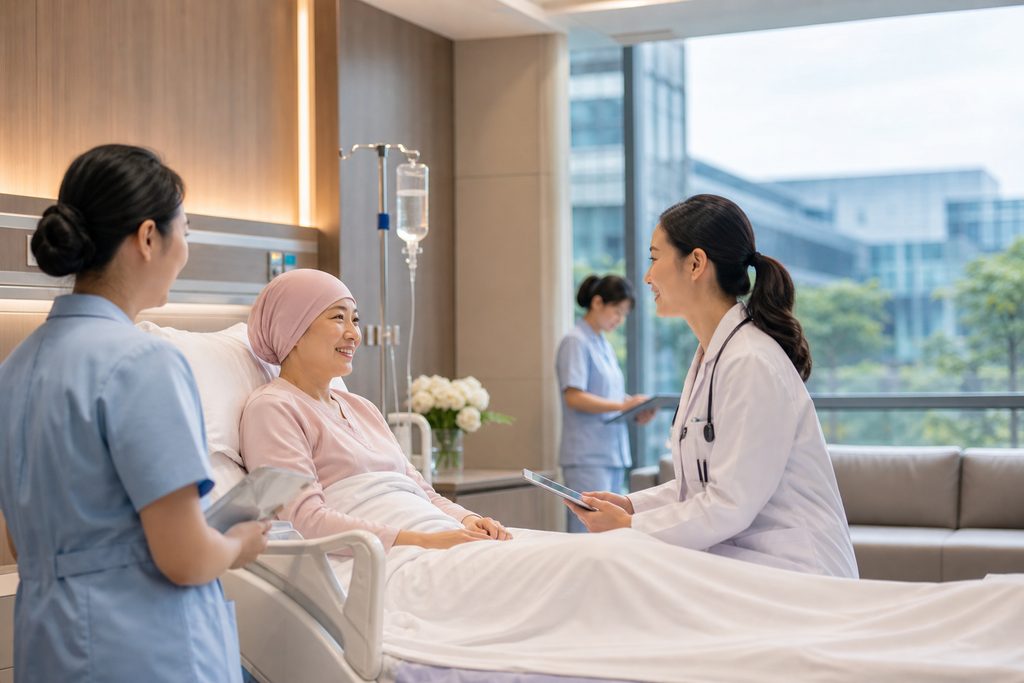
While a mastectomy in the United States routinely exceeds $25,000 before reconstructive work, the breast cancer surgery cost China at a Fudan-ranked teaching hospital typically falls between $6,000 and $12,000. Same procedure. Same modern surgical standards. A radically different invoice. For a woman facing a breast cancer diagnosis, that gap is not a curiosity—it is the difference between treatment and debt, between acting now and waiting.
We have spent years connecting international patients with China’s top-tier oncology departments. What follows is a straight account of how breast cancer surgery in China actually works: the real costs, the hospitals that matter, the timeline, the risks, and the decisions you will face.
How This Actually Works, Step by Step
The process begins with paper, not planes. You send us your existing records: pathology report, imaging (ultrasound, mammogram, MRI if done), any biopsy results, and a summary of what your local doctor has recommended. We translate these into Chinese and route them to a breast surgery department at one of our partner hospitals—typically a Fudan-ranked general hospital or a dedicated cancer center.
Within 5 to 10 working days, the surgical team reviews your case and returns a written assessment. They will tell you whether they agree with the proposed surgical approach, what additional staging they would require, and whether they see any reason to reconsider the plan. This written second opinion costs from $300 to $500. It is not a prescription. It is expert direction.
If you decide to proceed, we coordinate a video consultation with the same department, priced from $500 to $800 for a top specialist. You speak directly with the surgeon who would operate on you. You ask about margins, lymph node management, reconstruction options, recovery expectations. After that call, you make an informed decision.
Only then do we move to scheduling. And here is the part most foreign patients do not expect: Chinese public hospitals do not let you book surgery from overseas. You must appear in person for an outpatient consultation first. The surgeon examines you, reviews your imaging again, and only then places you on the surgical schedule.
That means your first trip to China is for evaluation, not for the operating table. Most patients spend 3 to 5 days in the city for this initial visit. Then they return home, wait for the surgical date, and come back for the procedure itself.
What Breast Cancer Surgery Actually Costs in China
Let us put numbers on the table. These ranges reflect our experience coordinating cases across top-ranked Chinese hospitals in Beijing, Shanghai, and Guangzhou. They vary by hospital tier, surgeon seniority, and case complexity.
| Procedure | China (Top Public Hospital) | China (Private International Hospital) | United States (Average) |
|---|---|---|---|
| Lumpectomy (breast-conserving surgery) | $4,000 – $7,000 | $10,000 – $18,000 | $15,000 – $25,000 |
| Total mastectomy (no reconstruction) | $6,000 – $12,000 | $15,000 – $25,000 | $25,000 – $50,000 |
| Mastectomy with immediate reconstruction | $12,000 – $20,000 | $25,000 – $40,000 | $50,000 – $100,000+ |
| Sentinel lymph node biopsy | $1,500 – $3,000 | $3,000 – $6,000 | $5,000 – $10,000 |
| Axillary lymph node dissection | $2,500 – $5,000 | $5,000 – $9,000 | $8,000 – $15,000 |
These are surgical fees. They do not include preoperative staging (PET-CT runs $800 to $1,500 in China), hospital bed charges, or postoperative medications. But even with those added, the total breast cancer treatment price abroad in China lands at roughly one-fifth to one-third of the American bill.
One honest note: the international department or VIP channel at a Chinese public hospital charges 1.5 to 2 times the standard rate. That premium buys you English-speaking coordination, shorter queues for imaging, and a private room. For most foreign patients, it is worth it.
Is Breast Cancer Surgery Safe in China?
The short answer: at the right hospital, yes. The longer answer requires understanding how Chinese healthcare stratifies.
China has over 35,000 hospitals. The top 5%—roughly 1,700 institutions—are classified as Grade 3A (三级甲等), the highest tier. Within that tier, the Fudan University hospital rankings identify the top 100 general hospitals and the top 10 in each of 45 specialties. Those are the institutions we work with. Not the average ones.
Breast cancer surgery at a Fudan-ranked hospital is performed by surgeons who do this every day. A breast surgeon at Fudan University Shanghai Cancer Center or Peking Union Medical College Hospital may perform 300 to 500 breast cancer operations per year. Volume matters. Studies consistently link higher surgical volume to lower complication rates and better oncologic outcomes.
Safety also depends on anesthesia, nursing, and infection control. The hospitals we coordinate with maintain JCI accreditation or equivalent domestic standards. Their operating rooms meet international benchmarks. But you should not take our word for it—ask during your video consultation. Ask about their surgical site infection rate. Ask about their reoperation rate. A serious department will answer without hesitation.
A Realistic Timeline
Here is what the calendar actually looks like for a woman seeking breast cancer surgery in China, based on cases we have coordinated.
| Stage | What Happens | Duration |
|---|---|---|
| Week 1 | You send records; we translate and submit to the surgical department | 2–3 working days for translation |
| Week 2–3 | Written second opinion returned; you decide whether to proceed | 5–10 working days |
| Week 3–4 | Video consultation with the operating surgeon | Scheduled within 1–2 weeks of request |
| Week 4–6 | S2 visa application with hospital invitation letter | 1–3 weeks depending on consulate |
| Week 6–7 | First trip: outpatient consultation, additional imaging if needed | 3–5 days in China |
| Week 7–10 | Return home; wait for surgical date confirmation | 1–4 weeks |
| Week 10–12 | Second trip: surgery and initial recovery | 7–14 days in hospital |
| Month 3–6 | Adjuvant therapy decision (chemo, radiation, endocrine) | Varies by pathology |
The step people forget is document translation. Chinese hospital departments will not review English-language records. Everything—pathology, imaging reports, prior treatment summaries—must be professionally translated. That takes days, not hours. Build it into your planning.
Visa timing is the other wildcard. The S2 visa is the correct category for medical treatment in China. It is issued for short stays and can be annotated for medical purposes. Your accompanying family member applies for the same S2. Processing times vary by consulate and season. We provide the hospital invitation letter and guidance, but we cannot guarantee approval.
What Can Go Wrong — and What Happens Then
We would rather you hear this from us than discover it in a hospital corridor.
The surgeon refuses to operate. This happens more often than patients expect. Chinese surgeons are conservative about operating on patients whose staging is incomplete or whose comorbidities are uncontrolled. If the surgeon says no, you ask why. Sometimes the fix is simple—a cardiac clearance, a repeat biopsy. Sometimes the surgeon recommends neoadjuvant chemotherapy before surgery. That is not a rejection; it is a different plan. You then decide whether to pursue that plan in China or at home.
Your pathology differs from the outside report. Chinese hospitals routinely re-review pathology slides. Occasionally the re-review changes the diagnosis or receptor status. If that happens, the surgical plan changes. You will be told. You will sign a new consent. This is not malpractice—it is the system working correctly.
The surgical date slips. Public hospital schedules move. A surgeon gets called to an emergency. A bed does not open. We have seen dates shift by a week or two. If you have already traveled to China, this is frustrating. Our coordination team works with the hospital to get you rescheduled as quickly as possible, but we cannot control the operating room calendar.
Complications occur. Every surgery carries risk: bleeding, infection, seroma, wound dehiscence. Chinese hospitals manage these competently, but you need to understand that if a complication requires extended hospitalization, your costs rise and your return flight moves. Buy travel insurance that covers medical complications. We can advise on this.
You cannot get the specific surgeon you wanted. Top breast surgeons in China are heavily booked. We can request a specific specialist, but we cannot promise one. If your preferred surgeon is unavailable, the department head assigns another attending surgeon. Ask about that surgeon’s volume and outcomes before agreeing.
Choosing the Best Breast Cancer Hospital in Shanghai—or Anywhere Else
Shanghai is where most foreign patients start their search, and for good reason. The city has 18 hospitals on the Fudan Top 100 list—second only to Beijing. Fudan University Shanghai Cancer Center is widely regarded as one of China’s leading oncology institutions, with a dedicated breast surgery department handling thousands of cases annually. Ruijin Hospital and Zhongshan Hospital also run high-volume breast programs.
But the best breast cancer hospital Shanghai offers is not necessarily the right one for you. The right hospital depends on your specific situation.
If your case is straightforward—early-stage, hormone receptor positive, no lymph node involvement—any of the top Shanghai cancer centers will serve you well. The surgical technique is standardized. The differences between them are marginal.
If your case is complex—triple-negative, locally advanced, requiring immediate reconstruction—you want a hospital with a dedicated breast reconstruction team and a tumor board that meets regularly. Ask specifically: Does this hospital run a multidisciplinary tumor board for breast cancer? How many immediate reconstructions did they perform last year? What is their flap failure rate?
If you want English-speaking staff throughout and direct insurance billing, a private international hospital like United Family or Jiahui in Shanghai may suit you better. You will pay two to three times the public hospital rate, but the experience is closer to what you would expect in a Western private hospital. See our private international hospital listings for details.
One more consideration: where will you recover? If you plan to spend weeks in China after surgery, choose a city where you have support—friends, family, or at minimum a comfortable serviced apartment near the hospital. Shanghai and Beijing are expensive. Guangzhou and Chengdu offer comparable hospital quality at lower living costs.
Practical Considerations: Records, Visa, Payment, and Follow-Up
Let us cover the unglamorous details that determine whether this works.
Records. You need complete, recent pathology. If your biopsy is older than three months, the Chinese hospital will likely repeat it. Bring glass slides if you can—they are the gold standard for re-review. Bring a USB drive with all imaging in DICOM format. Paper reports alone are often insufficient.
Visa. The S2 visa is what you apply for. It is a short-stay visa issued for private affairs, including medical treatment. Your accompanying family member applies for the same category. You will need the hospital’s invitation letter, which we help obtain after the surgical department accepts your case. There is no guarantee of approval. Apply early.
Payment. Chinese public hospitals require prepayment. You deposit funds at admission, and the hospital deducts from that balance as charges accrue. If the balance runs low, you top up. International departments accept major credit cards and wire transfers. Standard departments may require Chinese payment methods—another reason to use the international channel.
Insurance. Most Western insurers reimburse for treatment at JCI-accredited Chinese hospitals, but you must confirm before travel. Get pre-authorization in writing. If your insurer excludes treatment in China, you are paying out of pocket. Budget accordingly.
Language. Even in international departments, not every nurse or technician speaks English. Imaging, pharmacy, and billing are where communication breaks down. A bilingual companion—priced from $300 per day—handles queueing, translation, and navigation. It is not a luxury. It is the difference between a smooth process and a stressful one.
Follow-up at home. Chinese surgeons will give you a discharge summary and a follow-up plan. Your home oncologist needs to understand and accept that plan. Before you travel, confirm that your local doctor is willing to manage postoperative care and adjuvant therapy based on Chinese records. Some are not. Find out early.
Frequently Asked Questions
No. Public hospital rules require an in-person outpatient consultation before any surgery is scheduled. You can complete the remote evaluation—written second opinion and video consultation—from home, but the surgeon must examine you in person before placing you on the operating schedule. Private international hospitals may offer more flexibility, but even they typically require at least one pre-surgical visit.
Most women stay in hospital for 5 to 10 days after a mastectomy without reconstruction. Drain removal typically happens within the first week. Light activity resumes after 2 to 3 weeks. Full recovery—returning to work, driving, lifting—takes 4 to 6 weeks. With immediate reconstruction, hospital stay extends to 7 to 14 days and full recovery takes 6 to 8 weeks. These are ranges. Your surgeon will give you a specific timeline based on your procedure and your health.
Some international insurers and some US PPO plans reimburse for treatment at JCI-accredited Chinese hospitals. Others exclude China entirely. You must check with your insurer before committing. If you are paying out of pocket, the total cost—even with travel and accommodation—is typically 70 to 85% lower than the US equivalent.
At Fudan-ranked hospitals, surgical technique and oncologic outcomes are comparable to Western benchmarks. Chinese breast surgeons operate at high volume, and the top cancer centers follow NCCN or ESMO guidelines. The main differences are process-related: less hand-holding, more self-advocacy required, and a steeper language barrier. A bilingual companion mitigates most of that.
Adjuvant therapy is available at the same hospitals. Chemotherapy regimens follow international protocols. Radiation oncology departments at top Chinese hospitals are well-equipped. The question is whether you want to stay in China for months of adjuvant treatment or return home for that phase. Many patients have surgery in China, then complete adjuvant therapy with their local oncologist. Discuss this with both teams before deciding.
Your Next Step
Breast cancer surgery in China is not for everyone. It requires travel, paperwork, patience, and a tolerance for a different medical culture. But for women facing a five-figure bill at home—or a wait they cannot afford—the numbers speak for themselves. The breast cancer surgery cost China offers at top-ranked hospitals is a fraction of Western prices, with outcomes that hold up to scrutiny.
We are China Medical Services. We do not perform surgery, and we do not promise outcomes. What we do is handle the coordination: records translation, hospital matching, appointment scheduling, visa guidance, and bilingual accompaniment. If you want to explore whether this path makes sense for your case, request a <
For more medical information and treatment options in China, visit chinamedservices.com (China Medical Services).
