Thyroid Cancer Surgery in China: Minimally Invasive Thyroidectomy Coordination
Key Takeaways
- Thyroid cancer surgery in China typically costs between $4,000 and $8,000 for a total thyroidectomy — roughly one-fifth to one-tenth of the $35,000 to $50,000 billed in the United States.
- China’s top oncology hospitals perform thousands of thyroidectomies annually, with some centers reporting post-operative hypoparathyroidism rates below 2% — comparable to or better than benchmarks from high-volume Western centers.
- Public hospital outpatient clinics cannot be booked from overseas. Surgery requires an in-person consultation first. Without a bilingual coordinator, navigating registration, payment queues, and ward admissions alone is genuinely difficult.
- Any consultation fee paid through our coordination service is credited in full toward on-the-ground support if you proceed with surgery within 90 days — there is no financial penalty for exploring your options.
The Problem: A Diagnosis That Does Not Wait for Affordability
In 2023, the American Cancer Society estimated roughly 43,720 new cases of thyroid cancer in the United States. The diagnosis arrives as a cold shock. A small nodule found on a routine ultrasound. A biopsy confirms papillary thyroid carcinoma. The surgeon recommends a total thyroidectomy. And then the billing office sends an estimate: $35,000 to $50,000 for an uncomplicated procedure. For patients with high-deductible plans or no insurance, that number is not abstract. It is a second crisis.
Wait times add another layer of strain. In Canada and the United Kingdom, the interval between diagnosis and surgery can stretch past three months. Thyroid cancer is generally slow-growing. But waiting with a malignancy inside your body feels nothing like slow. The psychological toll is real. Patients lie awake wondering if the cancer is spreading while they wait for a surgical slot.
This is the exact scenario that pushes people to search for alternatives. Not because they want medical tourism. Because they need a solution that does not bankrupt them or delay treatment until anxiety becomes unbearable. The thyroid cancer surgery cost China is what brings most international patients to the conversation. What keeps them there is the clinical volume and the coordination support that makes the journey feasible.
Who We Are
We are not a hospital. We do not diagnose, treat, or prescribe. Our team functions as your logistical bridge to China’s top-tier medical system — a network of 340+ top-ranked hospitals across 37 cities, all drawn from the top 5% of China’s 35,000+ hospitals as ranked by the Fudan University hospital rankings and JCI accreditation standards. We handle hospital matching, appointment coordination through official international departments, bilingual medical companion services, and visa guidance. You bring the medical need. We build the pathway.
Why Minimally Invasive Thyroidectomy in China Delivers Results
Clinical Volume That Shapes Surgical Precision
Thyroidectomies are not rare procedures in China. A single high-volume endocrine surgery department at a major Shanghai or Beijing hospital may complete over 1,000 thyroid surgeries per year. Compare that to US benchmarks. A 2022 study in Annals of Surgery found that surgeons performing more than 25 thyroidectomies annually had significantly lower complication rates than low-volume peers. Many Western general surgeons fall below that threshold. In China’s top-tier hospitals, dedicated thyroid surgeons routinely exceed it by a factor of ten or more.
Volume drives outcomes. The recurrent laryngeal nerve sits millimeters from the thyroid gland. Damage to it means permanent voice changes. Surgeons who navigate that anatomy hundreds of times per year develop an intuitive familiarity that no textbook can replicate. The same applies to parathyroid gland preservation. Inadvertent removal or devascularization of the parathyroids causes post-operative hypocalcemia — a complication that can mean lifelong calcium supplementation. Published data from high-volume Chinese centers report permanent hypoparathyroidism rates below 2%, which aligns with the best outcomes reported internationally.
Minimally Invasive Approaches That Western Patients Do Not Always Access
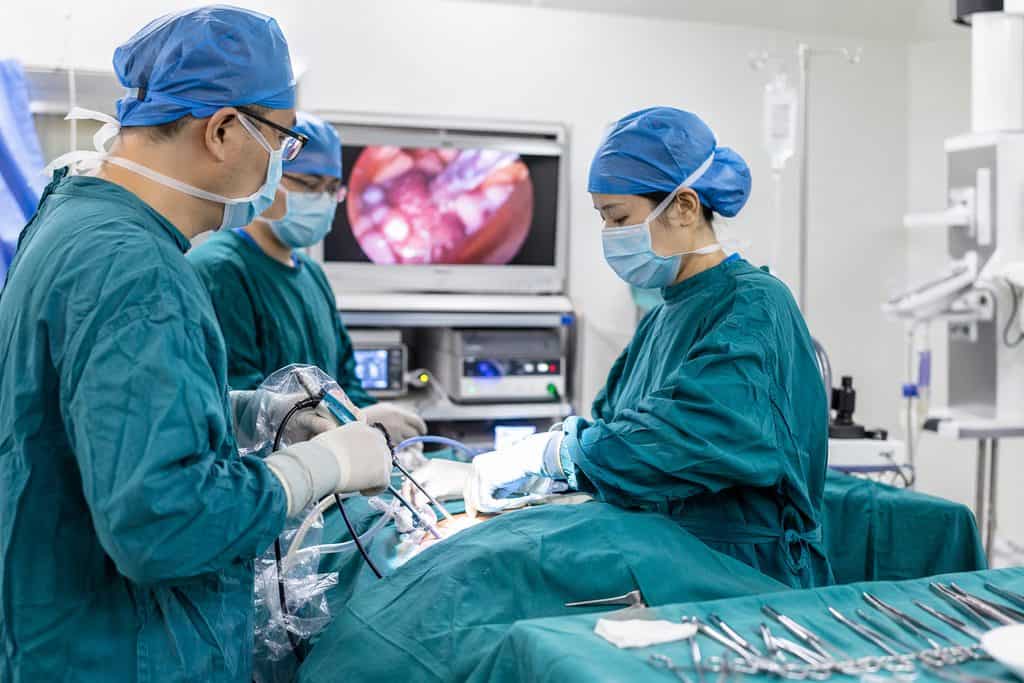
When patients search for minimally invasive thyroidectomy price Shanghai, they are often surprised by what is available. Chinese thyroid surgeons have adopted endoscopic and robotic-assisted techniques that avoid the anterior neck scar entirely. Trans-axillary, trans-oral, and retroauricular approaches place incisions in the armpit, mouth, or behind the ear. The thyroid comes out. The neck shows nothing.
These techniques are not experimental. They have been performed in China for over a decade. The trans-oral endoscopic thyroidectomy vestibular approach (TOETVA) leaves zero visible scarring and has been validated in multiple Chinese surgical cohorts with recurrence and complication rates equivalent to open surgery. In many Western countries, these approaches remain limited to a handful of academic centers. In China, they are part of the standard surgical repertoire at major hospitals. The price difference is substantial. An endoscopic thyroidectomy in Shanghai typically ranges from $5,000 to $9,000, depending on the hospital tier and complexity. That includes the surgeon’s fee, operating room charges, anesthesia, and a standard inpatient stay.
Cost Structure: Why the Numbers Are Different
The thyroid cancer surgery cost China is not low because corners are cut. It is low because the underlying economics are different. Hospital infrastructure costs, physician salaries, and pharmaceutical pricing in China operate on a completely different scale than in the United States. A top endocrine surgeon in Shanghai earns a fraction of what a comparable US surgeon earns — not because they are less skilled, but because the entire compensation structure of Chinese academic medicine is different. Operating room time costs less. Anesthesia costs less. Even the stainless steel surgical instruments cost less when manufactured domestically.
| Procedure | Estimated Cost in China (USD) | Estimated Cost in USA (USD) |
|---|---|---|
| Total Thyroidectomy (Open) | $4,000 – $7,000 | $35,000 – $50,000 |
| Endoscopic Thyroidectomy (TOETVA/Axillary) | $5,000 – $9,000 | $40,000 – $60,000 |
| Thyroid Lobectomy Only | $3,000 – $5,500 | $25,000 – $38,000 |
| Central Neck Dissection (added) | $1,500 – $3,000 | $8,000 – $15,000 |
All prices are approximate ranges and vary by hospital, surgeon seniority, and case complexity. These figures represent the hospital’s charges for the surgical episode and do not include travel, accommodation, or coordination service fees.
What about quality? That is the question every rational patient asks. The answer lies in accreditation and outcomes data. Multiple Chinese hospitals performing high-volume thyroid surgery hold JCI accreditation — the same international standard applied to hospitals in Singapore, Europe, and the Middle East. The best hospital for thyroid surgery in China is not a single institution but a cluster of academic medical centers with dedicated endocrine surgery divisions, published outcomes data, and international patient departments accustomed to coordinating care for overseas visitors.
What You Need to Know Before Going Alone
Arriving in China with a diagnosis and no plan is not a strategy. The barriers are real. Acknowledging them upfront is the only honest way to prepare someone for this journey.
- Visa Requirements: Medical treatment in China requires an S2 visa, specifically annotated for medical purposes. Accompanying family members also need S2 visas. The application requires an invitation letter from the treating hospital — a document that public hospital outpatient departments do not routinely issue to unregistered international patients. Without a formal hospital connection, obtaining the correct visa becomes a circular problem: you need the hospital to get the visa, but you need the visa to reach the hospital.
- Public Hospital Registration Reality: China’s top public hospitals operate on a same-day registration system for outpatient clinics. Patients queue at 6 AM for a chance to see a specialist. Appointments cannot be secured months in advance through a website or phone call from overseas. The specialists listed on hospital websites are often fully booked within minutes of registration opening. Surgery scheduling requires an in-person consultation first — no exceptions. This is not bureaucracy. It is scale. A single major hospital may see 10,000 outpatient visits per day.
- Language and Navigation: Hospital signage in public institutions is predominantly in Chinese. Payment counters, pharmacy windows, ultrasound scheduling desks — none of these operate in English. Even if the surgeon speaks English, the infrastructure around them does not. A missed payment slip means a delayed CT scan. A misunderstood instruction means showing up on the wrong floor at the wrong time. These are not hypotheticals. They happen daily.
- Payment Systems: Public hospitals require upfront payment. International credit cards are often not accepted at hospital cashier counters. WeChat Pay and Alipay dominate the payment ecosystem. Foreign patients without a Chinese bank account linked to these platforms face a genuine logistical barrier. International departments typically accept wire transfers, but the process takes days, not hours.
How We Help You Navigate This
These barriers exist for structural reasons. They are not designed to exclude international patients. They are simply the operating reality of a healthcare system built to serve 1.4 billion people. Our job is to create a parallel pathway through official channels — the hospital’s international department or VIP wing — where scheduling, language, and payment are handled differently.
The process starts with a consultation. You share your diagnosis, imaging reports, and biopsy results. We translate and format your medical records for review by the target hospital’s international patient center. The hospital confirms whether your case is appropriate for their surgical team. Only then do we coordinate an in-person consultation date. You fly to China on an S2 visa with a confirmed appointment — not a hope and a prayer. Our bilingual medical companion meets you at the hospital. They handle registration, payment, queue navigation, and real-time translation during your surgeon consultation. If surgery is recommended, they coordinate the admission process, pre-operative testing, and discharge instructions.
After discharge, the companion remains available. Follow-up appointments, medication pickups, pathology report collection — these are all coordinated. Recovery timelines matter. Patients often ask what is recovery time for thyroidectomy. For an uncomplicated total thyroidectomy, most patients stay in the hospital for 2 to 4 days. Voice rest is recommended for the first week. Strenuous activity is restricted for two to three weeks. Calcium levels are monitored closely in the first month. Full recovery and return to normal activity typically takes four to six weeks. Our team stays reachable throughout this period.
For those who want to book thyroid surgery medical tourism China with confidence, the pathway exists. It requires coordination, not just courage. The hospitals are here. The surgical expertise is here. What makes the difference is having someone on the ground who speaks both languages and understands both systems.
Frequently Asked Questions
Safety depends on hospital selection, not country. China’s top-tier academic medical centers — those ranked in the Fudan Hospital Top 100 or holding JCI accreditation — publish outcomes data comparable to major Western centers. Complication rates for recurrent laryngeal nerve injury and permanent hypoparathyroidism at high-volume Chinese centers fall within the 1-2% range reported internationally. The key variable is surgeon volume. A surgeon performing 200+ thyroidectomies annually in Shanghai is statistically safer than a general surgeon performing 15 annually in a Western community hospital. Choose the hospital carefully. Do not choose based on price alone.
Hospital stay is typically 2 to 4 days for an uncomplicated total thyroidectomy. Most patients are medically stable to fly within 7 to 10 days after discharge. However, calcium levels must be checked before flying. Post-operative hypocalcemia can develop 48 to 72 hours after surgery. Your surgical team will confirm stable calcium levels before clearing you for travel. We recommend staying in the same city as your hospital for at least one week post-discharge. Flying too soon after neck surgery is uncomfortable and medically unwise if calcium levels are not yet stable.
No. Public hospital regulations require an in-person consultation before any surgery can be scheduled. The surgeon must examine you, review your imaging, and confirm the surgical plan face-to-face. What we coordinate is a confirmed consultation appointment through the hospital’s international department — so you arrive knowing you will see the specialist, not hoping for a walk-in slot. The surgery date is set during that consultation. This is a universal rule across China’s public hospital system. Any service claiming to book a surgery date before you arrive is either misrepresenting the process or operating outside official channels.
The best hospital for thyroid surgery in China depends on your specific case. For standard papillary thyroid carcinoma, several Shanghai and Beijing hospitals with dedicated endocrine surgery departments offer excellent outcomes. Fudan University’s Shanghai Cancer Center and Peking Union Medical College Hospital both have thyroid surgery teams that perform over 1,000 procedures annually. For cases requiring lateral neck dissection or recurrent disease management, academic centers with dedicated head and neck surgery divisions are preferable. We match your clinical specifics — tumor size, lymph node involvement, histology — to the hospital with the most relevant surgical expertise. There is no single “best” hospital. There is the best match for your case.
Your Next Step
A thyroid cancer diagnosis forces decisions under pressure. The surgery is necessary. The costs at home may be impossible. The wait may be unacceptable. China’s top hospitals offer a genuine alternative — high surgical volume, minimally invasive techniques, and costs that make treatment accessible without financial ruin. The pathway requires coordination, not just determination. That is what we provide.
If you are weighing your options, start with a conversation. There is no cost to explore whether this path fits your situation. Reach out to our team with your diagnosis and questions. We will help you understand what is possible — honestly, specifically, and without pressure.
For more medical information and treatment options in China, visit chinamedservices.com (China Medical Services).
