What Is a Calcium Score Test? Cost in China vs. the West Explained
Have you ever wondered whether the plaque building up silently in your coronary arteries is something you should already be measuring? A calcium score test gives you a number that answers that question — long before chest pain ever shows up.
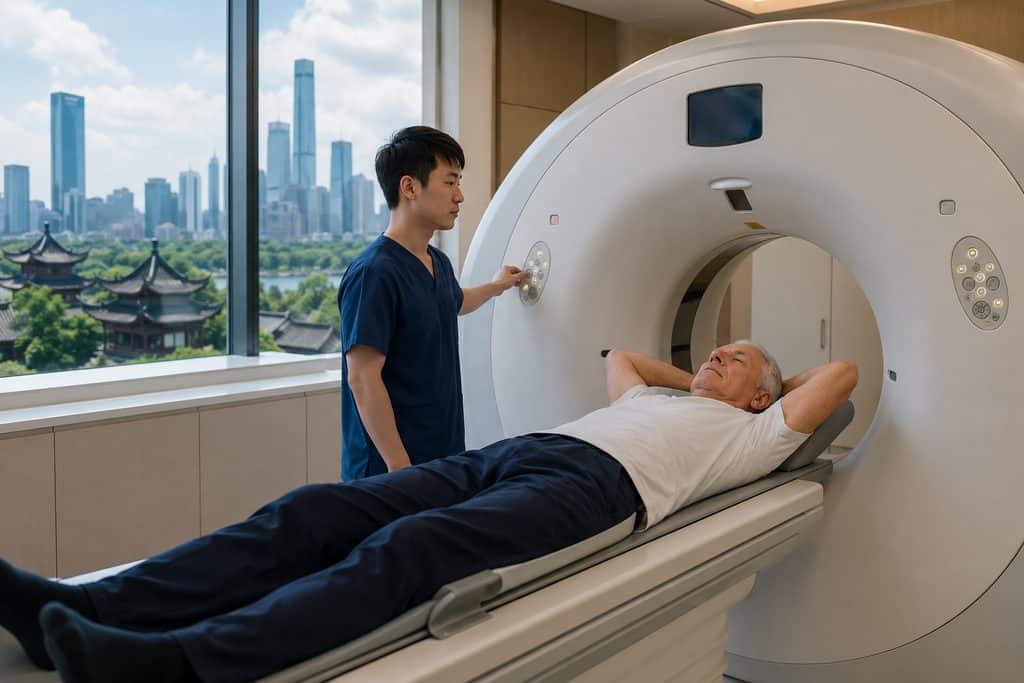
What is a calcium score test? It is a specialized CT scan of the heart that detects and quantifies calcified plaque in the coronary arteries. The result, called a coronary artery calcium score, helps estimate your risk of a future heart attack. For international patients, the calcium score test cost China offers is a fraction of Western pricing — but the real question is whether you can access it smoothly, and what that number actually means for your health.
Key Takeaways
- A calcium score test is a non-contrast cardiac CT that takes under 10 minutes and exposes you to roughly 1–2 mSv of radiation — comparable to a mammogram.
- The calcium score test cost China runs approximately $80–$200 at top-tier public and private hospitals, versus $400–$1,200 in the United States.
- Major barriers for foreign patients include language, hospital registration systems, and the fact that many Chinese public hospitals do not allow overseas patients to pre-book routine outpatient scans online.
- A calcium score of 0 is excellent, 1–99 indicates mild plaque, 100–399 moderate, and 400+ signals extensive calcified plaque requiring aggressive risk factor management.
The Problem: Heart Disease Kills Quietly, and Most People Find Out Too Late
Coronary artery disease remains the leading cause of death globally. The World Health Organization attributes roughly 9 million deaths each year to ischemic heart disease. In the United States alone, the American Heart Association estimates that someone has a heart attack every 40 seconds. And here is the uncomfortable part: for about half of men and two-thirds of women who die suddenly from coronary disease, the first symptom is death itself. No prior chest pain. No warning.
Standard risk calculators — the ones your primary care doctor uses — rely on age, cholesterol, blood pressure, smoking status, and family history. They miss a lot. The Multi-Ethnic Study of Atherosclerosis, published in the Journal of the American College of Cardiology, found that coronary artery calcium scoring significantly outperforms traditional risk factors in predicting cardiovascular events. Yet most patients in Western countries are never offered the test unless they push for it, and when they are, the out-of-pocket price stops many in their tracks.
Why China Delivers Results for Cardiac Calcium Scoring
Rapid Access to the Same CT Technology
The scanner used for cardiac CT calcium scoring is the same class of machine you would find at a major US or European hospital: a multidetector CT capable of ECG-gated imaging. China’s top-ranked hospitals operate thousands of these systems. Fuwai Hospital in Beijing, the world’s highest-volume cardiac surgery center, performs over 14,000 cardiac surgeries annually and runs an enormous cardiac imaging program. The sheer throughput means appointments are typically available within days, not weeks or months.
Can I Get a Calcium Score Test in Beijing?
Yes. Beijing is home to several hospitals that offer cardiac CT calcium scoring, including Fuwai Hospital and Peking Union Medical College Hospital. The challenge is not the availability of the scan — it is navigating the registration process. Public hospitals in China operate on a same-day queue system for general outpatient services. You cannot simply book a calcium score test online from abroad and show up. You need someone on the ground to register you, pay the deposit, and guide you to the correct imaging department. That is where bilingual coordination makes the difference between a one-hour scan and a multi-day ordeal.
Heart Scan Price Shanghai vs. Western Benchmarks
The heart scan price Shanghai hospitals charge for a calcium score test is typically between $80 and $150 at a public hospital’s international department, and $150 to $250 at a private international hospital like Jiahui or United Family. Compare that to the US, where the same non-contrast cardiac CT costs $400 to $1,200 depending on the facility, or the UK, where private clinics charge £300–£600. The cost difference is structural: lower labor costs, higher patient volume, and hospital pricing models that do not carry the administrative overhead of Western insurance billing.
What the Calcium Score Numbers Actually Mean
You get a number. What do you do with it? The Agatston score, named after the researcher who developed it, ranges from 0 to over 1,000. Here is the breakdown that matters:
| Calcium Score | Plaque Burden | What It Means |
|---|---|---|
| 0 | None detected | Very low 10-year cardiovascular risk. No calcified plaque visible. |
| 1–99 | Mild | Early plaque. Risk is elevated but manageable with lifestyle and possibly statins. |
| 100–399 | Moderate | Significant plaque. Most guidelines recommend statin therapy regardless of cholesterol levels. |
| 400+ | Extensive | High risk. Aggressive risk factor control and further cardiac evaluation are warranted. |
A score of 0 does not guarantee you will never have a heart attack — soft, non-calcified plaque can still exist. But it does mean your risk over the next decade is very low. A score of 400 or above is a serious finding that warrants immediate discussion with a cardiologist.
Who Should Consider Cardiac CT Calcium Scoring Abroad
The test is not for everyone. The American College of Cardiology and American Heart Association guidelines recommend calcium scoring for adults aged 40–75 with borderline or intermediate 10-year atherosclerotic cardiovascular disease risk — typically a 5% to 20% risk by standard calculators. If you are in that gray zone and wondering whether to start a statin, the calcium score often tips the decision.
It is less useful for people who already have known coronary disease, a prior stent or bypass, or very high or very low risk by standard measures. If you already have a stent, the calcium score will be high regardless of current plaque activity. The test is also not a replacement for CT coronary angiography, which uses contrast dye to visualize the artery lumen directly. Calcium scoring shows calcified plaque only. Coronary CT angiography shows both calcified and non-calcified plaque, plus the degree of stenosis.
How the Process Works: Step-by-Step for International Patients
Here is what actually happens when you pursue a calcium score test in China as a foreigner.
First, you do not need a referral in most cases. Chinese hospitals allow self-referral for routine imaging, though some international departments prefer a brief cardiology consultation first. The scan itself takes 5 to 10 minutes. You lie on the CT table, electrodes are placed on your chest for ECG gating, and the scanner captures images between heartbeats. No injection, no contrast dye, no fasting required in most protocols.
Results are usually available within 1 to 2 hours at private international hospitals, or the same day at public hospital international departments. The report will be in Chinese unless you specifically request an English version — which is standard at international departments and private facilities. If you are getting the scan at a public hospital’s general radiology department, bring a translator or use a bilingual companion service.
Practical Considerations: Booking, Payment, and What to Bring
Before you fly to China for a calcium score test, understand the logistics.
Visa: Medical travel to China falls under the S2 visa category, which covers short-term private affairs including medical treatment. You will need an invitation letter or supporting documents from the hospital or a medical coordination service. The S2 visa is not a “medical visa” — that term does not exist in Chinese immigration law. Family members accompanying you also apply for S2.
Payment: Public hospitals in China require prepayment at registration. International credit cards are accepted at international departments and private hospitals, but general public hospital counters often only accept Chinese bank cards, WeChat Pay, or Alipay. Bring cash or arrange payment through a coordinator.
Records to bring: Your passport, any prior cardiac imaging or lab results, a list of current medications, and your family history of heart disease. If you have had a previous calcium score test, bring the old report — serial scoring over 3 to 5 years is more informative than a single snapshot.
Language: Top-tier public hospitals are enormous. Fuwai Hospital sees over 10,000 outpatient visits per day. Signage is primarily in Chinese. Without Mandarin ability, you will struggle to find the right building, pay the right counter, and collect your report. A bilingual medical companion costs from $300 per day and removes this entire layer of friction.
Frequently Asked Questions
Yes. The radiation dose is approximately 1–2 mSv, which is comparable to a screening mammogram and far less than a diagnostic cardiac catheterization. The test does not use contrast dye, so there is no risk of allergic reaction or kidney strain. For most people in the appropriate risk category, the benefit of knowing your calcium score far outweighs the small radiation exposure.
Several structural factors. Chinese hospitals operate on much higher patient volumes, spreading equipment costs across far more scans. Labor costs for radiologists and technicians are lower. And Chinese public hospitals do not carry the same administrative and insurance billing overhead that inflates US healthcare prices. The CT scanners themselves — from Siemens, GE, Canon — are the same machines.
A high score is not a death sentence. It is information. Most cardiologists will recommend aggressive risk factor modification: statin therapy, blood pressure control, smoking cessation, and possibly a follow-up CT coronary angiography to assess whether any artery is significantly narrowed. The score tells you where you stand. What you do next determines where you go.
At private international hospitals, yes — you can often book directly by phone or email. At public hospitals, routine outpatient imaging is generally not pre-bookable from abroad. You need someone in China to register you in person. A coordination service can handle this, and a hospital appointment coordination service starts from $300, with a full refund if the appointment cannot be secured as described.
Your Next Step
A calcium score test is one of the most underused tools in preventive cardiology — cheap, fast, and remarkably predictive. If you are over 40 with borderline risk factors and want to know where you actually stand, the test is worth considering. China Medical Services helps international patients navigate top-tier Chinese hospitals for cardiac imaging and consultations. We are not a hospital and do not provide diagnoses — we connect you with the right specialists and handle the logistics. If you are considering a calcium score test in China, request a free consultation to discuss hospital options and pricing for your specific situation.
For more medical information and treatment options in China, visit chinamedservices.com (China Medical Services).
