Stroke Recovery and Rehabilitation Service in China: Post-Stroke Care Coordination
Key Takeaways
- Comprehensive inpatient stroke rehabilitation in China’s top-tier hospitals costs approximately $6,000 to $15,000 per month—a fraction of the $30,000 to $60,000 monthly cost common in the United States, with clinical outcomes that are statistically comparable.
- China’s leading rehabilitation centers integrate Traditional Chinese Medicine (TCM) techniques like acupuncture and tuina massage with Western physical therapy, creating a dual-pathway recovery model that is rarely available in Western facilities.
- Navigating a public hospital without Mandarin fluency or local guanxi is not a minor inconvenience—it is a genuine barrier to accessing consistent, high-quality post-stroke care. The system is built for speed and volume, not for hand-holding.
- A well-coordinated discharge and rehab plan requires pre-arrival logistics. You cannot simply land in Beijing and check into a rehabilitation bed. The hospital’s international VIP pathway is the only reliable mechanism for pre-booking a structured rehab program.
The Problem: When Survival Is Just the Starting Line
The moment a stroke survivor stabilizes, a new clock starts ticking. The first three to six months post-ictus represent a critical window of neuroplasticity where the brain is most capable of rewiring itself. Lose that window to a waiting list, and you lose function that may never return. In Canada, the median wait time for inpatient stroke rehabilitation is over 28 days. In the UK’s NHS, patients routinely wait six to eight weeks for a community neuro-rehab bed. That is a clinical emergency hiding in plain sight. And it is one that pushes families to look beyond their borders.
Approximately 1 in 4 stroke survivors will have a recurrent stroke within five years. The quality and intensity of your initial rehabilitation directly influences that statistic. We see families every month who are trapped between a health system that saved the patient’s life but cannot deliver the volume of therapy needed to rebuild it. They are not looking for a miracle. They are looking for access. They are looking for hours on a therapy mat, not weeks on a waiting list.
Who We Are
We are not clinicians. We do not prescribe protocols or promise recovery timelines. We are the operational layer between you and China’s most advanced neuro-rehabilitation hospitals. Our team handles the architecture of a medical journey—hospital matching based on your specific deficits, visa sponsorship documentation, bilingual companion scheduling, and the thousand logistical details that turn a daunting international trip into a structured recovery plan. We work exclusively with the top 5% of China’s 35,000+ hospitals, ranked by the Fudan University hospital rankings and JCI accreditation standards. We exist so you can focus entirely on your rehabilitation, not on translating a discharge summary or arguing with a billing desk.
Why China’s Post-Stroke Model Delivers a Different Kind of Recovery
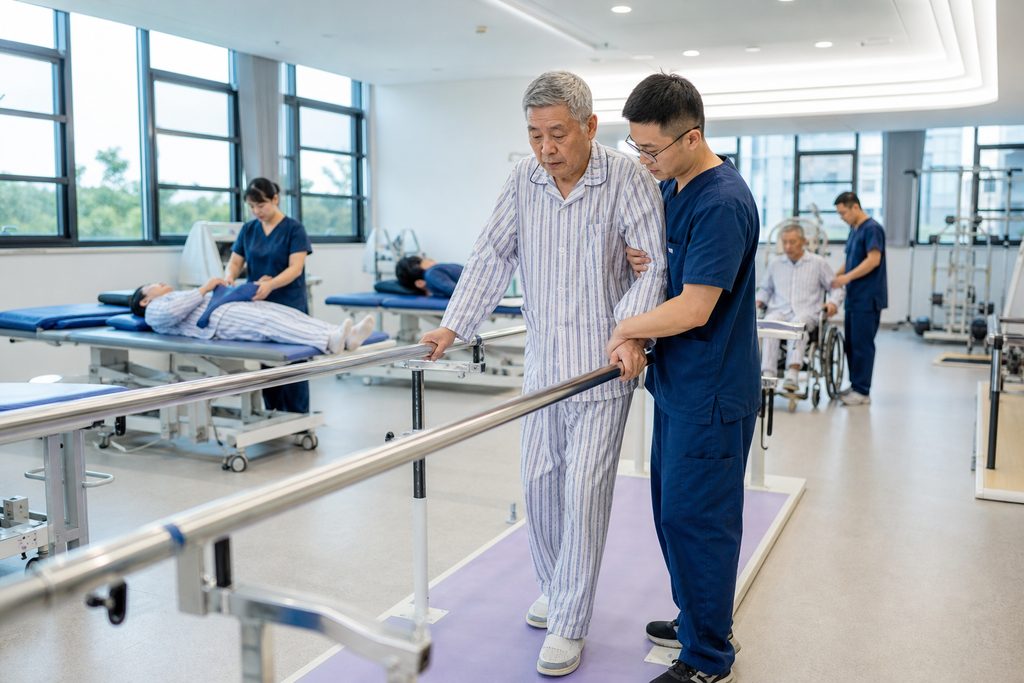
Stroke rehabilitation in China operates on a fundamentally different premise than what most Western patients expect. The model is high-volume, multi-modal, and inpatient-heavy. A typical day in a Beijing neuro-rehab ward might include two hours of one-on-one physical therapy, an hour of occupational therapy, speech therapy, and a session of electro-acupuncture. That intensity of therapy is expensive in the West. In China, it is the standard protocol. The structure of the system makes it possible.
Clinical Volume Creates Specialist Depth
China records over 2.4 million new strokes annually. The sheer caseload means that a senior physiatrist at a major Shanghai rehabilitation center manages more post-stroke spasticity cases in a single month than many Western specialists see in a year. This is not a marginal difference. A therapist who has guided 500 patients through hemiplegic gait retraining sees patterns and plateaus faster. They know when to push and when to back off. The best stroke recovery hospitals China are integrated within massive general hospitals—places like Huashan Hospital affiliated with Fudan University or China Rehabilitation Research Center in Beijing—where neurology, neurosurgery, and rehabilitation medicine sit on the same floor. A patient with post-stroke epilepsy does not wait two weeks for a neuro consult. The neurologist is a hallway away.
Technology Deployed at Scale, Not as a Novelty
Robotic exoskeletons for gait training. Transcranial magnetic stimulation for aphasia. Virtual reality mirror therapy for upper limb function. These are not pilot programs with a six-month waiting list in China’s top rehabilitation hospitals. They are integrated into daily therapy schedules. Beijing Bo’ai Hospital runs one of the largest robotic-assisted gait training programs in Asia, with multiple Lokomat and similar devices operating simultaneously. The cost of these technologies is amortized across a massive patient volume, which is why the stroke rehabilitation cost China remains accessible even when advanced technologies are part of the protocol. You are not paying for a machine’s idle time. You are paying for a system that runs at full capacity.
A Dual-Track Recovery: Western PT Meets TCM
This is where the model diverges most sharply from Western rehab. Alongside your conventional physical therapy, a Chinese rehabilitation program will likely offer acupuncture, tuina medical massage, and possibly herbal medicine tailored to post-stroke syndromes. The evidence base is mixed in Western literature, but the clinical practice is deeply embedded. Many of our patients report that acupuncture helps manage post-stroke fatigue and shoulder pain in ways that conventional analgesics do not. A typical stroke recovery package Beijing at a top hospital will include daily acupuncture as a standard line item, not an add-on. Our TCM services page explains the full scope of what is available, but the key point is this: you get both pathways, not one or the other.
What You Need to Know Before Going Alone
The clinical case for coming to China is strong. The logistical reality is brutal if you attempt it solo. We need to be completely direct about this. The barriers are real, and they will exhaust a family caregiver before the first therapy session begins.
- Visa Requirements Are Strict and Specific: Medical treatment in China requires an S2 visa with a clear annotation of the medical purpose. This is not a tourist visa. The application demands an invitation letter from the admitting hospital, stamped with the hospital’s official seal. Most public hospital departments will not issue this letter to a foreign patient they have never seen. Our team obtains this documentation through the hospital’s international medical center, which is the only channel authorized to sponsor a pre-arranged admission. A family member accompanying the patient also needs an S2 visa, not an L tourist visa. Getting this wrong at the consulate means a rejected application and lost time.
- Payment Is Upfront, and the System Is Cash-Based: Public hospitals in China operate on a prepaid deposit model. You load funds onto a patient card at admission, and services are debited daily. International credit cards are not accepted at most hospital cashier desks. You need a Chinese bank account or a local payment platform like WeChat Pay or Alipay, both of which require a Chinese phone number and bank card to set up. A rehabilitation stay of four weeks can require a deposit of $10,000 to $15,000 upfront. International insurance is almost always reimbursement-based, meaning you pay out of pocket and claim later. Our team handles deposit management and provides translated, itemized receipts formatted for international insurance submission.
- Language Is Not a Soft Barrier—It Is a Hard Wall: A rehabilitation ward is a high-speed, high-noise environment. Therapists give rapid instructions. Nurses call out medication schedules. The patient in the next bed needs help, and staff respond in Mandarin. Even in hospitals with English-speaking doctors, the day-to-day therapy is delivered by Mandarin-speaking therapists and nurses. A single misunderstood instruction during balance training can mean a fall. Our bilingual medical companions stay with you during all therapy sessions, translating in real time and ensuring that clinical nuance is not lost.
How We Help You Navigate This
These barriers exist because China’s hospital system is designed for domestic patients moving at domestic speed. It was never architected for an international patient who needs a pre-arranged, structured rehabilitation admission. That is the gap we fill.
The process starts with your medical records. We translate and summarize your stroke history, imaging reports, and current functional status into a clinical brief formatted for a Chinese physiatrist’s review. We submit this brief to the international departments of hospitals that match your specific needs—a facility strong in aphasia recovery if speech is your primary deficit, or a center known for gait retraining if mobility is the focus. We do not send your case to every hospital. We send it to the two or three that make clinical sense.
Once a hospital accepts your case, we lock in the admission date and the rehabilitation bed. This is the critical step. Without a pre-arranged admission through the VIP or international pathway, you cannot book a stroke rehabilitation program China in advance. You would need to arrive, register as an outpatient, see a specialist, and then wait for a bed to open. That wait can be weeks. We bypass that uncertainty entirely.
On the ground, our bilingual medical companion meets you at the airport, handles hospital registration, loads your deposit, and stays with you through every therapy session. At discharge, we coordinate your medical summary, imaging copies, and a translated discharge plan that your home-country physician can follow. The coordination fee for a comprehensive post-stroke program varies by hospital and complexity, but a typical arrangement starts from approximately $800 for appointment and admission coordination. For patients who require end-to-end support across a multi-week stay, our VIP coordination package ranges from $5,000 to $8,000. Any consultation or coordination fee is fully credited toward on-the-ground services if you upgrade within 90 days. That means your initial investment is never lost—it converts directly into bedside support.
What Does Stroke Rehabilitation Cost in China?
The stroke rehabilitation cost China varies by hospital tier, city, and therapy intensity, but the range is remarkably consistent across top-tier facilities. Inpatient neuro-rehabilitation at a Fudan-ranked hospital in Beijing or Shanghai typically runs between $6,000 and $15,000 per month, all-inclusive of therapy sessions, basic medications, and ward accommodation. This compares to $30,000 to $60,000 per month in a comparable US inpatient rehab facility. The delta is not a reflection of lower quality. It is a function of labor economics, hospital operational efficiency, and the absence of the administrative overhead that bloats Western hospital billing.
| Rehab Component | China (Monthly, Top-Tier Hospital) | United States (Monthly, Inpatient Rehab) |
|---|---|---|
| Inpatient Ward & Nursing | $2,000 – $4,000 | $10,000 – $20,000 |
| Daily PT/OT/Speech Therapy | $3,000 – $6,000 | $15,000 – $30,000 |
| Acupuncture & TCM Adjuncts | $500 – $1,000 | Typically not available |
| Robotic-Assisted Therapy | $1,000 – $2,500 | $5,000 – $10,000 |
| Total Estimated Range | $6,500 – $13,500 | $30,000 – $60,000 |
These figures are estimates based on published hospital price lists and patient-reported costs. The final amount depends entirely on your specific deficits, therapy hours prescribed, and any medical complications that arise during the stay. Private international hospitals like United Family or Jiahui operate at a higher price point—closer to $20,000 to $30,000 per month—but offer fully English-speaking environments and direct insurance billing. Our private hospitals page details those options for patients who prioritize a Western-style experience over cost savings.
How Long Does Stroke Rehab Take in China?
Patients often ask us how long does stroke rehab take in China, expecting a standardized protocol. The honest answer is that it depends entirely on the stroke’s severity and the deficits involved. But the structure of Chinese inpatient rehab allows for a longer, more intensive initial stay than most Western systems permit. Where a US inpatient rehab facility might discharge a patient after two to three weeks, a Chinese rehabilitation hospital may keep a patient for six to twelve weeks of daily intensive therapy. This is not because recovery is slower. It is because the funding model allows the clinical team to prioritize functional gains over insurance-driven discharge deadlines.
A typical program for a moderate ischemic stroke with hemiparesis might run eight weeks: four weeks of intensive inpatient therapy, followed by a transition to a day-hospital model where the patient lives nearby and attends therapy daily. Some patients stay for three months or longer. The discharge decision is driven by functional milestones, not by an arbitrary day count. That philosophical difference—treating to a goal rather than to a calendar—is one of the most underappreciated advantages of the Chinese rehabilitation model.
Is Post-Stroke Care Good in China?
The question is post-stroke care good in China deserves a nuanced answer. At the top 5% of hospitals—the ones we work with—the answer is an emphatic yes. The therapy intensity, the integration of TCM, and the physician expertise at a facility like Huashan Hospital or the China Rehabilitation Research Center rival or exceed what you would find at a top-tier Western neuro-rehab unit. But the quality drops off sharply outside this tier. A general county-level hospital will not have dedicated neuro-rehab therapists or advanced equipment. This is why hospital selection is everything. The system has enormous variance. We navigate patients exclusively to the top of that distribution. Our top hospitals database shows you exactly which institutions meet the Fudan ranking and JCI standards that define the top tier.
Frequently Asked Questions
Yes, but only through a hospital’s international medical center or VIP pathway. Standard public outpatient channels do not permit pre-booking of rehabilitation beds. Our team handles the entire pre-admission process, including clinical review by the receiving hospital and bed reservation. Without this step, you are essentially arriving as a walk-in patient with no guarantee of admission.
This is one of the structural strengths of being in a large general hospital rather than a standalone rehab facility. If a patient develops aspiration pneumonia, a post-stroke seizure, or a cardiac issue, the relevant specialist is in the same building. There is no ambulance transfer to an acute hospital. The rehab team and the acute medical team share the same electronic medical record. This integration reduces the clinical risk of a rehabilitation stay considerably.
At discharge, you receive a fully translated clinical summary, imaging on CD and cloud storage, and a structured home exercise program. We also facilitate a written second opinion or a remote video consultation with your Chinese physiatrist at the three-month mark if needed. The goal is that your home-country therapist can pick up exactly where the Chinese team left off, with no information gaps.
Acupuncture and tuina massage, when performed by licensed practitioners in a hospital setting, have a strong safety profile. The main risk is bruising or mild soreness at needle sites. Herbal medicine requires more caution. Some TCM herbs can interact with anticoagulants or antiplatelet medications. We always advise patients to disclose their full medication list to both their Western-trained neurologist and their TCM practitioner, and we ensure that both are on the same clinical team and communicating directly.
Your Next Step
Stroke recovery is a race against the brain’s closing window of maximal plasticity. The therapy hours you get in the first six months post-stroke are the most valuable hours in your entire rehabilitation journey. China’s top hospitals offer a model that delivers those hours at high intensity and at a cost that makes extended inpatient stays financially viable for families who would be priced out of equivalent care at home. The logistical complexity is real, but it is solvable. If you are considering this path, start with a conversation. We will review your case, recommend hospitals that match your specific deficits, and give you a clear cost estimate. No pressure. No vague promises. Just a structured plan for what comes next. Contact our team through our patient coordination page to begin.
For more medical information and treatment options in China, visit chinamedservices.com (China Medical Services).
