Clear Aligners vs Braces Cost Abroad: China’s $1,800 Advantage
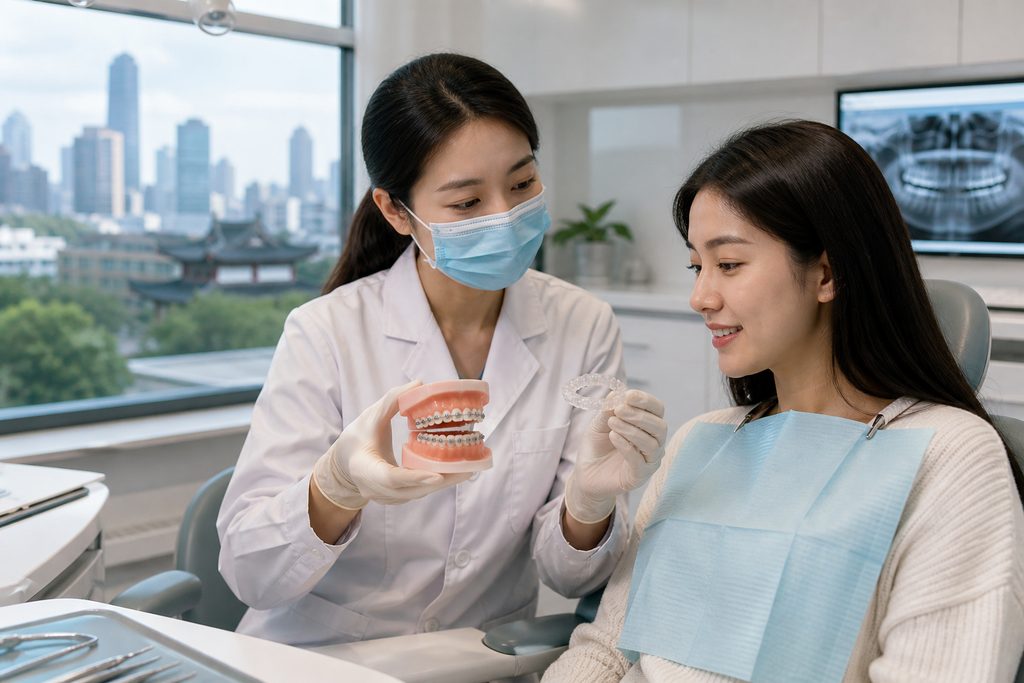
While Americans routinely pay $5,500 for clear aligner therapy, patients at top-tier Chinese dental hospitals complete equivalent treatment for under $2,000 — often with the same aligner brands. The gap widens when you factor in braces. Metal braces in the US average $3,000 to $7,000. In Shanghai, that figure drops to $800–1,500 at public hospital dental departments.
That price difference reshapes the entire decision calculus. It changes what “better” means.
Key Takeaways
- Clear aligners cost China averages $1,800–3,500 for full treatment at top public hospitals, versus $4,000–7,000 in the US
- Chinese orthodontists at Fudan-ranked dental departments handle 3–5x more aligner cases annually than the average Western orthodontist
- Complex bite corrections still favor braces — aligners cannot fix every malocclusion, and honest providers will tell you so
- International patients need in-person records (X-rays, impressions) before any aligner plan can begin — remote quotes are estimates only
The Problem: Orthodontic Care Has Become a Luxury Good in the West
The American Association of Orthodontists reports that the average comprehensive orthodontic treatment in the United States now costs between $5,000 and $7,000. Dental insurance, when it exists, typically caps orthodontic coverage at $1,500–2,000 lifetime. That leaves patients financing $3,500–5,500 out of pocket. In the UK, private aligner treatment through major chains runs £2,500–4,500. Canada sits in a similar range, with Invisalign treatment in Toronto averaging CAD $6,000.
So what happens? Patients delay treatment. They live with crowding, spacing, or bite issues that worsen over time. A 2023 study in the Journal of Clinical Orthodontics found that untreated malocclusion correlates with higher rates of periodontal disease, abnormal enamel wear, and temporomandibular joint dysfunction. Delaying orthodontic care is not a neutral choice — it carries compounding dental costs later.
The internet’s answer has been direct-to-consumer aligner kits. They promise $1,800 treatment without an orthodontist visit. But the American Dental Association has repeatedly warned that remote-only aligner treatment without in-person supervision risks root resorption, bite destabilization, and tooth loss. The patient is stuck between two bad options: overpay for supervised care, or risk unsupervised care.
Why China’s Orthodontic System Delivers Results at Half the Cost
China’s dental hospital system operates on a fundamentally different economic model. Public hospital dental departments are high-volume, low-margin operations. They are not profit centers designed to maximize per-patient revenue. Orthodontists are salaried physicians, not commission-driven providers. That structural difference alone explains most of the price gap — not lower quality.
Clinical Volume: The Repetition Advantage
A senior orthodontist at a top-tier Chinese dental hospital manages 150–300 active aligner and braces cases simultaneously. Their Western counterpart might manage 60–100. The volume difference matters because orthodontics is a pattern-recognition discipline. The more cases a clinician sees, the faster they identify complications, the more precisely they plan tooth movement, and the fewer mid-treatment surprises occur.
Peking University School of Stomatology, one of China’s leading dental institutions, treats over 800,000 outpatient dental visits annually across its affiliated hospital. Shanghai Ninth People’s Hospital’s orthodontic department handles more than 10,000 new orthodontic consultations per year. These are not small practices. They are orthodontic assembly lines run by specialists who have seen every malocclusion pattern thousands of times.
Technology Parity: Same Aligners, Different Price
Chinese hospitals do not use “inferior” aligner brands. International patients at major Chinese dental centers routinely receive treatment with Invisalign, Angelalign, or ClearCorrect — the same aligner systems used in the US and Europe. Angelalign, a Chinese aligner manufacturer, holds FDA clearance and has treated over 1 million patients globally. Invisalign treatment in Shanghai is widely available at public hospital international departments and private dental clinics.
The aligner manufacturing is identical. The clinical planning software is identical. What differs is the labor cost of the orthodontist who supervises your case — and that difference is profound.
Cost Structure: Why the Same Treatment Costs 60% Less
Let’s break down the numbers. A full clear aligner treatment in the United States includes: initial records ($300–500), orthodontist clinical fee ($3,000–4,500), aligner lab fee ($1,200–2,000), and retention ($400–800). The orthodontist’s clinical fee reflects US dental school debt (average $300,000+) and practice overhead (US dental office rent, malpractice insurance, staff salaries).
In China, a comparable treatment at a public hospital dental department costs: initial records ($50–100), orthodontist clinical fee ($600–1,200), aligner lab fee ($800–1,500), and retention ($100–200). Chinese dental school tuition is heavily subsidized. Hospital overhead is lower. Malpractice insurance is a fraction of US rates. The aligner lab fee — the actual cost of manufacturing your aligners — is the only component that stays roughly comparable, because it reflects global supply chain costs.
That is why clear aligners cost China patients $1,800–3,500 for full treatment. Not because corners are cut. Because the labor economics are different.
Clear Aligners vs Braces: The Real Clinical Comparison
Here is where honesty matters. Clear aligners are not universally “better” than braces. They are better for specific cases and worse for others. The decision depends on your malocclusion type, your compliance habits, and your treatment priorities.
| Factor | Clear Aligners | Traditional Braces |
|---|---|---|
| Average treatment time | 12–18 months | 18–30 months |
| Cost in China (full treatment) | $1,800–3,500 | $800–1,500 (metal) / $1,500–2,500 (ceramic) |
| Cost in US (full treatment) | $4,000–7,000 | $3,000–7,000 |
| Visibility | Nearly invisible | Highly visible (metal) / less visible (ceramic) |
| Best for | Mild to moderate crowding, spacing, relapse | Severe crowding, complex bite issues, rotations, extractions |
| Compliance required | 20–22 hours daily wear — failure extends treatment | None beyond hygiene and avoiding hard foods |
| Discomfort level | Mild pressure per tray change | Moderate to severe after adjustments |
| Office visits | Every 6–8 weeks | Every 4–6 weeks |
Braces remain the gold standard for complex cases. Severe rotations, significant bite discrepancies, extraction cases, and skeletal issues often require the precise three-dimensional control that brackets and wires provide. Aligners have improved dramatically — modern systems can handle moderate bite correction — but they are not a universal replacement.
How long does clear aligner treatment take? For mild to moderate cases, 12–18 months is typical. Complex cases with aligners can stretch to 24 months or more. Braces for equivalent cases often take 18–30 months. The aligner advantage in speed is real but modest, and it disappears entirely if you don’t wear the aligners as prescribed.
What International Patients Should Check Before Committing
Is clear aligner treatment safe in China? Yes — when performed at an accredited public hospital dental department or a reputable private clinic with licensed orthodontists. The safety profile matches international standards. Chinese orthodontic training requires 5 years of dental school plus 3 years of orthodontic residency. The aligner brands used are the same FDA-cleared or NMPA-approved products used globally.
But there are practical realities you must understand before booking clear aligner treatment in China.
You Cannot Start Treatment Remotely
No legitimate Chinese orthodontist will begin clear aligner treatment without in-person records. That means panoramic X-rays, lateral cephalometric X-rays, intraoral photographs, and digital impressions or PVS molds. These cannot be done by mail. You will need at least one in-person visit to establish records and receive your treatment plan. Subsequent visits every 6–8 weeks for aligner check-ups are standard — though some providers allow longer intervals for international patients, especially if you use remote monitoring apps.
Treatment Plans Are Not One-Size-Fits-All
Some international patients assume they can fly to Shanghai, get scanned, receive 40 aligners, and fly home. That model exists — but it is not the standard of care. Responsible orthodontists want to see you at key milestones: initial fit, mid-treatment progress check, and final refinement. If you live in Europe or North America, you will need 2–4 visits to China over 12–18 months. That travel cost must be factored into your “cheaper treatment” calculation. A $2,000 aligner treatment with $3,000 in flights and hotels is not a bargain.
Which Chinese Cities Offer the Strongest Orthodontic Care
Shanghai and Beijing dominate. Shanghai Ninth People’s Hospital and Peking University School of Stomatology are the two most recognized names in Chinese orthodontics. Both operate international departments with English-speaking coordination staff. Guangzhou’s Sun Yat-sen University dental hospital and Chengdu’s West China School of Stomatology are also excellent, with lower coordination fees than their coastal counterparts. Our hospital database covers orthodontic departments across 37 cities, including Fudan-ranked dental centers in Shanghai and Beijing.
Practical Considerations: Records, Visas, and Payment
If you are seriously evaluating clear aligner treatment in China, here is what the logistics actually look like.
Visa: Dental treatment falls under the S2 visa category, which covers short-term private medical treatment in China. You will need a letter from the treating hospital confirming your appointment and treatment plan. S2 visas are typically issued for 30–90 days per entry. If your treatment requires multiple visits, you may need multiple S2 entries or a longer-stay S1 visa for stays exceeding 180 days. Requirements vary by Chinese embassy — confirm with your local consulate before booking flights.
Payment: Public hospitals in China require prepayment. International departments typically accept international credit cards, but standard outpatient departments often require Chinese bank cards or cash. Budget for a 30–50% deposit at treatment initiation, with the balance due at milestone visits. Private dental clinics in Shanghai and Beijing often accept international insurance directly — JCI-accredited private facilities are the most foreigner-friendly option for direct billing.
Language: Public hospital orthodontic departments operate in Mandarin. International departments have English-speaking coordinators, but the orthodontist may not be fluent. A bilingual medical companion (from $300/day) handles registration, translation during consultations, and payment navigation. It is not mandatory, but it removes the single biggest source of friction for international patients.
Follow-up after returning home: If you complete treatment in China and return to your home country, you will need a local orthodontist for retention checks. Not all Western orthodontists will accept a case started abroad. Before you commit to treatment in China, identify a local provider willing to handle retention and any refinement needs. This is a critical step most patients overlook.
Frequently Asked Questions
For a single round-trip visit from Europe or North America, the total cost (treatment plus flights and accommodation) is typically 40–50% lower than US treatment. For multiple visits, the savings shrink. Patients from the Middle East, Southeast Asia, and Russia — where flights to China are shorter and cheaper — see the greatest net savings. Run the numbers for your specific route before deciding.
No. No reputable provider will start treatment without in-person records. Some clinics offer remote preliminary consultations where you send existing dental records for a rough assessment, but the official treatment plan requires an in-person records appointment. Anyone offering to ship you aligners based on photos alone is not following standard orthodontic care protocols.
Refinement is common — about 20–30% of aligner cases need additional aligner sets after the initial series. If your Chinese orthodontist planned for this, refinements can sometimes be managed through remote monitoring and shipped aligners. But some cases require in-person adjustments. Clarify the refinement policy before starting treatment, and have a local orthodontist lined up as a backup.
Angelalign, the largest Chinese aligner brand, holds FDA 510(k) clearance and CE marking. Its clinical data and safety profile are comparable to Invisalign for mild to moderate cases. The more important variable is the orthodontist supervising your case, not the aligner brand. A skilled orthodontist using any FDA-cleared aligner system will outperform a mediocre one using the most expensive brand.
Your Next Step
The question “are clear aligners better than braces?” has no universal answer. The right question is: which option fits your malocclusion, your budget, and your willingness to travel. If you are considering treatment in China, start by understanding your own case. We help international patients navigate Chinese dental care — from identifying suitable orthodontic departments to coordinating records appointments and bilingual support. We are not a hospital and do not provide diagnoses. If you want a clear-eyed assessment of whether Chinese orthodontic treatment makes sense for your situation, request a free consultation and we will help you evaluate your options.
For more medical information and treatment options in China, visit chinamedservices.com (China Medical Services).
