Regaining Speech After Stroke: Realistic Recovery Pathways and China’s Rehab Options
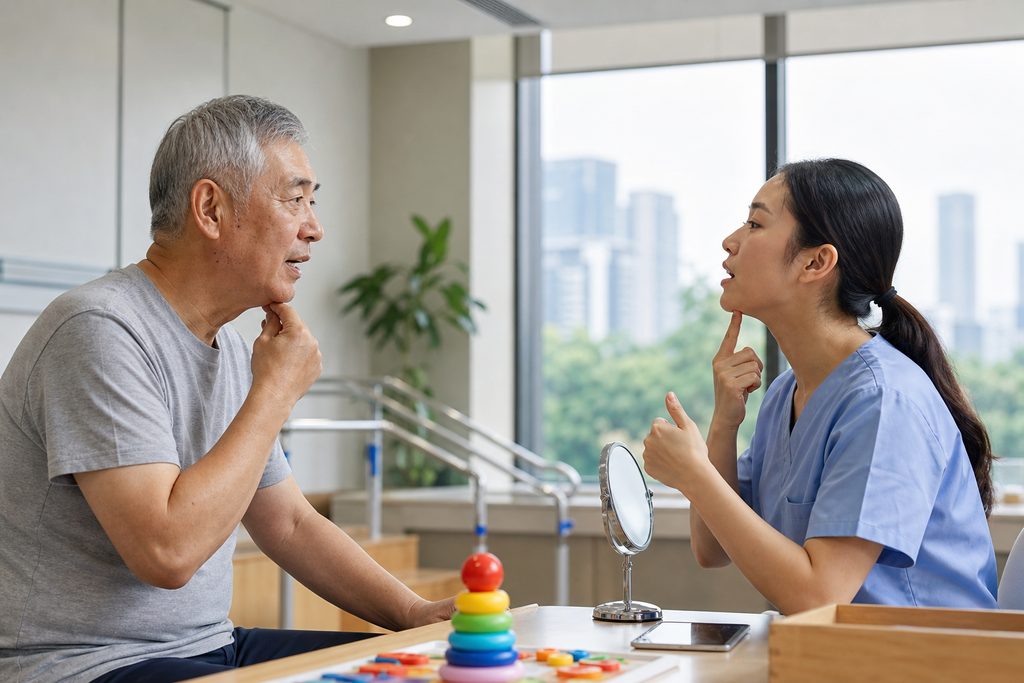
Have you ever found yourself staring at a loved one who is trying desperately to speak, the words trapped somewhere between thought and sound? A stroke steals many things, but losing the ability to communicate is perhaps the cruelest blow. The search for answers often begins with a single, desperate question: can I regain speech after a stroke?
The short answer is yes — for most people, meaningful recovery is possible. But the path looks different for everyone. A 2021 meta-analysis in Stroke found that approximately one-third of stroke survivors experience aphasia, and while spontaneous recovery happens in the first weeks, structured rehabilitation drives the most significant gains. When families contact us about speech therapy after stroke cost China, they are usually weighing two things: the quality of the therapy and whether the financial burden is manageable. We will address both honestly.
Our team at China Medical Services has coordinated rehabilitation care for international patients across 37 cities. We have seen what works, what stalls, and what families wish they had known earlier. This guide explains the actual process, the realistic timeline, and what you should understand before committing to treatment abroad.
How This Actually Works, Step by Step
You do not fly to China, walk into a hospital, and start therapy the same day. The process has a sequence, and understanding it saves you weeks of frustration.
First, you gather every medical record related to the stroke. Discharge summaries, imaging reports (CT, MRI), neurologist notes, and any prior speech-language pathology assessments. These documents need to be translated into Chinese. Our team handles this translation as part of the coordination service.
Second, the records go to the rehabilitation department of a hospital suited to your case. A specialist reviews them and determines whether you are a candidate for their program. This written second opinion typically costs $300–500 and provides a clear picture of what therapy would look like for your specific type of aphasia — whether it is Broca’s, Wernicke’s, or global.
Third, if both sides agree to proceed, we coordinate the appointment. Public hospitals in China cannot reserve outpatient slots for overseas patients without an in-person visit. The international department or VIP channel is the workaround. You arrive, meet the rehabilitation physician face-to-face, and a treatment plan is formalized.
Fourth, therapy begins. Sessions are typically scheduled several times per week. A bilingual companion from our team accompanies you to every appointment — registering, translating, and making sure the therapist’s instructions are understood. This is not a luxury. It is how the system works for non-Chinese speakers.
What Actually Determines Whether Speech Returns
The honest answer: three factors dominate. The location and size of the brain lesion. The time since the stroke. And the intensity of therapy delivered in the first six months.
Lesion location matters more than age. A small infarct in Broca’s area often produces aphasia that responds well to therapy. A large middle cerebral artery stroke affecting multiple language regions creates a much harder road. No hospital, in China or elsewhere, can change the neuroanatomy. What they can change is how aggressively the surviving brain tissue is trained to rewire.
Time is a factor families often misunderstand. The first three to six months after a stroke are the window of maximum neuroplasticity. Gains still happen after that — studies show improvement even years later — but the slope is steeper early. That is why we often see families make the decision to travel for intensive therapy within weeks of the stroke, not months.
Intensity is where China’s top rehabilitation hospitals distinguish themselves. Programs frequently run daily sessions, combining speech-language therapy with physical and occupational therapy in a single inpatient stay. That concentrated dose is difficult to replicate at home with two outpatient visits per week.
A Realistic Timeline
Here is what the process actually looks like, from the day you first contact us to the day therapy begins in China.
| Stage | Typical Duration | What Happens |
|---|---|---|
| Document collection and translation | 3–7 days | You send existing records; we translate and format them for Chinese hospital review. |
| Remote specialist review | 5–10 days | A rehabilitation physician evaluates your records and issues a written opinion on treatment feasibility. |
| Visa application (S2) | 1–3 weeks | You apply for an S2 visa with supporting hospital documentation. Processing times vary by consulate. |
| Travel and initial consultation | 2–3 days after arrival | In-person evaluation with the rehabilitation team. Formal therapy plan is set. |
| Intensive therapy phase | 2–6 weeks | Daily sessions begin. Many patients stay 4 weeks for an initial block. |
| Home program transition | Ongoing | Therapists provide a structured home exercise plan with video follow-up options. |
Notice the waiting steps people forget. Document translation is not instant. Visa processing has a real lead time. And the first available slot at a top rehabilitation department may be one to two weeks out. Plan for a total of four to six weeks from first contact to first therapy session.
What Can Go Wrong — and What Happens Then
Let us be direct about the failure modes, because pretending they do not exist helps no one.
The most common problem: the patient is not actually a candidate for intensive inpatient therapy. Severe medical instability, uncontrolled hypertension, or active infections can delay or cancel a rehabilitation admission. The hospital will not bend on this, and you should not want them to. What happens then? The remote review catches most of these cases before you travel. If the specialist says no, you have spent $300–500 on a second opinion instead of thousands on a trip that would not have worked.
Another failure mode: expectations outrun biology. A family arrives expecting a full return to pre-stroke speech in four weeks. That is not a realistic outcome for most moderate-to-severe aphasia. The hospital will not promise it. If this gap is not addressed before travel, the family leaves disappointed even if the therapy was excellent. We try to have this conversation early.
A third issue: the patient refuses to participate. Aphasia therapy is exhausting. It requires active engagement. A patient who is depressed or unmotivated will make minimal progress. Chinese rehabilitation hospitals screen for this and often incorporate psychological support, but no program can force effort.
And the logistical risks: a visa rejection, a flight cancellation, a hospital bed unavailable on the expected date. For visa rejections, we work with you to reapply with corrected documentation. For scheduling shifts, we adjust. But you should know these are real possibilities, not hypotheticals.
Is Stroke Speech Recovery Treatment in China Effective? What the Numbers Show
Effectiveness is not a marketing slogan. It is a measurable outcome, and you should ask hard questions about it.
Chinese rehabilitation hospitals treat enormous volumes. A single top-tier rehabilitation department in Shanghai may see more stroke aphasia cases in a month than a Western community hospital sees in a year. Volume builds clinical pattern recognition. Therapists have seen hundreds of Broca’s aphasia presentations, not dozens.
Intensity is the second measurable advantage. Inpatient programs in China commonly deliver two to three hours of combined therapy daily — speech, physical, occupational. A 2019 randomized controlled trial published in Neurorehabilitation and Neural Repair found that higher therapy intensity in the subacute phase produced significantly better language outcomes at six months. That is not a Chinese study, but it explains why the Chinese model of concentrated inpatient rehab works.
And then there is acupuncture. Can you regain speech after stroke with acupuncture? The evidence is mixed but not dismissible. A 2022 systematic review in Frontiers in Neurology examined scalp acupuncture for post-stroke aphasia and found modest but statistically significant improvements in language function when combined with conventional speech therapy. Acupuncture alone is not a cure. But as an adjunct, many patients report it helps with alertness, mood, and oral motor control. Top hospitals like Shanghai’s rehabilitation centers integrate TCM modalities alongside Western speech-language pathology.
So is it effective? For the right patient, with realistic expectations, yes. The therapy model — high intensity, high volume, integrated TCM — has real strengths. It is not magic. It is concentrated, well-structured work.
Speech Therapy After Stroke Cost China: A Breakdown
Most patients show measurable gains within two to four weeks of intensive daily therapy. The pace varies by lesion size, aphasia type, and patient engagement. Some see changes in the first week; others need six to eight weeks before improvement is obvious to family members.
It depends on medical stability. Most rehabilitation hospitals require at least two to four weeks of stabilization after the acute event before accepting an international patient for intensive rehab. Your neurologist should clear you for long-haul travel, and the remote review will assess whether you meet admission criteria.
The remote written review is designed to catch this before you travel. If a new medical issue emerges after arrival, the hospital may delay admission. You would work with our team to adjust the plan — either treating the new issue first or returning home until stability is achieved.
Some international insurers cover treatment at JCI-accredited or internationally recognized Chinese hospitals. Others require pre-authorization and retrospective claims. Check with your insurer before committing. We can provide the documentation your insurer requests, but we cannot guarantee coverage.
Your Next Step
Regaining speech after a stroke is a process, not an event. It takes the right therapy, the right intensity, and the right timing. Our role is to make the logistics manageable so you can focus on the work of recovery. We coordinate hospital matching, document translation, appointment scheduling, visa guidance, and bilingual accompaniment across 340+ top-ranked hospitals. We do not provide medical advice, and we do not promise outcomes. What we do is get you in front of the right specialists with less friction than you would face alone. If you are considering rehabilitation in China, start with a conversation. Send your records through our consultation page, and we will tell you honestly whether this path makes sense for your case.
Frequently Asked Questions
Yes. The hospitals used for international patients are JCI-accredited and follow the same international safety standards as top hospitals in the US and Europe. Surgical teams perform high volumes of procedures — often more than their Western counterparts — which studies show leads to better outcomes.
Costs vary by procedure and hospital, but international patients typically save 40-80% compared to US prices — even when factoring in travel and accommodation. A consultation with our team will give you an exact, all-inclusive quote with no hidden fees.
Send us your existing medical reports to get started. We handle everything from hospital selection and appointment scheduling to visa assistance and post-operative recovery planning. Your medical records are reviewed by the specialist before you even book a flight.
For more medical information and treatment options in China, visit chinamedservices.com (China Medical Services).
