Can LASIK Fix My Astigmatism? Costs, Safety, and Top Hospitals in China
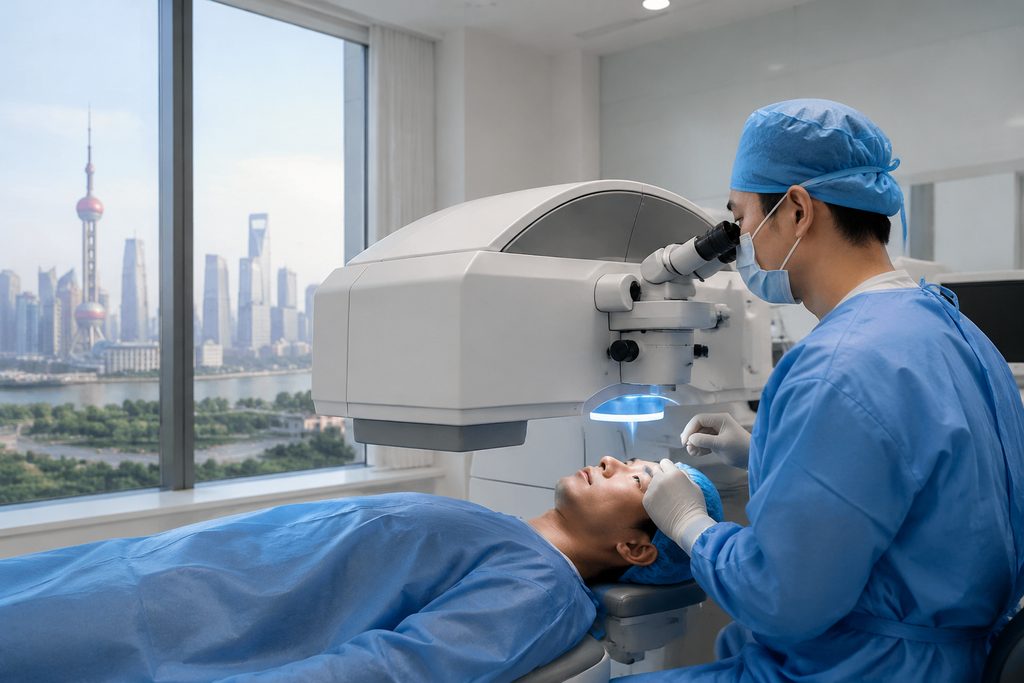
Astigmatism blurs your vision because the cornea is shaped more like a football than a basketball. Light focuses on two different points inside the eye instead of one. LASIK reshapes that curve into a more spherical form. So yes — LASIK can fix astigmatism. The real question is whether your specific degree of astigmatism fits within safe treatment parameters, and where you can get the procedure done well at a price that makes sense.
We work with international patients every week who ask us this exact question. Many have been quoted $4,000 to $6,000 in the United States or Europe. Others were told their astigmatism is too high for laser correction at home. Some are simply curious whether China’s top eye centers — which perform enormous volumes of refractive surgery — offer comparable quality at a fraction of the cost. The short answer is yes, with caveats we will lay out plainly.
LASIK and Astigmatism: The Short Answer
Modern LASIK platforms correct up to approximately 6.00 diopters of astigmatism. Some clinics treat up to 8.00 diopters in carefully screened patients. That covers the vast majority of people with this condition. The procedure takes about 10 to 15 minutes per eye. Most patients see dramatic improvement within 24 hours.
But “can LASIK fix astigmatism permanently” is a slightly different question. The corneal reshaping itself is permanent. The flap created during surgery heals into place. What changes over time is your eye — presbyopia arrives in your 40s, cataracts may develop later, and a small percentage of patients experience regression. So the correction is permanent, but your vision will still change as you age. That distinction matters when you are weighing the decision.
Who Is a Good Candidate — and Who Is Not
We always tell patients that candidacy is a medical determination, not a preference. A thorough pre-operative evaluation matters more than anything you read online. Still, there are clear patterns.
Typically good candidates:
- Stable prescription for at least 12 months
- Astigmatism up to 4.00 to 6.00 diopters, depending on corneal thickness
- Age 18 to 40, with corneas thick enough for safe flap creation
- No active eye disease, no significant dry eye
- Realistic expectations about night vision and possible glare
Who should not pursue LASIK:
- Corneas too thin for safe ablation — this is the number one disqualifier
- Keratoconus or any corneal ectasia, even if mild
- Uncontrolled autoimmune disease that affects healing
- Pregnancy or nursing, due to hormonal shifts that change corneal shape
- Severe dry eye that does not respond to treatment
High astigmatism deserves special attention. Is LASIK safe for high astigmatism? The answer depends on your corneal thickness and the specific laser platform available. Some newer excimer lasers handle up to 8.00 diopters with excellent outcomes. But if your cornea is thin, a surgeon may recommend implantable collamer lenses (ICL) instead — a procedure that places a corrective lens inside the eye without removing corneal tissue. China’s top refractive centers perform both procedures at high volume.
The Options, Compared
You are not limited to LASIK. Depending on your measurements, several refractive procedures might suit you better. Here is the landscape as of 2026.
| Procedure | Astigmatism Range | Recovery | Relative Cost in China | Best For |
|---|---|---|---|---|
| Standard LASIK | Up to 6.00 D | 1–2 days | $800–1,500 per eye | Most patients with mild to moderate astigmatism |
| Femtosecond LASIK | Up to 6.00 D | 1–2 days | $1,200–2,000 per eye | Patients wanting bladeless flap creation |
| SMILE | Up to 5.00 D | 2–3 days | $1,800–2,800 per eye | Active patients, lower dry eye risk |
| PRK / TransPRK | Up to 6.00 D | 5–7 days | $700–1,300 per eye | Thin corneas, contact sports |
| ICL | Up to 6.00 D (with toric lens) | 1–2 days | $3,000–5,000 per eye | High astigmatism, thin corneas |
Which column fits you? If your astigmatism is under 3.00 diopters and your corneas are average thickness, standard or femtosecond LASIK works well. If you play contact sports or have borderline dry eye, SMILE or PRK may be safer choices. If your astigmatism is high and your corneas are thin, ICL is often the only good surgical option. A proper topography-guided evaluation answers this definitively.
LASIK for Astigmatism Cost Shanghai: What Drives the Price
The primary keyword here reflects a real search: patients want to know LASIK for astigmatism cost Shanghai specifically, because Shanghai hosts some of China’s best eye hospitals. Prices vary based on three factors: the hospital tier, the laser platform, and the surgeon’s seniority.
At top public hospital international departments in Shanghai — such as the Eye and ENT Hospital of Fudan University — expect to pay $1,200 to $2,500 per eye for femtosecond LASIK with astigmatism correction. Private international clinics like Jiahui or United Family charge $2,000 to $3,500 per eye, with English-speaking staff and direct insurance billing. The same procedure in the United States typically runs $2,500 to $4,000 per eye. So you save roughly 40% to 60% by having it done in Shanghai, sometimes more.
What is included in those figures? Pre-operative evaluation, the procedure itself, and typically three to six months of follow-up visits. What is not included: travel, accommodation, and any enhancement surgery if you need a touch-up later. Ask about enhancement policies before you commit. Some hospitals include one free enhancement within 12 months; others charge separately.
How much is LASIK with astigmatism in Beijing? Similar range. Beijing Tongren Hospital‘s international department and Peking Union Medical College Hospital charge approximately $1,500 to $2,800 per eye for femtosecond LASIK. Private clinics in Beijing’s Chaoyang district run $2,200 to $3,800. The price difference between Beijing and Shanghai is rarely more than 10% for comparable platforms.
Best Eye Hospital for LASIK in China: How to Choose
China has no shortage of refractive surgery centers. The challenge for international patients is separating genuine expertise from aggressive marketing. We recommend starting with hospitals that appear on the Fudan University Hospital Ranking for ophthalmology — a specialty reputation list based on peer review and clinical volume.
The Eye and ENT Hospital of Fudan University in Shanghai performs among the highest volumes of refractive surgery in the country. Beijing Tongren Hospital is similarly respected, with a dedicated refractive surgery center handling thousands of cases annually. Zhongshan Ophthalmic Center at Sun Yat-sen University in Guangzhou rounds out the top tier. These are public institutions with international departments that accept foreign patients.
For patients who prefer a Western-style experience, private international hospitals like United Family and Jiahui offer LASIK with English-speaking ophthalmologists and JCI accreditation. Prices run higher, but the experience is smoother if you do not speak Chinese. You can also review our ophthalmology department rankings to compare top hospitals by specialty reputation.
LASIK eye surgery packages China clinics advertise often bundle pre-op testing, the procedure, medications, and follow-up into one price. Read those packages carefully. Some include only standard LASIK when you might need femtosecond or SMILE. Others quote a low base price but charge separately for astigmatism correction. Always ask for the all-in price with your specific prescription written down.
Practical Considerations: Travel, Records, and Follow-Up
If you are flying to China for LASIK, plan for at least 7 to 10 days on the ground. Day one is your comprehensive evaluation — corneal topography, pachymetry, dilation, and a dilated fundus exam. Surgery typically happens the next day or within 48 hours. You will have a follow-up at day one post-op, another at day three to five, and a final check before you fly home. That timeline works for most patients.
Bring your existing eye records. Any prescription history, corneal topography from your home clinic, and a list of medications helps the Chinese ophthalmologist assess stability. If you wear contact lenses, stop wearing soft lenses for at least one week before your evaluation, and rigid lenses for at least three weeks. This allows your cornea to return to its natural shape — critical for accurate measurements.
Visa category matters. Foreign nationals traveling to China for medical treatment typically apply for an S2 visa, which covers short-term private affairs including medical care. You will need supporting documents from the hospital confirming your appointment. We help patients coordinate this paperwork, but approval always rests with the Chinese embassy or consulate. Do not book flights until your visa is issued.
Payment is straightforward. Public hospital international departments accept credit cards and sometimes international bank transfers. Private international clinics often bill insurance directly. Most Chinese hospitals require payment before surgery, unlike the US model of billing after. Your insurance may reimburse you afterward if refractive surgery is covered under your plan — many plans exclude it as elective, so check first.
Follow-up after returning home is essential. You will need a local ophthalmologist to see you at one month, three months, and six months post-op. Chinese hospitals provide detailed post-operative records and can communicate with your home doctor if needed. Language is rarely a barrier at top international departments, where English-speaking coordinators handle most communication.
Frequently Asked Questions
The corneal reshaping is permanent. The flap heals into place and the corrected curvature does not revert. But your eye continues to change with age — presbyopia, cataracts, and occasional regression over decades. So the astigmatism correction is permanent, while your overall vision will still evolve. That is the honest answer.
For astigmatism up to 6.00 diopters with adequate corneal thickness, LASIK has an excellent safety record. Beyond that, the risk of regression and night vision issues rises. Your surgeon may recommend ICL instead, which avoids removing corneal tissue entirely. A topography-guided evaluation is the only way to know your personal risk profile.
The two cities are within roughly 10% of each other for comparable platforms. Beijing public hospital international departments charge about $1,500 to $2,800 per eye. Shanghai runs $1,200 to $2,500 per eye. Private clinics in both cities charge $2,000 to $3,800 per eye. The hospital’s tier and the laser platform matter more than the city.
Regression happens in about 5% to 10% of patients, usually within the first year. Most cases are mild and do not require further treatment. If regression is significant, an enhancement procedure can be performed — often at reduced cost or free within the first 12 months, depending on the hospital’s policy. Ask about this before you book.
No. Top public hospital international departments and private international clinics employ English-speaking staff. But outside those departments, in the general outpatient halls, Chinese is essential. That is why many international patients use a bilingual medical companion for registration, payment, and navigation. It removes the friction from an otherwise smooth clinical experience.
Your Next Step
LASIK can fix astigmatism for most patients, safely and permanently in the corneal sense. The decision comes down to your measurements, your risk tolerance, and where you choose to have the procedure done. China’s top eye hospitals offer world-class refractive surgery at 40% to 60% below US prices, with international departments built for foreign patients. We are not a hospital and we do not give medical advice. What we do is connect you with the right ophthalmology department, coordinate your evaluation and surgery dates, and provide bilingual support on the ground. If you are considering LASIK in China, start with a free consultation — we will help you understand your options before you commit to anything.
For more medical information and treatment options in China, visit chinamedservices.com (China Medical Services).
