Should I Fix My Pituitary Tumor? Understanding Your Options and When Surgery in China Makes Sense
Should I Fix My Pituitary Tumor? A Practical Guide to Observation, Medication, and Surgery
A pituitary tumor sounds terrifying. But in plain terms, it is an abnormal growth in a pea-sized gland at the base of your brain. Most are benign adenomas. Some need no treatment at all. Others require surgery. If you are weighing whether to fix yours, the answer depends on tumor type, size, symptoms, and growth rate. For many patients, especially those facing high out-of-pocket costs at home, understanding pituitary tumor surgery cost China becomes part of the decision.
Key Takeaways
- Up to 1 in 5 people have a pituitary adenoma found incidentally on MRI, yet fewer than 0.1% require urgent intervention.
- Transsphenoidal surgery in China typically ranges from $15,000 to $30,000, compared with $50,000 to $100,000+ in the United States.
- Not every pituitary tumor needs fixing. Prolactinomas often respond to medication, and microadenomas may be observed for years.
- Before any decision, you need a complete hormonal panel, a dedicated pituitary MRI, and a neuro-ophthalmology evaluation.
The Problem: Living with Uncertainty About a Brain Tumor
Finding out you have a tumor in your brain changes how you sleep. Even when your endocrinologist says it is “probably nothing,” the word tumor echoes. According to autopsy and MRI studies, pituitary adenomas are found in approximately 16.7% of the general population. The vast majority are microadenomas under 10 millimeters that never cause symptoms. But some do. And when they do, the effects can be life-altering: progressive vision loss, severe headaches, hormonal chaos, infertility, fatigue, weight changes, and in rare cases, a condition called pituitary apoplexy where the tumor bleeds suddenly.
Patients in the United States, United Kingdom, and Australia often face a second problem layered on top of the first: access. Wait times to see a pituitary specialist can stretch three to six months in some public systems. Insurance approval for surgery adds more weeks. And if you are uninsured or underinsured, the quoted price for a transsphenoidal resection can exceed $100,000. That number alone makes some patients freeze. They delay care. They hope the tumor stays quiet. Meanwhile, symptoms progress.
So the real question is not simply “should I fix my pituitary tumor?” It is: what does your specific tumor actually require, and what are your realistic pathways to getting that care without financial ruin?
Why China Has Become a Serious Option for Pituitary Surgery
China’s top neurosurgery centers now perform transsphenoidal procedures at volumes that few Western hospitals match. Volume matters in pituitary surgery. The learning curve for endoscopic endonasal approaches is steep, and studies consistently link higher surgeon volume with lower complication rates and better hormonal remission.
Clinical Volume Drives Better Outcomes
A dedicated pituitary neurosurgeon at a major Chinese center may complete 150 to 300 transsphenoidal cases per year. By comparison, the average US neurosurgeon performs fewer than 20 pituitary operations annually. This concentration of experience translates into measurable differences. Cerebrospinal fluid leak rates, the most common serious complication, have been reported below 3% at high-volume centers. Hormonal remission rates for Cushing’s disease and acromegaly at experienced centers in China are comparable to international benchmarks published in the Journal of Neurosurgery and Pituitary.
This is not a claim that Chinese neurosurgery is better. It is a statement that the top 5% of Chinese hospitals — those ranked by the Fudan University hospital rankings or accredited by JCI — operate at international standards while handling case volumes that build deep procedural fluency.
Technology and Efficiency at Scale
Chinese public hospitals are built for throughput. A major neurosurgery department in Beijing or Shanghai may run multiple dedicated pituitary operating rooms daily. Patients move from MRI to endocrine workup to surgical scheduling within days, not months. Endoscopic equipment, intraoperative MRI, and neuronavigation are standard at top centers. The workflow is different from what Western patients know — fewer private rooms, more shared spaces, faster discharge — but the clinical technology is current.
Cost Advantage Without Quality Compromise
Why is pituitary tumor surgery cost China so much lower? Structural economics. Physician salaries are lower. Hospital construction and equipment costs amortize differently. Malpractice insurance is a fraction of US rates. Administrative overhead is leaner. None of these factors touch surgical skill. The neurosurgeon operating on you in Shanghai trained at a top Chinese medical school, likely completed a fellowship abroad, and performs more pituitary cases in a year than many Western surgeons do in five. You are not paying for a lesser procedure. You are paying less for the same procedure because the entire cost structure of Chinese healthcare is lower.
How Pituitary Tumors Are Actually Removed in China
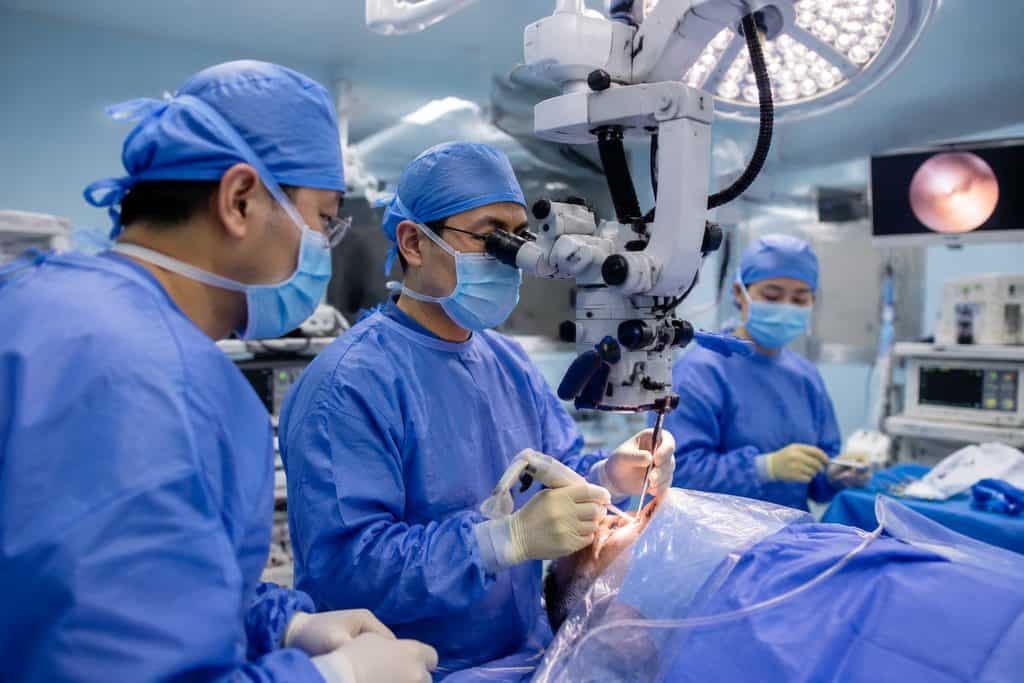
If you are researching how is pituitary tumor removed in China, the answer is almost always the same as in the West: endoscopic transsphenoidal surgery. No scalp incision. No craniotomy. The surgeon enters through the nostril, opens the sphenoid sinus, and removes the tumor using an endoscope and micro-instruments. For tumors under 3 centimeters, this is the standard of care worldwide.
The sequence in China typically runs like this. Day 1: admission and preoperative labs. Day 2: surgery. You wake up with nasal packing, which is usually removed within 48 hours. Most patients stay 5 to 7 days. Hormonal levels are checked before discharge. You fly home after your surgeon clears you, usually 10 to 14 days post-op. Follow-up MRIs happen at 3 months, 6 months, and annually. Your home endocrinologist can manage long-term hormone replacement if needed.
It is worth being direct about what Chinese public hospitals are not. They are not boutique. English is limited outside international departments. Billing requires prepayment. Family members share wards. If you want Western-style amenities, private international hospitals like United Family or Jiahui offer them — at 1.5 to 2 times the public hospital price, which is still far below US rates.
Evaluating Where to Have Surgery: A Cost and Capability Comparison
This is the section most readers search for. Here are the real numbers, acknowledging that every case varies by hospital and case complexity.
| Factor | United States | China (Top Public Hospital) | China (Private International) |
|---|---|---|---|
| Transsphenoidal surgery cost | $50,000–$120,000 | $15,000–$30,000 | $35,000–$60,000 |
| Wait time to surgery | 3–6 months (public/insured) | 1–4 weeks after evaluation | 1–2 weeks |
| Annual surgeon case volume | 10–50 | 150–300 | 50–100 |
| English-speaking staff | Yes | Limited (use international dept.) | Yes |
| Insurance direct billing | Yes | Rare (reimbursement model) | Common (JCI hospitals) |
These figures come from published hospital price lists, patient-reported data, and publicly available international department quotes. Always confirm current pricing with the specific hospital before making decisions.
Who Should Not Travel to China for Pituitary Surgery
This matters as much as who should. Can I travel to China for brain tumor surgery is a question with a conditional answer. If your tumor has caused acute visual deterioration, pituitary apoplexy, or a threatened airway from acromegaly, you need surgery now — not after a 12-hour flight. Emergency cases belong at the nearest capable hospital. If you have unstable cardiac or pulmonary disease, long-haul travel carries real risk. If you require complex skull-base reconstruction or prior radiation has distorted your anatomy, a local multidisciplinary team may serve you better. And if the thought of navigating a foreign healthcare system without fluent English support causes more anxiety than the tumor itself, the stress may not be worth the savings.
For stable patients with a confirmed adenoma, documented hormonal profile, and time to plan, China becomes a rational option. The key phrase is stable. Pituitary surgery is rarely an emergency. Most adenomas grow slowly. You have time to gather records, consult remotely, and make a measured decision.
Best Neurosurgeon for Pituitary Adenoma Shanghai: How to Find the Right Team
Searching for the best neurosurgeon for pituitary adenoma Shanghai leads most patients to a short list of institutions. Shanghai is home to several hospitals whose neurosurgery departments rank among China’s top 10 in the Fudan specialty reputation rankings. Huashan Hospital, affiliated with Fudan University, is widely considered the reference center for pituitary disease in eastern China. Its neurosurgery department runs a dedicated pituitary tumor program with integrated endocrinology and neuro-ophthalmology. Ruijin Hospital, also in Shanghai, has particular strength in neuroendocrine disorders including Cushing’s disease and acromegaly.
Beijing offers comparable options. If you are looking for a JCI accredited neurosurgery hospital Beijing, Peking Union Medical College Hospital (PUMCH) and Beijing Tiantan Hospital are the names that surface repeatedly. Tiantan performs among the highest volumes of neurosurgical procedures in the world. PUMCH brings a multidisciplinary tradition that dates back a century and is particularly strong in complex endocrine cases. Both operate international departments that accept foreign patients and provide some English coordination.
Choosing a surgeon is less about finding a single “best” name and more about matching your tumor type to a department’s specific strengths. A prolactinoma requiring medical management needs a strong endocrinology team. A large macroadenoma with cavernous sinus invasion needs a surgeon comfortable with extended endoscopic approaches. Ask about annual case volume for your specific tumor type. Ask about their CSF leak rate. Ask how many of their patients achieve hormonal remission. Good teams answer these questions directly.
Practical Considerations: Documentation, Visas, and Payment for Surgery in China
At a top public hospital’s international department, expect $15,000 to $30,000 for an uncomplicated transsphenoidal resection. Private international hospitals charge $35,000 to $60,000. Both figures include the surgical fee, hospital stay, anesthesia, and basic imaging. They exclude flights, visa fees, accommodation, and any post-discharge complications. Always request a written quote before traveling.
This is the fear that keeps people up at night. The honest answer: complications happen everywhere, and you are farther from home when they do. Top Chinese neurosurgery centers have complication rates comparable to international benchmarks. They also have neuro-ICU capabilities, endocrinology backup, and experience managing the exact complications that arise from pituitary surgery. What they may lack is seamless communication with your home physicians. Bring translated records, designate a family contact, and understand your insurance coverage before you go. Most patients do fine. But go in with eyes open.
Not through the standard public hospital route. Chinese public hospitals require an in-person consultation before scheduling surgery — you cannot lock a date from abroad. What you can do is arrange a remote video consultation with the neurosurgery team, send your records for review, and receive a provisional treatment plan. Once you arrive and the surgeon confirms the plan, surgery is scheduled quickly. Some international departments offer coordination packages that bundle the consultation, admission support, and bilingual assistance. These are coordination services, not guarantees of a specific surgeon or date.
Yes, and this is essential. Pituitary surgery requires lifelong hormonal surveillance. Your Chinese surgical team will provide a detailed discharge summary, pathology report, and hormonal baseline. Bring these to your home endocrinologist. Most Western endocrinologists are comfortable managing post-transsphenoidal patients regardless of where the surgery occurred. Coordinate before you travel so your home team knows your plan.
Your Next Step
Deciding whether to fix your pituitary tumor starts with understanding what you actually have. Get the MRI, the hormonal panel, the visual fields. Then get a second opinion if anything is unclear. If surgery is indicated and cost or wait times at home are barriers, China’s top neurosurgery centers offer a credible alternative at a fraction of the price. Our team at China Medical Services helps international patients navigate this process — from remote consultations to visa guidance to bilingual accompaniment. We are not a hospital and we do not provide diagnoses. We connect you with the right specialists and help you move through the system without getting lost. When you are ready, request a free consultation and we will help you understand your options.
You do not have to live with uncertainty. And you do not have to choose between good care and financial survival. Understand your tumor. Weigh your options honestly. Then act.
Frequently Asked Questions
Yes. The hospitals used for international patients are JCI-accredited and follow the same international safety standards as top hospitals in the US and Europe. Surgical teams perform high volumes of procedures — often more than their Western counterparts — which studies show leads to better outcomes.
Costs vary by procedure and hospital, but international patients typically save 40-80% compared to US prices — even when factoring in travel and accommodation. A consultation with our team will give you an exact, all-inclusive quote with no hidden fees.
Send us your existing medical reports to get started. We handle everything from hospital selection and appointment scheduling to visa assistance and post-operative recovery planning. Your medical records are reviewed by the specialist before you even book a flight.
For more medical information and treatment options in China, visit chinamedservices.com (China Medical Services).
