Vietnamese Patient Service to China: Your Hanoi & HCMC Treatment Journey Support
Key Takeaways
- Over 14,000 international patients seek care in Shanghai alone each year, with a growing number traveling from Vietnam for oncology and cardiovascular procedures.
- A cardiac bypass in a top Chinese public hospital costs between $12,000 and $20,000 — a fraction of the $120,000+ price tag common in the United States or Singapore.
- Public hospital registration happens on the day of the appointment. You cannot book a specialist from overseas unless you go through the official international medical center channel.
- The S2 visa is the only correct category for medical treatment. Applying with the wrong paperwork means an automatic rejection at the Chinese consulate in Hanoi or HCMC.
The Problem: When Local Options Feel Limited
Vietnam’s healthcare system has made real strides. Major public hospitals in Hanoi and Ho Chi Minh City handle complex cases every day. But for certain conditions — aggressive cancers, congenital cardiac defects, complex spinal deformities — patients and their families often start looking beyond the border. They search for second opinions. They search for clinical trials. They search for surgical volumes that simply do not exist in smaller populations.
That search usually leads to three destinations: Singapore, South Korea, or Thailand. The problem is the math. A comprehensive cancer treatment protocol at a private Singapore hospital can easily exceed $100,000. Many Vietnamese families liquidate assets to fund this. Others delay care while they raise money. Delay changes the clinical picture. Delay makes a treatable condition harder to treat.
There is another option. It is closer geographically than you might think. It costs significantly less. And it is backed by surgical volumes that rank among the highest in the world.
Who We Are
We are not a hospital. We do not employ doctors, we do not prescribe treatments, and we do not make clinical recommendations. What we do is build a bridge. Our team handles the logistics that make cross-border treatment feel overwhelming — hospital selection based on Fudan University’s specialty rankings, appointment coordination through official international medical channels, bilingual medical companions who stand beside you during every consultation, and visa documentation support. Think of us as your advance team on the ground in China, solving the practical problems so your family can focus on one thing: getting better.
Why a Medical Tourism Package from Vietnam to China Makes Clinical and Financial Sense
Surgical Volume That Changes the Odds
There is a straightforward relationship between how often a surgical team performs a procedure and how good they are at it. This is not controversial. Studies in The Lancet and JAMA Surgery have repeatedly linked high-volume centers to lower complication rates, shorter hospital stays, and better long-term survival for complex procedures.
China’s top hospitals operate at a scale that is hard to visualize until you see it. Fuwai Hospital in Beijing performs over 14,000 cardiac surgeries annually — the highest volume of any cardiac center on the planet. A single orthopedic department at a major teaching hospital might complete more joint replacements in a month than a typical Western hospital does in a year. For a Vietnamese patient facing a rare or technically demanding procedure, that volume matters. It means the surgical team has seen your exact presentation before. Many times.
Technology Deployed at Scale
Walk into the international medical center at Zhongshan Hospital in Shanghai or Peking Union Medical College Hospital in Beijing and you will find equipment that matches any academic medical center in Boston or Berlin. Robotic surgical systems. Proton therapy centers. Intraoperative MRI suites. The difference is utilization. These machines run constantly. The clinical teams using them accumulate experience rapidly.
For Vietnamese patients, this means access to technologies that may still be building case volumes in the region. It means a radiation oncology plan designed on equipment that has treated thousands of patients with your exact tumor profile.
The Cost Reality: Structural Advantages, Not Corner-Cutting
Let us address the obvious question directly. How can a top-ranked Chinese hospital deliver outcomes comparable to Western centers at one-fifth to one-tenth the price?
The answer is structural. China’s hospital system operates on a high-volume, lower-margin model. Labor costs for support staff, nursing, and hospital administration are lower than in the US or Singapore — not because quality is lower, but because the broader economy functions differently. Hospital construction costs are lower. Pharmaceutical pricing within China’s public hospital system is negotiated aggressively. None of this touches clinical quality. It touches overhead.
Here is what that looks like for a Vietnamese patient considering a medical tourism package from Vietnam to China:
| Procedure | Estimated Cost in China (USD) | Comparative Cost (US/Singapore) |
|---|---|---|
| Cardiac Bypass Surgery | $12,000 – $20,000 | $120,000+ (US) |
| Total Knee Replacement | $8,000 – $15,000 | $35,000 – $70,000 (US) |
| Cancer Treatment (6-month protocol) | $15,000 – $30,000 | $80,000 – $150,000 (Singapore) |
| Liver Transplant | $40,000 – $70,000 | $300,000+ (US) |
All figures are estimates. Final costs vary by hospital, case complexity, and length of stay. These ranges reflect public hospital international department pricing.
What You Need to Know Before Going Alone
We have seen Vietnamese families try to arrange this themselves. Some succeed. Many hit walls they did not anticipate. Here are the barriers that derail independent attempts — and why knowing them in advance changes everything.
- Visa Requirements Are Specific and Unforgiving: The China visa medical treatment from Ho Chi Minh City or Hanoi requires an S2 visa. Not an L tourist visa. Not an M business visa. The S2 specifically covers short-term private visits for medical treatment. Your application must include an official invitation letter from the Chinese hospital confirming your admission or appointment. Without this document, the consulate will not process the visa. Obtaining that invitation letter from overseas, without a coordinator on the ground, is where most independent attempts stall.
- Registration Happens Day-Of, Not in Advance: China’s public hospital system does not allow overseas patients to book a specialist appointment weeks ahead through a website or phone call. You show up. You register at 6:00 AM. You wait. For a patient flying in from Hanoi, that means arriving in a foreign city without a confirmed appointment. The international medical center channel — which we access on your behalf — operates differently. But the standard public registration system does not budge.
- Language Barriers Are Absolute: China’s top hospitals treat enormous volumes of local patients. English-speaking staff exist in international departments but are rare in standard wards, imaging centers, and pharmacy counters. A Vietnamese patient who speaks neither Mandarin nor English faces a near-total communication barrier. Medical translation is not just about vocabulary — it is about understanding lab values, surgical consent forms, and discharge instructions with zero margin for error.
How We Help You Navigate This
These barriers are not designed to exclude foreign patients. They exist because China’s hospital system evolved to serve a domestic population of 1.4 billion. International patients are a tiny fraction of total volume. The system was not built around your needs. That is where we come in.
When a family contacts us from Hanoi or HCMC, we start with a detailed case review. We need your medical records, diagnostic imaging, and a clear summary of what you are seeking — a second opinion, a surgical consultation, or a full treatment plan. Our team translates these documents into clinical Chinese and routes them to the appropriate international medical center. We do not choose a hospital for you. We present you with options based on Fudan University’s specialty rankings — China’s most authoritative hospital evaluation system — and explain why a particular center leads in your specific condition.
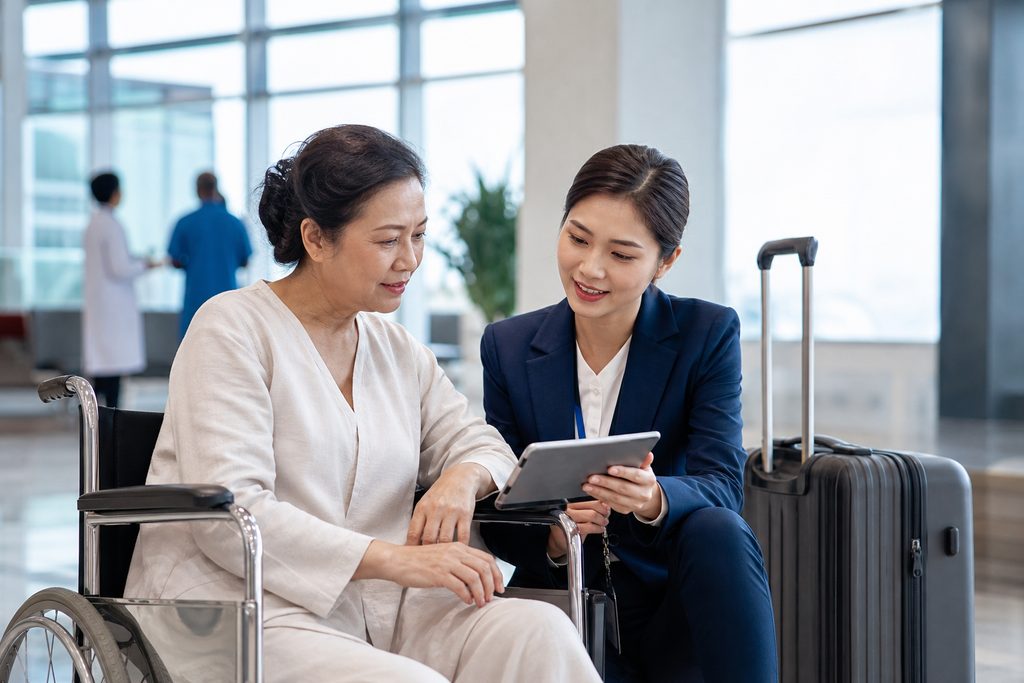
Once you select a hospital, we coordinate the official invitation letter that unlocks your S2 visa application. We book your initial consultation through the international department channel — not the public registration queue. When you land, a bilingual medical companion meets you at the airport. This person stays with you through every step: registration, vital signs, the doctor’s consultation, payment, imaging, pharmacy. They translate in real time. They explain what the doctor said in plain language. They handle the paperwork.
After your consultation or procedure, we manage discharge coordination, follow-up appointment scheduling, and medication instructions in Vietnamese or English. If your treatment requires a longer stay, we connect you with accommodation near the hospital and help with visa extensions. Our goal is simple: you should never feel alone in a Chinese hospital.
Is It Safe for Vietnamese to Get Surgery in China?
This question comes up in nearly every initial consultation. It deserves a direct answer.
China’s top-ranked hospitals — the ones we work with — operate under international accreditation standards. Many hold Joint Commission International (JCI) certification. Their infection control protocols, surgical safety checklists, and adverse event reporting systems mirror what you would find in any developed-country academic medical center. The doctors leading these departments often trained in the US, Europe, or Japan before returning to China. They publish in international journals. They attend the same conferences as their Western peers.
That said, safety is not uniform across all Chinese hospitals. There are over 35,000 hospitals in China. The top 5% — roughly 340 institutions ranked by Fudan University or holding JCI accreditation — deliver care at a globally competitive standard. Below that tier, variability increases. Our database covers only those top-tier institutions. We do not refer patients to hospitals outside this verified network.
So the honest answer to is it safe for Vietnamese to get surgery in China is: yes, at the right hospital, with the right coordination. The safety risk is not in the clinical care at a Fudan-ranked center. The risk is in attempting to navigate the system without language support, without confirmed appointments, and without someone who understands how Chinese hospital administration works.
How to Arrange Medical Travel from Hanoi to Shanghai
The logistics are simpler than most families expect — once the hospital side is confirmed.
Direct flights connect Hanoi and Ho Chi Minh City to Shanghai, Beijing, Guangzhou, and Shenzhen daily. Flight time from Hanoi to Shanghai is roughly three hours. From HCMC, about four hours. These are shorter journeys than flying to Singapore for many Vietnamese patients.
The sequence for how to arrange medical travel from Hanoi to Shanghai follows a clear path. First, we secure your hospital invitation letter. Second, you apply for the S2 visa at the Chinese Visa Application Service Center in Hanoi (on Hoang Dieu Street) or HCMC (on Nguyen Hue Boulevard). Processing typically takes four to seven business days. Third, we coordinate your appointment date based on the visa timeline. Fourth, you fly. Our companion meets you at Pudong or Hongqiao airport.
Accommodation near major Shanghai hospitals ranges from budget hotels at $30 per night to serviced apartments at $80 to $150 per night. We provide recommendations based on proximity to your specific hospital and length of stay. Many Vietnamese families choose apartments with kitchen facilities, especially for longer treatment protocols where cooking familiar food becomes important for morale.
Best Hospitals in China for Vietnamese Patients: A Specialty-Based Approach
There is no single “best hospital.” The question is: best for what? A hospital that leads in oncology may not be the right choice for orthopedics. Our recommendations follow Fudan University’s specialty rankings, which evaluate 45 clinical departments across China’s top hospitals annually.
For Vietnamese patients researching the best hospitals in China for Vietnamese patients, here is how we typically frame the discussion:
For oncology, Fudan University Shanghai Cancer Center and Peking University Cancer Hospital consistently rank among the top five nationally. For cardiac surgery, Fuwai Hospital in Beijing and Zhongshan Hospital in Shanghai are the two names that appear in every international comparison. For orthopedics, Peking University Third Hospital and Shanghai Sixth People’s Hospital lead the specialty rankings. For neurosurgery, Beijing Tiantan Hospital handles volumes that few centers globally can match.
We encourage Vietnamese families to explore our specialty department rankings to understand which hospitals lead in the specific condition they are facing. We also maintain detailed profiles of China’s top-ranked hospitals across 37 cities. The right match depends on your diagnosis, your budget, and your logistical preferences — not on a generic ranking.
Understanding the Cost of Cancer Treatment in China for Vietnamese Patients
Cancer is the diagnosis that drives the largest share of inquiries from Vietnam. Families want to know: what will this actually cost?
The cost of cancer treatment in China for Vietnamese patients depends on the cancer type, stage, treatment modality, and hospital tier. A six-month chemotherapy and targeted therapy protocol at a public hospital international department typically ranges from $15,000 to $30,000. Radiation therapy adds $5,000 to $15,000 depending on the technology used (IMRT, proton therapy, etc.). Surgical resection for a solid tumor ranges from $8,000 to $25,000 depending on complexity and whether robotic assistance is used.
These figures include hospital charges, surgeon fees, anesthesia, and standard ward stays. They do not include accommodation, flights, visas, or our coordination services. Compared to the $80,000 to $150,000 that a comparable protocol costs in Singapore, the savings are substantial — often enough to cover multiple family members’ travel and extended accommodation.
We always advise Vietnamese patients to budget for contingencies. A treatment plan that looks straightforward on paper can extend if complications arise or if the clinical team recommends additional cycles. We help families build realistic budgets — not optimistic ones.
Frequently Asked Questions
Most Vietnamese domestic health insurance policies do not provide direct coverage for treatment in China. Some international private insurance plans do offer coverage, but they typically reimburse after treatment rather than paying the hospital directly. Chinese public hospitals require upfront payment — either in cash, by UnionPay card, or via international credit card. Private international hospitals like United Family or Jiahui may offer direct billing arrangements with certain global insurers. We help patients understand their insurance position before travel and provide the documentation needed for reimbursement claims.
This happens regularly. It is not necessarily a sign that one doctor is wrong. Different medical systems develop different treatment protocols based on the patient populations they serve, the technologies available, and local clinical guidelines. When a discrepancy arises, we facilitate a structured discussion between you and the Chinese specialist. We translate the reasoning behind the recommendation. If you want a third tiebreaker opinion, we can arrange a written second opinion from another top specialist in the same field — typically within five to seven business days. No patient should proceed with a treatment plan they do not fully understand.
An S2 visa for medical treatment typically allows a stay of up to 180 days. If your treatment requires longer — for example, a complex oncology protocol spanning multiple cycles over eight or nine months — you may need to apply for an S1 visa, which covers longer-term private visits. Visa extensions can be processed within China at the local Exit-Entry Administration Bureau. We guide patients through the extension process, including the medical documentation required to justify the extended stay. Overstaying a Chinese visa carries serious penalties, so we track visa expiration dates proactively for every patient we support.
A family member who speaks conversational Mandarin can handle basic interactions — ordering food, asking for directions. Medical consultations are different. Informed consent for surgery requires understanding risks, alternatives, and post-operative protocols in precise detail. Misunderstanding a discharge instruction can lead to a preventable complication. Our bilingual medical companions are trained specifically in clinical terminology and hospital workflow. They know which window to approach for registration, which form is needed for an MRI booking, and how to escalate if a consultation is running hours behind schedule. Most Vietnamese families find that having a professional companion reduces stress dramatically — even when a Mandarin-speaking relative is present.
Your Next Step
Choosing to pursue medical treatment in another country is never a small decision. It involves trust, money, time away from work, and the emotional weight of being far from home while unwell. We understand that. Our role is to make the practical side of that decision as clear and manageable as possible — so your energy goes toward recovery, not logistics.
If you are considering a treatment journey from Vietnam to China, start with a conversation. There is no cost for an initial consultation. We will review your case, discuss which hospitals and specialists are most relevant to your diagnosis, and give you a realistic picture of timelines, costs, and what to expect on the ground. You can reach us through our patient coordination page. No pressure. No commitment. Just clarity.
For more medical information and treatment options in China, visit chinamedservices.com (China Medical Services).
