Nigerian Patient Medical Service to China: Lagos Abuja Full Treatment Coordination
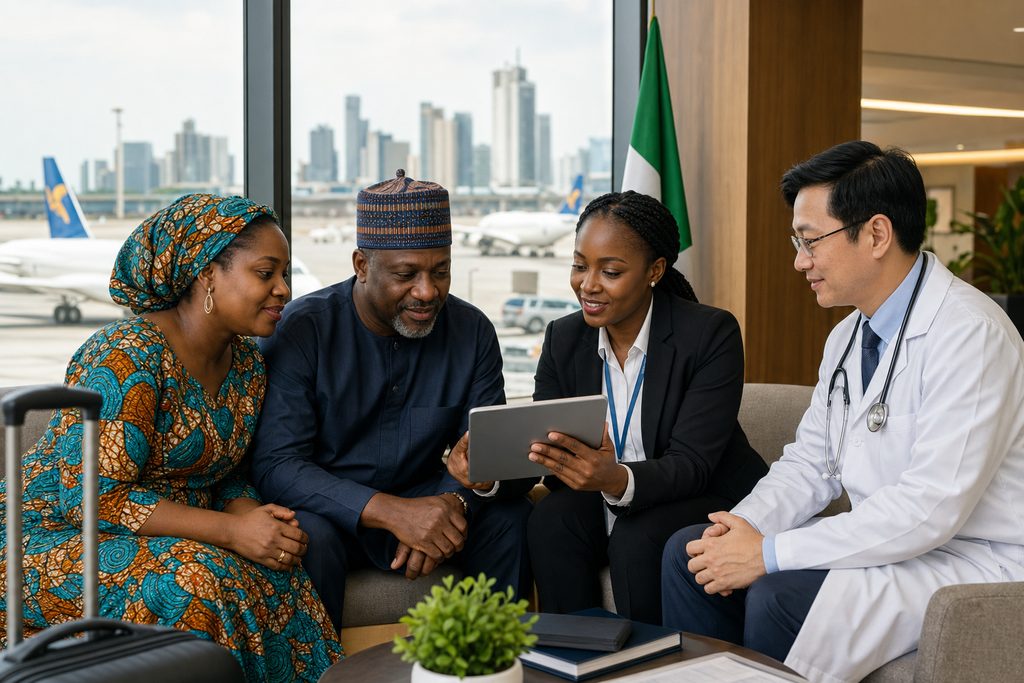
What if the distance between you and world-class surgery was not measured in miles, but in the clarity of the path to get there?
Key Takeaways
- Top-tier cardiac or orthopedic surgery in China costs 70-80% less than identical procedures in private Nigerian hospitals or medical tourism hubs like India and Turkey.
- Chinese public hospitals operate at massive scale—Fuwai Hospital alone performs over 14,000 cardiac surgeries annually—but navigating them without Mandarin fluency and local logistics support is practically impossible.
- The S2 visa is the only legal pathway for medical treatment in China; using a business (M) visa for surgery will result in denied entry or deportation.
- Every international patient must attend an in-person consultation before surgery can be scheduled. No hospital in China will lock in an operation date remotely.
The Problem: The Real Cost of Waiting for Treatment in Nigeria
Nigeria’s healthcare system carries a burden that statistics can only begin to describe. The country has approximately 0.4 physicians per 1,000 people—compared to 2.6 in the United States and 2.0 in China. For specialized surgeries, the bottleneck tightens dramatically. A patient in Lagos needing a complex cardiac procedure might wait six to twelve months in the public system, or face a bill exceeding $35,000 at a private facility. Many simply never receive treatment.
Medical tourism from Nigeria is not new. Thousands travel to India, the UAE, and Europe each year. But the financial arithmetic is punishing. A coronary artery bypass graft in India runs $15,000 to $25,000. In Turkey, $12,000 to $20,000. Add flights, accommodation, and the coordinator’s cut, and a family can burn through savings with nothing left for recovery.
So Nigerians ask a sharper question now. Is there a destination that delivers comparable clinical outcomes at a fraction of the cost? And if that destination exists, how do you actually get there from Lagos or Abuja without getting lost in a system that was never designed for you?
Who We Are
We are not a hospital. We do not provide medical treatment, clinical diagnoses, or surgical opinions. Our team functions as your logistical architects—we bridge the gap between you and China’s top-tier medical infrastructure. We handle hospital matching based on your actual diagnosis and imaging, appointment coordination through official international departments, bilingual medical companionship during every clinic visit, and the visa guidance that keeps your entry legal and stress-free. We work inside a network of 340+ top-ranked hospitals across 37 Chinese cities, all drawn from the top 5% of the country’s 35,000-plus medical institutions. Think of us as the local partner who knows exactly which door to knock on, and who speaks the language when it opens.
Why China Delivers Results for Nigerian Patients
Clinical Volume That Creates Surgical Precision
Volume is not just a number. It is the single most reliable predictor of surgical outcomes. A Chinese cardiac surgeon at a major center might perform 300 to 500 procedures annually. Compare that to a surgeon in a typical Nigerian teaching hospital, who may handle 30 to 50. The difference is not talent—it is system capacity. Fuwai Hospital in Beijing, the world’s highest-volume cardiac surgery center, completes over 14,000 operations each year. That repetition breeds speed, judgment, and an almost intuitive grasp of complications before they happen. For a Nigerian patient weighing the medical treatment cost China for Nigerians, this volume translates directly into lower mortality rates and shorter hospital stays.
Technology Infrastructure at Scale
Chinese hospitals adopted robotic surgery platforms like the da Vinci system in large numbers over the past decade. But the real story is less about any single machine and more about integration. A patient undergoing cancer staging in Shanghai can receive PET-CT, genetic sequencing, and a multidisciplinary tumor board review within 72 hours. In many systems, that same sequence takes weeks. Speed matters when disease is moving. And for international patients arriving on fixed timelines, diagnostic efficiency means the difference between starting treatment and flying home with only a report.
The Cost Equation: Quality Without Financial Ruin
Let us address the question that every Nigerian family asks first. How to arrange surgery in China from Nigeria without bankrupting the household. The structural answer is straightforward. Chinese public hospitals operate on high-volume, low-margin models. Labor costs for surgeons, nurses, and technicians are substantially lower than in North America or Europe. Pharmaceutical pricing is government-controlled. Hospital stays are shorter because efficiency is built into the reimbursement system. The result: a hip replacement that costs $40,000 in the United States and $12,000 in India might run $8,000 to $12,000 at a top Chinese orthopedic center. A cardiac bypass that exceeds $120,000 in America sits at $12,000 to $20,000 in China. These are not discount rates. They are structural realities.
| Procedure | China (USD) | India (USD) | Nigeria Private (USD) |
|---|---|---|---|
| CABG (Heart Bypass) | $12,000–20,000 | $15,000–25,000 | $25,000–40,000 |
| Hip Replacement | $8,000–12,000 | $10,000–15,000 | $15,000–22,000 |
| Knee Replacement | $7,000–11,000 | $9,000–14,000 | $14,000–20,000 |
| Liver Transplant | $50,000–80,000 | $55,000–90,000 | Not widely available |
Is China good for medical treatment for Africans? The clinical data says yes. The financial data says yes. But the operational reality—the part no spreadsheet captures—is that China’s healthcare system was built for Chinese citizens. An international patient walking into a public hospital with no Mandarin and no local guide will be overwhelmed within minutes. That is not a flaw. It is simply the truth of a system that serves 1.4 billion domestic patients first.
What You Need to Know Before Going Alone
Honesty builds trust. Here are the barriers that stop Nigerian patients who try to coordinate treatment independently.
- Visa Category Errors: The S2 visa is the only short-term medical treatment visa. It requires an invitation letter from the Chinese hospital, proof of medical necessity, and documentation of financial means. The M visa—a business visa—is frequently misused by unqualified agents who tell patients to claim they are attending meetings. Border officials in China are trained to spot this. Entry denial, deportation, and a black mark on future applications are the standard consequences.
- Payment Infrastructure Mismatch: Chinese public hospitals require upfront deposit payments, typically via UnionPay, Alipay, or WeChat Pay. Nigerian bank cards often fail on these networks. International wire transfers take days to clear. A patient who arrives without a confirmed payment pathway may be admitted but unable to start treatment.
- The In-Person Consultation Rule: No reputable Chinese hospital will schedule surgery remotely. The patient must attend an in-person outpatient consultation, undergo any required additional imaging, and receive a surgical recommendation from the attending specialist. This means planning for a minimum of one to two weeks in China before a surgery date is even set.
- Language Barrier Depth: Even at international departments, Mandarin dominates clinical workflows. Informed consent forms, surgical schedules, pharmacy instructions, and discharge summaries are in Chinese. A bilingual medical companion is not a luxury. It is a safety requirement.
How We Help You Navigate This
These barriers exist for structural reasons. They are not impossible to overcome—but they require local knowledge that no amount of internet research can replace.
Our process begins with your medical records. You send us your diagnostic reports, imaging files, and a summary of what you need. We translate these into clinical Chinese and submit them to the international departments of hospitals that match your condition. We do not choose hospitals randomly. We reference the Fudan University hospital rankings, which classify the top 100 hospitals into tiered bands and publish specialty-specific reputation lists across 45 clinical departments. If your case involves oncology, we look at hospitals ranked among China’s top 10 for cancer care. If it is orthopedics, we consult the orthopedic reputation rankings. This is evidence-based matching, not guesswork.
Once a hospital accepts your case for consultation, we handle the invitation letter for your S2 visa application through the Nigerian embassy or consulate. We coordinate your arrival, provide round-trip airport transfers from $200, and assign a bilingual medical companion who stays with you through every outpatient visit, every diagnostic test, and every payment counter. Our companions handle registration, queue management, fee payment, and real-time interpretation between you and your doctors. For patients seeking a full medical tourism package China Lagos Abuja, we extend this coordination to accommodation near the hospital, local transportation, and post-discharge follow-up scheduling.
What about fast-tracking? The phrase book surgery in China from Nigeria fast track requires an honest definition. We cannot skip the queue. What we can do is route you through hospital international departments and VIP channels where wait times are compressed because patient volumes are lower and attending specialists allocate dedicated slots. This is not queue-jumping. It is using the correct entry point for international patients. The cost is higher—typically 1.5 to 2 times standard public rates—but the timeline shrinks from months to weeks.
Frequently Asked Questions
A realistic budget for a major procedure like cardiac bypass or joint replacement runs $18,000 to $35,000 all-in. This covers surgery, hospital stay, flights from Lagos or Abuja, a two-week hotel stay, visa fees, and bilingual companion services. The final number depends entirely on the hospital tier, procedure complexity, and length of stay. We provide a detailed cost breakdown during consultation, never a flat package price that hides assumptions.
Expect eight to twelve weeks from the moment you send us your medical records to the day you fly home after surgery. The timeline breaks down roughly as follows: two to three weeks for hospital case review and invitation letter issuance, two to four weeks for S2 visa processing at the Chinese embassy in Abuja or Lagos, one to two weeks in China for pre-operative consultation and testing, and one to two weeks for the procedure and initial recovery. Urgent cases can move faster through VIP channels.
Yes. Your accompanying family member applies for an S2 visa under the same invitation letter, clearly noted as a caregiver. They cannot work or study while in China. We assist with their visa documentation and can arrange accommodation that suits two people. Having a family member present during recovery improves outcomes and reduces stress—we encourage it.
This is rare but possible. A hospital may determine during the in-person consultation that the patient is not a surgical candidate due to newly discovered risks. In that case, we immediately pursue one of two paths: a second opinion at another hospital in our network within the same city, or a revised treatment plan that may involve non-surgical intervention. If no treatment proceeds, our coordination fees for the unconsumed portion of the service are refunded. Hospital consultation fees already paid to the facility are generally non-refundable—this is standard policy across Chinese public hospitals.
Major Chinese cities with large international patient volumes—Beijing, Shanghai, Guangzhou—have adapted significantly. Hospital international departments employ English-speaking staff. Halal food options are available in all major cities, and Guangzhou in particular has a large African community with familiar food and cultural spaces. That said, cultural adjustment is real. The pace of Chinese cities, the density of crowds, and the directness of clinical communication style can feel jarring. We prepare every Nigerian patient for these differences before departure. Knowing what to expect removes most of the friction.
Your Next Step
You came here searching for a way to access world-class surgery without destroying your family’s financial future. The path exists. It runs through a system that demands local knowledge, language fluency, and operational precision—but once those pieces are in place, the clinical outcomes and cost advantages are real and measurable.
If you are ready to explore whether a Chinese hospital can treat your specific condition, send us your medical records for a free preliminary review. We will tell you honestly which hospitals match your case, what the likely cost range looks like, and how long the process will take. No promises we cannot keep. No pressure to commit. Just clarity from a team that has walked this road before. Start with a free consultation today.
For more medical information and treatment options in China, visit chinamedservices.com (China Medical Services).
