Medical Tourism from Saudi Arabia to China: Arabic Patient Support and Top-Tier Care
Key Takeaways
- China’s top-ranked hospitals perform over 6,000 liver transplants annually, with costs typically 50-70% lower than private facilities in Western Europe and North America.
- Dedicated Arabic-speaking patient coordinators and bilingual medical companions remove the single largest barrier for Saudi patients: language.
- Public hospital outpatient clinics cannot be booked from overseas. Without local coordination, you arrive with no appointment and no guarantee of seeing a specialist.
- Visa compliance is strict. The S2 visa is the only correct category for medical treatment. Using a business visa can result in denial of care or entry.
The Problem: Escalating Wait Times and Limited Options at Home
According to the Saudi Ministry of Health’s 2023 statistical yearbook, the Kingdom performs roughly 200 liver transplants each year across its transplant centers. Demand far exceeds supply. Patients wait. Sometimes months. Sometimes longer than their condition allows. For complex oncology cases, the wait for a definitive surgical slot at a government tertiary hospital can stretch beyond what feels safe.
The reflex is often to look West. London. Houston. Munich. But that path comes with a brutal price tag. A liver transplant in the United States averages $875,000. In Germany, the bill can exceed €350,000. Even with government sponsorship or private insurance, the approval process alone can consume precious weeks. And once approved, you are still competing for a donor organ in a system with its own queue. The math does not always work. So families in Riyadh, Jeddah, and Dammam have started asking a different question.
What about the East?
Who We Are
We are not a hospital. We do not provide medical treatment, clinical diagnoses, or organ procurement services. We are your logistical architects. Our team at China Medical Services bridges the gap between you and China’s top-tier medical institutions — the top 5% of over 35,000 hospitals nationwide, ranked by the authoritative Fudan University hospital rankings and accredited by JCI. We handle hospital matching, appointment coordination through official international departments, bilingual medical companionship, visa guidance, and ground logistics. We have walked this path with patients from the Gulf region before. We know where the friction points are.
Why China Delivers Results for Saudi Patients
Clinical Volume That Reshapes Surgical Skill
Fuwai Hospital in Beijing performs over 14,000 cardiac surgeries annually — the highest volume of any heart center on the planet. A cardiac surgeon there may complete more complex bypass procedures in a single year than a competent surgeon in a mid-sized European capital performs in a decade. Volume does not guarantee outcomes. But the correlation is well-documented. A 2013 study in the New England Journal of Medicine found that for major surgical procedures, each doubling of hospital volume was associated with a roughly 7% reduction in operative mortality. Chinese top-tier hospitals operate at a scale that generates this effect naturally.
For Saudi patients considering a liver transplant, the numbers matter. Renji Hospital in Shanghai, affiliated with Shanghai Jiao Tong University School of Medicine, has one of the world’s largest living-donor liver transplant programs. Its surgeons perform over 800 liver transplants each year. That is more than four times the total annual volume across all Saudi centers combined. When a team does something 800 times a year, the unpredictable becomes routine. The rare complication becomes something the attending physician saw last Tuesday and knows exactly how to manage.
Technology Deployed at Scale
China’s top hospitals do not just buy advanced equipment. They use it at a cadence that forces efficiency. Da Vinci surgical robots, proton therapy centers, and intraoperative MRI suites are integrated into workflows that handle patient volumes Western hospitals would find unmanageable. The result is not just clinical proficiency. It is operational speed. A diagnostic workup that takes three weeks in a fragmented outpatient system can be compressed into three days when imaging, lab, and specialist consultations are co-located under one roof.
This matters for international patients. You are traveling thousands of kilometers. Every day in-country costs money. Efficiency is not a luxury. It is the difference between a ten-day stay and a three-week stay.
Cost Structure: The Numbers Behind the Savings
The obvious question surfaces immediately. If the quality is high, why is the cost so much lower? The answer is structural, not mysterious. Chinese hospital systems operate on a high-volume, lower-margin model. Physician salaries, while rising, remain a fraction of US or Gulf compensation levels. Hospital construction costs per square meter are lower. Malpractice insurance premiums are negligible by American standards. These savings flow through to the patient invoice.
For a liver transplant, the all-inclusive cost at a top-ranked Chinese public hospital international department — including surgery, hospital stay, and standard post-operative care — typically ranges from $80,000 to $150,000. That is roughly 15-20% of the US price. Cardiac bypass surgery runs $12,000 to $20,000. A complex spinal fusion with instrumentation may cost $25,000 to $45,000. These are not discounted rates for substandard care. These are the same surgeons, the same operating theaters, and the same implant hardware used for domestic VIP patients.
| Procedure | China (Top Public Hospital) | USA (Average) | Saudi Private Sector |
|---|---|---|---|
| Liver Transplant | $80,000 – $150,000 | $875,000 | Not widely available |
| Cardiac Bypass (CABG) | $12,000 – $20,000 | $120,000+ | $45,000 – $65,000 |
| Knee Replacement | $10,000 – $18,000 | $35,000 – $50,000 | $20,000 – $30,000 |
| Spinal Fusion (Lumbar) | $25,000 – $45,000 | $110,000+ | $50,000 – $70,000 |
Prices vary by hospital and case complexity. These are estimates based on international department pricing for self-pay patients.
What You Need to Know Before Going Alone
We tell every prospective patient the same thing: the medicine in China’s top hospitals is world-class. The administrative reality on the ground is unforgiving. If you book a flight to Shanghai or Beijing without a local coordinator, you will land with a plane ticket and a problem. Here is what that problem looks like.
- Visa Requirements Are Non-Negotiable: Medical treatment in China requires an S2 visa with a specific annotation for medical purposes. The consulate will want an invitation letter from the Chinese hospital. Most public hospitals will not issue this letter until you have a confirmed appointment. And you cannot get a confirmed appointment without being physically present — or having someone present on your behalf. This is the circular dependency that strands patients before they even leave Saudi Arabia. The M visa, which is for commercial and trade activities, is not valid for medical treatment. Using it for healthcare can result in denied care or entry complications.
- Public Hospital Outpatient Clinics Do Not Accept Overseas Reservations: This is the single most important operational fact to understand. In China’s public hospital system, the standard outpatient clinic operates on a same-day registration model. Patients queue. They take a number. They see a doctor. You cannot email the hospital from Riyadh, reserve a slot with a specific specialist, and show up at 10 AM on a Tuesday. The system is not designed for that. The international department or VIP clinic is the only channel that allows pre-arranged appointments with senior specialists. That channel costs more — typically 1.5 to 2 times the standard rate — but it is the only viable path for an international patient who needs certainty.
- Payment Is Upfront: Chinese public hospitals, including their international departments, require a deposit before admission. Insurance reimbursement happens after discharge. The hospital will provide a detailed invoice and medical records suitable for insurance claims, but they will not bill your insurer directly. Private international hospitals like United Family or Jiahui operate differently — many have direct billing arrangements with major insurers. Know which model you are walking into before you commit.
How We Help You Navigate This
These barriers exist for structural reasons. They are not designed to exclude international patients. They are simply the byproduct of a healthcare system built to serve 1.4 billion domestic patients first. Our job is to create a parallel pathway that respects the system’s rules while getting you where you need to go.
It starts with your medical records. We translate them into clinical Chinese — not just language translation, but formatting them to match what a Chinese specialist expects to see. Imaging files in DICOM format. Pathology slides digitized. Lab values with reference ranges. A complete case summary that a department head can review in ten minutes and form a preliminary opinion. We submit this package through the official international patient channel at hospitals that match your condition. For oncology cases, we consult our database of specialty department rankings based on the Fudan University reputation survey — 45 specialties, each with a ranked top 10. We do not guess. We match.
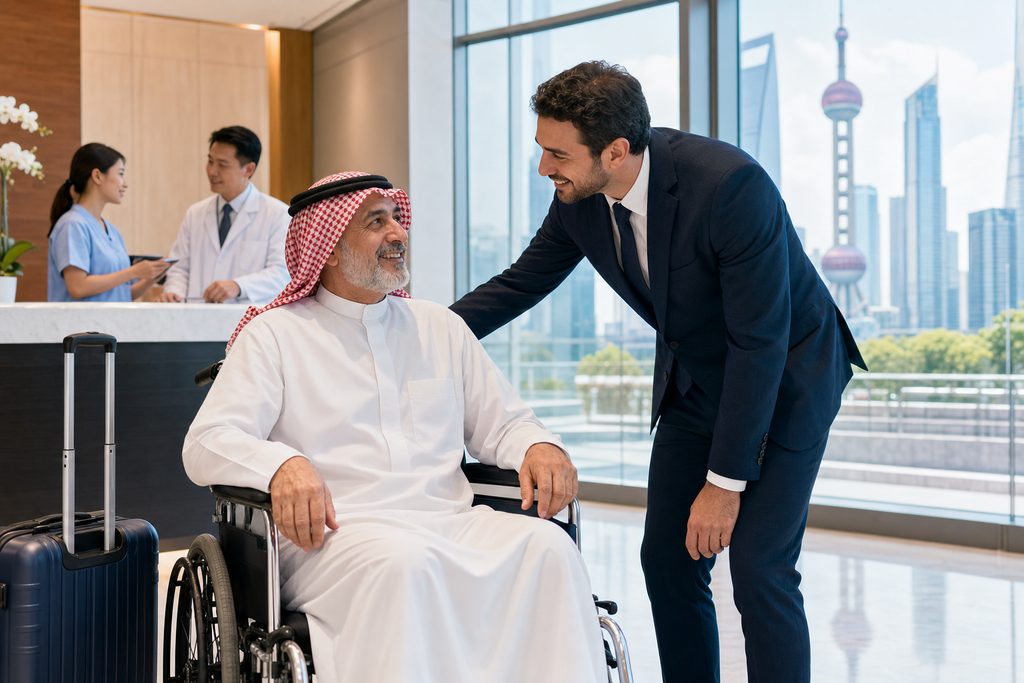
Once a hospital accepts your case and issues an invitation letter, we guide you through the S2 visa application at the Chinese consulate in Saudi Arabia. We coordinate your arrival. A bilingual medical companion — often an Arabic-English-Chinese speaker or a team of two covering the language pair — meets you at the airport, accompanies you to every consultation, handles registration and payment queues, interprets clinical conversations in real time, and ensures you understand every step before you consent to it. This is not a luxury. When a surgeon is explaining the risk of biliary complications after a liver transplant, you need to understand every word.
After discharge, we coordinate follow-up appointments, medication instructions translated into Arabic, and a recovery accommodation plan if you need to stay in China for monitoring before flying home. Our coordination fee for hospital appointment arrangements starts from $300. Bilingual medical companionship starts from $200 per day. These are logistical service fees. They are separate from hospital charges and are always quoted transparently before you commit.
For patients exploring their options before traveling, we facilitate remote video consultations with specialists at top-ranked hospitals. A written second opinion from a senior oncologist at Fudan University Shanghai Cancer Center, for example, costs $300 to $500. A live video consultation with a department head may range from $500 to $800. If you later decide to come to China for treatment, every dollar spent on these consultations is credited in full toward our on-the-ground coordination service within 90 days.
Frequently Asked Questions
Kidney transplantation for foreign nationals in China is legally restricted. China’s organ transplant system operates under strict regulations that prioritize Chinese citizens on the national waiting list. Living-donor transplantation is permitted only between immediate family members, and the relationship must be legally documented and verified. We can help you explore whether your case meets the criteria, but we are transparent from the outset: kidney transplant options for non-Chinese patients are extremely limited. Liver transplantation, by contrast, has a more established pathway for international patients at specific centers, particularly for living-donor procedures.
The safety of cardiac surgery in China’s top centers is comparable to international benchmarks. Fuwai Hospital’s 30-day mortality rate for isolated coronary artery bypass grafting was 0.6% in its most recent published data — a figure that stands against any cardiac center globally. The question behind your question, though, is really about communication. Surgery is not just about the hours in the operating room. It is about the pre-operative consent process, the post-operative instructions, the moment when a nurse needs to ask if your pain is at a 3 or a 7. Arabic-speaking medical staff are rare in Chinese hospitals. This is precisely why a bilingual medical companion is not optional. Our Arabic-English-Chinese coordinators ensure that language never becomes a clinical risk factor. They are present at every critical conversation. They translate discharge instructions into Arabic. They remain reachable during your recovery.
We do not sell standardized “packages” in the way a travel agency bundles a flight and hotel. Medical care is not a commodity. A knee replacement for a 45-year-old diabetic with a BMI of 38 is a different clinical proposition than the same procedure for a healthy 60-year-old. We build a personalized care coordination plan around your specific diagnosis, the hospital and specialist best suited to treat it, and your logistical needs. That plan always includes Arabic-capable language support — either through a single trilingual companion or a coordinated team. The cost depends on the complexity and duration of your stay. We provide a detailed quote only after reviewing your medical records and confirming the hospital’s requirements. There is no charge for the initial consultation.
Shanghai is home to several institutions ranked among China’s top 10 for oncology by the Fudan University hospital reputation survey. Fudan University Shanghai Cancer Center is consistently ranked at or near the top for multiple cancer subtypes, including breast, liver, and gastric cancers. Its proton therapy center is one of the few in Asia capable of delivering highly targeted radiation for complex head and neck tumors. Zhongshan Hospital, also affiliated with Fudan University, has a powerful liver cancer program built on China’s unfortunately high hepatocellular carcinoma caseload — a direct result of historical hepatitis B prevalence. Its surgeons manage cases that would be considered inoperable in many Western centers. For international patients, both hospitals operate international departments with English-speaking administrative staff. Arabic interpretation requires a third-party companion, which we provide. You can explore more about these centers on our Shanghai hospital guide.
The speed depends on two variables: how quickly the hospital reviews and accepts your case, and the surgeon’s schedule. A typical timeline looks like this. We submit your translated records within 72 hours of receiving them. The hospital’s international department typically responds within 3 to 5 business days with a preliminary acceptance and a proposed consultation date. Once you arrive in China for that consultation, the surgeon will confirm the surgical plan. Surgery can often be scheduled within 1 to 2 weeks after the consultation, depending on the surgeon’s operating room allocation. The total timeline from first contact to surgery is often 3 to 5 weeks. This is not a “fast track” in the sense of cutting a queue. It is the normal operating cadence of a high-volume surgical department. The bottleneck is usually the visa and travel logistics, not the hospital’s surgical calendar.
Your Next Step
You came here with a specific question — probably about cost, or safety, or whether the logistics are even possible for someone traveling from the Kingdom. The answer to all three is yes, with conditions. The cost is substantially lower than Western alternatives. The safety at top-ranked centers is real and measurable. The logistics are navigable, but not alone. The gap between a successful medical journey and a frustrating one is almost always local coordination. That is what we do.
If you want to understand whether a specific hospital and specialist can take your case, start with a conversation. There is no charge for the initial consultation. We will review your situation honestly and tell you what is possible. Contact our patient coordination team when you are ready to explore your options.
For more medical information and treatment options in China, visit chinamedservices.com (China Medical Services).
