Inpatient Companion vs Outpatient Companion: Costs, Roles, and How to Choose
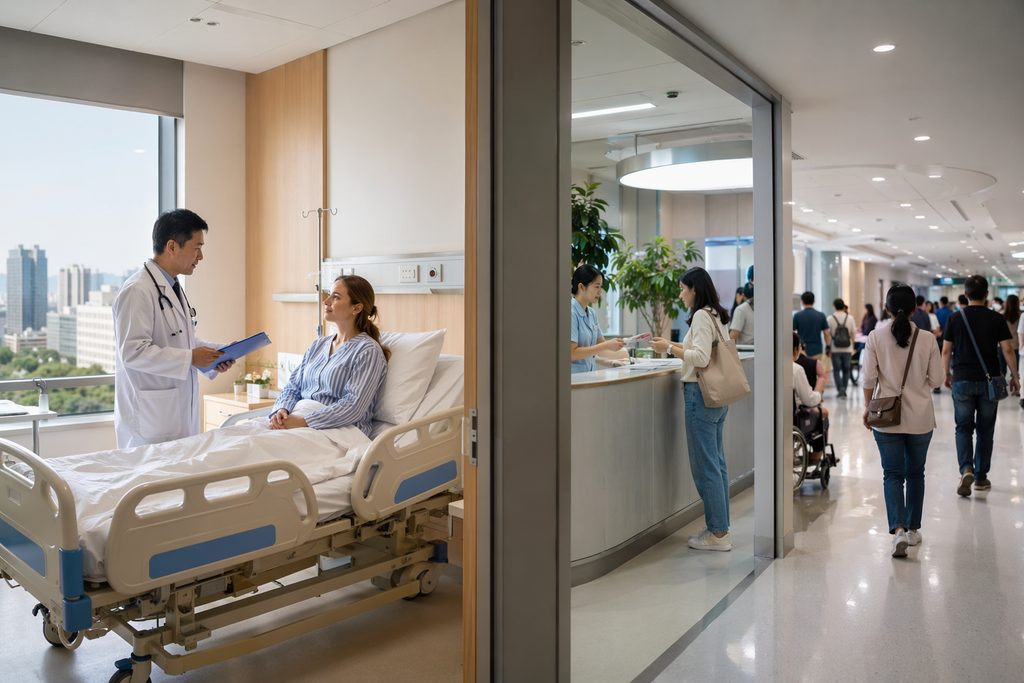
Inpatient Companion vs Outpatient Companion: What International Patients Actually Need in Chinese Hospitals
Key Takeaways
- Outpatient companions handle logistics for clinic visits — registration, queueing, payment, translation — typically from $300 per day in major Chinese cities.
- Inpatient companions provide bedside support during hospitalization, including communication with nursing staff, meal coordination, and family updates; costs vary significantly by hospital tier and required hours.
- China’s top hospitals see 10,000+ outpatient visits daily at major centers like Peking Union Medical College Hospital, making unassisted navigation nearly impossible without Mandarin fluency.
- Neither companion type is a substitute for medical care — they facilitate access and communication, while all clinical decisions remain with licensed hospital staff.
While a patient in Germany might wait 3-4 weeks to see a cardiologist, a foreign patient arriving at Fuwai Hospital in Beijing — which performs over 14,000 cardiac surgeries annually — faces a different challenge entirely: navigating a hospital campus larger than many European towns, with signage almost exclusively in Chinese and registration windows processing hundreds of patients per hour. The inpatient companion service cost China varies based on whether you need someone beside you during a 3-hour clinic visit or someone at your bedside throughout a 5-day post-surgical stay. These are fundamentally different services, and confusing them leads to wasted money and avoidable stress.
This guide breaks down exactly what each companion type does, what you should expect to pay, and how to decide which one — if either — matches your situation.
The Problem: Chinese Hospital Logistics Were Not Built for Foreign Patients
China’s public hospital system serves 8.9 billion outpatient visits annually, according to the National Health Commission. The top-tier facilities — the 340+ hospitals in our database — are concentrated in just 37 cities, and the best-known centers routinely handle over 20,000 outpatient visits per day. At West China Hospital in Chengdu, one of the largest single-campus hospitals globally, the outpatient building alone spans multiple interconnected towers.
What does this mean for an English-speaking patient? Registration windows operate on a same-day queue system. Most public hospital departments cannot be pre-booked from overseas. Payment requires a hospital-issued medical card, which itself must be created at a specific counter with your passport. Lab results print from self-service kiosks with Chinese-only interfaces. Pharmacy pickup requires scanning a barcode at yet another window. None of this is impossible to manage alone. But each step costs time — often 30-60 minutes per queue — and mistakes cascade: wrong queue, wrong floor, wrong document, start over.
An outpatient companion exists to remove that friction. An inpatient companion addresses a different problem: what happens after you are admitted to a ward.
What Is an Inpatient Companion in Chinese Hospitals?
In China, the term “companion” (陪护) has a specific cultural and practical meaning that differs from Western concepts of private nursing or patient advocacy. Chinese hospitals traditionally expect family members to handle non-clinical bedside care — bringing meals, helping with mobility, communicating with nurses about comfort issues, managing personal hygiene items. Nursing staff focus on clinical tasks: medication, wound care, monitoring, IV management.
For a foreign patient traveling without family, this gap is real. You may be in a shared ward where nurses speak limited English. You may need someone to explain what the doctor said during morning rounds, which often happen quickly and in Chinese. You may need help ordering food that matches post-operative dietary restrictions. You may simply need someone to hold your phone while you video-call your family back home.
That is what an inpatient companion does. They are not nurses. They do not administer medication or make clinical decisions. They are your communication bridge and logistical support during the hours when medical staff are occupied with dozens of other patients.
So when you research inpatient companion service cost China, you are pricing a non-clinical support role — which is why rates are substantially lower than private nursing in Western countries, but not trivial.
Outpatient Companion: The Day-Trip Navigator
An outpatient companion accompanies you for a single clinic visit or a full day of outpatient activity — consultations, imaging, lab tests, pharmacy pickup. This is the service most international patients need first, because it addresses the immediate barrier: getting from the hospital entrance to the doctor’s office without wasting hours or missing appointments.
Typical responsibilities include:
- Creating your hospital medical card using your passport
- Registering at the correct department window
- Queueing for your assigned number
- Escorting you to the correct consultation room
- Translating the doctor’s questions and instructions
- Paying deposits and fees at the correct counters
- Collecting lab results and medications
- Explaining follow-up appointment procedures
Rates for bilingual medical companions in major cities like Beijing and Shanghai typically start from $300 per day for an 8-hour shift. Half-day options (4 hours) are available at some providers. The exact figure depends on language requirements (English, Russian, Arabic, French), hospital location, and whether the companion needs specialized vocabulary for a particular department.
Inpatient Companion Service Cost China: What the Numbers Look Like
For a 5-day inpatient stay with a day-shift companion (8 hours daily), budget approximately $1,500–2,000 total. A 24-hour companion for the same period would run $2,500–3,500. These are reference figures — final pricing varies by hospital and case complexity, and some patients only need companion support for the first 2-3 days rather than the entire stay.
Can I just hire an interpreter through the hospital instead?
Some large public hospitals have international departments with English-speaking staff, and private international hospitals provide English services as standard. However, public hospital international departments typically serve only patients admitted through that channel, which costs 1.5-2 times standard rates. A companion service
Frequently Asked Questions
Yes. The hospitals used for international patients are JCI-accredited and follow the same international safety standards as top hospitals in the US and Europe. Surgical teams perform high volumes of procedures — often more than their Western counterparts — which studies show leads to better outcomes.
Costs vary by procedure and hospital, but international patients typically save 40-80% compared to US prices — even when factoring in travel and accommodation. A consultation with our team will give you an exact, all-inclusive quote with no hidden fees.
Send us your existing medical reports to get started. We handle everything from hospital selection and appointment scheduling to visa assistance and post-operative recovery planning. Your medical records are reviewed by the specialist before you even book a flight.
For more medical information and treatment options in China, visit chinamedservices.com (China Medical Services).
