Health Checkup in China: Fasting Rules and Real Preparation Costs
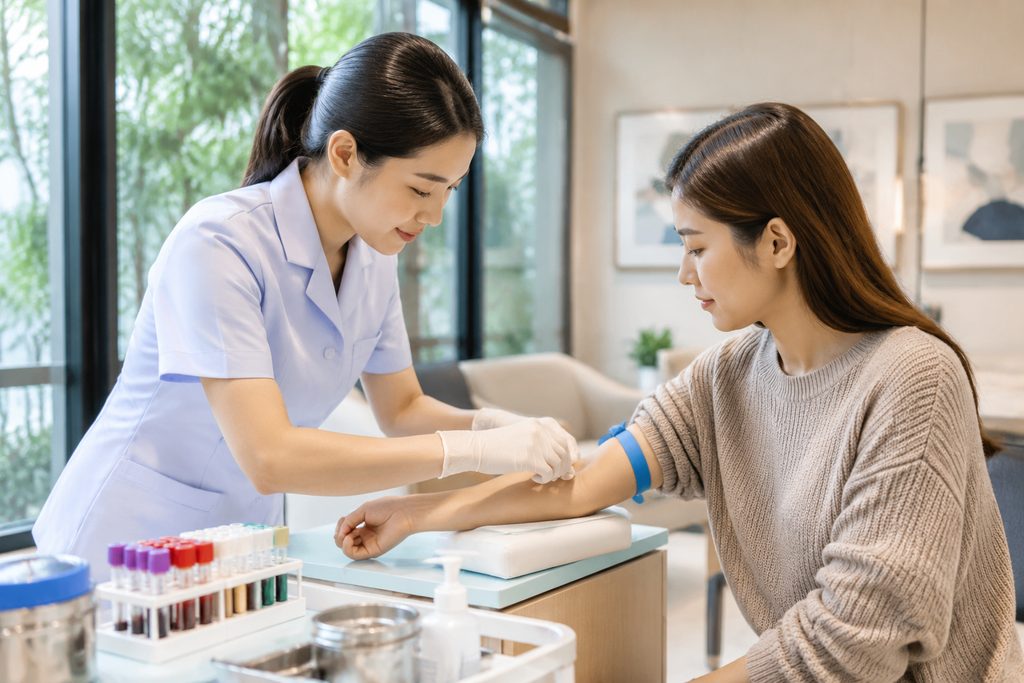
You’ve probably heard that getting a full health checkup abroad means either waiting months or paying thousands of dollars. The reality in China is different. A comprehensive executive screening at a top-tier Shanghai hospital costs between $300 and $800, while a comparable panel in the United States routinely exceeds $2,500. The catch? Preparation matters more than you think. One cup of coffee with milk at 7 a.m. can invalidate your lipid panel and force a retest.
We coordinate health screenings for international patients across China Medical Services‘ network of 340+ top-ranked hospitals. Every week, patients ask us the same questions: How long do I really need to fast? Will the results be reliable? What does a full body checkup abroad cost compared to back home? This guide answers those questions directly, with the fasting rules and preparation steps that determine whether your results are actually useful.
Key Takeaways
- A complete executive health screening in China costs $300–$800, roughly one-fifth to one-third of comparable US panels.
- Standard fasting before blood work is 8–12 hours — water is fine, coffee and gum are not.
- Top Chinese hospitals process thousands of checkup patients daily, which drives both efficiency and diagnostic volume.
- Results are reliable when you choose a hospital ranked in the Fudan Top 100 or accredited by JCI — but preparation errors remain the most common cause of invalid tests.
The Problem: Health Checkups Are Expensive, Slow, or Both
In the United States, a comprehensive executive physical with full blood panels, cardiac stress testing, and abdominal imaging costs between $2,500 and $6,000 at major medical centers. Insurance often covers only fragments of it. Scheduling can take six to eight weeks. In Canada and the UK, public systems rarely offer comprehensive preventive screenings to asymptomatic adults at all — you wait until something hurts.
That gap leaves a lot of people stuck. You feel fine, but you want baseline data. You want a cardiac calcium score, a full metabolic panel, thyroid function, tumor markers, an abdominal ultrasound. You want it done in one morning, not spread across three appointments and two months. And you don’t want to pay executive-retreat prices for it.
This is exactly the space where China’s top hospitals operate differently. They run checkup centers as high-volume, protocol-driven departments. A single facility may process 800 to 1,200 physical examination patients per day. That volume is not a quality compromise — it is the reason the infrastructure exists, the equipment is current, and the per-patient cost stays low.
Why China Delivers Reliable Health Screenings at a Fraction of the Cost
Volume Creates Diagnostic Experience
Radiologists at major Chinese hospitals read more abdominal ultrasounds and chest CTs in a month than many Western radiologists read in a year. Peking Union Medical College Hospital performs over 2 million outpatient visits annually. West China Hospital in Chengdu handles over 200,000 inpatient admissions per year. When you ask whether health screening in China is reliable, the answer depends on which hospital you choose — and the top-tier ones have diagnostic volume that is hard to match anywhere.
But volume alone is not enough. The Fudan University hospital rankings, published annually, identify China’s top 100 hospitals across 45 specialties. These are the institutions with the strongest clinical departments, the most experienced physicians, and the most rigorous internal quality controls. That is the pool we work from.
Operational Efficiency Keeps Prices Low
Chinese hospital checkup centers are built around throughput. You register at 7:30 a.m., receive a barcode wristband, and move through stations — blood draw, ECG, ultrasound, chest X-ray, physical exam — in a defined sequence. Results are compiled into a single report, often within 24 to 48 hours. The labor cost per patient is a fraction of what it is in the US or Europe, and that structural difference is why the health checkup package cost China offers stays so low.
That efficiency does not mean you are rushed. A full executive screening still takes two to four hours. What it means is that you are not paying for idle time, administrative overhead, or the defensive-medicine pricing that drives up costs in Western systems.
Cost Advantage Without Quality Compromise
Let’s be direct about the numbers. A full body checkup abroad cost comparison looks like this:
| Screening Component | China (Top Public Hospital) | United States (Academic Medical Center) | United Kingdom (Private) |
|---|---|---|---|
| Comprehensive executive panel (blood, urine, ECG, ultrasound, chest X-ray) | $300–$800 | $2,500–$6,000 | £1,800–£4,000 |
| Cardiac stress test (treadmill) | $80–$200 | $800–$1,500 | £600–£1,200 |
| Abdominal ultrasound | $40–$100 | $400–$800 | £250–£500 |
| Low-dose chest CT (lung screening) | $100–$250 | $500–$1,200 | £400–£900 |
Prices vary by hospital and case complexity. The structural reasons for the gap are straightforward: lower physician and nursing labor costs, higher patient throughput, and a system where hospitals compete on volume rather than margin. Clinical accuracy at Fudan-ranked institutions is not the weak point — navigation and language are. That is where preparation and coordination matter.
Fasting Before Your Health Checkup: The Rules That Actually Matter
How long to fast before blood test in China? The standard instruction at Chinese hospital checkup centers is 8 to 12 hours. That means no food, no coffee, no tea, no juice, no gum, and no mints after 10 p.m. the night before your appointment. Plain water is allowed and encouraged — dehydration concentrates your blood and can skew hematocrit and electrolyte readings.
Three mistakes trip up international patients more than any others. First, black coffee. It is not just the milk and sugar that affect your results — caffeine itself stimulates gastric acid and can alter glucose metabolism readings. Second, sugar-free gum. Chewing triggers digestive enzyme release, and many sugar-free gums contain sorbitol and other sugar alcohols that can affect glucose tests. Third, over-fasting. Going 16 or 18 hours without food can cause a rebound glucose spike in some people, which produces a misleading result.
If you take daily medication, the rules shift. Blood pressure medication should generally be taken as usual with a small sip of water — skipping it can cause a falsely elevated reading during your exam. Diabetes medication timing depends on the specific drug; you need to ask your prescribing doctor, not guess. Bring all medications with you in their original packaging and show them to the checkup physician.
What about alcohol? Avoid it for 48 hours before your screening. Alcohol affects liver enzymes, triglycerides, and blood pressure readings. A heavy dinner the night before — even within the fasting window — can elevate triglycerides for up to 12 hours. The night before your checkup, eat a light, low-fat dinner. No fried food, no red meat, no alcohol.
What to Expect During a Medical Checkup in China
If you have never been through a Chinese hospital checkup center, the process can feel unfamiliar — not because it is chaotic, but because it is structured differently from what you may expect. Arrive by 7:30 or 8:00 a.m. The fasting blood draw happens first, before anything else. After that, you can eat — most centers provide a simple breakfast, or you can bring your own.
What to expect during medical checkup China follows a predictable sequence. After registration, you receive a wristband or card with a barcode. Staff scan it at each station to route your results into your file. The typical order: blood draw, urine sample, height/weight/vitals, ECG, chest X-ray, abdominal ultrasound, then physician consultation. The physician reviews preliminary results, asks about your medical history, and may add or adjust tests based on what they see.
Two practical points. First, ultrasound gel is cold — this is universal, not a China-specific quirk. Second, the physician consultation at the end is your opportunity to raise concerns. Bring a list of questions. If you have prior imaging or lab results from home, bring those too — paper copies or digital files both work, but digital is easier to share.
Results timing varies. Basic blood panels are often available the same afternoon. Full reports with imaging interpretations take 24 to 72 hours. Most hospitals now provide results through a mobile app or online portal, with English translations available at international departments. If you need the results explained in detail, schedule a follow-up consultation rather than trying to interpret raw numbers yourself.
Executive Health Screening in Shanghai: What You Get for the Price
A comprehensive executive screening at a top Chinese hospital costs $300 to $800. A comparable panel at a US academic medical center runs $2,500 to $6,000. The gap reflects structural cost differences — lower labor costs and higher patient volume — not lower equipment quality or less experienced physicians at ranked hospitals.
Generally yes, especially when the testing is done at a Fudan-ranked or JCI-accredited hospital and the report is issued in English. Your home physician may want to repeat certain tests, but baseline results, imaging reports, and lab values are transferable. Bring digital copies and the original report.
You receive a written report with flagged abnormalities. The checkup physician will explain the findings during your consultation. If follow-up is needed, the hospital can arrange further testing — often the same day or within a few days. You are never obligated to pursue treatment in China; the report is yours to take home.
At international departments of major hospitals, no — English-speaking staff are available. At standard public checkup centers, some Chinese ability or a bilingual companion makes the process significantly smoother. The testing itself is protocol-driven; the language barrier shows up most in registration and the physician consultation.
Your Next Step
A health checkup in China is a practical option when you understand the fasting rules, choose the right hospital, and prepare your documentation. The cost advantage is real, and the clinical quality at top-ranked institutions is solid. We are not a hospital and do not diagnose conditions — what we do is help you select the right facility, coordinate your appointment, and make sure language and logistics do not get in the way. If you are considering a screening, start with a conversation: tell us what you need and we will help you map the options.
Frequently Asked Questions
Yes. The hospitals used for international patients are JCI-accredited and follow the same international safety standards as top hospitals in the US and Europe. Surgical teams perform high volumes of procedures — often more than their Western counterparts — which studies show leads to better outcomes.
Costs vary by procedure and hospital, but international patients typically save 40-80% compared to US prices — even when factoring in travel and accommodation. A consultation with our team will give you an exact, all-inclusive quote with no hidden fees.
Send us your existing medical reports to get started. We handle everything from hospital selection and appointment scheduling to visa assistance and post-operative recovery planning. Your medical records are reviewed by the specialist before you even book a flight.
For more medical information and treatment options in China, visit chinamedservices.com (China Medical Services).
