Limb Lengthening Surgery China: Full Distraction Osteogenesis Journey Support
Key Takeaways
- Limb lengthening surgery cost in China typically ranges from $45,000 to $85,000 — roughly one-third to one-half of what the same procedure costs in the United States or Western Europe.
- China’s top orthopedic centers perform distraction osteogenesis at volumes that dwarf most Western hospitals, which translates to refined surgical protocols and experienced rehabilitation teams.
- Navigating a foreign healthcare system alone introduces real risks — language barriers, visa complications, and fragmented aftercare can derail even a technically perfect surgery.
- Full journey support means someone handles hospital matching, visa documentation, bilingual accompaniment, and post-operative logistics so you can focus entirely on recovery.
The Problem: When Height Affects Every Room You Walk Into
Approximately 1 in 5,000 to 1 in 10,000 people are born with achondroplasia, the most common form of disproportionate short stature. Many more live with limb length discrepancies from trauma, congenital conditions, or simply a height that has eroded their confidence for decades. The psychological toll is well-documented. A 2006 study in the Journal of Clinical Endocrinology & Metabolism found that shorter stature in men was associated with significantly lower health-related quality of life scores. The solution exists. It is called distraction osteogenesis — a surgical technique where bone is intentionally cut and then gradually separated, allowing new bone to regenerate in the gap. The results can be life-changing. But the price tag in the United States often sits between $120,000 and $280,000 for bilateral femoral lengthening. That figure excludes months of physical therapy. Most insurance carriers classify the procedure as cosmetic and deny coverage. So patients face a brutal equation: live with the problem or find a way to afford a solution that costs as much as a house in some states. Many start searching abroad. That search leads here.
Who We Are
We are not a hospital. We do not perform surgery, prescribe medication, or make clinical judgments about your candidacy for any procedure. Our team of bilingual patient coordinators and logistics specialists connects international patients with China’s top-tier orthopedic hospitals. We handle the invisible work — the hospital matching, the appointment coordination, the visa guidance, the on-the-ground translation, the accommodation arrangements — so that you arrive prepared and stay focused on what matters. Think of us as your local operational partner. You bring the medical questions to your surgeon. We make sure everything else actually works.
How Does Distraction Osteogenesis Work — And Why China Delivers Results
A surgeon who performs 200 distraction osteogenesis cases annually operates with a level of pattern recognition that no textbook can teach. China’s leading orthopedic centers — particularly those in Beijing, Shanghai, and Guangzhou — manage caseloads that few Western hospitals match. The Chinese orthopedic community has published extensively on limb lengthening techniques. The Qinsihe method, developed by Professor Qin Sihe, integrates external fixation with minimally invasive approaches and has been applied in tens of thousands of cases across Asia. When you choose a hospital that runs a dedicated limb reconstruction unit, you are not getting a general orthopedist who dabbles in lengthening. You are getting a team that sees this procedure every single week. That repetition hardens protocols. Complications like pin-site infections, joint contractures, and premature consolidation still happen — no surgeon eliminates them entirely — but experienced teams catch them early and intervene fast.
Internal lengthening nails — such as the PRECICE system — have transformed the patient experience. No external frame. No pins protruding through skin. A magnetic mechanism inside the nail is activated by an external remote control, and the nail telescopes slowly, millimeter by millimeter. Chinese hospitals have adopted these systems aggressively. The PRECICE nail alone costs approximately $15,000 to $20,000 for the implant, which is a universal hardware cost regardless of geography. What changes is the surgical fee, the hospital stay, the anesthesia, and the rehabilitation support. China’s hospital infrastructure is built for throughput. That does not mean rushed care. It means efficient preoperative workups, streamlined operating room turnover, and rehabilitation wards designed for patients who stay weeks or months. Some international patient wings offer private rooms with dedicated physiotherapy spaces — a practical necessity when you cannot walk for months.
Safety depends on two variables: the hospital you select and the support structure around you. China’s top-tier orthopedic hospitals — those ranked in the Fudan University hospital rankings or holding JCI accreditation — operate at standards comparable to major Western centers. They use the same implant systems. Their surgeons train internationally. Their infection control protocols are audited. The risk profile of distraction osteogenesis is inherent to the procedure itself, not the country. Deep vein thrombosis, nerve injury, joint stiffness, and regenerate failure are documented complications everywhere from Mayo Clinic to Charité Berlin. The difference is this: if a complication arises and you do not speak Mandarin, cannot navigate the hospital system, and have no one to advocate for you, a manageable problem becomes a crisis. That is not a statement about Chinese healthcare quality. That is a statement about what happens when any foreign patient enters any foreign hospital alone. We have seen patients arrive without proper visa documentation and get turned away at the medical examination stage. We have seen patients misunderstand postoperative instructions because a translation app mangled the surgeon’s words. The surgery itself is safe when performed by a qualified team. The journey around the surgery is where things break.
Limb Lengthening Surgery Cost China vs. The World
The numbers tell a clear story. Here is what bilateral femoral lengthening with an internal nail typically costs across different markets, including implant hardware, hospital stay, surgeon fees, and anesthesia — but excluding travel, accommodation, and extended physical therapy:
| Country | Price Range (USD) | Typical Inclusions |
|---|---|---|
| United States | $120,000 – $280,000 | Implant, hospital, surgeon, basic PT |
| United Kingdom | $90,000 – $150,000 | Implant, hospital, surgeon |
| Germany | $80,000 – $140,000 | Implant, hospital, surgeon, some rehab |
| South Korea | $55,000 – $95,000 | Implant, hospital, surgeon, basic PT |
| China (top-tier hospital) | $45,000 – $85,000 | Implant, hospital, surgeon, basic PT |
These figures vary by hospital tier, implant choice, lengthening goal, and case complexity. A straightforward 5-centimeter femoral lengthening in a healthy 28-year-old costs less than a complex tibial lengthening with deformity correction in a patient with prior surgeries. The structural reasons for China’s cost advantage are not mysterious. Surgeon salaries, hospital operating costs, and ancillary staff wages are lower than in the US or Germany. That does not mean lower quality. The implant is the same PRECICE nail. The osteotomy technique is the same. The postoperative protocol is the same. You are paying less for the system around the surgery, not for corners cut inside the operating room.
What You Need to Know Before Going Alone
We want to be blunt here. Some patients arrive in China thinking they can handle everything independently. A few succeed. Most encounter friction they did not anticipate. Here are the barriers that consistently trip people up:
- Visa Requirements Are Specific and Unforgiving: Medical treatment in China requires an S2 visa with the purpose of medical care explicitly documented. You need an invitation letter from the hospital, proof of appointment, and supporting financial documentation. The S2 is not a tourist visa. Showing up on an L visa and trying to check in for surgery will get you rejected at hospital registration. Family members accompanying you also need S2 visas. The M visa is for commercial business — it has nothing to do with medical treatment. Applying with the wrong category wastes weeks and money.
- Payment Systems Do Not Work Like Home: Chinese public hospitals operate on a prepaid deposit model. You load funds onto a hospital account, and services are deducted as you go. International credit cards are not universally accepted at hospital cashiers. WeChat Pay and Alipay dominate daily transactions, and linking a foreign card to these platforms is not always straightforward. You may need a local bank account or a reliable intermediary to handle deposits, top-ups, and discharge settlements without daily stress.
- Language Barriers Compound Every Problem: A top surgeon may speak functional English. The nurse who checks your pin sites at 2 a.m. almost certainly does not. The radiology technician positioning you for a follow-up X-ray does not. The pharmacist explaining medication instructions does not. When you cannot communicate a sharp increase in pain or a strange sensation at the osteotomy site, small issues get missed. Missed issues become complications.
How We Help You Navigate This
These barriers are not signs of a broken system. They are signs of a system designed for local patients. Our job is to build the bridge. The process starts before you book a flight. You share your medical history, imaging, and goals with us. We translate and format everything for Chinese hospital standards — because a stack of English-language records dropped on a registrar’s desk does not get processed quickly. We match your case to hospitals with demonstrated expertise in distraction osteogenesis. We coordinate with the hospital’s international patient department to secure a formal invitation letter for your S2 visa application. We confirm appointment dates, surgeon availability, and estimated costs before you commit to travel.
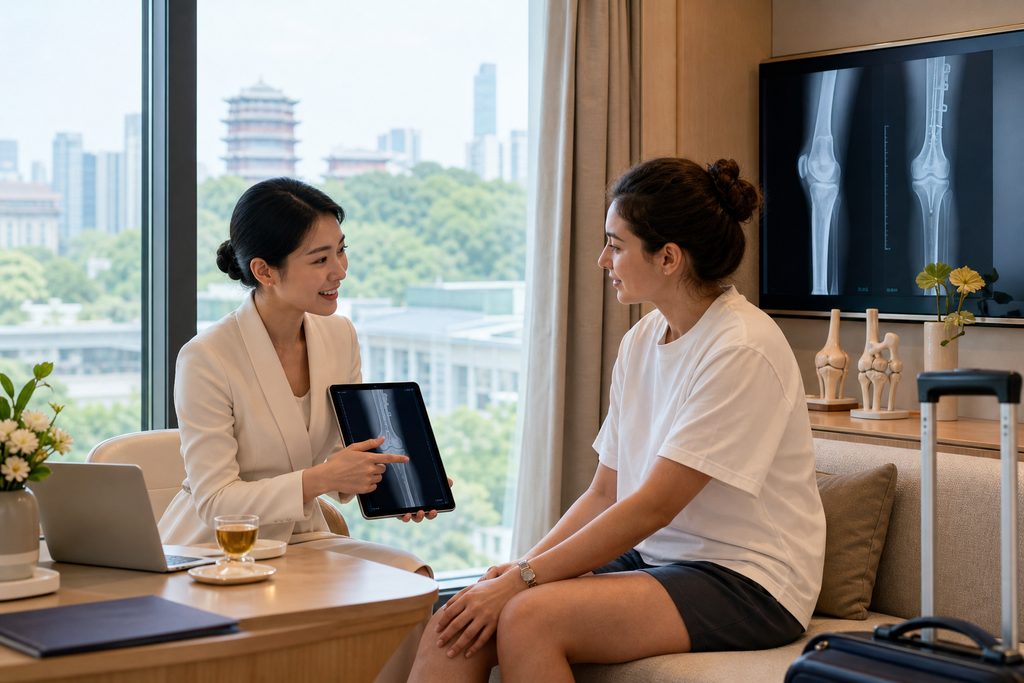
On the ground, a bilingual medical companion meets you at the airport. This person is not a translator on a screen. They are physically present — at registration, during consultations, in the preoperative briefing, outside the operating room, and at your bedside during recovery. They translate the surgeon’s postoperative instructions in real time. They handle pharmacy runs, deposit top-ups, and discharge paperwork. They know which floor has the physiotherapy unit and which cafeteria serves food you can actually eat. When the surgeon does rounds at 7 a.m. and you have a question about your consolidation progress, your companion is there to ask it in Mandarin and relay the answer in English.
After discharge, you are not abandoned. You may need to stay in China for weeks or months of physiotherapy before you are cleared to fly. We arrange extended-stay accommodations near the hospital, coordinate outpatient physio appointments, and keep the line open if something feels wrong. The goal is continuity. A distraction osteogenesis journey lasts 3 to 6 months from surgery to full weight-bearing. That is too long to white-knuckle through language barriers alone.
For patients considering the option of booking a limb lengthening surgery China package, we structure everything — hospital, accommodation, companion support, and rehabilitation coordination — into a single coherent plan. You know the timeline. You know the costs. You know who to call at every stage.
Frequently Asked Questions
Can I really save money by having limb lengthening surgery in China, or are there hidden costs?
The headline surgical fee is genuinely lower — typically $45,000 to $85,000 for bilateral femoral lengthening with an internal nail at a top-tier hospital. But you must budget for additional costs that do not appear on the hospital bill: international flights, 3 to 6 months of local accommodation, daily living expenses, extended physiotherapy, and companion services. Even with those additions, the total outlay usually lands well below US prices. We provide a transparent cost breakdown before you commit, and we flag every line item so nothing surprises you.
What happens if I develop a complication after I return home?
This is the hardest question, and it deserves a straight answer. Your operating surgeon in China will typically offer remote follow-up via video consultation to review imaging and symptoms. However, if you need surgical revision — say, for a nonunion or implant failure — you will likely need care from a local orthopedic surgeon familiar with distraction osteogenesis. Before you leave China, we help you compile a complete medical record in English, including operative notes, implant specifications, and imaging on a USB drive. This package makes it far easier for a home-country surgeon to take over your care if necessary. We recommend identifying a local orthopedist before you travel, so you have a name and a number ready. No one wants to think about complications. Planning for them is the responsible move.
How do I know which hospital is the best limb lengthening hospital in China for my specific case?
Hospital selection depends on your anatomy, your lengthening goal, and whether you need deformity correction alongside lengthening. Some centers excel at internal nail procedures. Others have deep experience with external fixation for complex reconstructions. We review your imaging and medical history, then match you to hospitals with documented expertise in cases like yours. You can explore our specialty department rankings to understand which orthopedic centers consistently appear in China’s top-tier lists. We never recommend a hospital based on a commission or partnership agreement. The recommendation flows from your clinical needs.
Is height increase surgery abroad full support worth the coordination cost?
Only you can answer whether the support fee justifies itself. What we can tell you is this: patients who attempt this journey alone report higher stress, more logistical errors, and longer recovery timelines. Patients who use full-support coordination report the opposite. The surgery itself is a biological process you cannot rush. The experience around the surgery — the paperwork, the communication, the daily friction of being a foreigner in a massive hospital system — is something you can control. That control comes from having someone in the room who speaks both languages and knows both systems.
Your Next Step
Distraction osteogenesis is a serious undertaking. It demands months of patience, daily discipline, and a tolerance for discomfort that no brochure will honestly describe. But for the right candidate — someone with a clear goal, realistic expectations, and the determination to complete the physiotherapy protocol — the outcome can reshape more than bone. If you want to understand whether a Chinese orthopedic center is the right fit for your case, start a conversation with our team. We will review your situation, explain your options, and give you a clear picture of what the journey actually looks like. No pressure. No sales script. Just the information you need to make a sound decision.
Learn more about how we support international patients at our patient coordination page, or browse China’s top-ranked hospitals to see which institutions lead in orthopedic care.
Medical disclaimer: This article is for informational purposes only and does not constitute medical advice. Limb lengthening surgery carries significant risks including infection, nerve damage, joint contracture, and nonunion. Always consult a qualified orthopedic surgeon to determine your candidacy for any surgical procedure.
For more medical information and treatment options in China, visit chinamedservices.com (China Medical Services).
