Private Villa Medical Recovery in China: Luxury Nursing Support for Post-Surgery Healing
Key Takeaways
- Private villa recovery services in China combine luxury accommodation with professional nursing support, starting from approximately $300 per day — roughly the cost of a basic hotel room in many Western cities.
- China’s top-tier hospitals discharge patients faster than Western facilities, making a well-planned recovery environment not a luxury but a practical necessity for international patients.
- Language barriers and fragmented service providers mean booking directly often fails — most villas lack medical-grade infrastructure, and most nursing agencies cannot coordinate with your surgical team.
- Vetting a recovery villa requires confirming three non-negotiables: registered nurse availability, proximity to your hospital (under 30 minutes), and a documented emergency transfer protocol.
The Problem: You Are Discharged Before You Are Ready
Let us be blunt. If you travel to China for a major surgery — a knee replacement, a spinal fusion, a cardiac procedure — your surgeon will likely discharge you within 3 to 7 days. That is the standard in Chinese top-tier hospitals. Beds turn over fast. The system is built on volume and efficiency. A study published in The Lancet in 2023 noted that average post-operative length of stay in Chinese tertiary hospitals has decreased by roughly 22% over the past decade, driven by surgical technique improvements and bed demand pressure.
So where do you go? You cannot fly home immediately. Long-haul travel within the first two weeks after major surgery carries a documented elevated risk of deep vein thrombosis. Your incision needs monitoring. Your pain management needs adjustment. You need someone who knows what a wound infection looks like at 2 a.m. A standard hotel room will not cut it. Room service does not change surgical dressings. This is the gap that private villa medical recovery services exist to fill — and it is a gap most international patients do not see coming until they are staring at discharge papers.
Who We Are
We are China Medical Services. We are not a hospital, not a clinic, and we do not provide medical treatment. What we do is simpler to explain and harder to execute: we build the logistical bridge between you and China’s 340+ top-ranked hospitals across 37 cities. That includes coordinating your post-surgical recovery environment. Our team handles the unglamorous, high-stakes details — verifying nursing credentials, confirming villa medical infrastructure, ensuring your recovery space sits within a 20-minute radius of your surgical hospital, and establishing a direct communication line between your recovery nurse and your surgeon’s department. We are case managers, not caregivers. But we make sure the caregivers you get are the right ones.
What a Private Villa Medical Recovery Service Actually Provides
The phrase “private villa recovery China price” gets searched because patients sense there is an option between a hospital ward and a five-star hotel. There is. But the term is unregulated. Some villas marketed as “medical recovery” are simply nice houses with a visiting nurse who stops by twice a week. That is not medical recovery. That is a vacation rental with a phone number.
Here is what a properly structured service includes.
The Physical Environment
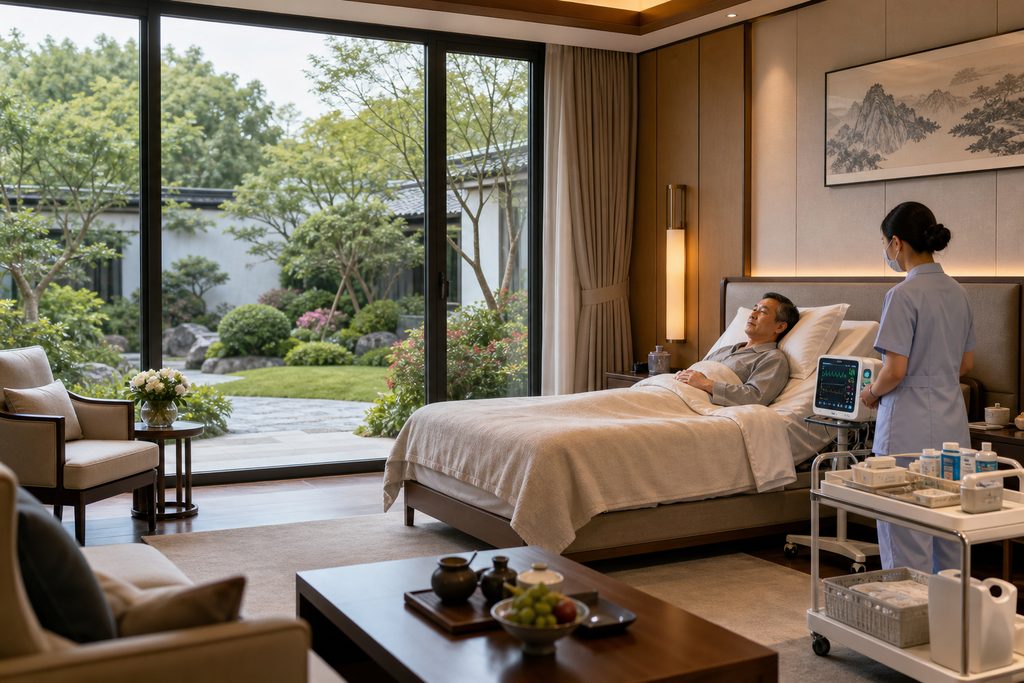
A genuine medical recovery villa is a private residence — typically 2 to 4 bedrooms — configured for post-operative care. Ground-floor bedroom access is non-negotiable if you are recovering from orthopedic surgery. Bathrooms must have grab rails, shower chairs, and non-slip flooring. The bed should be adjustable, or at minimum, positioned to allow a nurse to assist with repositioning. These are not hotel amenities. They are safety infrastructure. We have seen villas in Beijing’s Shunyi district and Shanghai’s former French Concession that were retrofitted specifically for this purpose — wide doorways for wheelchair access, emergency call buttons linked to the nurse’s station, and dedicated refrigeration for medications requiring cold storage.
Proximity matters enormously. If a post-surgical complication arises — a fever spike, unexpected bleeding, sudden shortness of breath — you need to be back in your surgeon’s department within 30 minutes. Not an hour. Not across the city in traffic. We map this distance precisely before confirming any villa. In a city like Beijing, where a cross-town drive can take 90 minutes during peak hours, the difference between a villa in Chaoyang versus one in Haidian can be clinically significant.
The Nursing Support Layer
This is where most “medical recovery” offerings collapse under scrutiny. A registered nurse in China holds a nationally standardized license. Many recovery villas staff “caregivers” or “health aides” who lack this credential. They may be warm, attentive, and completely unqualified to recognize early signs of surgical site infection or to safely manage a patient-controlled analgesia pump.
A legitimate service provides a licensed RN with post-surgical experience. The nurse should be on-site 24/7 — not on call, not reachable by phone, but physically present in the villa. This person checks your vitals, changes dressings, manages medication schedules, assists with mobility, and communicates directly with your surgeon’s team. The cost for this level of nursing support is part of what drives the private villa recovery China price, and it is the component you cannot afford to compromise on. In Shanghai, a private-duty RN with post-operative experience typically costs the villa operator between $120 and $180 per day. That cost is embedded in your package rate. If a villa quotes you a price that seems too low to cover this, ask directly: “Is the nurse a licensed RN, and will she be on-site 24 hours?” The answer usually explains the price.
Why China’s Recovery Model Makes Structural Sense
There is a reason this service category has grown rapidly in Beijing, Shanghai, and Guangzhou. It is not marketing. It is arithmetic.
Hospital Discharge Happens Fast — By Design
Chinese top-tier hospitals operate at enormous scale. Peking Union Medical College Hospital sees over 10,000 outpatient visits daily. Fuwai Hospital performs more than 14,000 cardiac surgeries annually — the highest volume of any cardiac center globally. Beds are a precious resource. Once you are clinically stable, you are discharged. This is not a criticism; it is how the system delivers world-class outcomes at a fraction of Western costs. But it means international patients need a recovery plan that begins the moment they leave the hospital floor.
Cost Structures Make Extended Recovery Affordable
The private villa recovery China price typically ranges from $300 to $800 per day, depending on the city, villa size, and nursing intensity. A full package — 14 days in a well-appointed villa with 24/7 RN support in Shanghai — often lands between $5,000 and $9,000 total. That is inclusive of accommodation, nursing labor, three meals, and ground transport to follow-up appointments. Compare this to an extended hospital stay in the United States, where a single day in a surgical ward can exceed $3,000 before physician fees. Or compare it to a medical recovery facility in Singapore, where comparable private nursing accommodation runs 40-60% higher.
Let us be precise. The best nursing care villa Shanghai cost we have coordinated for patients sits around $450 per day for a two-bedroom villa with a dedicated RN. That is roughly the nightly rate of a mid-range business hotel in central London — except the villa comes with a medical professional who knows your surgical history and has a direct line to your surgeon.
Continuity of Care Is Built In
When you recover in a villa near your hospital, your follow-up appointments become simple car rides rather than logistical ordeals. Your nurse accompanies you. She has been tracking your recovery daily and can brief the surgeon with specific observations — not vague impressions, but recorded data on wound healing, pain scores, mobility milestones. This continuity is difficult to replicate if you fly home immediately after discharge. Many surgeons in China’s top orthopedic and cardiac departments now explicitly recommend local recovery for their international patients during the critical first two weeks. They have seen too many complications arise from premature long-haul flights.
What You Need to Know Before Booking Alone
We have watched patients attempt to piece this together independently. Some succeed. Many do not. The barriers are real and specific.
Villa operators rarely understand medical requirements. The vacation rental market in China is vast and unstandardized. A beautiful villa in a Beijing hutong or a Shanghai lane house may be utterly unsuitable for post-surgical recovery — narrow staircases, no ground-floor bathroom, no space for a nurse to sleep on-site. The listing photos will not show you these problems. We have inspected villas that looked perfect online and turned out to have steps at every entrance and bathrooms too small to accommodate a shower chair.
Nursing credential verification is nearly impossible from abroad. China’s nursing license database is not easily searchable in English. Even if a villa operator claims to provide a “registered nurse,” confirming that credential independently from overseas is extremely difficult. We verify licenses against the national registry as a standard pre-booking step. Without this, you are relying on trust — and trust is not a verification method.
Emergency protocols are often nonexistent. What happens if your condition deteriorates at 3 a.m.? A properly structured recovery villa has a documented protocol: which hospital to call, which entrance to use, who will notify your surgeon, how the transfer will occur. Most independent villa operators have never drafted such a protocol. They assume nothing will go wrong. That assumption is dangerous.
How We Help You Navigate This
This is not a sales pitch. It is an explanation of process. When a patient contacts us about post-surgical recovery, we start with three questions: What procedure are you having? At which hospital? What is your surgeon’s expected discharge timeline? The answers determine everything.
We then identify villas within a 20- to 30-minute radius of your hospital that meet our infrastructure checklist. We verify nursing credentials. We negotiate a package rate that reflects the actual care intensity you need — a patient recovering from a spinal fusion requires more nursing hours than one recovering from a minor laparoscopic procedure, and the price should reflect that difference. We establish the communication protocol between your recovery nurse and your surgical team before you are discharged. And we remain reachable throughout your recovery period. If something shifts — a delayed discharge, a complication, a need to extend your stay — we adjust the arrangements.
For patients considering this path, it is worth understanding how the broader hospital selection process works. Our database of top-ranked hospitals covers 340+ institutions across 37 cities, all ranked in the top 5% of China’s 35,000+ hospitals by Fudan University’s authoritative hospital rankings and JCI accreditation standards. The hospital you choose determines the recovery geography. A surgery at Fuwai Hospital in Beijing’s Xicheng District demands a different villa location than a procedure at Zhongshan Hospital in Shanghai’s Xuhui District. We map this before anything else.
Some patients ask whether private nursing care is available after surgery in China without booking a full villa package. The answer is yes, with caveats. You can hire a private-duty RN to visit your hotel room. But hotels are not set up for recovery — no grab rails, no adjustable beds, no space for medical equipment. And a visiting nurse who leaves at 6 p.m. is not the same as 24/7 on-site care. For the first week after major surgery, we strongly advise against the hotel-plus-visiting-nurse model. The risk of a nighttime fall or a missed complication is too high. If cost is a concern, shorter villa stays with higher nursing intensity are safer than longer hotel stays with intermittent nursing visits.
Frequently Asked Questions
The medical recovery villa with nurse Beijing packages we coordinate typically range from $350 to $700 per day. The variance depends on villa location, size, and whether you need a bilingual RN. A 14-day stay in a two-bedroom villa with 24/7 nursing support in the Shunyi or Chaoyang districts generally falls between $5,000 and $9,000 total. Villas closer to the city center or near specific hospitals like Peking Union Medical College Hospital command higher rates due to real estate costs. All packages we arrange include ground transport to follow-up appointments and a direct communication line to your surgical department.
You can try. The phrase “book post surgery villa China nursing support” will return listings on various platforms. But we have seen too many problems to recommend this route. The villa may look beautiful and still lack a ground-floor bedroom. The “nurse” may be a caregiver without a license. The emergency protocol may not exist. If you choose to book independently, insist on three verifications before paying: a video tour focused on accessibility features, a copy of the nurse’s license with the registration number visible, and a written emergency transfer plan. If any of these three is missing or vague, walk away.
The question “how much for luxury recovery accommodation China” often comes from patients who assume higher price means better care. This is not always true. A luxury villa may offer a private garden, a personal chef, and designer furnishings — none of which affect your clinical recovery. What matters is nursing quality, proximity to your hospital, and safety infrastructure. We have placed patients in modest but well-equipped villas that cost $350 per day and delivered excellent recovery outcomes. We have also inspected $800-per-day luxury properties that lacked grab rails in the bathroom. Prioritize clinical safety over aesthetics. If both are available within your budget, great. But never trade safety for style.
Ideally, you should lock in a villa at least three to four weeks before your surgery date. The best-located properties near major hospitals book up, especially during peak surgical seasons — spring and autumn, when international patient volume is highest. Last-minute arrangements are sometimes possible but severely limit your options. You may end up in a villa 45 minutes from your hospital or with a nurse whose specialty does not match your procedure. Early booking also gives us time to establish the communication protocol with your surgical team, which pays dividends during recovery.
Your Next Step
Recovering from surgery in a foreign country is not an adventure. It is a vulnerable, physically demanding period where small logistical failures can cascade into serious clinical problems. The right recovery environment — a properly equipped villa with a licensed nurse who knows your case — transforms that vulnerability into a structured, supported healing process. This is not about luxury. It is about giving your body the best possible conditions to heal, close to the surgical team that knows your case best.
If you are considering surgery in China and want to understand your recovery options — costs, locations, nursing arrangements — we are here to walk you through it. No pressure. No pitch. Just a clear, honest conversation about what is possible. Request a free consultation and we will map out what your recovery could look like, based on your specific procedure and hospital.
For more medical information and treatment options in China, visit chinamedservices.com (China Medical Services).
