Dedicated Family Liaison Officer Service China: Daily Updates When Your Loved One Is in Treatment
When 42-year-old Michael first heard his wife’s oncology diagnosis, the silence in the doctor’s office swallowed him whole. He had questions. Dozens of them. But the words wouldn’t come. A week later, sitting at his kitchen table in Manchester, the real terror set in. Not just the disease. The distance. His wife had chosen to pursue treatment at a top-tier cancer center in Shanghai. And Michael couldn’t be there for the full eight weeks. He needed to know what was happening. Every day. Not a rushed WhatsApp message. Not a confusing translation. Real updates. That is exactly where the search for a dedicated family liaison officer service in China begins.
Key Takeaways
- A dedicated family liaison officer provides structured daily communication — not just translation, but clinical context — bridging the gap between busy medical teams and anxious families back home.
- The family liaison officer medical tourism China cost typically ranges from $200 per day for basic bilingual coordination, scaling with case complexity and specialist involvement.
- Public hospitals in China handle over 10,000 outpatient visits daily; without a dedicated coordinator, families face a near-insurmountable language and procedural barrier when seeking real-time updates.
- This service is not a luxury add-on — for families managing cross-border care, it is the structural mechanism that transforms fragmented information into coherent daily reports.
The Problem: When Distance Turns Anxiety Into Paralysis
Medical travel creates a unique kind of suffering for the family left behind. A 2023 study published in the Journal of Travel Medicine found that 68% of medical travelers’ family members reported clinically significant anxiety during the treatment period. The cause was not the diagnosis alone. It was the information vacuum. Time zones swallow messages. Medical terminology gets lost in translation. Hospital staff, stretched thin with patient loads that can exceed 100 consultations per surgeon per day in China’s top public institutions, simply cannot provide individualized family updates.
You stare at your phone. You refresh WeChat. You call. No answer. You imagine the worst. That cycle wears people down. And it damages the patient’s recovery too. Patients who know their families are panicked and uninformed experience higher stress levels, which studies correlate with slower wound healing and longer hospital stays. The problem is not a lack of love. It is a lack of structure.
Who We Are
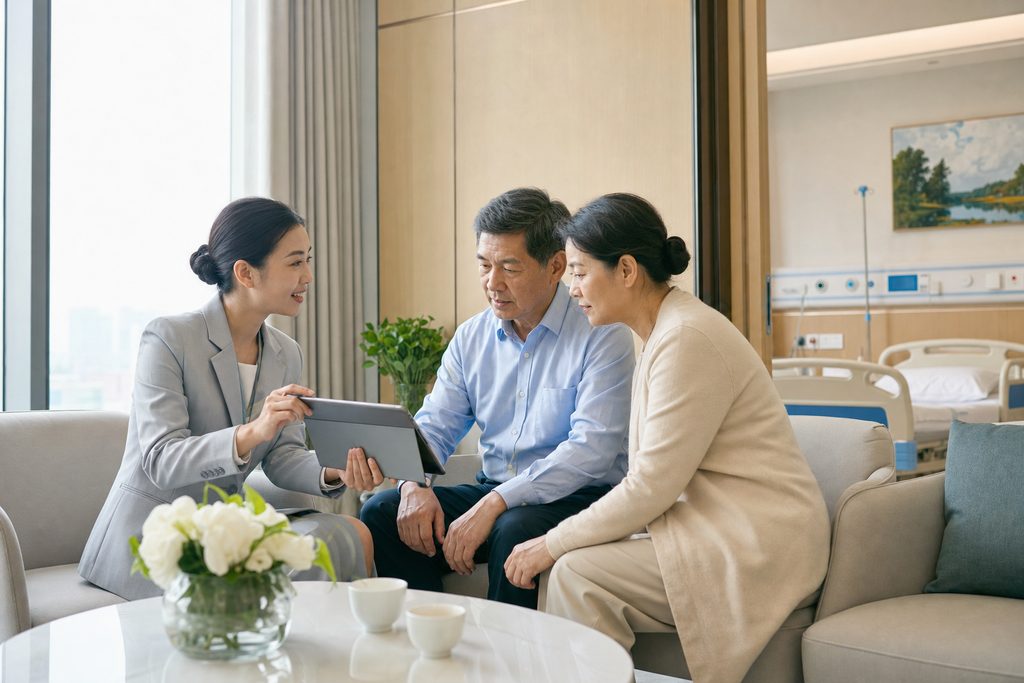
We are not a hospital. We do not provide medical treatment or clinical diagnoses. Our team functions as your logistical architects — we bridge the gap between you and China’s top-tier medical expertise. Think of us as the operational layer that sits between foreign patients, their families, and the massive, high-velocity machinery of China’s best hospitals. We handle hospital matching, appointment coordination, visa guidance, and bilingual medical companionship. The family liaison officer role is the natural extension of that work: we become the trusted daily conduit of information, translating clinical updates into clear, compassionate English and ensuring no family member is ever left staring at a silent phone.
Why a Dedicated Family Liaison Officer Service in China Delivers Results
The concept is straightforward. A single, named professional takes ownership of your family’s communication flow. But the execution requires deep local knowledge. Here is what makes the model work in the Chinese hospital context.
Clinical Volume Demands a Dedicated Communication Layer
Fuwai Hospital in Beijing performs over 14,000 cardiac surgeries annually. That is roughly 38 hearts operated on every single day. The outpatient halls of West China Hospital in Chengdu process patient volumes that rival a small city’s daily foot traffic. In this environment, surgeons and nurses are optimized for clinical throughput. They are extraordinary at what they do. Communicating with a patient’s spouse in English at 9 PM UK time is simply not part of their workflow. A liaison officer steps into that gap. They are physically present, able to speak with the care team during rounds, absorb the clinical nuances, and then distill that information into a format a worried family member can actually understand.
This is not about replacing direct doctor-patient communication. It is about supplementing it with a consistent, reliable reporting structure. The surgeon operates. The liaison officer translates the outcome — not just the words, but the implications.
What Is a Patient Liaison Service for Foreigners in China Actually Doing Each Day?
Let us be concrete. A typical day for a liaison officer assigned to your loved one’s case at a hospital in China with daily updates for family might look like this: arrive at the hospital at 7:30 AM local time. Attend the morning ward round with the attending physician. Take structured notes — vital signs, treatment adjustments, medication changes, pain levels, mobility milestones. By 9:00 AM, a concise written update is sent to the family via their preferred channel. If the family is in London, that lands at 1:00 AM — ready for them when they wake up. If there is a scheduled procedure, the liaison officer is at the unit, providing real-time updates as the patient moves from prep to recovery. In the afternoon, a video call is arranged so the family can see the patient’s face, not just read words on a screen.
That rhythm — morning report, procedure updates, evening video facilitation — creates a psychological container. The family knows when they will hear something. The uncertainty collapses.
Shanghai Hospital Dedicated Family Coordinator: A Case in Operational Precision
Shanghai’s international medical infrastructure has matured rapidly. Hospitals like Zhongshan Hospital Fudan University and Ruijin Hospital now regularly manage complex cases for international patients. A Shanghai hospital dedicated family coordinator operates with an understanding of both the clinical pathways and the logistical friction points. They know which department handles discharge summaries. They know the pharmacy hours. They can intercept billing questions before they become panic-inducing surprises.
This local operational knowledge is the difference between a family receiving a confusing, machine-translated discharge note and receiving a clear summary with follow-up instructions the patient can actually follow. Medical travel China keeping family informed daily is not a passive reporting exercise. It is active case management on the communication front.
What You Need to Know Before Going Alone
Both. A family whose loved one is undergoing a complex cardiac procedure clearly needs intensive daily communication. But even elective orthopedic surgeries — a hip replacement at a top orthopedics department, for instance — generate anxiety for distant families. The service scales to the case. A three-day hospitalization for a knee replacement might require lighter-touch updates than a three-week oncology protocol. The structure remains the same; the intensity adjusts.
This is the moment the liaison officer proves their value. Complications create chaos. Families receive fragmented, alarming information. The liaison officer’s job is to get the facts straight from the clinical team, contextualize them honestly, and communicate without causing unnecessary panic. We never sugarcoat. We also never leave a family to interpret raw clinical data alone. If a second opinion or an urgent family conference is needed, we facilitate it immediately.
Yes. They often become the family’s operational anchor. They can coordinate accommodation extensions, arrange airport transfers, manage pharmacy runs, and help the patient navigate discharge paperwork. The role naturally expands to cover whatever logistical friction arises during a cross-border medical stay.
Your Next Step
Medical travel asks a great deal of families. It asks for trust across distance, patience across time zones, and emotional resilience in the face of incomplete information. A dedicated family liaison officer does not eliminate the difficulty of having a loved one in treatment far from home. But it replaces the information vacuum with a steady, reliable signal. You know what is happening. You know when you will hear next. You can sleep between updates instead of staring at the ceiling.
If you are considering treatment in China for yourself or a family member, begin with a conversation. No commitment. Just clarity on what is possible.
Frequently Asked Questions
Yes. We work with JCI-accredited and major Grade 3A tertiary hospitals that follow international safety standards comparable to top hospitals in the US and Europe. Surgical teams perform high volumes of procedures — often more than their Western counterparts — which studies show leads to better outcomes.
Costs vary by procedure and hospital, but international patients typically save 40-80% compared to US prices — even when factoring in travel and accommodation. A consultation with our team will give you an exact, all-inclusive quote with no hidden fees.
Send us your existing medical reports. The relevant specialty reviews them and gives you a written opinion, including treatment direction and options, before you commit to any travel. From there you can add a video consultation with the doctor, or have us attend an appointment on your behalf.
For more medical information and treatment options in China, visit chinamedservices.com (China Medical Services).
