Ankle Surgery and Fusion Service China: Complex Foot and Ankle Procedure Coordination
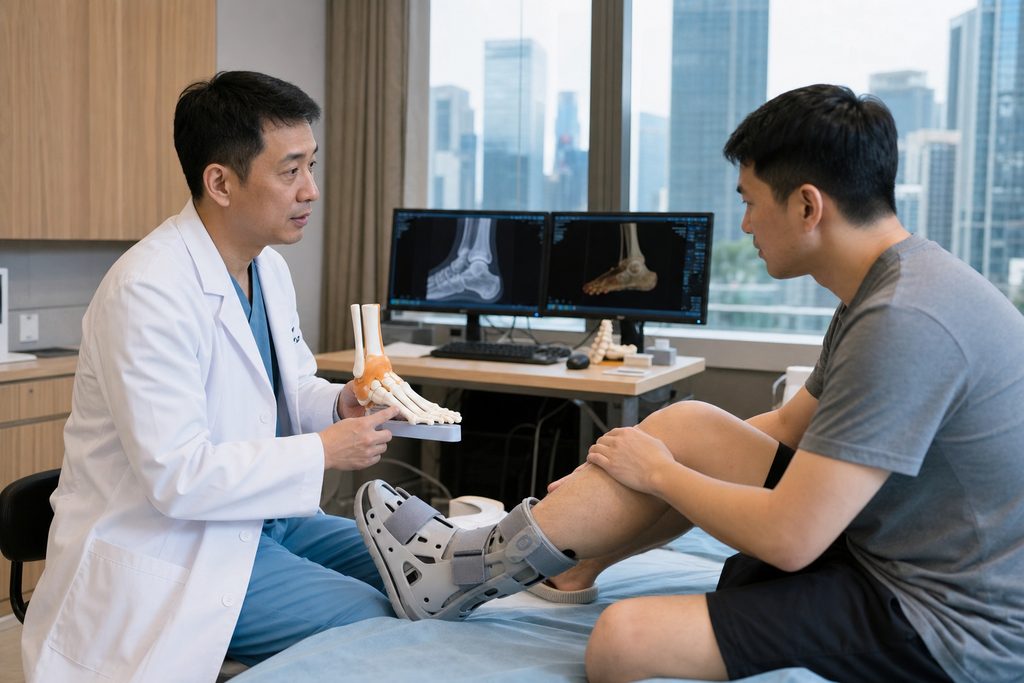
Key Takeaways
- Ankle fusion surgery cost in China typically ranges from $8,000 to $18,000 — roughly 70-85% less than the $50,000-$80,000+ billed in the United States for comparable procedures.
- China’s top orthopedic centers perform thousands of complex foot and ankle reconstructions annually. Surgical volume at this scale correlates directly with lower complication rates.
- Navigating a public Chinese hospital independently without Mandarin fluency or local payment systems is genuinely difficult. The infrastructure was not built for international patients.
- Understanding the difference between a standard public hospital pathway and a coordinated international care pathway is essential before you commit to travel.
The Problem: When Walking Becomes a Losing Battle
End-stage ankle arthritis does not just hurt. It steals your autonomy. Approximately 1 in 8 adults over 45 lives with debilitating foot or ankle pain severe enough to limit daily movement, according to data from the Global Burden of Disease Study. For many, the cartilage is simply gone. Bone grinds on bone. Cortisone shots stop working. You start planning your day around how many steps you have left before the pain spikes.
Your orthopedic surgeon back home finally says the words you were dreading: ankle fusion or total ankle replacement. Then the bill arrives. In the United States, an uninsured or high-deductible patient can face a surgical invoice exceeding $70,000 just for the hospital facility fee. In the UK or Canada, the clinical need is clear. But the wait for a complex hindfoot reconstruction can stretch past 18 months. You do not have 18 months of function left to lose.
That is the exact moment patients start typing “ankle fusion surgery cost China” into a search bar. They are not looking for a discount. They are looking for a timeline they can actually live with.
Who We Are
We are China Medical Services. We are not a hospital. We do not perform surgery, diagnose conditions, or prescribe treatment. What we do is dismantle the logistical wall that stands between you and China’s highest-ranked orthopedic surgical teams. Our database connects patients to over 340 top-ranked hospitals across 37 cities. We handle the opaque parts — the visa documentation, the bilingual medical record translation, the hospital matching based on real surgical volume data, and the on-the-ground support that prevents a foreign hospital visit from turning into a crisis of navigation. We are case managers, not gatekeepers.
Why Complex Ankle Reconstruction in China Delivers Results
Clinical Volume Drives Better Outcomes in Foot and Ankle Surgery
There is a brutal but honest rule in orthopedic surgery: you want the surgeon who does your specific procedure every single day, not once a month. A high-volume foot and ankle surgeon at a major Chinese orthopedic center like Shanghai Sixth People’s Hospital or Peking University Third Hospital performs upwards of 300 to 400 complex hindfoot and ankle reconstructions annually. Compare that to the average general orthopedic surgeon in a Western community hospital, who might perform 10 to 20 ankle fusions per year. The difference in intraoperative decision-making speed and complication management is not theoretical. A 2022 systematic review in the Journal of Foot and Ankle Surgery found that higher surgeon volume was independently associated with lower rates of nonunion and surgical site infection in ankle arthrodesis.
We connect patients with departments that treat complex foot and ankle pathology not as an occasional referral, but as a core subspecialty. These are teams that see post-traumatic deformities, failed prior fusions, and Charcot arthropathy on a weekly basis. The volume is not just a number. It is a safety mechanism.
How Is Ankle Fusion Surgery Performed in China: Technique and Technology at Scale
The surgical technique for ankle fusion in top Chinese hospitals mirrors the best international standards — and in some areas, pushes ahead. Most fusions are performed via an anterior approach with the patient supine. The surgeon removes the remaining articular cartilage from the tibial plafond and the talar dome, then compresses the two bones using large cannulated screws. The goal is rigid internal fixation that lets the tibia and talus heal into a single, stable, pain-free unit.
What differs is the workflow. Preoperative planning frequently uses low-dose weight-bearing CT scans and 3D-printed patient-specific cutting guides. These guides — designed from your own CT data — let the surgeon make precise bone cuts and position screws with less intraoperative guesswork. The technology itself is not unique to China. But the speed at which it moves from radiology to the operating table is remarkable. A custom 3D-printed guide that might take two weeks to fabricate and ship in a fragmented Western hospital system can be produced and sterilized within 48 hours at a high-efficiency Chinese university hospital. Less time waiting means less muscle atrophy and less disease progression before surgery.
Ankle Fusion Surgery Cost China: Structural Price Advantage Without Quality Compromise
Let us address the obvious question directly. The complex ankle reconstruction price abroad — particularly in the United States or Western Europe — is driven by high physician labor costs, expensive implant markups, and multi-layered administrative overhead. In China, the same FDA-equivalent or CE-marked titanium cannulated screw systems cost a fraction of the price. The surgeon’s fee is lower not because of inferior training, but because of different healthcare labor economics. The hospital facility fee is dramatically lower because Chinese public hospitals operate at immense scale with lean administrative structures.
Here is what that looks like in real numbers for a standard ankle fusion:
| Cost Component | United States (USD) | China — Top Public Hospital (USD) |
|---|---|---|
| Surgeon & Anesthesia Fees | $8,000 – $15,000 | $2,000 – $4,000 |
| Hospital Facility & Operating Room | $25,000 – $45,000 | $3,500 – $7,000 |
| Implants & Hardware (Screws/Plates) | $8,000 – $14,000 | $1,500 – $4,000 |
| Post-Op Rehabilitation (6 weeks) | $3,000 – $6,000 | $1,000 – $3,000 |
| Estimated Total Range | $50,000 – $80,000+ | $8,000 – $18,000 |
These figures vary by hospital tier and case complexity. A revision ankle fusion with bone grafting and deformity correction will sit at the higher end. A primary fusion with straightforward anatomy sits lower. But the structural gap remains. You are not paying for less care. You are paying for a system built on volume and efficiency rather than inflated unit prices.
What You Need to Know Before Going Alone
We want to be completely direct about what happens if you try to arrange this independently. Some patients succeed. Most hit walls they did not see coming.
- S2 Visa Documentation: Medical treatment in China requires an S2 visa with a formal invitation letter from the treating hospital. Public hospitals do not issue these letters to unknown foreign individuals who email the general inquiries desk. The letter must come through the hospital’s official international department, with a confirmed appointment already in place. It is a closed loop. You cannot get the letter without the appointment, and you cannot get the appointment without navigating the system in Mandarin.
- Payment Systems: Chinese public hospitals operate on a prepaid deposit system. You load funds onto a hospital-issued card at admission, and the hospital deducts from it daily. WeChat Pay and Alipay dominate. International credit cards are often rejected at public hospital cashiers. A foreign patient without a local bank account or a Chinese mobile payment setup can find themselves unable to pay for a CT scan at 8 a.m. on a Monday. This is not a hypothetical scenario. It happens regularly.
- Medical Records and Imaging Standards: Chinese radiologists and orthopedic surgeons need your imaging in a specific DICOM format on a CD or USB, not a cloud link or a printed report. Your overseas MRI report — even if translated — will not be accepted as a standalone diagnostic. The surgeon will almost always order a repeat weight-bearing X-ray or CT on arrival. You need someone who can explain why, coordinate the imaging slot, and ensure the results reach the right attending physician before your surgical window closes.
How We Help You Navigate This
These barriers are not signs of a broken system. They are signs of a system optimized for 1.4 billion domestic patients, not for international visitors. Our job is to build the bridge.
Before you travel, we translate and format your complete medical dossier — operative notes, imaging studies, prior implant records — into the structure a Chinese orthopedic department expects to see. We submit it through official channels to the hospitals that match your specific pathology, not just the most famous name. A complex pilon fracture nonunion requiring a tibiotalocalcaneal fusion belongs at a trauma reconstruction center, not necessarily the hospital with the best general orthopedics reputation. We make that distinction. We also coordinate the invitation letter and guide you through the S2 visa application at your local Chinese consulate.
During your treatment, a bilingual medical companion meets you at the hospital entrance. They handle registration, prepaid deposit loading, queue management, and real-time translation during the surgeon consultation. You do not guess which floor Radiology is on. You do not stand in the wrong line for 40 minutes. The companion stays with you through the critical preoperative briefing, ensuring you understand the surgical plan, the implant choice, and the expected weight-bearing restrictions — in clear English, without medical jargon getting lost in translation.
After discharge, we coordinate your follow-up imaging schedule, your rehabilitation protocol, and your clearance for international travel. Ankle fusion patients typically cannot fly long-haul for at least 7 to 10 days post-op due to swelling and deep vein thrombosis risk. We help you plan a safe recovery window in-country before you board the plane home. The foot surgery recovery time in a China hospital setting — for a standard ankle fusion — usually involves a 3 to 5-day inpatient stay, followed by 6 to 8 weeks of non-weight-bearing in a cast, with serial X-rays to confirm union. We ensure you have those X-rays on a CD in your hand before you leave.
Frequently Asked Questions
Not in the way a travel agency books a hotel. Surgery requires an in-person consultation. The surgeon must examine your ankle, review your imaging personally, and confirm the surgical plan with you face to face. What you can lock in before travel is a confirmed consultation slot with the specific foot and ankle department, a scheduled surgical window contingent on that consultation, and all the logistical infrastructure — visa, accommodation, companion support — already in place. Think of it as a fully coordinated surgical pathway, not a pre-packaged product.
This is a fair concern. In China’s large teaching hospitals, the attending surgeon of record is the one who performs the critical portions of the procedure. When we coordinate your case through a hospital’s international department or VIP channel, the attending foot and ankle specialist is explicitly named on your surgical consent and your admission paperwork. Residents or fellows may assist with opening, closing, or retraction, but the osteotomy preparation, joint surface preparation, and screw fixation are done by the attending. We verify this structure with the department before your case is confirmed. You can also directly ask the surgeon during your preoperative consultation: “Will you personally perform the bone cuts and the fixation?” The answer should be an unambiguous yes.
Ankle fusion nonunion rates in high-volume centers are approximately 5-10%, consistent with published international benchmarks. If a nonunion or deep infection occurs after you return home, your local orthopedic surgeon manages the acute issue. We provide your complete operative record, implant serial numbers, and intraoperative imaging to your home surgeon at no additional cost. The original Chinese surgical team can also provide a written second opinion or a video consultation to advise on revision planning. However, revision surgery itself would typically require a return to China or treatment within your home healthcare system. We do not promise a complication-free outcome. No ethical surgical coordinator can. We promise that your records will never be held hostage and that the communication channel remains open.
The hospital quote you receive covers the surgeon’s fee, anesthesia, operating room time, standard implants, and the inpatient stay. It does not cover your airfare, hotel, meals, or the cost of a bilingual medical companion. It also does not cover unexpected extensions — for instance, if your preoperative CT reveals a large bone cyst that requires a structural allograft not in the original plan. We flag these financial variables before you travel. You arrive knowing the base cost, the likely range of variance, and exactly what is excluded. No hidden line items.
Your Next Step
Living with a failed ankle is not a life sentence. It is a logistics problem with a surgical solution. The solution exists in China at a cost that does not require you to drain your retirement savings, delivered by surgical teams whose daily case volume exceeds what most Western surgeons see in a quarter. The hard part is not the surgery. The hard part is getting through the door.
If you want to understand whether your specific ankle pathology is a good fit for treatment in China — and what the realistic timeline and cost would look like — start a conversation with our coordination team. There is no charge for the initial consultation, and no pressure to commit. Just an honest assessment of your options. Get a free consultation now.
For more medical information and treatment options in China, visit chinamedservices.com (China Medical Services).
