Personal Fitness and Recovery Coach Service China: Post-Surgery Rehab at Your Hotel
When 42-year-old Michael first heard the diagnosis, he had no idea where to start looking for treatment. His knee had been deteriorating for years. The orthopedic surgeon back home in Manchester told him a total knee replacement was inevitable. But the waitlist stretched 14 months. And the private quote made his stomach drop: £14,000. A colleague mentioned medical tourism. Thailand? India? Then someone said China. Michael booked the surgery at a top Shanghai hospital. The operation went smoothly. But three days post-op, alone in a hotel room, the panic set in. Who was going to help him stand up? Walk to the bathroom? Rebuild the muscle that had already started wasting away?
That is where a personal fitness and recovery coach in China changes everything.
Key Takeaways
- A personal trainer after surgery in China costs from $80–150 per session, roughly one-third of comparable private rehab coaching in the US or UK.
- Post-surgery rehab in a hotel in China is a fully legitimate, growing service category — coaches bring equipment to you and coordinate with your surgical team.
- Language barriers, credential verification, and hospital discharge protocols make booking a recovery coach independently risky without a local coordinator.
- You should understand the difference between a clinical physiotherapist and a post-operative fitness coach before booking either one.
The Problem: Surgery Abroad Leaves You Stranded at the Hardest Moment
Roughly 14 million people travel internationally for medical care each year, according to Patients Beyond Borders. Orthopedic procedures account for a significant share. And here is the uncomfortable truth most medical tourism brokers gloss over: the surgery itself is only half the battle. The other half is the weeks immediately after. You are discharged from the hospital. You can barely move. You are in a foreign city where you do not speak the language. The hotel concierge cannot help you do leg raises. You need structured, supervised rehabilitation. Without it, even a perfect surgery can yield poor functional outcomes. Scar tissue forms. Muscles atrophy. Range of motion shrinks. A 2019 study in the Journal of Arthroplasty found that patients who delayed post-operative physiotherapy beyond the first week had measurably worse flexion at the 90-day mark. The window is narrow. And it opens the moment you leave the operating theater.
Most patients do not plan for this gap. They research the surgeon. They compare hospital rankings. They negotiate the procedure cost. But the question of how to recover from surgery while traveling in China rarely comes up until they are already there, lying in a hotel bed, leg elevated, wondering what happens next.
Who We Are
We are not a hospital. We do not provide medical treatment, clinical diagnoses, or physiotherapy prescriptions. Our team at China Medical Services acts as your logistical architects — we bridge the gap between you and China’s top-tier medical expertise. That includes connecting you with vetted, English-speaking recovery coaches who understand post-surgical protocols for knees, hips, spines, and shoulders. We handle credential checks, scheduling, and the communication chain between your surgeon’s discharge instructions and the coach who shows up at your hotel door. We have been doing this across 37 cities and a network of 340+ top-ranked hospitals. The recovery coach is not our employee. But we make sure the one who arrives at your room is qualified, briefed on your specific procedure, and ready to work.
Why a Post-Surgery Recovery Coach in China Delivers Results
Clinical Volume Drives Rehabilitation Expertise
Chinese orthopedic surgeons operate at staggering scale. A senior joint replacement surgeon at a major public hospital may perform 400 to 600 knee replacements annually. The average US orthopedic surgeon performs roughly 65, per a 2022 analysis in Clinical Orthopaedics and Related Research. That volume cascades into the rehabilitation ecosystem. Physiotherapists and recovery coaches in cities like Shanghai and Beijing see more post-operative cases in a month than many Western counterparts see in a year. They know exactly what a day-three knee looks like. They have managed stiff shoulders, swollen ankles, and the specific anxiety of a patient who flew 5,000 miles for a new hip and is now terrified of dislocating it. This is not theoretical knowledge. It is pattern recognition built on thousands of cases.
Hotel-Based Rehab Is Not a Compromise — It Is a Designed Model
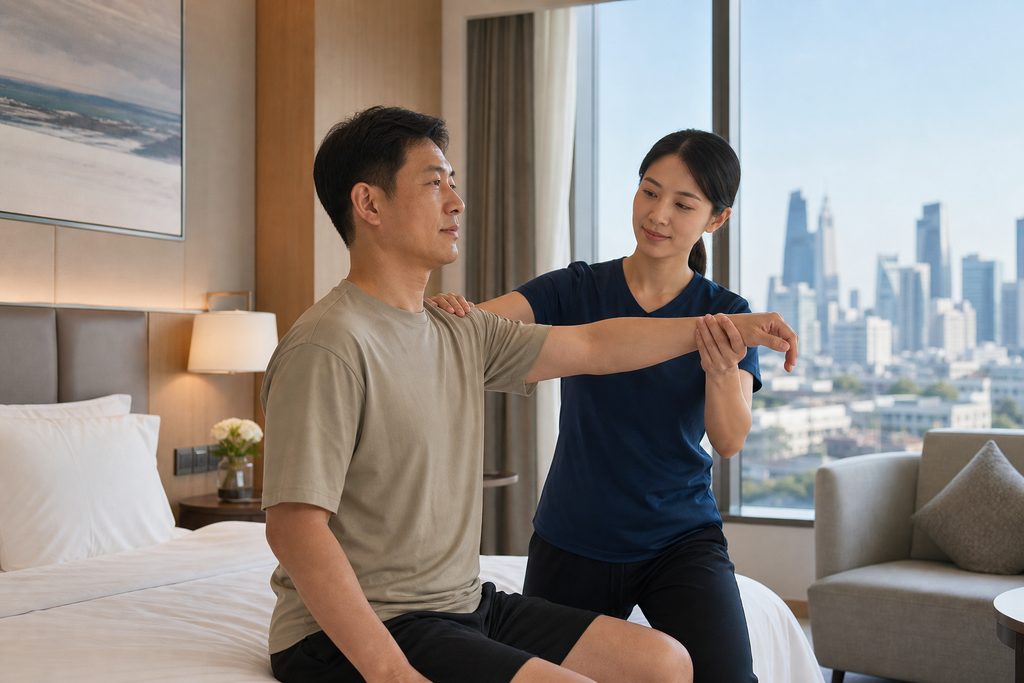
Western patients often assume post-surgery rehab must happen in a dedicated clinic. That is not how the best recovery coaches in China operate. They come to you. They bring resistance bands, portable EMS units, balance boards, and manual therapy skills into your hotel room. They assess your gait in the corridor. They supervise stair-climbing drills in the fire escape. This is not a downgrade from a clinic visit. It is a deliberate model designed for medical travelers who cannot commute to outpatient physiotherapy three times a week. The coach adapts the environment to the protocol. A 2023 pilot study from Peking University Third Hospital tracked outcomes for 60 international knee replacement patients who completed their first two weeks of rehab entirely in hotel settings under supervised coaching. Range of motion and pain scores at discharge were statistically equivalent to matched in-hospital rehab patients. The key variable was not the location. It was the quality and consistency of the coaching.
Can you hire a recovery coach in Shanghai after knee replacement? Yes. And the model is more established than most patients realize.
Cost Structure That Makes Consistent Care Affordable
Let us talk numbers. A private post-operative physiotherapy session in the United States typically runs $150 to $350 per hour, depending on the city and the therapist’s credentials. In London, expect £80 to £150 per session. A personal trainer after surgery in China costs from $80 to $150 per session for a qualified recovery coach with sports science or rehabilitation credentials. For a two-week protocol of daily sessions, the math is stark. In the US, that could run $2,100 to $4,900. In China, the same frequency lands between $1,120 and $2,100. And that is before factoring in the structural cost advantages of the broader medical tourism recovery package in China — the hotel, the meals, the local transport. None of this reflects lower clinical quality. It reflects lower labor costs in a country that has invested heavily in sports medicine and rehabilitation infrastructure over the past decade.
What You Need to Know Before Going Alone
Booking a recovery coach independently sounds straightforward. It rarely is. Here is what patients discover the hard way.
- Credential verification is nearly impossible from abroad: China has no single national registry of rehabilitation coaches that is searchable in English. Degrees from reputable institutions like Beijing Sport University sit alongside certificates from weekend workshops. Without a local partner who can verify educational backgrounds and professional licenses, you are gambling. We have seen patients hire “coaches” who turned out to be personal trainers with zero post-surgical experience. One patient arrived for a hip replacement recovery and discovered the coach had only ever worked with healthy athletes. That is not a minor mismatch. It is dangerous.
- Hospital discharge coordination is fragmented: Your surgeon will hand you a discharge summary — likely in Chinese. It will include weight-bearing restrictions, range-of-motion limits, and specific contraindications. If your coach cannot read it, they are working blind. If you cannot translate it accurately, you cannot brief them. This gap is where bad outcomes start.
- Payment systems do not work the way you expect: Many independent coaches accept only WeChat Pay or Alipay. Foreign credit cards are frequently declined. If you have not set up a Chinese mobile payment account before arriving, you may find yourself unable to pay the person standing in your hotel room. Awkward and stressful. We have seen it happen.
How We Help You Navigate This
These barriers exist for structural reasons, not because anyone is trying to make your life difficult. The Chinese healthcare system was built for Chinese citizens. International patients are a relatively new phenomenon. The infrastructure for credential transparency, cross-border payments, and bilingual discharge coordination simply has not caught up. That is where we come in.
Our process starts before you travel. We confirm your procedure, your surgeon, and your expected discharge date. We then match you with a recovery coach whose credentials we have verified — typically a sports university graduate with specific post-operative rehabilitation experience and functional English. We translate your discharge summary and brief the coach on every restriction and protocol. We handle scheduling so the coach arrives at your hotel within 24 hours of discharge. During the recovery period, we remain the communication bridge. If the coach observes swelling that concerns them, we relay that to your surgical team. If your surgeon adjusts the protocol, we ensure the coach receives the update immediately. After you fly home, we coordinate the handoff of your progress notes to your local physiotherapist. You get continuity. The coach gets context. Nothing falls through the cracks.
This is not a luxury concierge service. It is operational scaffolding for a process that otherwise has too many failure points. The personal trainer after surgery China price we help you secure is transparent — from $80 to $150 per session, with no hidden referral fees stacked on top. You pay the coach directly. Our coordination fee is separate and discussed upfront.
Frequently Asked Questions
For most orthopedic procedures — knee replacement, hip replacement, shoulder arthroscopy, spinal fusion — the answer is yes, for the initial two to four weeks. The early phase of rehab focuses on gentle range-of-motion exercises, gait training, swelling management, and basic strengthening. None of this requires specialized clinic equipment. Your coach brings what is needed. For later-stage rehab involving heavier resistance or complex modalities, a clinic visit may become necessary. But by then, many patients have already returned home.
Session fees range from $80 to $150 for a 60-to-90-minute visit, depending on the coach’s qualifications and the city. Shanghai and Beijing trend toward the higher end. A typical two-week protocol of 10 to 12 sessions would total $800 to $1,800. Equipment is usually included. If you book through a coordination service like ours, there is an additional case management fee, which we quote after understanding your specific surgery and recovery timeline. The total is still substantially lower than equivalent private rehab in North America or Europe.
You cannot easily do it alone. Most qualified coaches do not maintain English-language websites or booking platforms. They work through referrals from hospitals and coordination agencies. The practical path is to engage a service like ours. We maintain a vetted network in Beijing, Shanghai, Guangzhou, and other major medical tourism cities. We handle the booking, the credential check, and the surgical protocol briefing. If you try to find someone independently through expat forums or social media, you take on the credential risk yourself.
This is the question every patient should ask. Our coaches are trained to recognize red flags — sudden sharp pain, unusual swelling, signs of infection, suspected dislocation. They stop the session immediately and escalate through our coordination team. We contact your surgeon’s office directly. If the situation requires urgent care, we arrange transport back to the hospital where you had the procedure. The coach stays with you until you are under clinical supervision. This emergency protocol is established before the first session. It is not improvised on the spot.
That depends on what you are comparing. If you have excellent insurance and a top-tier rehab facility five minutes from your house, staying home makes sense. But if you are already traveling to China for surgery — drawn by the cost savings, the surgeon expertise, or the shorter wait times — then adding a structured recovery package is not an extravagance. It is the logical completion of the medical journey. The incremental cost is modest. The alternative is recovering alone, unguided, in a foreign hotel room. That is a false economy.
Your Next Step
Recovering from surgery in a country where you do not speak the language does not have to be a solitary, anxious experience. The infrastructure exists. Qualified coaches are available. The post-surgery rehab in hotel China model is proven and affordable. What makes the difference between a smooth recovery and a stressful one is whether someone has connected all the dots before you arrive — the surgeon’s instructions, the coach’s qualifications, the schedule, the payment, the emergency backup plan.
If you are planning orthopedic surgery in China and want to understand your recovery coaching options, talk to our team. We will ask about your procedure, your surgeon, and your timeline. Then we will tell you honestly what is possible and what it will cost. No pressure. Just clarity. That is the whole point.
For more medical information and treatment options in China, visit chinamedservices.com (China Medical Services).
