Hotel-to-Hospital VIP Transfer China: Daily Chauffeur for Treatment & Therapy
Key Takeaways
- Dedicated medical chauffeur services in China bridge the critical gap between your hotel recovery and hospital appointments, with daily rates starting from $200.
- China’s top-tier hospitals are high-volume, high-efficiency machines—but navigating their massive campuses without language support can derail a treatment plan.
- Independent ride-hailing apps like Didi often refuse short-distance medical trips or cannot access secure hospital VIP entrances, leaving patients stranded at critical moments.
- A structured transfer service is not a luxury add-on; in cities like Shanghai and Beijing, it is the logistical backbone that keeps a multi-week therapy schedule on track.
The Problem: When Missing a Single Appointment Is Not an Option
According to data from China’s National Health Commission, top-tier Grade A tertiary hospitals in major cities handle over 10,000 outpatient visits daily. For an international patient, that number is not just a statistic. It is a wall of people. You are staying at a serviced apartment in Jing’an, Shanghai, and you need to be at Huashan Hospital by 8:30 AM for a precise immunotherapy infusion. The treatment window is narrow. The drug has been prepared. A 20-minute delay caused by a ride-hailing app driver who cancels because the trip is “too short” is not an inconvenience—it is a clinical disruption that wastes a $4,000 dose. This is the daily reality for patients managing long-term treatment protocols in China. The standard tourist infrastructure fails here. Public transit is clean but physically draining for an immunocompromised patient. Standard taxis cannot access the designated international medical center drop-off points. You need a system that treats punctuality as a medical necessity, not a hope.
Who We Are
We are not a hospital. We do not provide medical treatment, clinical diagnoses, or prescribe therapies. Our team functions as your logistical architects on the ground in China. We design and manage the non-clinical infrastructure that makes treatment possible: the car that arrives before you walk out of the hotel lobby, the bilingual coordinator who checks you in at the international department, the pre-vetted driver who knows which entrance bypasses the general outpatient crowd. We bridge the gap between you and the clinical expertise inside China’s 340+ top-ranked hospitals. Humble about medicine. Obsessive about logistics.
Why a Structured Medical Transfer Service Delivers Results
Patients often ask us what is included in medical tourism concierge China, expecting a simple car service. The answer is a fully integrated mobility plan. It starts with the recognition that a hospital visit in China is fundamentally different from a hospital visit in London or Dubai. The scale alone demands a different approach. A private chauffeur for medical appointments Shanghai is not just a driver waiting in a parking lot. They are the fixed point in a schedule that must hold.
Clinical Volume Demands Logistical Precision
Consider the numbers. Fuwai Hospital in Beijing performs over 14,000 cardiac surgeries annually—the highest volume of any heart center globally. The outpatient hall processes a city’s worth of people before noon. A patient arriving without a pre-planned drop-off sequence will be funneled into the general entrance, which can mean a 300-meter walk through dense crowds before reaching the international wing. Our transfer protocol reverses this. The vehicle is pre-registered with the hospital’s international patient center. The drop-off point is Door 3 of the VIP building, not the main gate. The driver communicates with the bilingual escort inside the hospital 10 minutes before arrival. The patient walks 15 meters from the car to the reception desk. This is not comfort. This is clinical common sense for a post-operative patient or someone mid-cycle in chemotherapy.
How Does Hotel to Hospital Transfer Work for International Patients?
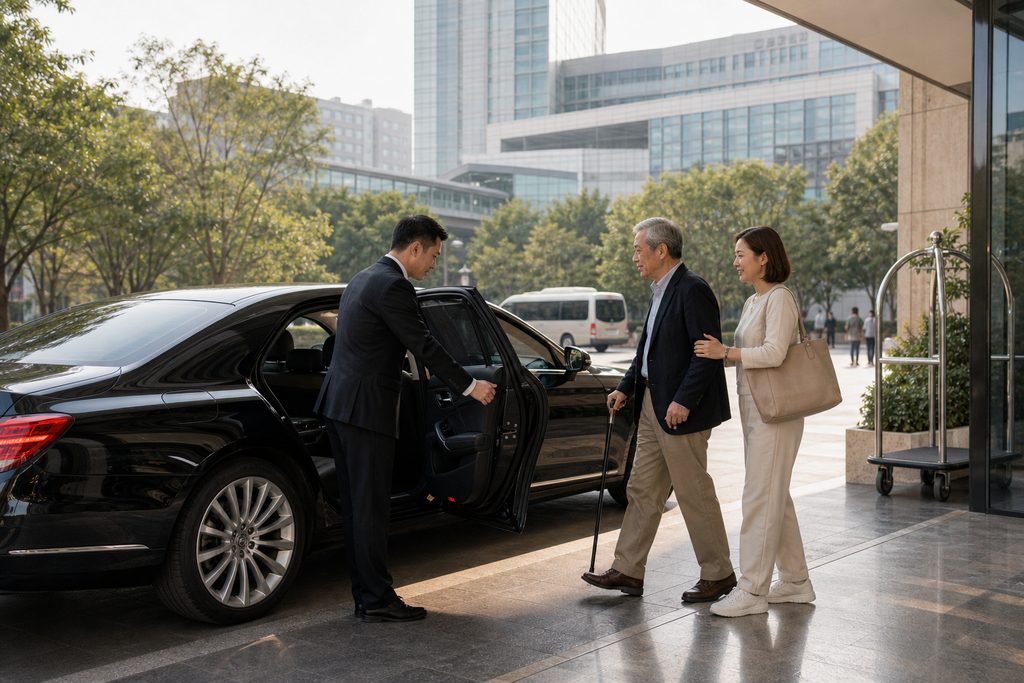
The mechanics are simple in design but rigorous in execution. The night before an appointment, the patient receives a confirmed schedule: pickup time, vehicle plate number, driver contact, and a photo of the exact hotel entrance to use. The vehicle—typically a black Buick GL8 or similar MPV with privacy glass and neutral interior—arrives 15 minutes early. The engine is off. The cabin is pre-cooled in summer or pre-warmed in winter. The driver does not honk. They wait. When the patient exits the lobby, the door is opened. The route has been driven the previous evening to check for road works or diversions. The drop-off sequence at the hospital has been confirmed with the ward coordinator. The patient steps out directly into the care pathway. After treatment, the process reverses: the driver is alerted when the patient is cleared to leave, and the car is brought from a shaded holding area to the pickup point within 5 minutes. No standing on a curb. No negotiating with a driver who does not understand why a 2-kilometer trip matters.
Cost Structure Without Hidden Arithmetic
There is a persistent assumption that luxury medical transport packages China abroad must cost thousands of dollars per day. The reality is more grounded. Our daily chauffeur service starts from $200 for an 8-hour block. That covers the vehicle, fuel, tolls, parking, and the driver’s standby time. It does not layer on surprise surcharges for short trips or multiple stops. A patient undergoing daily radiation therapy for three weeks in Beijing can book a daily driver for cancer therapy in Beijing and know the fixed cost for the entire treatment block. Compare this to the alternative: a single missed fractionated radiotherapy session due to transport failure can compromise the therapeutic ratio of the entire protocol. The economics shift when you measure cost against clinical risk.
What You Need to Know Before Going Alone
The impulse to self-navigate is understandable. But the friction points are real and they compound quickly. Here is what patients encounter when they try to manage medical transport independently:
- Ride-Hailing Refusals: Didi drivers see the trip distance before accepting. A 1.5-kilometer fare from a hotel to a hospital is often rejected by multiple drivers in succession because it is not profitable. For a patient who needs to be at the hospital by 8:00 AM, a 15-minute chain of rejections is a crisis.
- Access Denial: General taxis and ride-hail cars are not permitted to enter the secure underground drop-off zones used by hospital international departments. The patient is dropped at the public entrance, often 200 meters or more from the correct building, with unclear signage in Chinese characters.
- Payment Fragmentation: A patient trying to book a different car for each appointment over a 10-day treatment course will deal with multiple payment holds, varying vehicle quality, and zero continuity. The driver on Day 7 will not know that the patient on Day 3 needed extra time to exit the vehicle due to post-procedure dizziness. Institutional memory matters.
How We Help You Navigate This
Our team handles the full mobility architecture. Before you land, we map every appointment against your accommodation and the hospital’s specific VIP entry points. We pre-register the vehicle and driver with hospital security where required. During treatment, the driver becomes a constant—same face, same car, same quiet understanding that conversation is optional and silence is often preferred. After discharge, if you are recovering at a hotel and need a follow-up blood draw or dressing change, the same vehicle and driver execute the round trip without needing a new briefing. We also integrate the transfer service with our broader coordination: the driver is in direct contact with the bilingual medical companion inside the hospital, so the handover from car to clinic is seamless. This is how the VIP hospital transfer service China price translates into actual value—not a line item for a car, but a guarantee of continuity across a treatment calendar that might span six weeks and 30 appointments. For patients who want to understand the full scope of what a concierge provides, our team lays out every component during the initial consultation. There is no black box. You know what you are paying for and why it exists.
Frequently Asked Questions
The driver is on standby for the full 8-hour block you have booked. There is no penalty for a delayed pickup. We monitor your appointment status through our in-hospital companion and adjust the driver’s positioning accordingly. You will never walk out to find the car gone.
No. The driver’s role is strictly transport and vehicle management. Medical translation requires a separate, trained bilingual medical companion who understands clinical terminology and can accurately convey information between you and the physician. We coordinate both roles so they work as one team, but the functions are deliberately separated to protect clinical accuracy.
For treatment blocks exceeding 20 days, we structure a fixed weekly rate that reduces the per-day cost. The exact figure depends on the city, the distance between your accommodation and the hospital, and the specific hospital’s access protocols. We provide a transparent quote before any commitment is made.
Our standard medical transfer vehicle is a Buick GL8 MPV—high roof, wide door aperture, flat floor entry, and a suspension tuned for smooth urban driving. For patients with mobility restrictions, we can arrange a wheelchair-accessible Toyota Hiace with a ramp. Specific model requests can be accommodated with advance notice, subject to availability in that city.
Your Next Step
A treatment journey in China is a serious undertaking. The clinical decisions belong to you and your doctors. The logistics belong to a team that has executed this hundreds of times. When your daily protocol depends on being in the right place at the right time, a structured transfer service stops being optional. It becomes the quiet engine that keeps everything moving. If you are planning treatment and want to understand how the full coordination works—from airport pickup to daily hospital transfers to departure—our team is ready to walk you through it.
For more medical information and treatment options in China, visit chinamedservices.com (China Medical Services).
