Full Companion for Elderly Patients: Safe Medical Travel Support in China
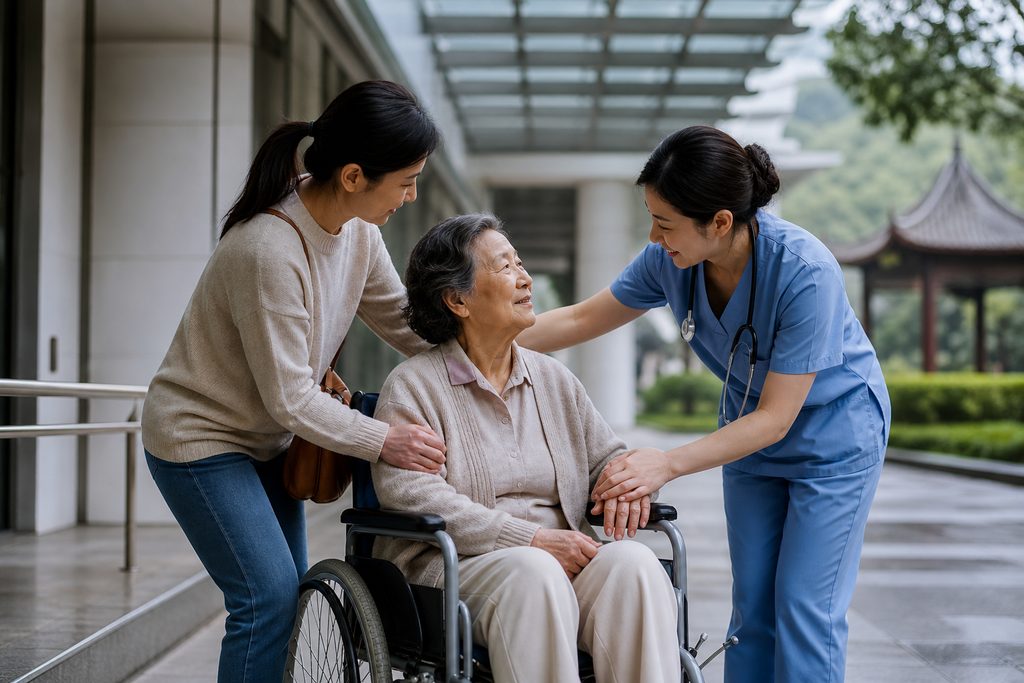
Elderly Companion Care China: The Short Answer
Elderly companion care China means assigning a dedicated bilingual coordinator to an older patient throughout their medical journey — from airport pickup to hospital registration, specialist consultations, inpatient admission, and discharge. For international families, this service typically costs from $300 per day for a bilingual medical companion, with full end-to-end coordination packages running $5,000–8,000 depending on case complexity and hospital tier.
But here is the part most families do not anticipate. A companion in China is not simply a translator who stands beside your parent. The role spans logistics, clinical navigation, payment handling, and emotional reassurance inside hospitals that routinely see 10,000+ outpatient visits daily. Without someone who understands both the medical system and the language, a 75-year-old arriving alone at a Beijing public hospital will struggle at every counter. That reality shapes everything about how this service should be arranged.
Who This Is Right For — and Who It Isn’t
Companion care makes sense in specific situations. It is not a blanket solution for every older traveler.
Typically a good candidate:
- A patient aged 65+ traveling without adult children who speak Mandarin
- Someone with mobility limitations, hearing loss, or cognitive decline that makes independent navigation unsafe
- A family seeking elective surgery or comprehensive health screening at a top-ranked Chinese hospital
- A patient with complex chronic conditions requiring multiple department visits across several days
- Someone recovering from a procedure who needs help with follow-up appointments, medication pickup, and discharge paperwork
Who should not pursue this:
- Patients with unstable acute conditions that require immediate emergency care in their home country — travel itself poses risk
- Individuals whose primary need is long-term daily living assistance, not medical navigation. A medical companion is not a home health aide
- Families expecting a companion to make clinical decisions or override physician instructions. Companions coordinate; they do not diagnose or treat
- Patients with severe cognitive impairment who cannot participate in their own care decisions and lack a legally authorized family representative traveling with them
Being clear about the limits protects everyone. The companion’s value is in removing friction, not replacing medical judgment.
The Options, Compared
Families evaluating how to arrange companion care for elderly in Shanghai or elsewhere in China face three genuine choices. Each carries different cost structures and risk profiles.
| Option | Daily Cost | What You Get | Best For |
|---|---|---|---|
| Bilingual Medical Companion (day rate) | from $300/day | Hospital navigation, queue management, payment assistance, interpretation, appointment-day support | Patients who already have a confirmed hospital plan and need on-the-ground help |
| Hospital Appointment Coordination + Companion | from $300 coordination + $300/day companion | Pre-arrival registration, medical card creation, appointment scheduling, plus in-person support | Families who need the full logistics chain handled before arrival |
| VIP End-to-End Coordination | $5,000–8,000 total | Airport transfers, hospital matching, international department coordination, bilingual companion throughout, discharge support | High-acuity cases, multiple hospital visits, or families wanting a single accountable team |
The day-rate companion suits patients with a clear, single-purpose visit — one consultation, one imaging session, one procedure. The VIP package becomes economical when a stay stretches beyond two weeks or involves multiple hospitals. Most families fall somewhere in between: they want hospital appointment coordination handled remotely first, then a companion on the ground for the actual visit days.
Medical Escort Services for Seniors China: What Actually Happens Day by Day
Understanding medical escort services for seniors China requires walking through a typical visit. Here is what a companion actually does, hour by hour, on a consultation day at a major public hospital like Zhongshan Hospital in Shanghai or Peking Union Medical College Hospital in Beijing.
Before 7:00 AM: The companion arrives early to queue for registration. Top-tier public hospitals release daily registration numbers in person, and the best specialists fill quickly. The companion holds the patient’s passport, medical records, and any pre-arranged appointment confirmations.
7:00–9:00 AM: Registration, hospital medical card creation, and payment of the consultation fee. Many public hospital counters operate in Chinese only. The companion handles all paperwork while the patient waits in a designated seating area.
9:00 AM–12:00 PM: Escort to the correct department floor. Queue management for the specialist consultation. Real-time interpretation of the doctor’s questions, findings, and recommendations. Collection of prescriptions or imaging orders.
12:00–2:00 PM: Payment for any prescribed tests, then navigation to imaging or laboratory departments. This is where companions earn their fee — CT, MRI, and ultrasound departments in large hospitals are often in separate buildings with their own queue systems.
2:00–5:00 PM: Test results pickup where same-day results are available. Return to the specialist for review, or scheduling of a follow-up. Medication pickup at the hospital pharmacy. Translation of all discharge or follow-up instructions into written English for the family.
That is a full day. An elderly patient attempting this alone, without Mandarin, would face genuine hardship at every step. The companion’s role is not luxury — it is functional necessity for many seniors.
Is Companion Care for Elderly Safe in China?
The companion’s protocol includes immediate contact with the family, escort to the nearest appropriate emergency department, and real-time communication with hospital staff. Companions do not make clinical decisions. If the patient requires admission, the companion coordinates with the hospital’s international patient office and keeps the family informed. Emergency care in China is accessible, but families should understand that public hospital emergency departments operate at high volume, and wait times can be significant.
Standard day-rate companions work 8-hour shifts. Overnight presence requires a separate arrangement, typically $450–600 per day, and depends on hospital policies regarding non-family visitors in inpatient wards. Some hospitals restrict overnight companions to one designated family member. The coordination team clarifies ward rules for the specific hospital before the patient travels.
No. A companion handles logistics, navigation, and interpretation. They are not a legal guardian or medical decision-maker. For elderly patients with cognitive impairment or complex treatment decisions, a family member should travel with the patient. The companion supports both of them.
Ask for the companion’s relevant experience with the specific hospital and department your parent will visit. Request a written scope of service. Confirm the escalation protocol for emergencies. Reputable coordination services provide all three without hesitation. If a provider is vague about what happens when something goes wrong, choose another.
Your Next Step
Arranging full companion support for an elderly parent traveling to China is manageable when the pieces are handled in the right order: records first, then hospital matching, then visa, then the human support on the ground. Our team at China Medical Services coordinates bilingual medical companions, hospital appointment scheduling, and pre-arrival documentation for families across 37 cities and 340+ top-ranked hospitals. We are not a hospital and we do not provide diagnoses or treatment. We handle the logistics so your parent can focus on the medical care itself.
If you are weighing this decision, start with a conversation. Describe the situation, ask the hard questions, and see whether the plan makes sense before committing to anything. That conversation costs nothing and clarifies everything.
Frequently Asked Questions
Yes. The hospitals used for international patients are JCI-accredited and follow the same international safety standards as top hospitals in the US and Europe. Surgical teams perform high volumes of procedures — often more than their Western counterparts — which studies show leads to better outcomes.
Costs vary by procedure and hospital, but international patients typically save 40-80% compared to US prices — even when factoring in travel and accommodation. A consultation with our team will give you an exact, all-inclusive quote with no hidden fees.
Send us your existing medical reports to get started. We handle everything from hospital selection and appointment scheduling to visa assistance and post-operative recovery planning. Your medical records are reviewed by the specialist before you even book a flight.
For more medical information and treatment options in China, visit chinamedservices.com (China Medical Services).
