Children: A Companion in the Room During Pediatric Surgery in China
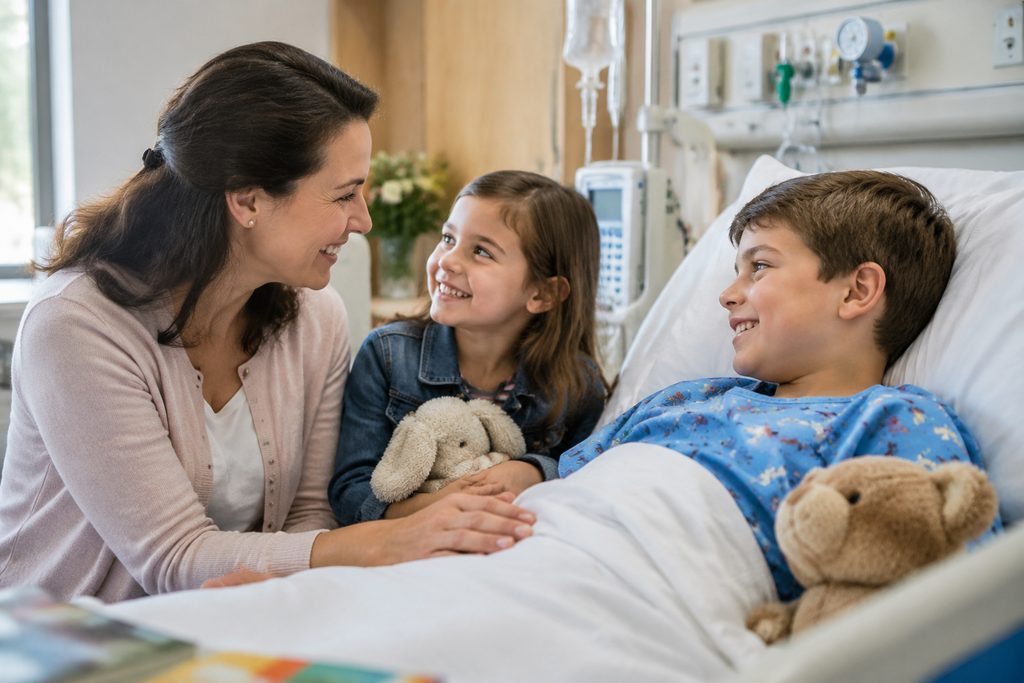
You have probably heard that taking a child abroad for surgery means handing them over to strangers at the operating room doors. The reality at China’s top pediatric centers is different. A parent or guardian is often present right up until anesthesia begins, and back at the bedside within minutes of the child leaving the recovery room. That changes the entire experience.
Parents searching for pediatric surgery cost China are usually not just comparing prices. They are comparing systems. They want to know whether a hospital in Shanghai or Beijing will let them stay with their child overnight, whether the nursing model matches what they expect at home, and whether a lower bill means a lower standard of care. These questions deserve direct answers.
How This Actually Works, Step by Step
The process starts with records, not travel. You send us the child’s existing diagnostic reports — imaging, lab work, physician notes, anything already done at home. A pediatric specialist at a partner hospital reviews those documents and tells us whether the case is appropriate for treatment in China. That written assessment usually takes five to ten working days.
If the specialist says the case is feasible, we move to a video consultation. You speak directly with the treating team. You ask about the surgical approach, the expected hospital stay, the complication rate for that specific procedure at that specific center. Nothing is promised at this stage. You are building the information you need to decide.
Only after you decide to proceed do we coordinate the practical steps: hospital registration, admission scheduling, visa support documents, and a bilingual medical companion for the days you are in the hospital. The companion handles queueing, payment counters, pharmacy runs, and translation. You stay with your child.
Can a Parent Stay with a Child During Hospital Treatment in China?
At most top-tier pediatric wards in China, the answer is yes — but the arrangement differs from Western hospitals in ways that matter. Public hospital pediatric wards typically assign one parent or guardian as the designated bedside caregiver. You sleep in the room, often on a fold-out cot beside the child’s bed. Nursing staff handle medical tasks; you handle comfort, feeding, and emotional support. This is the norm, not a special request.
Private international hospitals and the international departments of public hospitals offer more flexible arrangements. Rooms are often single-occupancy with a proper parent bed. Some allow both parents to stay. The trade-off is cost: international department room rates run roughly 1.5 to 2 times the standard ward rate, and that gap widens for private facilities like United Family or Jiahui.
One thing to clarify early: the parent who stays is usually the one who signed the admission consent. If both parents travel, only one may be permitted in certain intensive care settings. Pediatric ICUs in China have visiting windows, not open access. A child coming out of major surgery may spend the first 12 to 24 hours in a unit where parents visit at scheduled times rather than staying continuously. Ask about this before you book flights.
How Safe Is Pediatric Heart Surgery in China?
The question deserves a precise answer, because it is the one parents ask most often. China’s top cardiac centers operate at volumes that would be extraordinary anywhere in the world. Fuwai Hospital in Beijing performs more than 14,000 cardiac surgeries annually, and its pediatric program handles complex congenital cases referred from across Asia. Volume matters in pediatric heart surgery. Teams that repair a specific defect hundreds of times a year have complication rates that reflect that repetition.
Safety, however, is not just about the surgeon. It is about the perfusion team, the pediatric anesthesiologists, the ICU nursing ratios, and the post-operative monitoring. The best Chinese centers match international benchmarks on these measures. Several children’s hospitals in Shanghai and Beijing hold JCI accreditation, which requires meeting standards for pediatric patient safety, medication protocols, and family communication.
What parents should ask: How many of this exact procedure does the center perform per year? What is the center’s 30-day mortality rate for this condition? What is the reoperation rate? Reputable centers will give you these numbers. If a hospital will not share its volume data, that is information too.
A Realistic Timeline
Parents underestimate the pre-travel phase. Records must be gathered, translated into Chinese, and reviewed. A visa takes time. The hospital has its own scheduling constraints. Here is what a typical journey looks like for a planned, non-emergency pediatric procedure:
| Stage | What Happens | Typical Duration |
|---|---|---|
| Week 1–2 | Collect and submit medical records; arrange professional translation | 3–10 working days |
| Week 2–4 | Specialist document review; written assessment returned | 5–10 working days |
| Week 3–5 | Video consultation with treating team; treatment plan discussion | 30–60 minutes, scheduled within 1–2 weeks of request |
| Week 4–6 | Hospital issues invitation letter; S2 visa application submitted | Visa processing: 4–10 working days depending on embassy |
| Week 6–8 | Arrival in China; in-person specialist consultation; pre-op testing | 2–4 days before admission |
| Week 8–10 | Admission, surgery, hospital recovery | 5–14 days inpatient, procedure-dependent |
| Month 3 | Follow-up imaging or video review with surgical team | Remote or short return visit |
Emergency cases move faster, but planned pediatric surgery rarely happens within two weeks of first contact. The document review and visa steps cannot be skipped.
What Can Go Wrong — and What Happens Then
The honest failure modes are worth naming. A hospital may decline the case after document review — the condition is too advanced, the surgical risk too high, or the center has no clear advantage over what is available at home. That is a frustrating outcome after weeks of waiting, but it is also the system working. A second opinion that says “do not travel” has value.
Visa delays happen. The S2 visa, used for short-term private affairs including medical treatment, requires a hospital invitation letter and supporting documents. Embassies process at different speeds. If the visa arrives late, the hospital admission date shifts. We handle rescheduling; you handle the changed flights.
Clinical complications occur in every health system. China’s top pediatric centers have the infrastructure to manage them — that is part of why you choose a high-volume center. But parents should understand that a complicated post-operative course may extend the hospital stay beyond the original estimate. Travel insurance with medical extension coverage matters.
And then there is the language barrier. Even in international departments, not every nurse speaks English. A bilingual companion who stays with you through admission, surgery day, and discharge removes a layer of stress that parents do not need. You are already managing enough.
Book Pediatric Neurosurgery Package Beijing: What That Actually Means
Parents searching for a way to book pediatric neurosurgery package Beijing are usually looking for certainty: a fixed scope, a fixed price, a fixed date. The reality of Chinese public hospitals is that no one can guarantee a specific surgeon on a specific date before the child has been seen in person. That is the rule, not an exception.
What a “package” can include is the coordination layer: document review, video consultation, visa support, airport transfer, bilingual companion, hospital admission coordination, and post-discharge follow-up. Coordination fees for in-person top-specialist consultations typically range from $800 to $1,200. Video consultations with a top specialist run $500 to $800. These are service fees, not treatment charges. Hospital costs are billed separately by the hospital.
Beijing’s pediatric neurosurgery strength sits in centers like Tiantan Hospital and the pediatric units of major university hospitals. For parents evaluating options, the Fudan specialty rankings are a useful starting point — they rank hospitals by clinical reputation within 45 specialties, including neurosurgery. Our department pages organize those rankings by specialty so you can see which centers appear repeatedly at the top.
Best Children’s Hospital Shanghai for Foreigners: Evaluating the Options
Shanghai has three categories of pediatric care relevant to international families. The first is the public children’s hospitals — large, high-volume, and clinically strong. The second is the international departments within those public hospitals, which offer English-speaking coordination and private rooms at 1.5 to 2 times the standard rate. The third is private international hospitals with JCI accreditation, direct insurance billing, and Western-style care models.
The best children’s hospital Shanghai for foreigners depends on the child’s condition. A complex congenital heart defect belongs at a high-volume public cardiac center. A routine orthopedic procedure might be perfectly handled at a JCI-accredited private hospital with English-speaking staff. The right answer is condition-specific, not a single brand name.
Several children’s hospital JCI accredited China facilities operate in Shanghai, Beijing, and Guangzhou. JCI accreditation means the facility passed an external audit covering patient safety, infection control, medication management, and family rights. It is a meaningful signal, though not the only one. A hospital can be excellent without JCI accreditation, and a JCI-accredited hospital can still be the wrong choice for a rare condition.
Practical Considerations: Records, Visa, Payment, and Follow-Up
Medical records must be translated into Chinese before the first specialist review. Professional medical translation is not the same as general translation — terminology errors change meaning. Budget $100 to $300 for a complete record set, depending on volume.
The visa category for pediatric treatment is S2, issued for short-term private affairs including medical treatment. The accompanying parent applies under the same category. Processing takes four to ten working days at most embassies, but you need the hospital’s invitation letter first. We guide you through the document sequence so the visa application does not stall on missing paperwork.
Payment works differently than at home. Public hospitals require pre-payment — you deposit funds at admission and the hospital draws down as services are delivered. International departments and private hospitals may accept direct billing from international insurers. Check with your insurer before travel. Most public hospital charges are reimbursed after the fact, not settled directly.
Follow-up matters more than parents expect. The surgical team will want imaging or video follow-up at one month and three months. Some of that can happen remotely. Some requires a return visit. Factor that into your planning before you commit.
For families still comparing destinations, our top hospital database covers 340+ top-ranked hospitals across 37 cities, drawn from the Fudan rankings and JCI accreditation lists. It is a starting point, not a substitute for a specialist review of your child’s specific case.
Frequently Asked Questions
Yes, in most pediatric wards one parent or guardian is designated as the bedside caregiver and sleeps in the child’s room. Private international hospitals and international departments often provide a proper parent bed; standard public wards may use a fold-out cot. Pediatric ICU visiting is more restricted, typically with set visiting windows rather than continuous access.
Pediatric surgery cost China typically runs one-fifth to one-tenth of the equivalent US price. A procedure billed at $100,000 in the United States might cost $12,000 to $20,000 at a top Chinese public hospital. International departments and private hospitals charge more — roughly 1.5 to 2 times standard public rates — but remain well below US prices. Final costs vary by hospital, procedure complexity, and length of stay.
At top-tier centers, the surgical and anesthetic teams are highly trained, and many senior physicians speak functional English. The gap is in day-to-day ward communication — nurses, pharmacy staff, and administrative counters. A bilingual medical companion closes that gap. The clinical safety of the procedure depends on the center’s volume and protocols, which you should verify before committing.
This is why the remote review step exists. The specialist document review and video consultation happen before you book flights. If the case is not appropriate, you learn that from home, not from a hospital waiting room in Shanghai. That said, a final in-person assessment can still change the plan — a surgeon may want additional imaging or a different approach. Travel insurance with medical coverage protects you against the unexpected.
Both the child and the accompanying parent need visas. The S2 visa covers short-term private affairs including medical treatment for both patient and family members. The hospital provides an invitation letter that supports the application. Processing times vary by embassy, so start the visa step as soon as the hospital confirms the admission plan.
Your Next Step
Bringing a child to China for surgery is a serious decision, and the right first move is information, not commitment. China Medical Services connects international families with top-tier Chinese pediatric hospitals. We do not perform medical procedures and we do not promise outcomes. What we do is handle the coordination — records, specialist review, video consultation, visa support, bilingual companionship — so you can focus on your child.
If you want a clear-eyed assessment of whether treatment in China makes sense for your child’s specific condition, start with the records. Send us what you have. We will tell you what is possible, what it costs, and what the timeline really looks like. No pressure. Just answers.
For more medical information and treatment options in China, visit chinamedservices.com (China Medical Services).
