Hospital Matching: Teaching Hospitals Explained for Foreigners
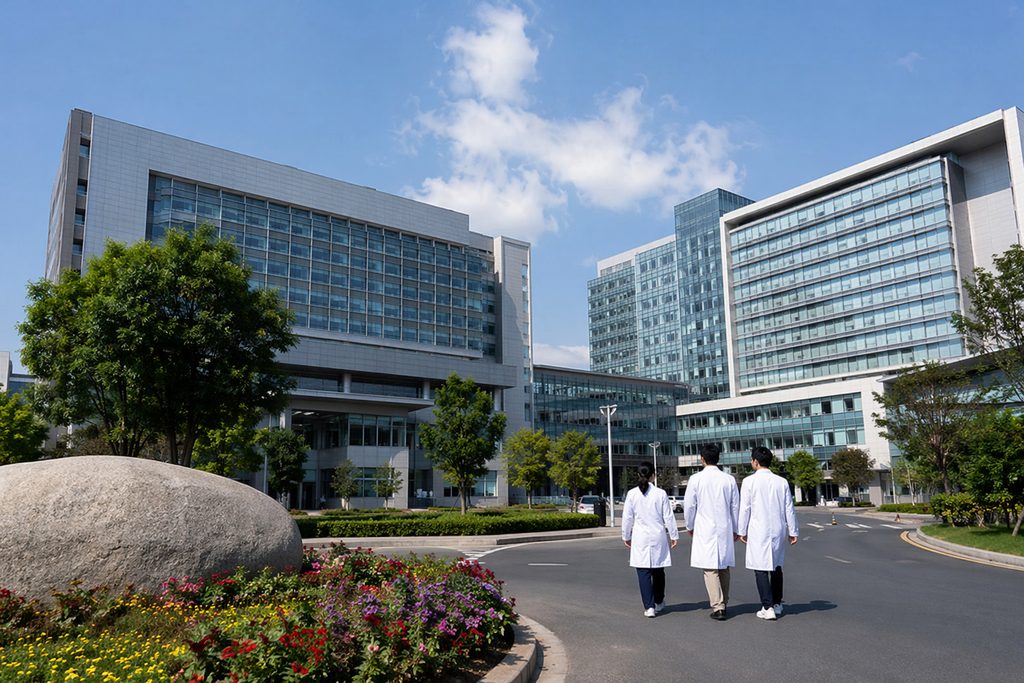
When Daniel, a 58-year-old engineer from Manchester, started researching cardiac care options abroad, the term “teaching hospital” kept appearing in every search result. He had no idea what it meant in the Chinese context. Was it a training facility? A research institute? Would he be treated by students? The confusion nearly sent him back to his local NHS waiting list. What he eventually discovered changed his entire medical plan.
A teaching hospital in China is not a training ground. It is the top tier of the public medical system. These are university-affiliated hospitals where senior professors run departments, clinical research shapes treatment protocols, and surgical volumes rank among the highest in the world. The teaching hospital China cost is typically 20–40% higher than a standard public hospital but still 70–90% lower than comparable care in the United States or Western Europe.
What Is a Teaching Hospital in China: The Short Answer
A teaching hospital in China is a public hospital affiliated with a medical university. It serves three functions simultaneously: patient care, medical education, and clinical research. The doctors treating you are faculty members — associate professors and full professors who teach medical students, supervise residents, and publish peer-reviewed research. You are not being treated by students. You are being treated by the people who write the textbooks.
That distinction matters enormously for international patients. The attending physician in a Chinese teaching hospital typically sees 60–100 outpatients per day and performs hundreds of procedures annually. Volume drives competence. Fuwai Hospital in Beijing, a teaching hospital affiliated with Peking Union Medical College, performs over 14,000 cardiac surgeries every year — the highest volume of any heart center globally.
But the system has sharp edges. These hospitals are crowded. Registration happens the same day for ordinary outpatient clinics. You cannot book a specific professor from overseas through the standard public channel. That is where the teaching hospital China cost question gets complicated — because the price depends entirely on which channel you use.
Who This Is Right For — and Who It Isn’t
Teaching hospitals suit a specific profile. Knowing whether you fit saves time and money.
Good candidates:
- Patients with complex or high-risk conditions requiring senior surgical expertise — cardiac bypass, valve replacement, tumor resection, complex orthopedic reconstruction
- Patients who have a confirmed diagnosis and imaging but face long wait times at home
- Patients seeking a written second opinion from a top-ranked specialist before committing to surgery
- Patients who want access to high-volume centers for procedures where surgeon experience directly predicts outcomes
- Families accompanying a patient — the S2 visa covers both patient and accompanying relatives
Who should not pursue this:
- Patients with unstable conditions requiring immediate emergency care — a cross-border trip adds days, not hours
- Patients seeking cosmetic or elective procedures better served by private international hospitals with English-speaking staff and direct insurance billing
- Patients who cannot tolerate a 2–4 week stay for evaluation, surgery, and early recovery
- Patients without a confirmed diagnosis — you will still need in-person evaluation before any surgical plan is finalized
- Patients expecting Western-style privacy and individual attention — public teaching hospitals are efficient but not luxurious
One sentence captures the trade-off: you come for the surgeon’s hands, not the hospital’s hospitality.
The Options, Compared
When foreigners ask how do teaching hospitals work for foreigners, the honest answer is: through three distinct access routes. Each has different pricing, different wait times, and different levels of service.
| Access Route | Typical Cost (USD) | Wait Time | Language Support | Best For |
|---|---|---|---|---|
| Standard public outpatient | $15–50 per visit | Same-day registration, hours of queueing | Mandarin only | Budget-conscious patients with Mandarin ability |
| Hospital international department / VIP clinic | $100–400 per visit | 3–10 days with coordination | English-speaking staff | Most international patients |
| Private international hospital (e.g., United Family, Jiahui) | $200–600 per visit | 1–3 days | Full English service | Routine care, diagnostics, non-surgical treatment |
If you need complex surgery from a top-ranked specialist, the international department of a teaching hospital is the sweet spot. You get the same professor who operates in the public wing, but with English coordination, scheduled appointments, and shorter queues. Expect to pay roughly 1.5–2 times the standard public fee. For a cardiac bypass, that means $18,000–30,000 instead of $12,000–20,000 — still a fraction of the $120,000+ billed in the United States.
If your condition is straightforward and you value comfort over prestige, a private international hospital may serve you better. But private hospitals in China rarely handle the most complex surgical cases. The top surgeons work in teaching hospitals.
How Do Teaching Hospitals Work for Foreigners: The Booking Reality
Here is the part most articles gloss over. Ordinary outpatient clinics in Chinese teaching hospitals do not accept advance bookings from overseas. You show up at 6:00 AM, queue for a registration ticket, and hope the department you need still has slots. Even then, you are assigned whichever doctor is on duty that day. You do not choose.
For a foreigner without Mandarin, this is a non-starter. The pragmatic route is the hospital’s international department or VIP clinic. These units exist precisely because the hospital knows foreign patients cannot navigate the standard system. They employ bilingual coordinators, offer scheduled appointments, and can arrange imaging and lab work on the same day.
But even the international department cannot guarantee a specific professor on a specific date. Senior surgeons split their time between operating theaters, academic duties, and outpatient clinics. Their schedules are set 2–4 weeks in advance. That is why remote evaluation matters. A written second opinion or video consultation lets the specialist review your records first, confirm your case is appropriate, and then propose realistic dates. You avoid flying to China only to discover the surgeon is away at a conference.
This is also where the difference between “booking an appointment” and “booking a surgery” becomes critical. In a Chinese teaching hospital, surgery is never scheduled before an in-person outpatient evaluation. The surgeon must see you, review your imaging, and confirm the operative plan. No legitimate service can promise a surgery date from overseas. What a coordination service can do is arrange the outpatient consultation, prepare your medical records in Chinese, and have a bilingual companion with you on the day.
Best Teaching Hospitals in Beijing: Where the Volume Lives
Beijing hosts 21 of the Fudan-ranked Top 100 hospitals — more than any other city. If your condition is cardiac, oncologic, or neurological, the capital is where you will find the deepest bench of senior specialists.
The flagship names matter. Peking Union Medical College Hospital (PUMCH) is the reference center for complex internal medicine and rare diseases. Fuwai Hospital handles more cardiac surgeries than any center on earth. Beijing Tiantan Hospital is a global leader in neurosurgery. Beijing Cancer Hospital ranks among China’s top 10 for oncology in the Fudan specialty reputation rankings.
And here is a fact that surprises many Western patients: these hospitals are not small. PUMCH sees over 10,000 outpatient visits per day. The scale is staggering. That is why showing up without preparation is a recipe for exhaustion. You need a plan, a translator, and realistic expectations about wait times even in the VIP clinic.
For a detailed breakdown of ranked institutions across all specialties, our Top Hospitals database groups Fudan-ranked hospitals by city with their specialty strengths.
University Hospital Shanghai Price List: What You Actually Pay
Shanghai has 18 Fudan Top 100 hospitals — the second-highest concentration in China. Institutions like Zhongshan Hospital (Fudan University), Ruijin Hospital (Shanghai Jiao Tong University), and Huashan Hospital are household names in Chinese medicine. The university hospital Shanghai price list varies by department and access channel, but the structure is consistent.
Here is what a typical international patient pays at a Shanghai teaching hospital’s international department:
- Outpatient consultation with a senior specialist: $150–350
- MRI: $300–600
- CT scan: $150–300
- Comprehensive blood panel: $80–200
- Inpatient ward (standard private room): $150–400 per night
- Cardiac bypass surgery (all-inclusive, uncomplicated): $18,000–30,000
- Total knee replacement: $15,000–25,000
- Laparoscopic cholecystectomy: $4,000–7,000
These figures are ranges, not quotes. Final pricing depends on case complexity, implant choices, length of stay, and whether complications arise. Always request an itemized estimate before committing. And remember: public teaching hospitals require prepayment. You settle the bill before discharge, then file a claim with your insurer. Private international hospitals are the ones that offer direct billing.
For patients considering Shanghai specifically, our Shanghai city guide breaks down the hospital landscape by specialty and access channel.
Book Appointment Teaching Hospital Guangzhou: Southern China’s Hub
Guangzhou holds 10 Fudan Top 100 hospitals — the third-largest cluster. The city is the medical capital of southern China, drawing patients from Southeast Asia, the Middle East, and Africa. Its proximity to Hong Kong also makes it a convenient entry point.
The leading institutions are Sun Yat-sen University Cancer Center (one of China’s top oncology centers), the First Affiliated Hospital of Sun Yat-sen University, and Nanfang Hospital. For international patients trying to book appointment teaching hospital Guangzhou, the same rule applies as in Beijing and Shanghai: use the international department, not the standard public channel.
Guangzhou’s international departments tend to be slightly less expensive than Beijing’s — often 10–20% lower for equivalent consultations. The climate is subtropical, which some patients find easier for post-operative recovery, especially in winter months. And the city’s long history of international trade means more English-speaking support staff in hotels, transport, and hospitality than in most Chinese cities.
If your condition is oncologic, Guangzhou deserves serious consideration. Sun Yat-sen University Cancer Center treats more than 100,000 new cancer patients annually and runs one of China’s largest clinical trial programs. For a patient who has exhausted standard options at home, access to trial protocols not yet available in Western markets can be a decisive factor.
Teaching Hospital China Cost: What Drives the Price
Let’s address the teaching hospital China cost question head-on. Why does one patient pay $3,000 and another $30,000 for the same procedure at the same hospital?
Four variables explain most of the variance:
Access channel. Standard public outpatient care costs a fraction of the international department. The medical staff is the same. What you are paying for is scheduling, language support, and reduced waiting. That premium is real and worth it for most foreigners.
Surgeon seniority. A department chair with 30 years of experience commands a higher consultation fee than a junior attending. In the international department, that difference can be $100–300 per visit. For surgery, the senior surgeon’s fee may add $2,000–5,000 to the total.
Implants and consumables. This is the biggest wildcard. A standard hip implant might cost $3,000. A premium ceramic-on-ceramic implant from a Western manufacturer could be $8,000. Chinese hospitals typically offer both domestic and imported options. You choose, but the price difference is substantial.
Length of stay and complications. An uncomplicated cardiac bypass means 7–10 days in hospital. An infection or arrhythmia adds days and costs. No hospital can quote a fixed price for surgery with certainty. Reputable ones provide a range and explain what could push you to the upper end.
Practical tip: Always ask for a written cost estimate that separates surgeon fees, hospital fees, implant costs, and estimated length of stay. This makes it easier to compare offers and to file an insurance claim afterward.
Practical Considerations: Records, Visa, Payment, and Follow-Up
Before you book anything, get your paperwork in order. Chinese teaching hospitals require a complete medical record: imaging (DICOM format preferred), pathology reports, lab results, and a summary letter from your treating physician. All of it must be translated into Chinese for the senior specialist to review efficiently. A bilingual medical companion or coordination service can handle this translation — it is not a DIY task unless you are fluent in medical Mandarin.
Visa comes next. Foreigners seeking medical treatment in China apply for an S2 visa, which is issued for short-term private affairs including medical treatment. Accompanying family members apply under the same category. The S2 visa typically allows stays of up to 180 days. For treatment extending beyond that, an S1 visa applies. The hospital’s international department will provide an invitation letter and treatment confirmation document to support your application. No visa category guarantees approval — the embassy or consulate decides each case on its merits.
Payment is straightforward but inflexible. Public teaching hospitals, including their international departments, require prepayment. You deposit an estimated amount upon admission, and the hospital draws down against it. Insurance reimbursement happens after discharge — the hospital provides itemized invoices and medical reports, which you submit to your insurer. Some international departments have relationships with major insurers and can provide the documentation in English. Do not expect direct billing at a public teaching hospital.
Language is the final hurdle. Even in the international department, not every nurse, technician, or pharmacist speaks English. The senior doctor likely does. The radiology tech probably does not. A bilingual companion who stays with you through registration, imaging, payment, and discharge removes a layer of stress that compounds quickly when you are already unwell. The cost — from $300 per day — is often the best money spent on the entire trip.
Follow-up after you return home is the piece most patients forget to plan. Your Chinese surgeon will want post-operative imaging and lab results at defined intervals. You will need a local physician willing to order those tests and share results. Before you leave China, ask for a written follow-up protocol in English and confirm how to reach the department with questions. Most international departments provide an email contact for post-discharge queries.
Frequently Asked Questions
You can request a specific specialist through the hospital’s international department or a coordination service, but confirmation depends on the professor’s schedule. Senior surgeons set their outpatient and operating schedules 2–4 weeks ahead. A written second opinion or video consultation is the most reliable way to confirm your case is appropriate for that specific doctor before you travel. No legitimate service can guarantee a named surgeon on a specific date from overseas.
Teaching hospitals are public, university-affiliated, and staffed by senior academic physicians. They handle the most complex cases and the highest surgical volumes. Private international hospitals offer Western-style comfort, English-speaking staff, and direct insurance billing, but their surgical depth is shallower. For complex cardiac, oncologic, or neurosurgical care, the teaching hospital is the stronger choice. For diagnostics, routine procedures, or comfort-focused care, the private option may suit you better.
Chinese teaching hospitals have standard complication management protocols, and their intensive care units are well-equipped. But you are far from home, and the legal framework for medical disputes differs from Western systems. You should carry comprehensive medical travel insurance that covers complications, extended hospitalization, and medical evacuation. Ask your insurer specifically about coverage in China before you travel. No hospital or coordination service can guarantee a complication-free outcome.
Yes, the standard public outpatient fee is $15–50 per visit. But you will queue for hours, communicate in Mandarin, and be assigned whichever doctor is on duty. For a complex surgical case, that is a false economy. The international department costs more but gives you scheduled appointments, English coordination, and access to the same senior specialists without the chaos. Most international patients find the premium justified.
Plan for 2–4 weeks minimum. That includes 2–3 days for initial consultation and pre-operative testing, the surgery itself, 5–10 days of inpatient recovery depending on the procedure, and a short period of outpatient follow-up before you are cleared to fly. Complex cardiac or orthopedic procedures may require closer to 4–6 weeks. Your surgeon will advise on a safe timeline for air travel based on your specific case.
Your Next Step
The decision to pursue
For more medical information and treatment options in China, visit chinamedservices.com (China Medical Services).
