Virtual Tumor Board Service China: Multiple Specialists Review Your Cancer Case Remotely
When 42-year-old Michael first heard the diagnosis — stage III colorectal cancer with liver metastases — his oncologist in Manchester laid out a single treatment pathway. Surgery, then chemotherapy. Standard protocol. But Michael had read about different sequencing approaches. Should chemotherapy come first to shrink the tumors? Was aggressive surgery the right call given the spread? His doctor was excellent, but one opinion felt insufficient for a decision that would define the rest of his life. He needed multiple specialists to weigh in. He needed a tumor board.
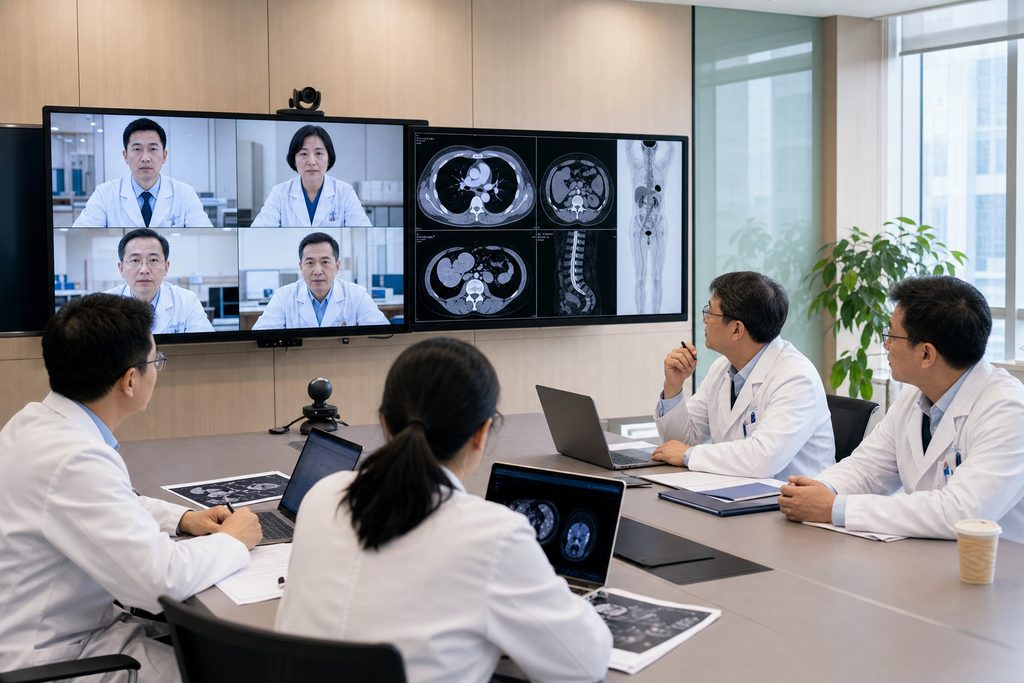
That is exactly what a virtual tumor board service China provides. Instead of traveling 5,000 miles, Michael’s complete case file — imaging, pathology slides, genomic reports, treatment history — was reviewed simultaneously by three Chinese oncologists from a top-ranked cancer center. A surgical oncologist. A medical oncologist. A radiation specialist. They debated his case. They reached a consensus. They delivered a unified recommendation within ten days.
The virtual tumor board China price makes this accessible. It starts from $1,500. For context, a single in-person specialist consultation at a major US cancer center often runs $800–1,200 without insurance. Here, you get three to five specialists, a structured deliberation, and a written consensus report — for roughly the cost of one and a half American consultations.
This article explains how the process works, what it costs, which hospitals participate, and what you should know before submitting a case.
Key Takeaways
- Virtual tumor boards in China connect you with 3–5 oncology specialists from hospitals ranked among China’s top 10 for cancer care, delivering a consensus opinion within 7–14 days.
- The virtual tumor board China price ranges from $1,500 to $2,000 — roughly 60–80% less than equivalent multi-specialist reviews in the US or Europe.
- Chinese oncologists at major cancer centers manage case volumes that far exceed Western benchmarks. A thoracic surgeon at a top Chinese hospital may perform 400+ lung cancer resections annually, compared to 50–80 for a typical US counterpart.
- Language barriers, medical record formatting, and visa logistics are real obstacles. Working with a coordination service that handles translation and hospital liaison is not optional — it is essential for a usable result.
The Problem: One Opinion Is Not Enough When the Stakes Are This High
Cancer treatment has grown staggeringly complex. Twenty years ago, a patient with locally advanced lung cancer might see a surgeon and get surgery. Today, that same patient might need input from a medical oncologist about neoadjuvant immunotherapy, a radiation oncologist about stereotactic options, and a molecular pathologist about targetable mutations. No single physician — no matter how skilled — can hold all of this in their head.
Yet the standard model in most countries remains: one patient, one oncologist, one treatment plan.
A 2021 study published in the *Journal of Clinical Oncology* found that when breast cancer cases were reviewed by a multidisciplinary tumor board, the treatment plan changed in 43% of cases. Not tweaked. Changed. Different surgery. Different systemic therapy. Different sequencing. Nearly half the time, multiple eyes caught something a single clinician missed.
The problem is access. Tumor boards exist in every major academic medical center, but they are internal. They review cases from within the institution. If you are a patient in Manchester, or Miami, or Melbourne, you cannot simply request that a tumor board at MD Anderson or Memorial Sloan Kettering review your file. Those boards serve their own patients.
This is where a virtual tumor board service China changes the equation. It opens a door that has traditionally been closed to international patients — direct access to multi-specialist deliberation at hospitals that handle some of the highest cancer volumes on the planet.
Who We Are
We are not a hospital. We do not provide medical treatment, prescribe therapies, or offer clinical diagnoses. Our team functions as your logistical architects — we bridge the gap between you and China’s top-tier oncology expertise. We translate your medical records into clinical Chinese, identify the appropriate tumor board at a hospital ranked among China’s best for your specific cancer type, coordinate the multi-specialist review, and deliver the consensus report back to you in clear, actionable English. We handle the complexity so you get the clarity.
What Is a Virtual Tumor Board for Cancer — and How Does the China Model Work?
Let us define the term precisely. A tumor board — sometimes called a multidisciplinary team meeting or MDT — is a structured conference where specialists from different oncology disciplines review a single patient’s case together. The radiologist presents the imaging. The pathologist discusses the tissue findings. The surgeon, medical oncologist, and radiation oncologist each contribute their perspective. They debate. They reach a consensus. The output is a unified treatment recommendation, not three separate opinions that the patient must somehow reconcile on their own.
The virtual version removes geography from the equation. Your case file is digitized, translated, and distributed to the participating specialists before the conference. They review it independently. Then they meet — either in person or via secure video — and deliberate. You receive a written report summarizing their discussion, their areas of agreement, any points of disagreement, and their final consensus recommendation.
How does multi-specialist cancer review work in China specifically?
The process follows the same clinical rigor as an in-person tumor board at a major Chinese cancer center. The difference is that the patient is not physically present. Here is the typical workflow:
Your complete medical file is collected — imaging studies in DICOM format, pathology slides (which can be shipped or digitally scanned), surgical reports, lab results, genomic sequencing data if available, and a summary of treatments received to date. Our team translates every document into clinical Chinese, paying particular attention to pharmaceutical names (which differ between markets), lab reference ranges, and terminology that does not have a one-to-one translation.
The translated file goes to the tumor board coordinator at the selected hospital. Participating specialists — typically three to five physicians — receive the file at least 72 hours before the conference. They review it independently. Then they convene, either in a physical conference room with a video link for any remote participants, or entirely via secure telemedicine platform. The session usually runs 45 to 90 minutes per case.
You receive a written consensus report in English, typically within 7–14 days of submitting your complete file. The report names the participating specialists, summarizes the key discussion points, and states the agreed-upon recommendation. It is a medical document intended for your treating physician at home — not a prescription, but a structured expert opinion that your local oncologist can evaluate and potentially implement.
Why Chinese Oncologists Deliver Exceptional Tumor Board Reviews
The question patients often ask us, phrased delicately, is: why China? They have access to oncologists at home. They could seek a second opinion from a major Western cancer center. What makes a remote oncology consultation China best hospitals worth pursuing?
The answer rests on three structural advantages that are difficult to replicate elsewhere.
Case Volume That Builds Pattern Recognition
Chinese oncologists at top-tier cancer centers see volumes that are hard to comprehend from a Western perspective. The cancer hospital affiliated with Fudan University in Shanghai treats over 150,000 cancer patients annually. A single thoracic surgery department at a major Chinese cancer center may perform more lung cancer resections in one year than an entire mid-sized European country.
Why does volume matter? Because cancer is not one disease. It is thousands of rare subtypes, each with its own biological behavior and treatment response. A surgical oncologist who has managed 50 cases of a particular rare presentation has seen patterns that a colleague who has managed 5 cases simply cannot recognize. The literature captures broad principles. Volume builds intuition for the exceptions — and cancer treatment lives in the exceptions.
A 2020 analysis in *The Lancet Oncology* examined the relationship between hospital surgical volume and long-term survival for esophagectomy patients. Hospitals in the highest-volume quartile showed 30-day mortality rates below 1%. Those in the lowest quartile exceeded 8%. The pattern holds across nearly every complex cancer surgery. Volume is not everything, but it is a hard proxy for experience. Chinese cancer centers operate in the highest volume tier globally.
Technology Adopted at Speed and Scale
China’s hospital system has undergone an infrastructure transformation over the past fifteen years. The equipment in a top-ranked Chinese cancer center — linear accelerators for radiation, robotic surgical systems, PET-CT scanners, next-generation sequencing platforms — matches or exceeds what you would find at leading Western institutions. The difference is the pace of adoption and the scale of deployment.
A single large Chinese cancer hospital may operate six or more linear accelerators for radiation therapy. Most Western centers manage with two or three. This capacity means shorter waits for treatment initiation and more bandwidth for complex techniques like stereotactic body radiation therapy (SBRT) or intensity-modulated radiation therapy (IMRT).
For tumor board purposes, this matters because the specialists reviewing your case are working in an environment where advanced technologies are routine, not exceptional. They are not asking “is this technology available?” — they are asking “is this technology appropriate for this specific patient?” That is a more useful conversation.
Cost Structure Without Quality Compromise
Let us address the elephant in the room directly. The virtual tumor board China price is lower than equivalent services in the US or Europe — $1,500 to $2,000 versus $5,000 to $10,000 or more for a multi-specialist review at a major Western cancer center. Does lower cost imply lower quality?
No. The cost difference reflects structural economics, not clinical compromise. Chinese specialist physicians earn less than their American counterparts — not because they are less skilled, but because the overall compensation structure in Chinese academic medicine is different. Hospital operating costs are lower. Malpractice insurance burdens are lighter. These savings pass through to the patient without touching the quality of the clinical deliberation.
Think of it this way: the same CT scan interpreted by the same caliber of radiologist costs $200 in Shanghai and $1,200 in San Francisco. The image is identical. The interpretive skill is comparable. The price difference reflects the system around the scan, not the scan itself.
What You Need to Know Before Pursuing a Virtual Tumor Board in China
Honesty matters more than enthusiasm. There are real barriers. Some are manageable with proper support. Some are inherent to the cross-border nature of the process. You should understand all of them before committing.
- Medical Record Completeness Is Non-Negotiable: A tumor board is only as good as the information it reviews. If your file is missing critical imaging sequences, if pathology slides are unavailable for re-review, if your treatment history has gaps — the consensus recommendation will carry an asterisk. Chinese tumor boards will not guess. They will note what is missing and qualify their conclusions accordingly. Gathering a complete file takes time and diligence. Rushing this step undermines everything that follows.
- Translation Must Be Clinical-Grade, Not Conversational: This is the single most common point of failure we see. A patient’s family member or a general translator converts records into Chinese. Pharmaceutical names get mangled. Lab values lose their reference ranges. Surgical descriptions become ambiguous. The oncologists reviewing the file are working with degraded information. The resulting recommendation may be clinically sound based on what they read — but what they read may not accurately reflect the patient’s reality. Clinical translation by someone who understands oncology terminology in both languages is not a luxury. It is a prerequisite for a usable result.
- The Report Is an Opinion, Not a Prescription: A virtual tumor board delivers a consensus recommendation. It carries the weight of multiple specialists from a top-ranked institution. But it is not a treatment order. Your local oncologist must evaluate the recommendation, determine whether it is appropriate and feasible in your specific healthcare context, and write the actual prescriptions or schedule the actual procedures. The tumor board report is a powerful input into that process. It does not replace it.
- Not Every Cancer Case Benefits Equally: Virtual tumor boards add the most value when there is genuine clinical uncertainty — complex staging decisions, conflicting treatment options, rare subtypes, progression after standard therapy, or situations where different sequencing approaches could lead to meaningfully different outcomes. For a straightforward early-stage cancer with a well-established standard of care, a single second opinion may be sufficient. We tell patients this directly. The goal is not to sell a service. It is to match the right level of review to the complexity of the case.
How We Help You Navigate This Process
These barriers exist for structural reasons. Medical records are fragmented across different systems. Clinical Chinese is a specialized language that few general translators handle well. Hospital tumor boards have internal processes that are not designed for external patients. None of this is impossible to navigate. It is just difficult to navigate alone.
Our team handles the full workflow. We start by helping you assemble a complete case file — identifying what is missing, requesting the right imaging studies in the right formats, and ensuring pathology materials are available for review. We manage the clinical translation, using translators with oncology-specific expertise who understand both the terminology and the clinical context. We identify the appropriate tumor board based on your cancer type and treatment history — matching you to a hospital with genuine subspecialty depth in your specific diagnosis rather than simply routing you to the largest or most famous institution.
We coordinate the review timeline, handle the hospital liaison, and deliver the consensus report in clear English with context that helps your local physician act on the recommendations. Throughout the process, you have a single point of contact who can answer questions and provide updates.
For patients who ultimately decide to pursue treatment in China based on the tumor board’s recommendation, any fees paid for the virtual consultation are credited in full toward the on-the-ground coordination service — a one-time credit applied to the coordination fee, never to hospital treatment charges. This means the tumor board is not a sunk cost if you choose to act on its guidance.
Frequently Asked Questions
How long does the virtual tumor board process take from start to finish?
From the moment your complete case file is submitted and translated, the typical turnaround is 7–14 days. The variable is file completeness. If we need to go back and request missing imaging sequences or additional pathology materials, the timeline extends. The internal review and conference scheduling at the hospital side is usually efficient — the bottleneck is almost always on the front end, getting everything assembled and translated correctly. We tell patients to budget 3–4 weeks from initial contact to receiving the final report, accounting for the record-gathering phase.
What does the virtual tumor board China price actually include?
The fee — typically $1,500 to $2,000 — covers the clinical translation of your case file, distribution to the participating specialists, the tumor board conference itself, and the written consensus report in English. It does not include any additional diagnostic procedures the board might recommend (such as repeat pathology review or additional genomic testing), nor does it cover treatment if you subsequently travel to China. The fee structure is transparent and quoted upfront based on the complexity of your case and the number of specialists involved.
Can my local oncologist participate in the virtual tumor board discussion?
In most cases, yes — and we encourage it. When your treating physician can join the conference via video link, the discussion becomes a true clinical dialogue rather than a one-directional review. Your oncologist can ask questions, clarify treatment history, and understand the reasoning behind the consensus recommendation in real time. This also makes implementation smoother, since your local physician has been part of the deliberation rather than receiving a report cold. We coordinate the scheduling and the technical connection. If your oncologist cannot attend live, they can submit specific questions in advance, and the board will address them in the written report.
What if the tumor board recommendation conflicts with my current treatment plan?
This happens regularly. As noted earlier, multidisciplinary review changes the treatment plan in roughly 40% of cases. When it does, you face a decision — not a crisis. You take the consensus report to your treating oncologist. You discuss it together. Your oncologist may agree with the recommendation and adjust your treatment accordingly. They may partly agree but modify the plan based on local availability of specific therapies or your individual clinical circumstances. Or they may disagree and explain their reasoning. The tumor board report is not a binding directive. It is expert input into a decision that remains yours, in partnership with the physician who knows you and your case personally.
Are the Chinese oncologists on the tumor board aware of treatment options and drug approvals in my home country?
This varies by specialist and institution, but we select tumor boards with significant international exposure precisely for this reason. Oncologists at China’s top-ranked cancer centers frequently attend international conferences, publish in global journals, and collaborate with Western colleagues. They are generally familiar with FDA and EMA approval landscapes. That said, we always recommend that you flag this concern explicitly when submitting your case. Ask the board to note any recommended therapies that may not be available in your country and suggest alternatives where possible. A good tumor board will account for the practical context in which their recommendation must be implemented.
Your Next Step
A cancer diagnosis narrows your world. Suddenly, every decision feels monumental and every path uncertain. Seeking multiple expert perspectives is not a sign of distrust in your current oncologist. It is an acknowledgment that cancer is complex, that no single physician sees every pattern, and that the stakes justify thoroughness. A virtual tumor board service China gives you access to specialists who have managed more cases of your specific cancer type than most Western oncologists will see in a career. Their consensus opinion, delivered in a structured report your local physician can act on, costs a fraction of what equivalent multi-specialist reviews command elsewhere.
You do not need to travel. You do not need to navigate a foreign healthcare system alone. You need a complete case file, clinical-grade translation, and a team that knows which tumor board to approach for your specific diagnosis.
That is what we do. If you want to understand whether a virtual tumor board makes sense for your situation, reach out for a conversation. No commitment. No pressure. Just an honest assessment of whether this path fits your needs.
—
*This article is for informational purposes only and does not constitute medical advice
For more medical information and treatment options in China, visit chinamedservices.com (China Medical Services).
