Wearable Health Device Loan Service China: Apple Watch and Fitbit for Post-Surgery Monitoring
Key Takeaways
- Renting an Apple Watch or Fitbit during post-operative recovery in China provides continuous heart rate, blood oxygen, and activity data — metrics that catch complications early, potentially reducing readmission risk by up to 40% in some surgical populations.
- Our team coordinates device loans directly through hospital international departments and trusted local partners in 37 cities, eliminating the logistical headache of purchasing, activating, and returning hardware while you focus on healing.
- Wearable data is a supplement, never a substitute for clinical monitoring. No device can replace a nurse’s assessment or a surgeon’s follow-up — a reality many promotional materials conveniently skip.
- Before committing to any device loan, understand the hospital’s data-sharing policies, the device’s accuracy limitations in a clinical context, and what happens if readings trigger a false alarm at 2 a.m.
The Problem: Post-Surgery Monitoring Gaps Are Dangerous and Expensive
Roughly 1 in 12 surgical patients worldwide experiences a preventable complication within 30 days of discharge, according to a 2022 analysis published in The BMJ. Most of these events — surgical site infections, arrhythmias, pulmonary emboli — announce themselves through subtle vital sign shifts hours or days before a patient feels sick enough to call for help. The trouble is, nobody is watching. You leave the hospital with a discharge summary and a follow-up appointment scheduled two weeks out. In that gap, your body is on its own.
For international patients recovering in China after major surgery, the monitoring gap gets wider. You are far from your primary care physician back home. The local healthcare system — for all its clinical firepower — operates on a reactive model. You present at the emergency department when something feels wrong. But what if you could spot the warning signs before the crisis? That is where a wearable health device loan service in China changes the recovery equation. Heart rate variability trending downward? Blood oxygen dipping at night? Step count plummeting instead of slowly climbing? These are the breadcrumbs that, stitched together, tell a story worth acting on.
Cardiac surgery patients face particularly stark numbers. Post-operative atrial fibrillation strikes approximately 30% of coronary artery bypass graft patients, often in the first five days after discharge. An Apple Watch Series 8 or later, configured for continuous heart rhythm monitoring, flags irregular rhythms that a patient would never feel. The data does not diagnose — that requires a 12-lead ECG — but it triggers the conversation. And in post-surgical recovery, early conversations save lives.
Who We Are
China Medical Services is not a hospital. We do not provide medical treatment, prescribe medications, or interpret clinical data. We are your logistical architects — a bilingual team that bridges the gap between international patients and China’s 340+ top-ranked hospitals across 37 cities. Our work covers hospital matching, appointment coordination, visa guidance, and on-the-ground bilingual medical companionship. When a patient needs to rent an Apple Watch for post-surgery monitoring in China, we handle the sourcing, configuration, and return logistics so the device is waiting at your bedside, not stuck in a shipping warehouse. We work exclusively through hospital international departments and their approved vendor networks. No shortcuts, no grey-market hardware, no data privacy compromises.
Why a Wearable Health Device Loan Service in China Delivers Results
Continuous Monitoring Catches What Episodic Check-Ups Miss
Standard post-operative follow-up in China — as in most countries — consists of a clinic visit 7 to 14 days after discharge. The surgeon checks the wound, reviews any lab work, and asks how you feel. That snapshot captures perhaps 15 minutes out of 20,000 waking minutes since discharge. A wearable device fills the gaps. An Apple Watch tracking overnight heart rate variability can reveal autonomic nervous system stress days before a patient registers feeling unwell. A Fitbit logging step count and sleep fragmentation provides an objective recovery trajectory that a subjective “I feel okay” cannot match.
A 2023 study in The Lancet Digital Health tracked 2,400 post-surgical patients using consumer wearables and found that deviations in resting heart rate and step count from expected recovery curves predicted unplanned readmissions with 82% sensitivity. The devices did not replace clinical judgment. They amplified it. For a patient recovering in Shanghai or Beijing, where language barriers can delay symptom reporting, that amplification matters enormously.
Technology That Travels With You — Without the Ownership Burden
Buying an Apple Watch or Fitbit outright for a three-week recovery stay makes little financial sense. An Apple Watch Series 9 starts at approximately $399. A Fitbit Charge 6 runs around $160. Add international activation hassles, Chinese app store compatibility issues, and the question of what to do with the device once you fly home, and ownership becomes an expensive complication. A Fitbit health loan service for medical tourists in China strips away those frictions. The device arrives pre-configured, paired with a loaner phone if needed, and set to the language and health metrics your surgical team wants to track. When you leave, you hand it back. No e-waste, no depreciation, no drawer full of forgotten chargers.
This model also sidesteps a lesser-known problem: regional device variants. An Apple Watch purchased in North America may not support certain cellular bands used by Chinese networks. A loaner device sourced locally avoids connectivity dead zones that could interrupt data syncing at a critical moment.
Cost Clarity in a Murky Market
How much does it actually cost to rent an Apple Watch or Fitbit after surgery abroad? Independent rental shops in Shanghai or Beijing quote anywhere from $8 to $25 per day depending on the device model and rental duration. But those prices rarely include hospital-compatible configuration, data privacy compliance, or a replacement unit if the device malfunctions. Through hospital international department partnerships, our coordinated loan service runs from approximately $10 per day for a Fitbit to $18 per day for a current-generation Apple Watch, with setup, support, and a backup device guarantee baked in. That is roughly the price of a hospital cafeteria lunch, for a tool that provides continuous physiological surveillance.
| Device | Retail Price (Purchase) | Loan Service Rate (per day) | Best For |
|---|---|---|---|
| Fitbit Charge 6 | ~$160 | from $10 | Activity tracking, sleep, SpO2 spot checks |
| Apple Watch SE (2nd gen) | ~$249 | from $14 | Heart rate, fall detection, basic ECG |
| Apple Watch Series 9 | ~$399 | from $18 | Full ECG, continuous SpO2, temperature sensing |
What You Need to Know Before Relying on a Wearable in a Chinese Hospital Context
Let us be blunt about the limitations. A consumer wearable is not a medical device. It is not FDA-cleared for diagnostic use. It will not replace the nursing staff who check your vitals every four hours on the ward. And in a Chinese public hospital — where a single nurse may cover 20 or more post-surgical patients — nobody is monitoring your Apple Watch dashboard. The data lives on your wrist and your phone. It is your responsibility to share concerning readings with your care team.
- Hospital Data Policies Vary Widely: Some Chinese hospitals welcome patient-generated health data. Others view it with skepticism, worried about liability if a wearable reading contradicts their equipment. Ask your surgeon during the pre-operative consultation whether the team will review your device data. If they say no, the device still holds value for your own awareness — but set expectations accordingly.
- Accuracy Has Limits: An Apple Watch ECG is a single-lead rhythm strip. It can flag possible atrial fibrillation. It cannot detect a myocardial infarction, a pulmonary embolism, or a deep vein thrombosis. A Fitbit SpO2 sensor takes spot measurements, not continuous arterial blood gas readings. If you feel genuinely unwell — chest pain, shortness of breath, a fever above 38.5°C — the device reading is irrelevant. Seek immediate medical attention.
- Language and App Ecosystems: The Health app on a loaner iPhone in China may display in Chinese by default. We configure devices in English before delivery, but system updates can reset language preferences. Our bilingual support line handles these hiccups, but a patient attempting a DIY rental from a local shop may find themselves staring at Mandarin menus with no obvious escape route.
How Does Wearable Health Device Loan Work for Surgery Recovery in China?
The process is straightforward, but the details matter. We start with a pre-arrival consultation where our team reviews your surgical plan, your surgeon’s monitoring preferences, and your personal comfort with technology. Not every patient needs an Apple Watch. Some need only basic step and sleep tracking. Others benefit from continuous ECG and blood oxygen trending. We match the device to the clinical need, not the marketing brochure.
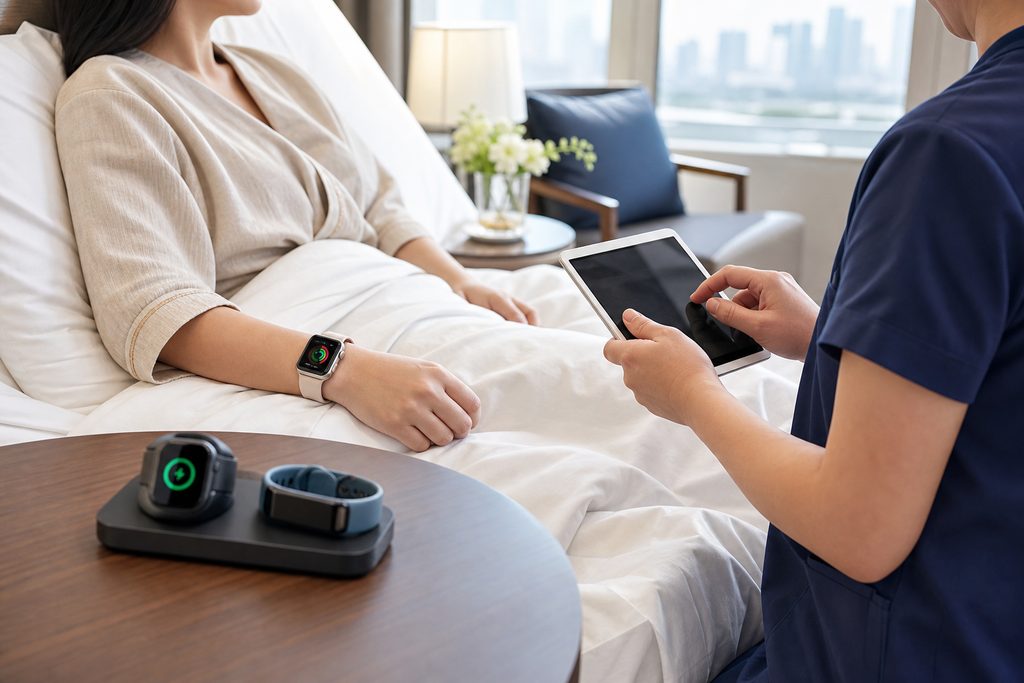
Once you land in China, the device is delivered to your hospital room or recovery accommodation. A bilingual coordinator walks you through setup — pairing, health metric configuration, alert thresholds — in under 30 minutes. If your surgeon wants daily step count targets or heart rate ceiling alerts, we program those in. Throughout your recovery, we provide a support contact who can troubleshoot syncing issues, replace a faulty device within hours, and coordinate data sharing with your care team if authorized.
At discharge, we handle the return. You hand over the device. We wipe the data per your hospital’s privacy protocol. That is the end of it. No subscription cancellation, no international shipping label, no device gathering dust in a cabinet back home.
Can I Borrow a Fitbit for Recovery Monitoring in Chinese Hospitals?
The short answer: yes, but through the right channel. Walking into a Chinese public hospital and asking to borrow a Fitbit will generate blank stares. Hospital wards do not stock consumer wearables. The best wearable device rental for post-op monitoring in Shanghai or any major Chinese city comes through international patient departments or specialized medical concierge services that maintain relationships with approved device vendors. These channels ensure the hardware is genuine, the software is configured for medical context, and the data handling meets both Chinese cybersecurity regulations and international privacy expectations like GDPR for European patients.
Attempting to rent from a consumer electronics shop on Huaihai Road bypasses all of those safeguards. The device may be a grey-market import with region-locked features. The shop will not understand what “continuous SpO2 trending for a post-thoracotomy patient” means. And if the device fails at 11 p.m. on a Saturday, you are on your own. The premium paid for a coordinated loan service buys reliability, not just hardware.
Frequently Asked Questions
First, do not panic. Consumer wearables generate false positives — a loose band, a moment of movement, or low battery can all produce spurious readings. If the reading persists after repositioning the device and resting for five minutes, contact your surgical team or the hospital’s international patient coordinator. If the abnormal reading accompanies symptoms like chest pain, shortness of breath, or heavy bleeding, bypass the device entirely and seek emergency care. The wearable is an early warning system, not a diagnostic instrument.
Data security depends entirely on the rental channel. Devices sourced through hospital international departments follow the hospital’s data governance policies, which in top-tier institutions like Fudan-ranked hospitals align with international standards. Devices rented from consumer shops carry no such guarantees. Our coordinated loans include a data wipe protocol executed at device return, with a certificate of erasure provided on request. Health data stored on the paired phone is encrypted and never uploaded to third-party servers without explicit patient consent.
Absolutely — if it works in China. Check whether your device supports Chinese cellular bands if you need standalone connectivity. Confirm that the Health app or Fitbit app functions normally with a Chinese Apple ID or Google account (Google services are blocked in China without a VPN). If your device was purchased in North America or Europe, the blood oxygen app on newer Apple Watch models may be disabled due to an ongoing patent dispute — a limitation that does not affect devices sourced within China. Many patients find that renting a locally sourced device avoids these compatibility headaches entirely.
Some do. Some do not. This is not a technology question — it is a workflow and liability question. A cardiac surgeon at Fuwai Hospital who performs 14,000+ procedures annually may have no time to review a patient’s Fitbit dashboard. A surgeon at a private international hospital like Jiahui or United Family may welcome the data as part of a comprehensive recovery plan. Ask during your pre-operative consultation. If the answer is no, the device still serves your personal awareness. If the answer is yes, we configure data exports that integrate with the hospital’s preferred format.
Your Next Step
Post-surgical recovery in a foreign country is challenging enough without wondering whether your heart rate is climbing or your oxygen is dipping while you sleep. A wearable health device loan gives you data — continuous, objective, trendable — that fills the monitoring gap between discharge and follow-up. It does not replace your surgeon. It does not eliminate risk. But it gives you something rare in the anxious weeks after an operation: information you can act on.
If you are planning surgery in China and want to explore whether a device loan fits your recovery plan, our team can walk you through the options, the costs, and the configuration specifics — no commitment, no pressure. Get a free consultation and we will help you think through what makes sense for your procedure, your hospital, and your peace of mind.
For more medical information and treatment options in China, visit chinamedservices.com (China Medical Services).
