Studio-Quality Remote Surgeon Meetings: High-Definition Video Consultation in China
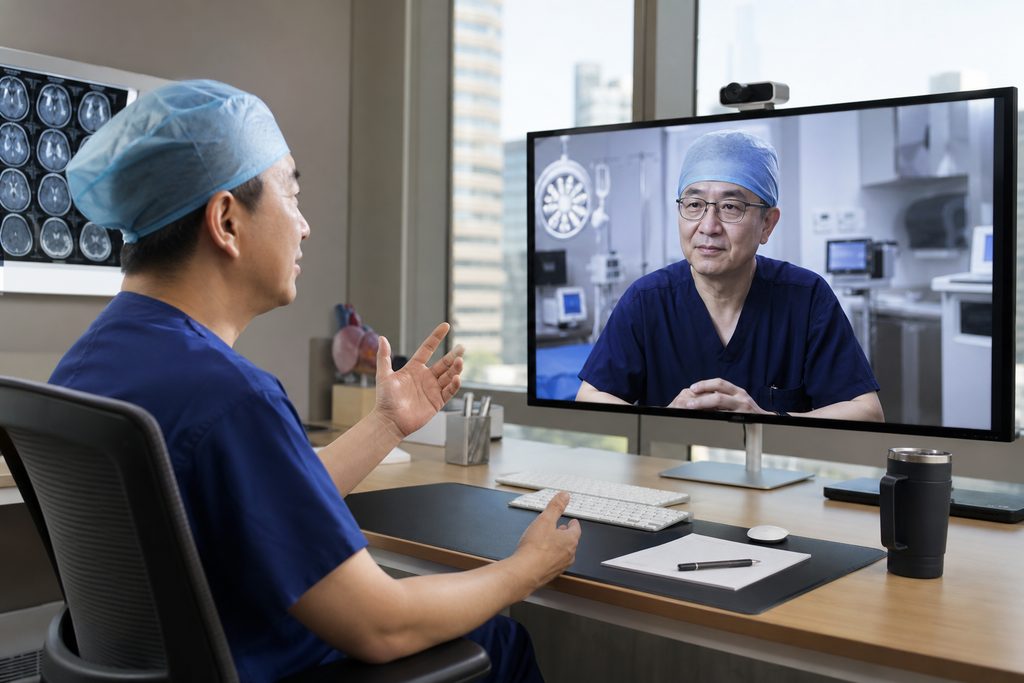
Have you ever sat in a doctor’s office, heard a life-changing diagnosis, and felt the ground shift beneath you? The words blur. You nod, but inside, a single question pounds: is this really the only path forward? For thousands of patients every year, the search for a second opinion ends not in another local clinic, but 7,000 miles away in a quiet, studio-lit room in Shanghai or Beijing. A room where a surgeon is reviewing your scans in 4K resolution, ready to offer a perspective that could rewrite your treatment plan.
Key Takeaways
- Top-tier Chinese hospitals now offer studio-quality video consultations with specialists who perform 5–10 times the annual surgical volume of many Western peers, using dedicated medical-grade cameras and diagnostic monitors.
- The typical studio quality video consultation surgeon china cost ranges from $500 to $800 for a top-specialist session, with fees fully credited toward any future in-person treatment coordination.
- Language barriers and hospital access protocols remain the biggest hurdles for international patients—working through a bilingual case management team is often the only way to secure a direct, uninterrupted meeting with a department chair-level surgeon.
- These are not generic telehealth calls. They are structured, pre-charted consultations where your full medical history has been translated, summarized, and reviewed by the specialist before the camera ever turns on.
The Problem: When a Single Opinion Isn’t Enough
A 2023 study published in the Journal of the American College of Surgeons found that approximately 1 in 5 patients seeking a second opinion at a major academic medical center received a materially different diagnosis or treatment plan. That is not a rounding error. That is 20% of people walking toward an operating room or a chemotherapy regimen that might not be the optimal path. For complex conditions—spine tumors, congenital heart defects, recurrent cancers—the stakes are even higher.
But getting that second opinion from a genuine sub-specialist is hard. The surgeon who literally wrote the textbook on your condition probably does not practice in your city. They might not even practice in your country. And even if you identify the right expert, how do you reach them? How do you ensure they actually study your case, not just glance at a radiology report during a 12-minute video call squeezed between clinic patients?
This is the gap that high-definition remote surgical consultation in China is designed to close. Not with a smartphone and a prayer. With broadcast-grade cameras, dedicated diagnostic displays, and a structured process built around one goal: giving you and your local doctor the clearest possible picture of what Chinese medicine can offer.
Who We Are
We are not a hospital. We do not provide medical treatment, interpret your scans, or offer clinical diagnoses. Our team at China Medical Services functions as your logistical architects—we bridge the gap between you and the 340+ top-ranked hospitals in our network across 37 Chinese cities. We handle the unglamorous, essential work that makes a studio-quality video consultation possible: translating and reformatting your medical records to Chinese clinical standards, negotiating access to specific specialists through official hospital international departments, and ensuring that when you sit down in front of the camera, the surgeon on the other side has already spent meaningful time with your case. Think of us as the production crew and the diplomatic corps rolled into one. You bring the questions. We build the bridge.
Why Studio-Quality Remote Surgeon Meetings in China Deliver Results
There is a quiet, uncomfortable truth in surgery: the more you do, the better you get. A 2022 analysis in The BMJ examining over 700,000 procedures demonstrated a clear volume-outcome relationship across multiple surgical specialties. This is where Chinese top-tier hospitals operate on a different scale entirely. Fuwai Hospital in Beijing performs over 14,000 cardiac surgeries annually—the highest volume of any cardiac center on the planet. A typical high-volume US cardiac surgeon might perform 100–150 bypasses a year. At Fuwai, individual senior surgeons routinely handle 400–500. For rare congenital procedures, a surgeon at Shanghai Children’s Medical Center may see more cases of a specific anomaly in six months than a Western colleague encounters in a decade.
When you book an hd remote surgical consultation china price starting at $500, you are not just buying 45 minutes of a surgeon’s time. You are purchasing access to a pattern-recognition engine trained on an extraordinary volume of cases. The surgeon looking at your imaging has likely seen your exact presentation dozens of times. That matters. Especially when the question is not “can this be operated on?” but “should it be, and exactly how?”
Technology and a Structured Process, Not a Rushed Video Call
Understanding how does high definition telemedicine consultation work in china requires setting aside the image of a doctor propping up an iPad in a busy hallway. The studios used for these consultations are purpose-built. They feature 4K pan-tilt-zoom cameras, directional microphones that eliminate background echo, and—critically—medical-grade DICOM-calibrated monitors that display your CT, MRI, and PET scans with diagnostic-level fidelity. The surgeon is not squinting at a compressed JPEG on a laptop. They are reviewing your images on the same monitors they use to plan actual surgeries.
The process itself is front-loaded. Before the consultation, our team collects your complete medical dossier: imaging files in their original DICOM format, pathology slides, operative notes, current medication lists. This is not a quick email attachment job. We translate every document into clinical Chinese, reformat it to match the structure Chinese hospital departments expect, and submit the package through the official international patient channel days in advance of your scheduled meeting. The surgeon reviews it. They annotate. They prepare. When the camera light turns green, the conversation starts at a depth that would normally take three preliminary appointments to reach.
Cost Advantage Without Quality Compromise
Let’s address the obvious question head-on. The studio quality video consultation surgeon china cost sits at a fraction of what an in-person surgical second opinion would require in the US—typically $500 to $800 for a top-specialist session, compared to $700–$1,500+ for an equivalent in-person consultation at a major American academic center, before travel. Why the difference? It is not because the Chinese surgeon is less qualified. Peking Union Medical College Hospital and Ruijin Hospital train their department heads to standards that rival any Western institution. The cost difference reflects structural economics: lower operational overhead, a healthcare system built on massive patient throughput, and the simple fact that Chinese hospital international departments price their services for a global market where American rates are an outlier, not a benchmark.
And there is a mechanism that makes this even more practical. Any consultation fee you pay is credited in full toward future in-person treatment coordination if you decide to travel to China within 90 days. It is a one-time credit applied to our coordination service fees—never to hospital treatment charges. This turns the consultation from a sunk cost into a down payment on a potential treatment journey.
What You Need to Know Before Going Alone
We are direct about the barriers because pretending they do not exist helps no one. Reaching a top Chinese surgeon for a high-definition video consultation is not like booking a Zoom call through a consumer app. The obstacles are real and they are structural.
- Hospital Access Protocols: Chinese public hospitals do not operate on a direct-booking model for international patients. You cannot email a department chair and get a consultation slot. The official route runs through each hospital’s International Medical Department or VIP clinic, and these departments prioritize cases submitted by recognized coordination partners. A cold email from an overseas patient with English-language records will rarely, if ever, reach the right desk. The records must be pre-translated, the case must be triaged to the correct sub-specialist, and the appointment must be negotiated through channels that operate in Mandarin and follow local administrative rhythms.
- Medical Records Translation: This is the bottleneck that kills most independent attempts. Chinese surgeons expect records organized in a specific format: chronological operative summaries, pathology reports translated with precise oncological terminology, imaging uploaded in full-resolution DICOM format. A 200-page PDF of mixed English medical records is not a consultation-ready package. It is a puzzle that no busy surgeon has time to solve. Professional medical translation and dossier preparation is a specialized skill—one that goes far beyond bilingual fluency.
- Payment and Scheduling: International wire transfers to Chinese hospital accounts can take days to clear. Scheduling windows for senior specialists are narrow—often two to four weeks out, and they shift. Confirming a time that works across a 12-hour time zone difference requires persistent back-channel communication, not a single confirmation email.
How We Help You Navigate This
These barriers exist for structural reasons, not because anyone is trying to keep you out. Chinese hospitals handle staggering patient volumes—a single outpatient department at West China Hospital can see 20,000 patients in a day. International cases require a different workflow, and that workflow runs through coordination teams like ours.
We start by collecting everything: your imaging, your reports, your history. Our medical translators—who work exclusively with Chinese clinical terminology—produce a translated dossier formatted to the standards of the specific hospital department you need. We submit it through the official international patient channel. We track it. We follow up. When the consultation is scheduled, we brief you on the surgeon’s background, the format of the meeting, and the questions you should ask. During the call, a bilingual medical interpreter stays on the line—not as a passive translator, but as a bridge who ensures that clinical nuance does not get lost between languages. Afterward, you receive a written summary in English, along with the surgeon’s formal opinion letter.
If you decide to move forward with treatment in China, the consultation fee is credited back. You are not starting over. You are continuing a conversation that already has momentum.
Frequently Asked Questions
Can I get a second opinion from a Chinese surgeon via video call without traveling?
Yes. This is exactly what the studio-quality remote consultation process is designed for. You do not need a Chinese visa to participate in a video consultation. You do need properly prepared medical records and a coordination team to arrange the meeting through the hospital’s official international channel. The consultation produces a formal written opinion that you can take to your local treating physician for discussion.
How do I book an HD video consultation with a surgeon in Shanghai specifically?
The process to book hd video consultation with surgeon in shanghai starts with identifying the right specialist for your condition. Shanghai is home to 18 hospitals ranked in China’s Fudan Top 100, including Zhongshan Hospital (cardiac and liver surgery), Ruijin Hospital (endocrinology and hematology), and Shanghai Ninth People’s Hospital (craniofacial and orthopedic surgery). Once the appropriate surgeon is identified, the booking flows through that hospital’s International Medical Department. Our team handles the submission, scheduling, and interpretation. You do not contact the hospital directly—the channel runs through a coordination partner that the department already trusts.
What if the surgeon recommends a treatment I cannot access at home?
This happens more often than you might expect. Chinese hospitals offer certain procedures—minimally invasive spine techniques, specific tumor ablation protocols, TCM-integrated rehabilitation regimens—that may not be widely available in Western hospitals. If the surgeon recommends a treatment path that requires travel to China, we can pivot to discussing the practicalities: the S2 visa for medical treatment, the estimated timeline, the hospital’s international ward accommodations, and the cost breakdown. There is no obligation. The consultation stands on its own as a second opinion. But the door to treatment is open if you choose to walk through it.
How does an international patient video meeting with a doctor in China actually feel?
An international patient video meeting with doctor china is structured differently from a typical Western telehealth visit. Expect a more formal opening, with the surgeon often joined by a member of the international department staff. The surgeon will reference specific images from your scans—they will have them pulled up on their diagnostic monitor and may share their screen to walk you through findings. The pace is deliberate. These surgeons are not rushing between clinic rooms; the consultation block is protected time. You should prepare a list of questions in advance. Our interpreter will ensure every question is asked and every answer is clarified. The tone is professional, direct, and focused on clinical decision-making.
Your Next Step
A second opinion should not feel like a gamble. It should feel like clarity. The surgeons you need to reach are practicing right now in Beijing, Shanghai, and Guangzhou—they are reviewing cases, planning procedures, and achieving outcomes that deserve global attention. The technology to connect you to them in studio-quality detail exists. The process is structured, transparent, and surprisingly practical once you have the right team handling the logistics.
If you are facing a complex diagnosis or a high-stakes surgical decision, consider what a conversation with a surgeon who has seen your condition hundreds of times could add to your decision-making. Learn more about how our case management team prepares every international patient consultation or explore the top-ranked hospitals in our network to see where your specialty’s leaders practice.
For more medical information and treatment options in China, visit chinamedservices.com (China Medical Services).
