Joint Replacement Hydrotherapy in China: Pool Rehab for Faster Recovery
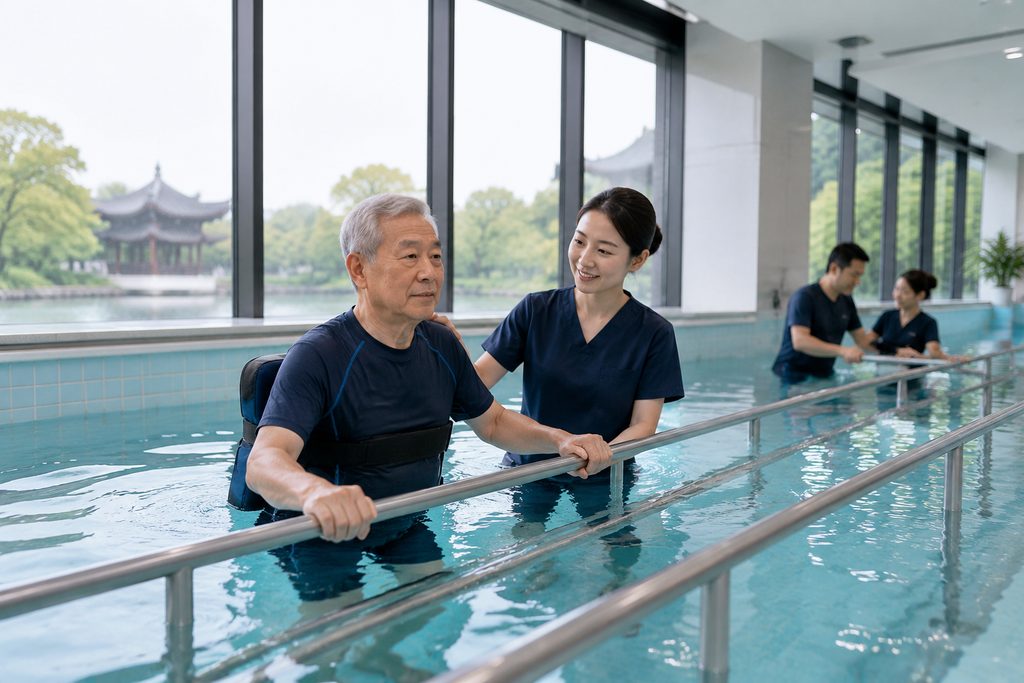
You probably think major joint surgery means months of painful, land-based physiotherapy with slow, grinding progress. That is the standard path in most Western countries. But there is a different model gaining traction among international patients. It involves warm water, buoyancy, and a rehabilitation timeline that often surprises people. It is called hydrotherapy. And China has quietly built some of the most advanced hospital-based aquatic rehabilitation facilities in the world. The real question is not whether water therapy works. The science on that is settled. The question is whether you can access it at a joint replacement hydrotherapy China cost that makes the entire journey worth considering.
Key Takeaways
- Hydrotherapy can reduce post-operative pain by 30-50% and accelerate range-of-motion recovery by 2-3 weeks compared to land-based rehab alone, according to multiple randomized controlled trials.
- China’s top orthopedic hospitals operate dedicated inpatient hydrotherapy pools — not off-site wellness centers — meaning therapy begins while you are still admitted, often within 48-72 hours after surgery.
- Public hospital aquatic therapy pools are not tourist-friendly. Language barriers, separate billing systems, and appointment logistics make independent navigation extremely difficult without a bilingual coordinator.
- The all-in cost for a joint replacement with integrated hydrotherapy rehab in China typically runs 60-80% less than the US equivalent, but you must plan for a 3-4 week minimum stay to complete the protocol.
The Problem: Rehab That Drags On When It Should Not
Approximately 20% of total knee replacement patients report persistent pain and functional limitation at one year post-surgery. That number comes from a 2022 meta-analysis in The Journal of Arthroplasty. The root cause is often not the surgery itself. It is what happens in the six weeks afterward. Standard land-based physiotherapy hurts. Swollen joints pressed against hard surfaces. Gravity pulling on freshly traumatized tissue. Patients compensate. They guard the joint. They develop altered gait patterns. And those patterns stick.
In the US, the average outpatient physical therapy copay runs $30 to $75 per session. That assumes insurance covers it. Many patients get 12 to 20 sessions before benefits run out. Then they are on their own. The result is inconsistent. Some recover fully. Many do not. A significant minority never regain their pre-arthritic functional baseline.
There is a better way. Water changes everything.
How Does Hydrotherapy Speed Up Recovery After Hip Replacement
The mechanism is straightforward physics. Water provides buoyancy that unloads the joint. At chest depth, a 200-pound person effectively weighs about 30 pounds. That means you can move through a full range of motion without compressive forces grinding bone against implant. Hydrostatic pressure reduces swelling. Warm water — typically maintained at 33-35°C — relaxes muscle guarding and increases local blood flow.
A 2023 systematic review in Clinical Rehabilitation examined 17 randomized controlled trials comparing aquatic therapy to land-based exercise after total hip and knee arthroplasty. The findings were consistent. Water-based groups achieved significantly better early range of motion. Pain scores dropped faster. Length of hospital stay shortened by an average of 1.8 days. The authors concluded that early aquatic intervention — starting within the first week post-op — produced outcomes that land-based therapy alone could not match in the same timeframe.
None of this is fringe. Hydrotherapy pools are standard equipment in Germany’s orthopedic rehabilitation hospitals. They are common in Japan. And they are increasingly central to post-surgical protocols in China’s top-tier joint replacement centers. The difference is scale. Some Chinese hospitals perform 3,000 to 5,000 joint replacements annually. That volume funds dedicated inpatient aquatic facilities that most Western hospitals cannot justify.
Who We Are
We are not a hospital. We do not perform surgeries, prescribe treatment plans, or make clinical decisions. We are China Medical Services — a medical concierge organization that connects international patients with China’s top-ranked hospitals. Our team handles the logistics: hospital matching based on your specific condition, appointment coordination through official international departments, bilingual medical companions who stay with you through every consultation and therapy session, visa guidance, and accommodation planning. We bridge the gap between you and a healthcare system that delivers exceptional value but requires local expertise to navigate safely.
Is Water Therapy After Joint Surgery Available in Shanghai
Yes. Shanghai is one of the best-served cities in China for inpatient aquatic rehabilitation. Several hospitals ranked in the Fudan University Hospital Rankings operate dedicated hydrotherapy units within their orthopedic departments. These are not converted swimming pools. They are medical-grade facilities with adjustable-depth floors, underwater treadmills with video gait analysis, resistance jet systems, and continuous water quality monitoring. Therapists trained in aquatic protocols work directly with the surgical team — not as an afterthought but as part of the integrated care pathway.
Shanghai Sixth People’s Hospital, for instance, runs one of the country’s busiest orthopedic programs. Their rehabilitation department includes a purpose-built hydrotherapy center that serves post-arthroplasty patients starting as early as day three post-op, wound closure permitting. The protocol typically involves daily 30-minute sessions progressing from passive range-of-motion exercises to active strengthening over a two-week inpatient stay. Patients then transition to outpatient aquatic sessions before discharge.
Other cities are equally equipped. Beijing hosts multiple hospitals with hydrotherapy capabilities, including facilities affiliated with Peking University and the Chinese PLA General Hospital. Guangzhou and Chengdu have invested heavily in rehabilitation infrastructure over the past five years. The geographic spread means you are not locked into a single city. Hospital choice can be driven by surgical specialization and surgeon availability rather than facility access alone.
Joint Replacement Hydrotherapy China Cost: What the Numbers Actually Look Like
Let us address the question that brings most international patients to this page. The joint replacement hydrotherapy China cost structure breaks down into three components: the surgery itself, the inpatient rehabilitation including hydrotherapy, and the service fees for international patient coordination.
A total knee or hip replacement at a top-tier Chinese public hospital through the international VIP department typically ranges from $18,000 to $28,000. That includes the implant, surgeon fees, anesthesia, hospital stay, and basic physiotherapy. Adding a structured hydrotherapy protocol during the inpatient stay adds approximately $2,000 to $4,000 depending on session frequency and duration. For comparison, the same procedure in the United States averages $35,000 to $50,000 for the surgery alone — often without any aquatic therapy component unless you pay out of pocket at a separate facility.
Here is how the numbers compare across common destinations for medical travelers:
| Cost Component | China (VIP Dept) | United States | Germany | Thailand |
|---|---|---|---|---|
| Total Knee Replacement (surgery + implant) | $18,000 – $28,000 | $35,000 – $50,000 | $22,000 – $30,000 | $15,000 – $22,000 |
| Inpatient Hydrotherapy Protocol (10-14 sessions) | $2,000 – $4,000 | $3,500 – $6,000 (outpatient) | $2,500 – $4,500 | $1,500 – $3,000 |
| International Patient Coordination | $800 – $5,000 (varies by package) | N/A (domestic system) | $2,000 – $4,000 | $1,000 – $2,500 |
| Estimated All-In Range | $20,800 – $37,000 | $38,500 – $56,000+ | $26,500 – $38,500 | $17,500 – $27,500 |
These figures are estimates. Final costs vary by hospital, implant type, surgeon seniority, length of stay, and case complexity. The Chinese figures assume treatment through a hospital’s international or VIP department — the only channel through which overseas patients can realistically access scheduled care. Standard public outpatient channels do not accommodate pre-arranged international bookings.
Thailand appears cheaper on paper. But China’s advantage lies in surgical volume and hydrotherapy integration. A surgeon who performs 400 knee replacements annually — common at major Chinese orthopedic centers — has seen complications and variations that a lower-volume surgeon encounters over a decade. That experience translates into intraoperative decision-making that no price tag captures.
Medical Tourism Packages Joint Replacement Rehab China: What Is Included
The phrase “medical tourism package” gets thrown around loosely. In the Chinese hospital context, it means something specific. A coordinated package through an international patient department typically bundles the following:
- Pre-arrival virtual consultation with the operating surgeon (often priced separately at $300-$800, credited toward the procedure if you proceed)
- Surgical procedure with specified implant type
- Private room accommodation for the patient and one companion during the inpatient stay
- Daily hydrotherapy sessions as prescribed by the rehabilitation team
- Land-based physiotherapy on non-pool days or as a complement to aquatic work
- Post-discharge outpatient follow-up appointments before international departure
- Discharge summary and imaging records in English
What is typically NOT included: international airfare, visa fees, accommodation before admission or after discharge, meals beyond hospital-provided patient meals, and any complications requiring extended stay or revision surgery. These exclusions are standard worldwide. No reputable provider bundles contingency costs into a fixed package because those costs are unknowable in advance.
Our role at China Medical Services is to assemble and coordinate these components across the hospital, the surgeon’s schedule, and your travel timeline. We do not sell a pre-packaged product off a shelf. We build a plan around your specific diagnosis, imaging, and recovery goals. Then we execute the logistics.
Best Hospital for Pool Rehab After Knee Surgery China: What to Look For
Ranking a single “best” hospital is misleading. The right hospital depends on your specific joint, the complexity of your case, and whether you need a primary replacement or a revision. That said, several institutions consistently appear at the top of the Fudan University Hospital Rankings for orthopedics and offer robust inpatient hydrotherapy programs.
Peking University Third Hospital in Beijing runs one of China’s most respected orthopedic departments, with a dedicated sports medicine division that handles complex knee cases. Their rehabilitation unit includes a hydrotherapy pool with underwater camera systems for gait retraining. Shanghai Sixth People’s Hospital, as mentioned, combines massive surgical volume with integrated aquatic rehab. West China Hospital in Chengdu has invested heavily in rehabilitation technology and serves a large international patient population from across Asia.
For patients specifically seeking book hydrotherapy rehabilitation after knee replacement Beijing options, the capital offers multiple pathways. Beyond Peking University Third Hospital, the Chinese PLA General Hospital (301 Hospital) operates a comprehensive rehabilitation center with aquatic therapy capabilities. Jishuitan Hospital, despite being less known internationally, is arguably China’s highest-volume orthopedic hospital and has a well-established hydrotherapy protocol for joint replacement patients.
What matters more than the hospital name is whether the hydrotherapy program is truly integrated with the surgical team. Ask these questions before committing: Does the same rehabilitation physician who oversees your land-based therapy also design your aquatic protocol? Are the pool sessions conducted in the hospital building or at an external facility? How many days post-op does the typical patient enter the water? The answers reveal whether hydrotherapy is core to the recovery pathway or merely an optional add-on.
For a deeper look at orthopedic specialization across China’s top institutions, our department rankings page breaks down hospital strengths by specialty.
What You Need to Know Before Going Alone
This is the most common concern — and a legitimate one. Hospital-grade hydrotherapy pools maintain continuous circulation, filtration, and disinfection systems that meet medical standards far stricter than public swimming pools. Water quality is tested multiple times daily. Before entering the pool, your wound is covered with a waterproof surgical dressing rated for full submersion. The dressing is inspected after every session. Infection rates in patients undergoing early aquatic therapy show no statistically significant increase compared to land-based-only protocols, according to a 2021 study in Archives of Physical Medicine and Rehabilitation that specifically examined this question.
What if my joint replacement has complications — who manages revision surgery?
The surgeon who performed your primary replacement remains responsible for managing early complications during your stay in China. For complications that arise after you return home, responsibility transfers to your local orthopedic team. This is standard in medical travel globally. We strongly recommend establishing a relationship with a local orthopedic surgeon before you
Frequently Asked Questions
Yes. We work with JCI-accredited and major Grade 3A tertiary hospitals that follow international safety standards comparable to top hospitals in the US and Europe. Surgical teams perform high volumes of procedures — often more than their Western counterparts — which studies show leads to better outcomes.
Costs vary by procedure and hospital, but international patients typically save 40-80% compared to US prices — even when factoring in travel and accommodation. A consultation with our team will give you an exact, all-inclusive quote with no hidden fees.
Send us your existing medical reports. The relevant specialty reviews them and gives you a written opinion, including treatment direction and options, before you commit to any travel. From there you can add a video consultation with the doctor, or have us attend an appointment on your behalf.
For more medical information and treatment options in China, visit chinamedservices.com (China Medical Services).
