Hindu Patient Medical Tourism China: Dietary & Cultural Coordination
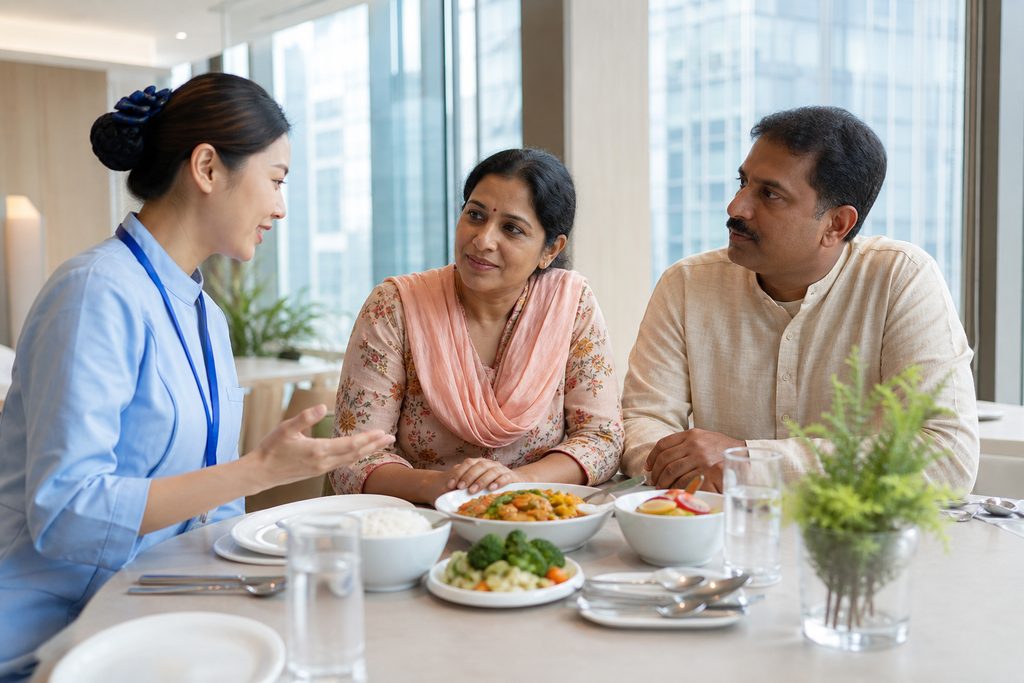
What happens when a life-changing surgery is available at a fraction of the cost, but the hospital kitchen has never prepared a satvic meal? This is not a hypothetical worry. It is the quiet, gnawing question that keeps many Hindu patients and their families awake at night when considering medical tourism to China. The clinical data on Chinese hospitals is compelling. The cost savings are real. But the cultural distance feels vast.
Our team at China Medical Services has spent years closing that gap. We do not perform surgeries. We do not prescribe treatments. We are the logistical bridge between your dietary requirements, your spiritual practices, and a medical system that operates with extraordinary clinical efficiency. We handle the details so you can focus on recovery.
Key Takeaways
- China’s top-tier hospitals deliver surgical outcomes comparable to Western centers, with cardiac procedures costing roughly $12,000–20,000 versus $120,000+ in the US.
- A hindu friendly hospital China cost structure includes not just the procedure, but the coordination of strict vegetarian meal planning, which requires advance logistical work, not just a menu request.
- Public hospitals in China do not typically have Ayurvedic kitchens or default vegetarian meal lines—cultural dietary coordination must be arranged before you arrive.
- You should never assume a hospital can accommodate Hindu dietary laws without a dedicated local coordinator verifying the kitchen workflow and ingredient sourcing.
The Problem: When Clinical Excellence Meets Cultural Silence
China’s rise as a destination for complex medical care is backed by hard numbers. Fuwai Hospital in Beijing performs over 14,000 cardiac surgeries annually—the highest volume of any cardiac center on the planet. A knee replacement that might cost $35,000 in the United States runs between $8,000 and $15,000 at a top orthopedic hospital in Shanghai. The clinical argument is strong.
But here is the friction point. Approximately 1 in 5 international patients we speak with raises dietary and cultural practice coordination as their primary anxiety—not the surgery itself. They have read the outcome studies. They trust the surgical volume data. What they cannot visualize is how their morning puja happens in a recovery room, or whether the hospital kitchen understands that “no meat” also means no meat-based broth, no lard, and no utensils that have touched animal products.
This is not a small detail. For a practicing Hindu patient, dietary adherence during recovery is not a preference. It is a non-negotiable component of the healing process. And in China’s public hospital system, where daily patient volumes can exceed 10,000, the default meal line is designed for the local population. Pork, beef, and mixed broths are common. Cross-contamination in shared kitchens is the norm, not the exception.
Who We Are
We are not a hospital. We do not provide medical treatment or clinical diagnoses. China Medical Services is a medical concierge organization that connects international patients with China’s 340+ top-ranked hospitals across 37 cities. Our team handles the architecture of your medical journey: hospital matching based on your specific condition, bilingual medical companion services, visa guidance, and—critically for Hindu patients—dietary and cultural practice coordination that starts weeks before you board your flight. We translate your needs into a workflow the hospital can execute.
Why China Delivers Results for International Patients
The structural advantages of China’s top-tier medical system are not about cutting corners. They are about scale, specialization, and a fundamentally different economic model that lowers the hindu friendly hospital China cost without compromising clinical standards.
Surgical Volume Drives Precision
A top Chinese orthopedic surgeon completes between 200 and 500 joint replacements per year. The average US orthopedic surgeon performs roughly 65. This volume gap matters. Multiple studies, including research published in The Lancet, have demonstrated a clear correlation between hospital procedure volume and patient outcomes—particularly for complex surgeries like cardiac bypass, liver resection, and spinal fusion. When you choose a top-ranked Chinese hospital through our verified hospital database, you are selecting a center where your specific procedure is performed hundreds or thousands of times annually. The surgical team has seen your case before. Many times.
Cost Advantage Without Quality Compromise
The lower hindu friendly hospital China cost is not a signal of lower quality. It is a function of structural economics. Labor costs for highly skilled surgeons and nurses are lower in China than in the US or Europe. Hospital operational efficiency is higher—turnover time between surgeries is shorter, bed utilization is more aggressive, and administrative overhead is leaner. A cardiac bypass that costs $120,000 in the US might cost $15,000 at a top Chinese public hospital. The implants, the surgical protocols, and the infection control standards are equivalent. The price difference reflects economic structure, not clinical compromise.
Technology Deployment at Scale
China’s top hospitals deploy advanced surgical technologies at a pace that surprises many Western patients. Robotic-assisted surgery systems are common in urology and gynecology departments. Intraoperative imaging and navigation systems are standard in major orthopedic centers. The combination of high case volume and modern equipment means surgical teams are not just trained on the technology—they are fluent in it.
What You Need to Know Before Going Alone
We tell every prospective patient the same thing: the clinical infrastructure is world-class. The cultural and logistical friction is real. Here is what you will face if you attempt to navigate this independently.
- Dietary Coordination is a Pre-Arrival Project: Public hospital kitchens in China are not set up to accommodate Hindu dietary laws by default. Ingredient sourcing, separate cooking surfaces, and dedicated utensils require a documented workflow that must be negotiated with the hospital’s international patient department. This is not a conversation you can have at the admissions desk on surgery day.
- Language Barriers Extend to the Kitchen: Explaining the distinction between “vegetarian” and “no animal-derived ingredients whatsoever” requires precise Mandarin—and a cultural translator who understands both the dietary requirement and how Chinese kitchens operate. A simple translation app will not capture the nuance of “no oyster sauce, no chicken powder, no lard in the pastry.”
- Cultural Practice Space is Not Automatic: A quiet space for prayer, the ability to keep a small murti at the bedside, or coordinating a visit from a Hindu spiritual advisor are all possible—but they must be arranged through the hospital’s international patient channel. Walking into a standard ward and making these requests will likely result in confusion, not accommodation.
How to Arrange Hindu Dietary Needs During Surgery in China
The process of arranging how to arrange Hindu dietary needs during surgery in China starts with hospital selection. Not every top-ranked hospital has an international department equipped to handle detailed cultural meal planning. We match you with hospitals that have demonstrated experience accommodating international dietary requirements—and then we do the ground-level coordination that makes it real.
Our bilingual medical companion team begins the dietary coordination process at least two weeks before your arrival. We submit a detailed dietary protocol document to the hospital’s international patient center, specifying permitted and prohibited ingredients, cooking surface requirements, and utensil separation. We confirm in writing that the kitchen understands the requirements. On the day of your admission, our companion physically verifies the meal preparation workflow and remains your point of contact for any dietary issues throughout your stay.
For patients requiring vegetarian meal medical tourism China packages, we coordinate with hospital international wards that have experience preparing Jain-vegetarian, lacto-vegetarian, and satvic meals. This is not a standard menu option. It is a custom arrangement that requires advance planning and a local team to execute. The hindu friendly hospital China cost for this level of coordination is typically incorporated into the international ward service fee, which runs 1.5 to 2 times the standard ward rate—but includes English-speaking staff, private rooms, and the logistical infrastructure to handle non-standard dietary requests.
One of the most common questions we receive is: is there Ayurvedic food in Chinese hospitals? The direct answer is no. Chinese hospitals do not have Ayurvedic kitchens. Traditional Chinese Medicine (TCM) hospitals use a completely different framework of food therapy based on Chinese medicinal principles—warming and cooling foods, qi-balancing ingredients—which is not equivalent to Ayurvedic dietary practice. What we can arrange is the delivery of externally prepared Ayurvedic meals to your hospital room, provided the hospital’s international ward approves external food. This requires case-by-case negotiation and is not guaranteed at every facility. We are transparent about this limitation because setting false expectations serves no one.
Best Hospital for Indian Patients in Shanghai: Price and Practical Considerations
Chinese hospitals do not prepare Ayurvedic food. This is a hard fact we communicate to every patient upfront. The workaround is external food delivery, which requires approval from the international ward nursing station. Some hospitals permit it. Some do not, citing infection control or dietary safety policies. We negotiate this on a case-by-case basis and will tell you honestly if your preferred hospital cannot accommodate external food. In those cases, we work with the hospital kitchen to approximate your dietary requirements as closely as possible within their ingredient and preparation constraints.
In a private international ward room, this is usually possible if arranged in advance. In a shared ward, it is generally not feasible due to space limitations and the need to respect other patients’ space. We include cultural practice requirements in the pre-arrival coordination document so the hospital is aware before you are admitted. This avoids the awkwardness of negotiating these details while you are in a hospital gown.
The procedure cost varies widely by specialty and hospital—a cardiac bypass might run $12,000–20,000, while a complex spinal surgery could be higher. The coordination layer adds approximately $300–800 for hospital appointment coordination, plus $200 per day for a bilingual medical companion who handles dietary verification and cultural advocacy. International ward rates add $200–400 per night over standard ward fees. A realistic total budget for a two-week stay with surgery, international ward accommodation, and full dietary coordination typically falls between $18,000 and $45,000, depending on the procedure. Every quote is customized to your specific case.
Your Next Step
Traveling to China for medical care as a Hindu patient is not about compromising your practices for a lower price. It is about choosing a destination with genuine clinical strengths and then building the cultural support structure around that choice. The hospitals exist. The surgical expertise is real. The dietary coordination is possible—but it will not happen by accident.
If you are considering treatment in China and dietary or cultural coordination is on your mind, start with a free consultation. No cost. No pressure. Just a clear conversation about what is possible and what it takes to make it happen.
Medical Disclaimer: This article is for informational purposes only and does not constitute medical advice. Always consult a qualified healthcare provider about your specific condition and treatment options. China Medical Services does not provide medical treatment or clinical diagnoses.
Frequently Asked Questions
Yes. We work with JCI-accredited and major Grade 3A tertiary hospitals that follow international safety standards comparable to top hospitals in the US and Europe. Surgical teams perform high volumes of procedures — often more than their Western counterparts — which studies show leads to better outcomes.
Costs vary by procedure and hospital, but international patients typically save 40-80% compared to US prices — even when factoring in travel and accommodation. A consultation with our team will give you an exact, all-inclusive quote with no hidden fees.
Send us your existing medical reports. The relevant specialty reviews them and gives you a written opinion, including treatment direction and options, before you commit to any travel. From there you can add a video consultation with the doctor, or have us attend an appointment on your behalf.
For more medical information and treatment options in China, visit chinamedservices.com (China Medical Services).
