MR-Guided Focused Ultrasound in China: Incisionless Brain and Tumor Treatment
Key Takeaways
- MR-guided focused ultrasound (MRgFUS) treats essential tremor and uterine fibroids without a single incision — patients are often awake and go home the next day.
- Treatment costs in China typically run 60-70% lower than in the United States, with comparable technology and clinical protocols.
- This is not a universal solution. Tumor location, skull density, and prior treatments all affect eligibility — and the technology cannot treat every brain condition.
- Navigating China’s hospital system alone is genuinely difficult. Language barriers and registration systems make professional coordination a practical necessity, not a luxury.
The Problem: When Surgery Feels Like Too Much
Imagine your hand shakes so badly you cannot sign your name. Or pour a glass of water without spilling. Essential tremor affects approximately 7 million people in the United States alone. That is roughly 1 in 40 adults. Medications help some. But for many, the drugs stop working. Or the side effects become unbearable.
Then there are uterine fibroids. Roughly 20-50% of women of reproductive age develop them. The standard surgical fix — a hysterectomy — means weeks of recovery. Lost work. Lost normalcy. Some women are told they need major surgery for a condition that is not even cancerous.
What if the scalpel was never necessary?
That question is no longer theoretical. MR-guided focused ultrasound exists. It is real. It is approved by the FDA. And it is available in China at a fraction of Western costs. But here is what most articles will not tell you upfront: getting access to this technology as an international patient is complicated. We will walk through exactly how it works, what it costs, where to find it, and — most importantly — what nobody tells you about the logistical hurdles.
Who We Are
We are China Medical Services. We are not a hospital. We do not perform MRgFUS procedures, provide medical diagnoses, or offer clinical treatment recommendations. Our team acts as your logistical bridge to China’s top-tier medical institutions — the 340+ top-ranked hospitals across 37 cities that make up the top 5% of China’s 35,000+ healthcare facilities. We handle hospital matching, appointment coordination through official international departments, bilingual medical companion services, and visa guidance. You focus on your health. We handle everything else.
What Exactly Is MR-Guided Focused Ultrasound?
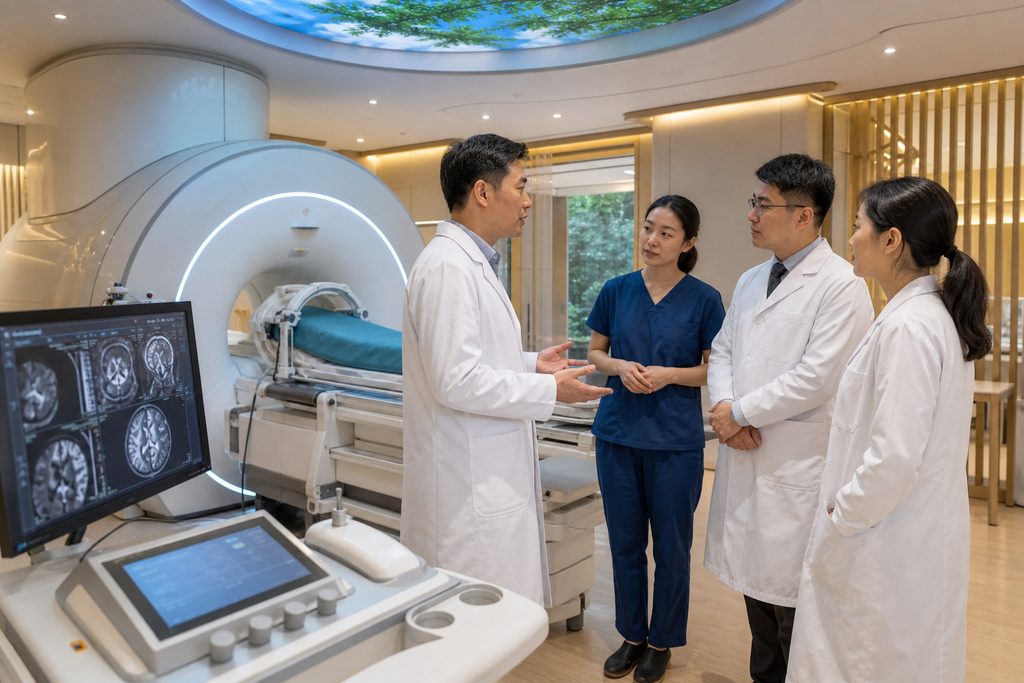
Let us demystify the jargon. MRgFUS combines two technologies. First, magnetic resonance imaging provides real-time, high-resolution images of the inside of your body. Second, focused ultrasound delivers over 1,000 precisely targeted sound waves that converge on a single point — like a magnifying glass focusing sunlight. At that convergence point, the temperature rises to approximately 55-60°C. The targeted tissue is destroyed through thermal ablation. The surrounding healthy tissue? Untouched.
No incision. No radiation. No hospital stay for many patients.
The MRI scanner is not just taking pictures. It is providing live thermal maps. The treating physician watches the temperature rise inside your body in real time. They see exactly which tissue is being heated. They adjust on the fly. This is the safety mechanism that makes the procedure viable.
How does focused ultrasound treat essential tremor
Essential tremor originates in a tiny area of the brain called the thalamus. Specifically, the ventral intermediate nucleus. This cluster of neurons fires abnormally, causing the rhythmic shaking in hands, head, and voice. MRgFUS targets that exact spot.
The patient lies in the MRI scanner. Fully awake. A stereotactic frame holds the head still. The neurosurgeon identifies the target on high-resolution imaging. Then, low-energy test pulses are delivered. The patient provides real-time feedback — “the tremor in my right hand just stopped.” If the test pulses miss the mark, the team adjusts the target. No permanent damage done. Once the precise location is confirmed, therapeutic energy levels are applied. The abnormal neurons are ablated. For most patients, the tremor stops immediately. On the table. While they are awake.
This is not science fiction. A 2023 study published in the Journal of Neurosurgery reported that over 80% of essential tremor patients maintained significant tremor reduction at three-year follow-up after MRgFUS thalamotomy.
MR guided focused ultrasound for uterine fibroids Beijing
Uterine fibroids are benign tumors in the uterine wall. They cause heavy bleeding, pelvic pain, and fertility problems. Traditional treatment options range from myomectomy (surgical removal of fibroids) to hysterectomy (removal of the uterus). Both require incisions. Both mean recovery time.
MRgFUS for fibroids works differently. The patient lies face down on the treatment table. The focused ultrasound transducer is positioned beneath her. MRI identifies each fibroid’s exact location, size, and blood supply. The ultrasound energy is then directed through the abdominal wall — no incision — to heat and destroy fibroid tissue. The dead tissue gradually shrinks and is absorbed by the body over weeks to months.
Beijing is home to several hospitals offering this treatment. The Chinese PLA General Hospital and Beijing United Family Hospital both have established MRgFUS programs. Treatment sessions typically last 2-3 hours. Most women return to normal activities within 24-48 hours.
Compare that to six weeks of recovery after a hysterectomy.
MR guided focused ultrasound cost China: The Numbers That Matter
Let us talk about money directly. In the United States, MRgFUS for essential tremor costs between $30,000 and $50,000. For uterine fibroids, expect $15,000 to $25,000. Insurance coverage varies wildly. Many patients face significant out-of-pocket costs or outright denials.
In China, the picture shifts dramatically. The MR guided focused ultrasound cost China for essential tremor runs approximately $18,000 to $28,000 through hospital international departments. Uterine fibroid treatment typically ranges from $8,000 to $15,000. These are all-inclusive figures covering the procedure, hospital stay, and imaging. The structural reasons for this gap are straightforward: lower physician and staff labor costs, higher patient volumes that distribute equipment costs more efficiently, and a healthcare pricing system that is not built around insurance company negotiations.
| Procedure | Estimated Cost (China) | Estimated Cost (USA) |
|---|---|---|
| MRgFUS Essential Tremor | $18,000 – $28,000 | $30,000 – $50,000 |
| MRgFUS Uterine Fibroids | $8,000 – $15,000 | $15,000 – $25,000 |
| Bilingual Medical Companion (per day) | from $200 | N/A |
| VIP End-to-End Coordination | $5,000 – $8,000 | N/A |
These prices vary by hospital and case complexity. A patient with multiple large fibroids will pay more than someone with a single small one. A tremor patient with challenging skull density may require additional imaging and planning. Always confirm pricing based on your specific medical records — never budget based on a generic estimate alone.
Best MRgFUS brain tumor center Shanghai: Where to Go
Not every hospital offering MRgFUS is equal. Shanghai has emerged as a leading destination for this technology in Asia. Huashan Hospital, affiliated with Fudan University, operates one of China’s most advanced neurosurgery departments. Their focused ultrasound program treats essential tremor, Parkinson’s disease tremor, and neuropathic pain. The hospital is consistently ranked among China’s top 10 for neurosurgery by the Fudan Hospital Ranking — China’s most authoritative hospital evaluation system.
For patients searching for the best MRgFUS brain tumor center Shanghai, a clarification is necessary. MRgFUS is not yet widely approved for brain tumor treatment. Clinical trials are ongoing globally, including in China, for glioblastoma and brain metastases. But standard clinical practice for brain tumors still centers on surgical resection, radiation, and chemotherapy. If you are reading about MRgFUS for brain tumors, you are likely encountering research programs, not routine treatment protocols.
That said, Shanghai’s concentrated expertise in focused ultrasound makes it the natural starting point for anyone exploring this technology. The city hosts 18 of China’s top 100 hospitals. Its international medical infrastructure is more developed than most Chinese cities. English-speaking coordinators are more readily available. For international patients, these practical advantages matter enormously. You can explore our Shanghai hospital resources for a broader view of what is available.
Is incisionless brain surgery safe in China?
Safety is the right question to ask. The short answer: yes, when performed at accredited hospitals with experienced teams. But that qualification matters.
MRgFUS has a well-documented safety profile. The most common side effects during the procedure include scalp heating, nausea, and transient dizziness. These are managed in real time — the patient is awake and communicating throughout. Serious complications are rare. A 2022 meta-analysis covering over 1,200 MRgFUS thalamotomy patients reported a less than 1% rate of permanent neurological deficits. The most common lasting side effect is gait disturbance, which typically improves over weeks to months.
But here is what most promotional content will not tell you. Skull density matters. Approximately 10-15% of patients have skulls too dense for the ultrasound beams to penetrate effectively. These patients cannot be treated with current MRgFUS technology. They are identified during pre-procedure CT screening. There is no way to know your skull density ratio until that scan is done.
Chinese hospitals performing MRgFUS use the same Exablate Neuro systems manufactured by Insightec — the same equipment used at Stanford, Mayo Clinic, and the University of Virginia. The technology is identical. The variable is the team operating it. At top-tier hospitals like Huashan in Shanghai or the Chinese PLA General Hospital in Beijing, neurosurgeons have completed hundreds of these procedures. Their complication rates are consistent with international benchmarks. At smaller centers with less experience, the risk profile shifts. This is why hospital selection is not a detail — it is the entire ballgame.
For a deeper look at hospital quality standards, visit our top-ranked hospitals database.
Focused ultrasound treatment packages China price: What Is Actually Included
The phrase “treatment package” sounds reassuring. It implies everything is handled. But packages vary enormously in what they cover. Some hospital international departments quote an all-inclusive price covering pre-procedure imaging, the MRgFUS procedure itself, one night of inpatient observation, and one follow-up consultation. Others quote only the procedure fee — and the MRI, CT, blood work, and hospital bed are billed separately.
When evaluating focused ultrasound treatment packages China price, ask these questions directly:
- Does the quoted price include pre-procedure CT and MRI? These scans determine eligibility and can cost $800-1,500 on their own.
- Is the hospital stay included? Most MRgFUS patients stay one night for observation.
- Are follow-up imaging and consultations covered? Tremor patients typically need a 3-month follow-up MRI.
- What about interpreter services? If the package does not include an English-speaking coordinator, factor in that cost separately.
A genuine all-inclusive package for essential tremor MRgFUS in China typically falls in the $22,000-28,000 range. Anything quoted significantly below that is almost certainly excluding key components. Price transparency upfront prevents ugly surprises later.
What You Need to Know Before Going Alone
MRgFUS has a strong safety record, but no medical procedure is risk-free. The most common lasting side effect is mild gait or balance disturbance, which typically improves. If a complication occurs, you are under the care of the treating hospital’s neurosurgery or gynecology department — the same teams that manage complications from conventional surgery. Your medical care is between you and the hospital. Our role is to ensure communication is clear and that you have support navigating the hospital system during any extended stay. We strongly recommend medical travel insurance that covers procedure complications.
For essential tremor MRgFUS, plan for approximately 5-7 days. This includes pre-procedure CT and MRI (day 1-2), the procedure itself (day 3), overnight observation (day 3-4), and a post-procedure neurological evaluation (day 4-5). Uterine fibroid treatment is typically shorter — 3-5 days total. Some patients stay longer to explore the city. But medically, a week is sufficient for most cases. Your treating physician will confirm the exact timeline based on your case.
This is generally not advisable. MRgFUS is a significant procedure even without an incision. Your body needs time to respond. Combining it with other surgical or interventional procedures during the same trip increases medical risk and complicates post-procedure monitoring. If you have multiple medical needs, we recommend prioritizing and staging treatments across separate visits. Discuss this with the treating physician — never assume combining procedures is safe or cost-effective.
Your Next Step
MR-guided focused ultrasound represents a genuine shift in how certain neurological and gynecological conditions are treated. No incision. Minimal recovery. Immediate results for many patients. China offers this technology at costs that make it accessible to people who would otherwise be priced out — without
Frequently Asked Questions
Yes. We work with JCI-accredited and major Grade 3A tertiary hospitals that follow international safety standards comparable to top hospitals in the US and Europe. Surgical teams perform high volumes of procedures — often more than their Western counterparts — which studies show leads to better outcomes.
Costs vary by procedure and hospital, but international patients typically save 40-80% compared to US prices — even when factoring in travel and accommodation. A consultation with our team will give you an exact, all-inclusive quote with no hidden fees.
Send us your existing medical reports. The relevant specialty reviews them and gives you a written opinion, including treatment direction and options, before you commit to any travel. From there you can add a video consultation with the doctor, or have us attend an appointment on your behalf.
For more medical information and treatment options in China, visit chinamedservices.com (China Medical Services).
