Verify Before You Fly: How to Check If a Chinese Hospital Website Is Actually Legit
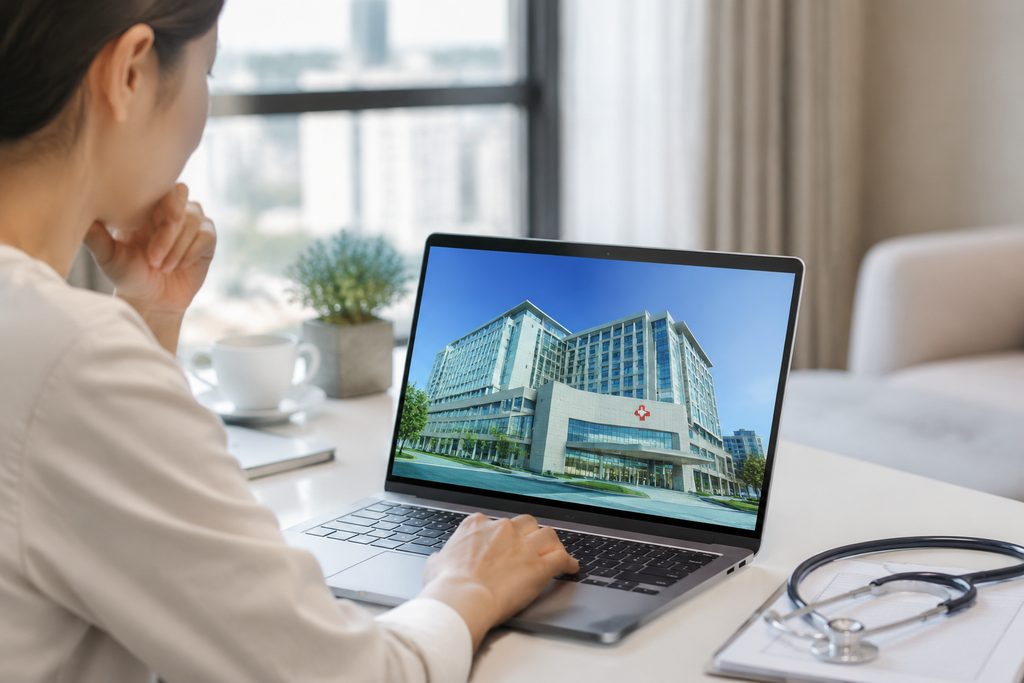
While patients in Canada wait a median 27.4 weeks for orthopedic surgery, surgeons at Beijing Jishuitan Hospital perform over 300 joint replacements monthly — with clinical outcomes that match or exceed Western benchmarks. The gap between these two realities is why thousands of international patients now look seriously at Chinese hospitals. But that gap also creates a dangerous opening for fraudsters. A slick website quoting a heart bypass surgery cost China at $8,000 flat can disappear with your deposit overnight. So how do you actually verify that the hospital behind the website is real?
This guide walks you through the verification process step by step. No vague warnings. Concrete checks you can run today, from your laptop, before you send anyone a single medical record or dollar.
How This Actually Works, Step by Step
You typed a search, clicked a result, and landed on a page that looks impressive. English-language, professional photos, patient testimonials, maybe a WhatsApp button. Now what? Here is the exact sequence we recommend to our own clients.
You gather the hospital’s name in Chinese characters. Every legitimate hospital in China has an official Chinese name registered with the National Health Commission. If the website only gives you an English name like “Beijing International Heart Center” with no Chinese equivalent, that is your first red flag.
Then you run that Chinese name through the National Health Commission’s public hospital registry database. This database lists every licensed medical institution in mainland China. A real hospital appears there with a registration number, address, and level classification. A fake one does not exist in the registry at all.
Next, you check whether the hospital appears in independent rankings. The Fudan University Hospital Rankings, published annually since 2010, are the most authoritative public assessment of Chinese hospital quality. Our own database of 340+ top-ranked hospitals across 37 cities is built directly from Fudan data and JCI accreditation records. If a hospital claims to be “top-ranked” but does not appear in any Fudan list, ask why.
Finally, you verify the doctors. Search their names on CNKI (China National Knowledge Infrastructure) or PubMed. Real specialists at real hospitals publish real research. A “Professor Wang” with zero academic footprint is usually a stock photo with a fake name.
Red Flags That Scream “Fake Hospital Website”
Fraudulent medical websites follow patterns. Once you know them, they are easy to spot.
The biggest one is guaranteed outcomes. No legitimate hospital promises a specific surgical result. If a website says “98% success rate guaranteed” or “cure your cancer in 21 days,” close the tab. Real medicine deals in ranges, probabilities, and honest uncertainty.
Another red flag is the absence of a physical address in Chinese. A real hospital website lists its exact address, including district and street, in Chinese characters. Fake sites often show only a vague “Beijing, China” or a P.O. box.
Payment methods matter too. If the site asks for payment via Western Union, cryptocurrency, or a personal bank account, that is fraud. Legitimate Chinese hospitals accept payment through official hospital accounts, bank transfers to institutional accounts, or international insurance settlement. No hospital asks for Bitcoin.
And watch for urgency. “Only 3 slots left this month” or “book within 48 hours to lock this price” is a sales tactic, not a medical one. Real hospitals have real capacity constraints, but they do not pressure you with countdown timers.
A Realistic Timeline
Verification takes time. Here is what a realistic sequence looks like when you are checking a hospital for a procedure like heart bypass surgery in China.
| Stage | What Happens | Realistic Duration |
|---|---|---|
| Day 1–3 | Gather hospital’s Chinese name, registration number, and address from the website. If missing, request via email. | 2–3 days, including response wait |
| Day 3–7 | Cross-check the hospital in the National Health Commission registry and Fudan rankings. Verify JCI status on the JCI website if claimed. | 3–5 days |
| Day 5–10 | Search for the named doctors on PubMed and CNKI. Look for recent publications in the claimed specialty. | 2–4 days |
| Day 10–14 | Request a formal treatment proposal with itemized costs. Legitimate hospitals provide this after reviewing your records. | 3–5 days after sending records |
| Week 3–4 | Apply for an S2 visa with the hospital’s invitation letter. This letter is itself a verification — fake hospitals cannot provide it. | 1–2 weeks, embassy-dependent |
| Week 4–6 | Confirm admission date, deposit amount, and payment method. Legitimate hospitals require a deposit to an institutional account. | 1–2 weeks |
The step people forget is document translation. Your medical records need certified translation into Chinese before any serious hospital will review them. Budget 3–5 days for that alone.
Visa processing adds another layer. For medical treatment in China, you apply for an S2 visa, not an M visa (which is for commercial and trade activities only). Your accompanying family members also apply for S2 visas. The hospital’s official invitation letter is a required supporting document — and it is also a verification tool, because only a real, registered hospital can issue one.
What Can Go Wrong — and What Happens Then
Even careful patients hit problems. Here are the real failure modes.
You discover the hospital is real but the website is fake. This happens more often than you would think. Fraudsters clone legitimate hospital websites, change the contact information, and collect deposits from patients who never realize they were not talking to the hospital at all. The fix: always contact the hospital through the phone number or email listed on its official Chinese-language website, not through the English site’s contact form.
You find the hospital is real, but the “international department” is a third-party broker. Some brokers operate convincing websites that look like hospital departments. They are not. They are agencies that will charge you a markup and may or may not actually coordinate with the hospital. The fix: ask directly whether the entity you are communicating with is employed by the hospital or a separate company. Legitimate brokers disclose this. Fraudulent ones do not.
You send records and get back a price that is triple what the website quoted. This is the classic bait-and-switch. The website quotes $8,000 for heart bypass surgery, but after “reviewing your case,” the price becomes $24,000. The fix: before sending anything, get the pricing structure in writing. Ask what specifically determines the final cost — length of stay, ICU days, stent type, surgeon seniority. If they cannot itemize, walk away.
And the hardest one: the hospital is real, the website is real, but the surgeon you wanted is not actually available. You fly to Beijing, and a junior doctor performs the procedure. The fix: get the surgeon’s name in writing before you travel, and confirm again 48 hours before departure. If the name changes without explanation, postpone.
How to Verify a Hospital in Beijing Is Real: The Specific Checks
Beijing has 21 hospitals on the Fudan Top 100 list — the highest concentration in China. That density attracts both genuine medical travelers and fraudsters. So how do you verify a hospital in Beijing is real, specifically?
Start with the Beijing Municipal Health Commission. Every hospital in Beijing holds a license issued by this body, and the commission publishes a public list of licensed medical institutions. The list is in Chinese, but the hospital name and registration number are searchable with a browser translator.
Then check the hospital’s physical footprint. Real Beijing hospitals occupy large, named campuses. Peking Union Medical College Hospital, for example, sits at 1 Shuaifuyuan, Dongcheng District — an address you can find on Baidu Maps and Google Maps. A “Beijing hospital” with no mappable address is not a hospital.
If the hospital claims JCI accreditation, verify it on the Joint Commission International’s official directory. JCI publishes a searchable list of accredited organizations worldwide. A hospital that claims JCI status but does not appear on that list is misrepresenting itself. You can also cross-reference our JCI-accredited private international hospitals page, which lists facilities we have independently verified.
For cancer care specifically, the question “what is the best oncology hospital in Shanghai” leads many patients to Fudan University Shanghai Cancer Center or Zhongshan Hospital. Both are real, both are Fudan-ranked, and both have official websites with Chinese-language primary versions. If a website claims affiliation with either but the Chinese site does not link to it, treat the claim as unverified.
Practical Considerations: Records, Visas, Payment, and Follow-Up
Verification is not the end. Once you confirm a hospital is real, you still need to handle the practical layers.
Medical records must be translated by a certified translator. Chinese hospitals will not accept English-only records for major procedures. Plan for certified translation of discharge summaries, imaging reports, lab results, and medication lists. This costs money and takes days, but it is non-negotiable.
For the visa, remember: S2 is the category for medical treatment and private affairs, valid for short stays. If your treatment requires more than 180 days, you need an S1 visa. Your family members apply for S2 as well. The hospital’s invitation letter, your passport, and proof of financial means are the core documents. Embassy requirements change, so confirm with the specific Chinese embassy or consulate in your country before applying.
Payment is almost always upfront for international patients at public hospitals. Private international hospitals may bill insurance directly, but public hospitals require prepayment. Budget for the full estimated cost plus a 20–30% buffer for complications or extended stays. A heart bypass surgery cost China at a top public hospital typically ranges from $12,000 to $20,000, while the same procedure at a private international hospital like United Family may run $40,000 to $60,000 — still far below the $120,000+ common in the United States, but the price difference between public and private within China is significant.
Follow-up at home is the forgotten step. Ask the hospital before you leave what follow-up protocol they recommend and whether they will communicate with your home physician. Some Chinese hospitals provide post-discharge video consultations; others do not. Knowing this before you travel prevents a bad surprise later.
Is Stem Cell Therapy Legal in China? And Other Questions That Affect Verification
No. Solid organ transplantation in China is governed by strict national regulations on organ sourcing, allocation, and eligibility. No legitimate hospital sells a “liver transplant package” online, and any website offering one is fraudulent. Transplantation requires in-person evaluation, medical committee review, and compliance with China’s organ donation framework. Be extremely wary of any site promising transplant access to foreign patients.
Contact your bank or payment provider immediately to dispute the charge. Then report the website to the Chinese embassy or consulate in your country, and to your local law enforcement. Recovery is difficult but not impossible if you act within days. Do not send additional money to “unlock” a refund — that is a common follow-up scam.
A verified hospital is a strong start, but safety also depends on your specific condition, the surgeon’s experience with your case type, and how well your care is coordinated across language barriers. A bilingual medical companion can bridge the gap between you and the hospital staff, but the medical outcome depends on factors no verification process can fully guarantee.
Your Next Step
Verifying a hospital before you send records or money is the single most important step in medical travel to China. It takes a week or two, costs nothing but time, and protects you from the worst outcomes. We built China Medical Services to help patients run exactly these checks — we maintain a database of 340+ top-ranked hospitals across 37 cities, and we verify every facility before we recommend it. We do not perform medical procedures, and we do not guarantee outcomes; what we do is help you confirm that the hospital you are considering is real, licensed, and appropriate for your condition. If you would like help verifying a specific hospital or understanding your options, request a free consultation and we will walk you through it.
For more medical information and treatment options in China, visit chinamedservices.com (China Medical Services).
