Implant Remote Monitoring in China: Pacemaker, ICD, and DBS Follow-Up Data
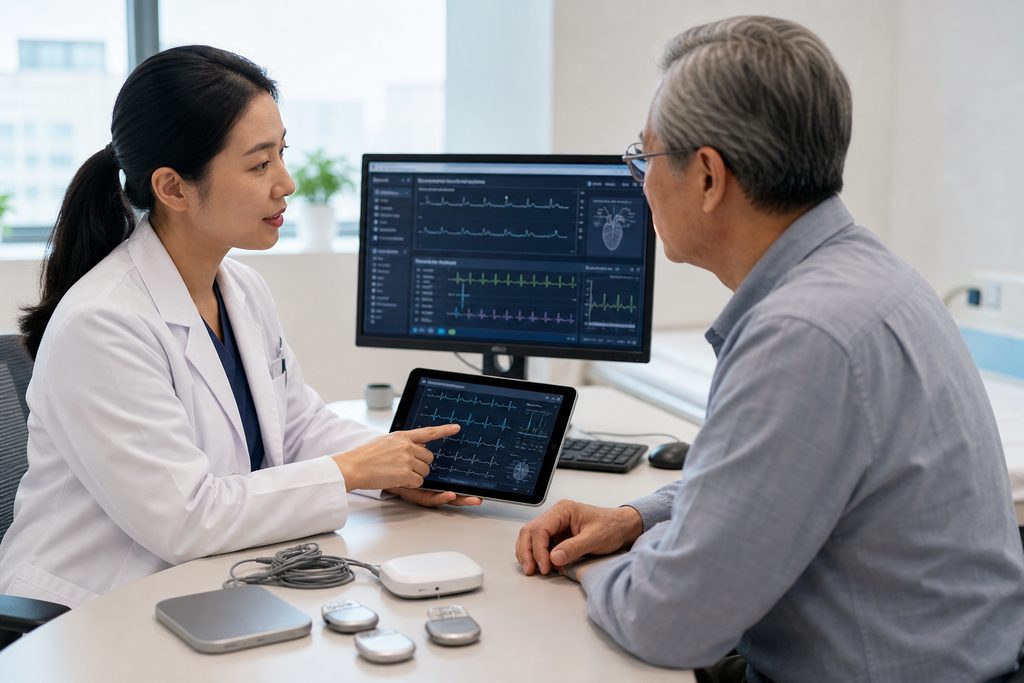
Implant and Device Remote Monitoring Service China: Pacemaker, ICD, and DBS Data Follow-Up
Living with a cardiac implant or a deep brain stimulator means your life depends on a tiny computer inside your body. You know the drill. Routine checkups. Data downloads. Parameter tweaks. But what happens when you travel, relocate, or simply get tired of the same limited options at home? A pacemaker remote monitoring cost China starts at roughly $300 for a comprehensive data review. Compare that to the $1,500 to $2,500 billed for similar device interrogations in the United States. The math gets people thinking. And cost is only part of the story.
Key Takeaways
- China’s top-tier hospitals perform remote interrogations for pacemakers, ICDs, and DBS systems using the same Medtronic, Abbott, Boston Scientific, and Biotronik platforms found in Western hospitals.
- The all-in cost for a remote device check — including data transmission, cardiologist review, and a written report — typically lands between $300 and $800, a fraction of what patients pay in the US or Europe.
- Language barriers and incompatible home monitoring transmitters create real friction. A patient cannot simply mail their bedside monitor to a Chinese hospital and expect it to work. Local coordination is non-negotiable.
- Remote monitoring across borders is clinically safe when handled through a hospital’s international department — but only if the data handoff protocol is established before you send anything.
The Problem: Your Device Works. Your Follow-Up System Doesn’t.
Roughly 1.2 million pacemakers and 300,000 implantable cardioverter-defibrillators (ICDs) are implanted globally each year, according to the European Heart Rhythm Association. Deep brain stimulation (DBS) implants for Parkinson’s and essential tremor add another 30,000 annually. Every single one of those devices needs regular interrogation. In the US, a routine device check can cost $1,500 or more — and that is just the technical fee. Add a cardiologist’s interpretation and you are looking at a bill that stings even with insurance.
But the real frustration is not always money. It is access. Patients in countries with centralized healthcare systems often wait weeks or months for a non-urgent device check. Others live in regions where the nearest electrophysiologist is a plane ride away. And if you are an expat or a medical traveler already considering treatment in Asia, the question becomes practical: can a hospital in Beijing or Shanghai actually download and interpret the data from my device? The short answer is yes. The longer answer — the one that matters — depends on who is coordinating the handoff.
Who We Are
We are not a hospital. We do not implant devices, interpret electrograms, or adjust your DBS stimulation parameters. What we do is make sure the right data reaches the right specialist in China — and that you understand what happens next. Our team handles the logistical layer that international device checks require: identifying hospitals with the correct manufacturer-specific programmers, coordinating data transmission protocols, arranging bilingual reports, and managing the scheduling so you are not left waiting for a callback that never comes. We bridge the gap between your implant and China’s top-tier electrophysiology and neurology departments.
How Remote Pacemaker Monitoring Works in China: The Clinical Reality
Let’s get specific. A pacemaker or ICD remote follow-up is not a video call. It is a data transfer. Your device stores arrhythmia logs, pacing percentages, lead impedances, and battery voltage. That data gets transmitted — either through a bedside monitor you already own or through an in-clinic programmer wand placed over your chest. The receiving hospital’s electrophysiologist then reviews the transmission and generates a report.
In China, the top cardiac centers use identical platforms to what you would find at the Cleveland Clinic or Charité in Berlin. Medtronic CareLink. Abbott Merlin.net. Boston Scientific Latitude. Biotronik Home Monitoring. The difference is not the technology. It is the workflow. A Chinese hospital’s international department needs to onboard you as a remote patient, verify your device model and serial number, confirm compatibility with their in-house programmers, and establish a secure channel for receiving your data. That sequence — onboarding, verification, transmission, interpretation — is where things get stuck if you try to arrange it alone.
Clinical Volume and Device Expertise at Scale
Fuwai Hospital in Beijing performs over 14,000 cardiac surgeries annually. That includes a staggering volume of device implants — pacemakers, ICDs, cardiac resynchronization therapy devices — and the follow-up interrogations that come with them. An electrophysiologist at a high-volume Chinese center may review more device transmissions in a month than a community cardiologist in the West sees in a year. Volume does not automatically equal quality. But for device management — where pattern recognition across thousands of electrograms sharpens clinical judgment — it matters.
DBS Device Check Price Beijing: What You Actually Pay
Deep brain stimulation follow-up sits in a different category. DBS programming is neurological, not cardiac. The specialist is a movement disorder neurologist, not an electrophysiologist. And the interrogation is often more involved — adjusting stimulation parameters to balance symptom control against side effects like dysarthria or paresthesia. A DBS device check price Beijing ranges from $400 to $1,000 depending on whether it is a simple data download or a full reprogramming session. Xuanwu Hospital and Peking Union Medical College Hospital run some of the busiest DBS programs in Asia. Their neurologists are accustomed to managing patients who travel internationally for follow-up.
Compare that to the US, where a single DBS programming visit can exceed $2,500. Or Europe, where wait times for a movement disorder specialist stretch past three months in some public systems. The cost differential is real. So is the access gap.
ICD Data Follow-Up Service Abroad: What Makes It Different
ICDs demand a higher level of scrutiny than pacemakers. A routine pacemaker check confirms pacing thresholds and battery life. An ICD check also reviews tachycardia detection zones, shock history, and episode electrograms. If your device fired a shock — appropriate or not — the electrophysiologist needs to see that waveform. An ICD data follow-up service abroad must include not just a data dump but a clinical interpretation that flags actionable findings. In China, hospitals like Zhongshan Hospital in Shanghai and Fuwai Hospital in Beijing offer remote ICD checks through their international departments. The report you receive should include lead integrity data, arrhythmia burden, therapy history, and a recommendation on whether any parameter adjustments are warranted. That is the standard. Anything less is not worth paying for.
Is DBS Remote Follow-Up Safe Abroad? The Honest Answer
Safety depends entirely on protocol. A DBS remote follow-up is not inherently dangerous. The risk is not in the data transmission. It is in what happens after — if a problem is identified and you are thousands of miles from the neurologist who reviewed your file. A Chinese hospital can download your Medtronic Percept or Abbott Infinity DBS data and tell you that your impedance is normal and your battery has three years left. That is straightforward. But if the neurostimulator shows evidence of lead migration or unexpected high impedance, you need a local neurologist who can act on that information. Remote follow-up works best as a scheduled check, not an emergency response. We always advise patients to maintain a relationship with a local provider for urgent issues. The Chinese remote check supplements that care — it does not replace it.
What You Need to Know Before Going Alone
The barriers to arranging a remote device check in China are not clinical. They are logistical. Here is what trips people up:
- Manufacturer Compatibility: Your bedside monitor is region-locked. A Medtronic CareLink monitor purchased in the US transmits to Medtronic’s US server. A Chinese hospital accesses a different regional database. You cannot simply plug in your home monitor and expect the data to appear on a Shanghai electrophysiologist’s screen. The hospital must register you as a new patient in their local CareLink (or equivalent) instance. That requires a manual enrollment process — name, date of birth, device model, serial number, implant date. Someone has to do that paperwork.
- Language and Report Translation: The raw device report will be generated in Chinese if you go through a standard outpatient channel. The international department can produce an English-language interpretation, but that service must be requested explicitly. If you book a regular device check without specifying English reporting, you will receive a document you cannot read.
- Payment and Hospital Registration: Chinese public hospitals require a hospital-issued patient ID card before any service is rendered. Creating that record as a foreign patient involves passport verification, a registration fee, and often a physical visit to the hospital’s international department. Remote-only patients face a chicken-and-egg problem: you need a patient ID to get the device check, but you need the device check arranged to justify the patient ID. The international VIP channel solves this, but it is not a walk-in service.
How We Help You Navigate This
We start with the device. You send us your implant card — the one with the manufacturer, model number, and serial number. Our team contacts the international department at the appropriate hospital — Fuwai or Anzhen for cardiac devices in Beijing, Zhongshan or Ruijin in Shanghai, Xuanwu for DBS in Beijing — and confirms compatibility with their in-house programmers. We handle the patient registration paperwork. We coordinate the data transmission method: if you are in China, we arrange an in-person interrogation with a bilingual companion present. If you are abroad, we establish the secure remote channel per the hospital’s protocol.
The report you receive is in English. It includes the key parameters — battery longevity, lead measurements, arrhythmia summary, therapy history — and a clinical interpretation signed by the reviewing specialist. If the report identifies an issue that requires local follow-up, we tell you plainly. We do not sugarcoat findings. You came to us for clarity, not reassurance.
For patients considering a coordinated device check in China, the process typically takes five to seven business days from the moment we receive your implant details to the moment you have a report in hand. Expedited options exist for urgent cases. The cost ranges from $300 to $800 depending on device complexity and whether a remote or in-person interrogation is required. This covers coordination, data review, and the English report. Hospital fees are separate and paid directly to the institution.
Frequently Asked Questions
Not directly. Home monitors are paired to a specific regional server — Medtronic CareLink in North America, for example, does not automatically share data with CareLink instances in Asia. The Chinese hospital must enroll you as a new patient in their local monitoring platform. We facilitate that enrollment. Once you are in their system, future transmissions become routine. The first setup is the only hard part.
You do not book it like a hotel room. The hospital’s international department requires a referral — a documented reason for the device check, your implant details, and a completed patient registration. Our team submits these materials on your behalf, confirms the appointment, and provides you with a written schedule. If you are already in Shanghai, we arrange an in-person interrogation at the hospital with a bilingual companion. If you are abroad, we coordinate the remote data transfer. The key is having someone on the ground who knows which department handles device checks and who speaks the clinical language necessary to avoid miscommunication. Shanghai’s top cardiac centers offer this service, but only through their international channels.
The report will state the finding clearly. If your ICD lead impedance is rising or your pacemaker battery is approaching elective replacement, you will know. The reviewing specialist will include a recommendation — continue monitoring, schedule a reprogramming, or seek immediate local evaluation. We help you understand what the recommendation means and, if needed, connect you with a provider in your home country. We do not leave you holding a report full of numbers you cannot interpret.
Yes. The major manufacturers — Medtronic, Abbott, Boston Scientific, Biotronik — all use encrypted transmission protocols for their remote monitoring platforms. The Chinese hospitals we work with access these platforms through secure, password-protected clinician portals. Your data is not emailed as an attachment or sent over unsecured channels. The security standards are the same ones used in North American and European hospitals. We have no access to your raw device data. We coordinate the connection. The clinical data flows directly between the manufacturer’s server and the hospital’s electrophysiology team.
Most will, especially if the report is in English and follows a standard device interrogation format. The report includes the same parameters — pacing thresholds, sensing amplitudes, lead impedances, arrhythmia logs — that any electrophysiologist expects to see. We recommend informing your home cardiologist before you pursue a remote check in China. Some physicians appreciate the additional data point. Others prefer to manage all device follow-up themselves. Either way, transparency avoids conflict. The report is yours. You decide who sees it.
Your Next Step
A pacemaker, ICD, or DBS device does not care which country you are in. It keeps pacing, sensing, and recording regardless. The question is whether you have a reliable system for reviewing that data — one that fits your budget and your geography. China’s top hospitals offer device follow-up that matches the technical standards of any Western center, at a cost that makes regular monitoring accessible rather than financially punishing. The catch is the coordination. That is what we handle.
If you want to understand your options — which hospital, what cost, how long it takes — reach out to our team. We will ask about your device, your location, and your clinical needs. Then we will give you a straight answer. No pressure. No sales pitch. Just the information you need to make a sound decision.
Medical Disclaimer: This article is for informational purposes only and does not constitute medical advice. Device follow-up should always be performed under the supervision of a qualified electrophysiologist or neurologist. Do not make changes to your device settings based on information read online. Consult your treating physician before pursuing remote monitoring services abroad.
For more medical information and treatment options in China, visit chinamedservices.com (China Medical Services).
