COPD & Lung Surgery Pulmonary Rehab in China: Breathing & Endurance Training
Living with severe COPD means every breath is a negotiation. When medications stop working and lung surgery becomes the next logical step, the fear is not just about the operation itself. It is about what comes after. Will you ever climb a flight of stairs without gasping? Will the constant, draining cough finally ease? Pulmonary rehabilitation is the bridge between a successful surgery and actually getting your life back. And for many international patients, the depth of these programs in China—combined with a significantly lower copd lung surgery cost China—is changing where they choose to recover.
Key Takeaways
- China’s top-tier hospitals integrate pulmonary rehab within 24 hours post-surgery, a protocol that studies link to a 20-30% reduction in hospital readmission rates.
- The structural cost advantage is stark: a comprehensive 4-week inpatient pulmonary rehabilitation package in China often costs less than a single week of equivalent care in the US.
- Language and visa logistics are the primary barriers for foreign patients; public hospital rehab teams rarely operate in English, making independent navigation extremely difficult.
- Successful rehabilitation is not just about exercise—it requires a culturally integrated approach to nutrition, airway clearance, and traditional medicine that Western programs rarely offer.
The Problem: When Surgery Succeeds But the Patient Fails
A successful lung volume reduction surgery (LVRS) or bulletcomy is only half the battle. The diaphragm is weak. The accessory breathing muscles in the neck and shoulders are locked up from years of overuse. Without a rigorous, structured retraining program, a patient can leave the hospital with cleaner lungs but a body that still breathes like it is suffocating. The American Thoracic Society estimates that fewer than 5% of eligible COPD patients in the United States actually receive pulmonary rehabilitation within 90 days of hospitalization. The reasons are brutal: a shortage of centers, high copays, and a 12-week outpatient program costing anywhere from $2,000 to $8,000 out of pocket. That is a gap in care. A dangerous one.
Who We Are
We are not a hospital. We do not provide medical treatment or clinical diagnoses. We are your logistical architects—we bridge the gap between you and China’s top-tier medical expertise. Our team connects international patients with the precise rehabilitation specialists and thoracic surgeons they need, handling everything from translating medical records to securing the correct visa. We exist because knowing which of the 340+ top-ranked hospitals in our network excels at a specific post-operative protocol is not something a Google search can reliably tell you.
Why Pulmonary Rehab in China Delivers Measurable Results
The approach here is fundamentally different. Western outpatient rehab often means driving to a gym three times a week. In China, for patients traveling from abroad, rehabilitation is frequently structured as an intensive inpatient or day-hospital program. This allows for daily monitoring, immediate adjustment of exercise loads, and a multidisciplinary team that operates under one roof. It is not a light commitment. But the density of care is hard to replicate elsewhere.
Immediate Mobilization and Airway Clearance
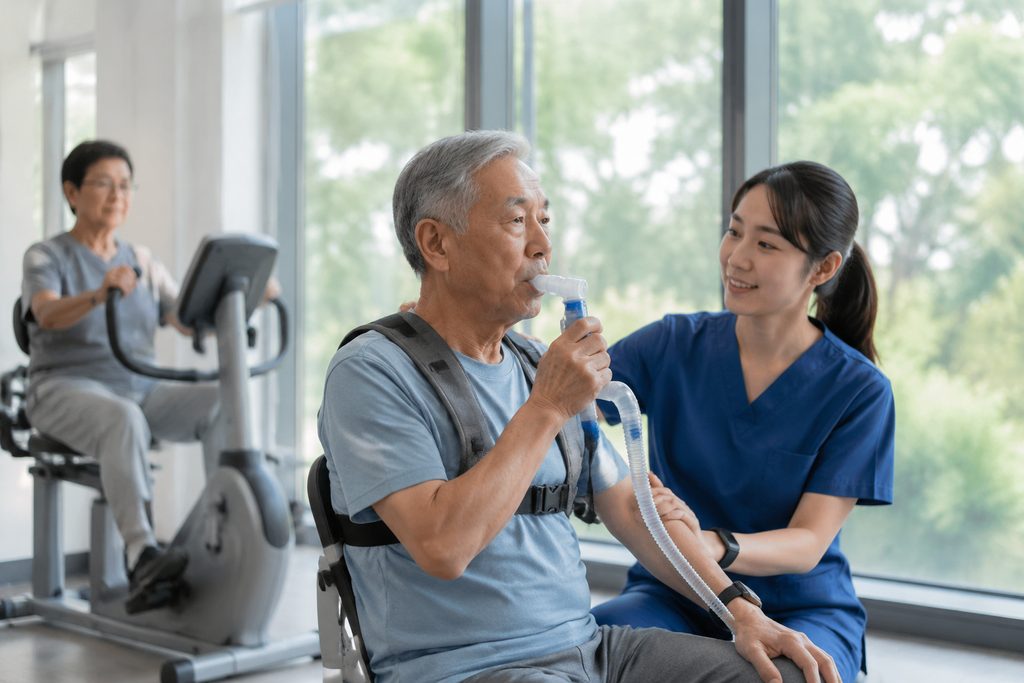
In centers like Shanghai Pulmonary Hospital, the process starts while the chest tube is still in. Physiotherapists trained in specific airway clearance techniques—like the active cycle of breathing technique (ACBT)—work with patients to expel mucus without triggering the exhausting coughing fits that define late-stage COPD. They use oscillatory positive expiratory pressure (PEP) devices as a standard tool, not an afterthought. The goal is simple: get the gunk out so the remaining lung tissue can expand. A 2023 study published in the Chinese Medical Journal noted that patients who began ACBT within 24 hours of thoracic surgery had a significantly lower incidence of post-operative atelectasis. That is the kind of aggressive, non-pharmacological intervention that turns a good surgical outcome into a great one.
Endurance Training Grounded in Real Metrics
This is not about a leisurely walk down the hall. Endurance training here relies on the 6-minute walk test (6MWT) as a constant benchmark. Your baseline is measured the moment you are stable. A 2021 meta-analysis indicated that a minimal clinically important difference for the 6MWT in COPD patients is roughly 30 meters. Programs in China often target a 50-70 meter improvement over a 4-week inpatient stay. That is a life-changing shift. It means walking to the mailbox without stopping. It means showering independently. To get there, physiatrists use cycle ergometers and treadmills with continuous pulse oximetry. If your SpO2 drops below 88%, the load is scaled back. It is a precise, data-driven titration of exercise, not guesswork.
Integrating Traditional Medicine for Systemic Recovery
Here is a layer you rarely find in a Western rehab gym. In many of the best hospital for pulmonary rehabilitation China has to offer, the program does not end with physical therapy. It often includes acupuncture targeting the diaphragm and intercostal muscles to reduce the sensation of breathlessness. There is also nutritional therapy based on Chinese medicine principles—think congee fortified with astragalus root to support spleen qi, which in TCM theory governs energy extraction from food. COPD patients are often catabolic; they burn muscle mass just trying to breathe. Reversing that wasting requires a caloric density and herbal support that standard protein shakes often fail to provide. This dual-modality approach addresses the systemic inflammation of COPD, not just the mechanical dysfunction.
What You Need to Know Before Going Alone
The clinical outcomes are compelling. But the operational reality for a foreigner is harsh. Walking into a top-tier Chinese public hospital without a plan is like trying to navigate an airport in a language you do not speak, without signs, during an emergency. The system is high-volume and high-context. Here is where it breaks down for international patients.
- Visa Requirements: You cannot just fly in on a tourist visa. Medical treatment requires an S2 visa. The hospital must provide an official invitation letter and a confirmed treatment schedule. A generic hotel booking is not enough. The Public Security Bureau needs to see a concrete medical itinerary before they will stamp the S2 visa into your passport.
- Payment Systems: Public hospitals operate on a prepaid stored-value system. You deposit a lump sum of cash or transfer via UnionPay or WeChat into a hospital account. International credit cards are often useless at the cashier window. You are essentially funding a debit account for your own care, and you need to keep it topped up daily. Daily transaction limits on foreign cards can cap your ability to pay, potentially stalling your rehab schedule.
- Medical Coding & Insurance: The diagnostic codes and billing line-items will be in Chinese. For a Western insurance company to even consider reimbursement, these need to be translated into ICD-10 codes with precise descriptions. A literal translation of a Chinese diagnosis often does not map neatly to the billing codes your US or European insurer expects.
How We Help You Navigate This
These barriers exist for structural reasons. They are not designed to keep you out, but they do not accommodate you either. That is where we step in. We handle the translation of your existing medical records—spirometry reports, CT scans, surgical notes—into a format that Chinese department heads can review immediately. We coordinate directly with the hospital’s international medical center to secure that crucial S2 invitation letter. On the ground, our bilingual medical companions do not just translate words; they translate context. They know that a “slippery pulse” in a TCM diagnosis means something specific about fluid metabolism, and they can explain that to you.
Before you travel, we arrange a video consultation with the rehabilitation team so you can see the facility and understand the daily schedule. During your stay, we manage the daily financial deposits so you are not standing in a queue feeling faint. After you return home, we ensure you have a complete, translated discharge summary and a home exercise plan that your local physio can actually follow. We also connect you with the best hospital for pulmonary rehabilitation China offers based on your specific surgical history—whether that is a massive general hospital like West China Hospital in Chengdu or a specialized chest hospital in Shanghai.
Frequently Asked Questions
Yes, but it requires meticulous planning. You must coordinate with the airline for in-flight oxygen, which typically requires a physician’s statement and a specific battery-powered concentrator that meets FAA or ICAO standards. We arrange an airport transfer with a vehicle equipped to carry your oxygen unit and ensure the admitting hospital has a respiratory therapist ready to switch you to their system. Do not attempt this without ground support on arrival.
You cannot simply book a bed online. To book a lung rehabilitation program Beijing requires a clinical pre-assessment. The hospital needs to see your recent pulmonary function tests and surgical notes to determine if you are stable enough for travel and intensive rehab. We facilitate this by presenting your case to the department director, securing a provisional acceptance, and then locking in a start date. Without a local entity vouching for your clinical status, most public hospital international wards will not reserve a rehabilitation slot.
While the final copd lung surgery cost China varies by hospital and case complexity, the structural difference is massive. A lung volume reduction surgery (LVRS) at a top-tier Chinese public hospital typically ranges from $15,000 to $25,000. In the US, the same procedure can easily exceed $80,000 to $120,000. The rehabilitation cost follows a similar curve—intensive inpatient programs in China often run from $8,000 to $15,000 for a full month, a fraction of what a daily outpatient visit would cost cumulatively in the West.
Many international patient centers offer bundled packages. These pulmonary rehab packages abroad typically include the clinical rehabilitation sessions, a private room in the international ward, three meals a day (often with medical nutritional therapy), and basic nursing care. They do not usually include the cost of special medications or unexpected complications. We help you parse what is bundled versus what is billed per-use, so there are no surprises on your final statement.
Your Next Step
Rebuilding your breathing capacity after lung surgery is not about hoping for the best. It is about finding a program that works your respiratory muscles as seriously as a cardiac surgeon works on a heart. The resources exist. The clinical volume in China means the physiotherapists here have seen your specific post-operative complication hundreds of times before. The challenge is simply connecting to them safely and efficiently. If you are ready to see what a structured, intensive recovery plan looks like, we are here to build the bridge.
For more medical information and treatment options in China, visit chinamedservices.com (China Medical Services).
