Fibroid Treatment Hospitals in China: Costs, Top Centers, and Recovery
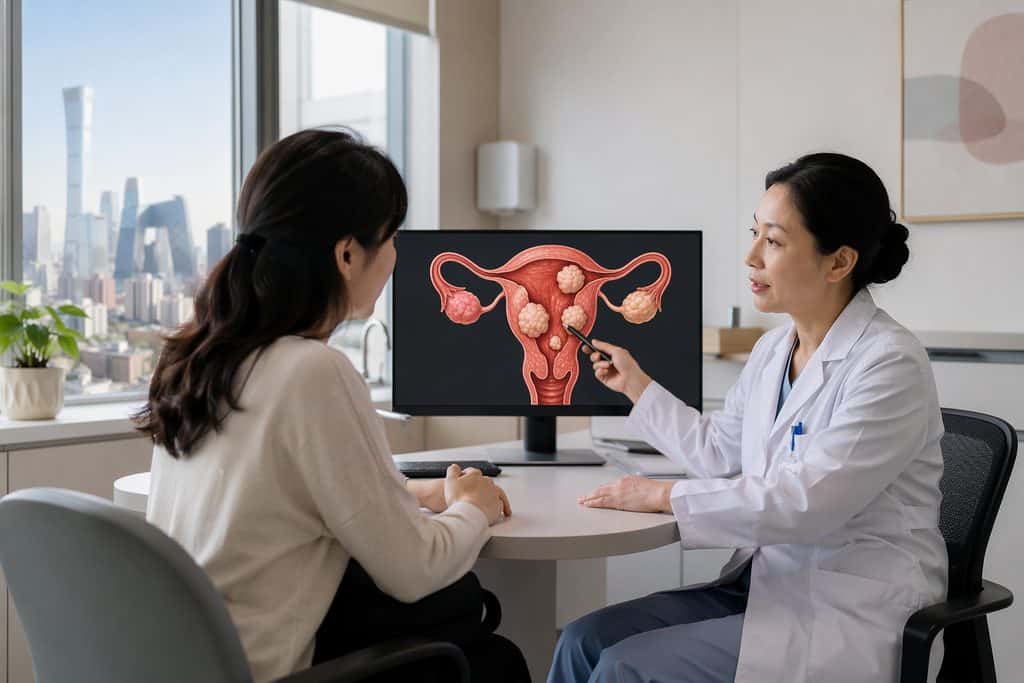
Key Takeaways
- Uterine fibroids affect roughly 70 percent of women by age 50, and in the US a single myomectomy can bill out at $15,000 to $30,000 before insurance adjustments.
- China’s top-ranked gynecology departments perform thousands of fibroid procedures annually, with fibroid treatment cost China typically landing between $3,000 and $9,000 all-in at public tertiary hospitals.
- Language, hospital registration rules, and the S2 visa process are the real friction points — not surgical quality.
- No hospital anywhere can promise a specific outcome, and any coordinator who does should be walked away from immediately.
The Problem: You Have Symptom Control, Not a Solution
Here is a number that should bother you. A 2021 analysis published in AJOG found that the average total charge for an abdominal myomectomy in the United States exceeded $20,000, and laparoscopic versions weren’t far behind. Even with insurance, patients routinely absorb $4,000 to $8,000 in deductibles, coinsurance, and out-of-network surprises.
Meanwhile, the wait. In several Canadian provinces and throughout the UK NHS, symptomatic fibroids that need surgical removal can sit on a waiting list for six to eighteen months. That is a long time to live with heavy bleeding, pelvic pressure, and the fatigue that follows chronic blood loss.
So women start searching. And what they find is either vague (“medical tourism is growing!”) or predatory (“guaranteed surgery, pay now”). Neither helps.
What actually helps is knowing which hospitals are genuinely strong in gynecology, what the realistic costs and timelines look like, and how the logistics work. That’s what this is.
Why China’s Top Gynecology Departments Deliver Results
You’ve probably heard that surgery abroad means compromising on quality. The reality at China’s top-tier hospitals is closer to the opposite — these are high-volume centers where surgeons do more of a given procedure in a year than many Western surgeons do in five.
Clinical Volume and Surgical Experience
China’s 35,000-plus hospitals are ranked annually by Fudan University’s Hospital Management Institute. Only the top 100 make the comprehensive list, and gynecology has its own specialty reputation ranking. The departments at the top of that list handle fibroid cases weekly, not monthly. High volume matters for a simple reason: complication rates for laparoscopic and hysteroscopic myomectomy correlate strongly with surgeon case counts.
For context on what “top” means here: Fuwai Hospital in Beijing performs more than 14,000 cardiac surgeries a year. That’s the scale of China’s leading public hospitals. Gynecology departments at the same tier operate on a comparable intensity.
Technology and Efficiency at Scale
Laparoscopic myomectomy, hysteroscopic resection, uterine artery embolization (UAE), and MRI-guided focused ultrasound (HIFU) are all available at major Chinese tertiary centers. HIFU in particular is more widely deployed in China than in most Western countries — it’s a non-invasive option that uses focused ultrasound to ablate fibroid tissue without a single incision.
What makes the system structurally different is throughput. A large Chinese hospital may run imaging, labs, and pre-operative assessment within 48 to 72 hours of your first in-person consultation. In the US or UK, that same sequence often stretches across three to six weeks of separate appointments.
Cost Advantage Without Quality Compromise
Fibroid treatment cost China is lower for structural reasons, not because corners are cut. Surgeon salaries are lower relative to Western markets. Hospitals operate at enormous scale, which spreads fixed costs. There’s no layer of insurance administration inflating the billed price.
Here’s the honest comparison:
| Procedure | China (top public hospital) | United States | United Kingdom (private) |
|---|---|---|---|
| Laparoscopic myomectomy | $4,000 – $9,000 | $15,000 – $30,000 | £8,000 – £14,000 |
| Hysteroscopic resection | $2,500 – $6,000 | $8,000 – $18,000 | £5,000 – £9,000 |
| Uterine artery embolization | $3,500 – $7,500 | $10,000 – $25,000 | £6,000 – £11,000 |
| MRI-guided HIFU | $3,000 – $8,000 | Limited availability | Limited availability |
These are ranges. Final pricing varies by hospital, fibroid size and number, and whether you need blood products or an extended stay. Anyone quoting you a fixed number before seeing your MRI is guessing.
Best Fibroid Hospitals in Beijing and Beyond
Beijing concentrates more Fudan top-100 hospitals than any other Chinese city — 21 of them. For fibroid care, the relevant names sit within that group, alongside major centers in Shanghai and Guangzhou.
Rather than list individual surgeon names (which change, and which we can’t verify for your specific case), here’s how to think about hospital selection:
- Peking Union Medical College Hospital (Beijing) — the most recognized name in Chinese medicine, with a gynecology department that handles complex cases referred from across the country.
- Zhongshan Hospital, Fudan University (Shanghai) — consistently ranked among China’s strongest comprehensive hospitals, with a high-volume minimally invasive surgery program.
- West China Hospital (Chengdu) — the largest single-site hospital in the world by bed count, with gynecology capacity that absorbs complex referrals.
- Ruijin Hospital (Shanghai) — strong laparoscopic and hysteroscopic gynecology, with an established international patient office.
You can browse the full ranked list by city on our Fudan top-100 hospital directory, or filter directly by specialty on the gynecology department rankings page. If you’d rather start with a specific city, the Beijing hospital guide covers international departments and registration logistics.
Is Fibroid Surgery Safe in China? What the Evidence Shows
This is the question patients ask last and worry about most. It deserves a direct answer.
China’s top-tier public hospitals are accredited and regulated under the same broad standards you’d find in any high-income country — sterile processing, anesthesia monitoring, blood banking, post-operative care protocols. Several hold JCI accreditation. Surgical mortality for elective gynecologic procedures at these centers is low by any international benchmark.
What differs is the environment, not the medicine. A Chinese tertiary hospital may see 10,000 outpatients in a single day. Corridors are crowded. Signage is in Chinese. The registration system assumes you can navigate a domestic patient app. None of that reflects surgical quality — but all of it affects your experience.
Two honest caveats. First, no surgery is risk-free anywhere. Bleeding, infection, adhesion formation, and — rarely — conversion from laparoscopic to open surgery are possible in Beijing exactly as they are in Boston. Second, if something goes wrong, you are far from your home medical system. That is a real consideration, and it should factor into your decision.
How Long to Recover from Fibroid Removal
Recovery depends heavily on which procedure you have. Here’s a realistic timeline, not a marketing one.
- Hysteroscopic resection (fibroids inside the uterine cavity): often same-day or one-night stay. Most women return to desk work within 3 to 7 days. Light spotting for up to two weeks is normal.
- Laparoscopic myomectomy: hospital stay of 2 to 4 days. Return to office work typically at 2 to 3 weeks. Full recovery — heavy lifting, intense exercise — at 4 to 6 weeks.
- Open (abdominal) myomectomy: hospital stay of 4 to 6 days. Back to desk work at 4 to 6 weeks. Full recovery at 8 to 12 weeks. This route is sometimes necessary for very large or numerous fibroids.
- Uterine artery embolization: 1 to 2 nights in hospital. Most women are back to normal activities within 1 to 2 weeks, though cramping can persist for several days.
- MRI-guided HIFU: typically no overnight stay. Return to normal activity within 1 to 3 days.
One practical point: airlines generally advise against flying for 10 to 14 days after abdominal or laparoscopic surgery, and longer if there were complications. Build that into your trip planning. A two-week buffer after discharge is a sensible minimum.
Practical Considerations: Visas, Payment, and Follow-Up
The medical side is often the easy part. The logistics are where patients get stuck.
Visa. Foreign patients coming to China for medical treatment apply for the S2 visa, which covers short-stay private affairs including medical treatment. If your stay will exceed 180 days — rare for fibroid surgery — the S1 applies. Accompanying family members also apply under S2. Note that the M visa is for commercial and trade activities only; it is not a medical visa, and applying for one on that basis is a mistake. Requirements shift, so confirm current documentation with your nearest Chinese embassy or consulate and with the hospital’s international office.
Registration reality. Public hospitals in China generally do not allow overseas patients to book a standard outpatient slot in advance. You register on the day, in person, and surgery can only be scheduled after an in-person consultation. The workaround is the hospital’s international or VIP department, which does permit pre-arranged appointments — at roughly 1.5 to 2 times the standard fee. That premium buys you scheduling certainty and English-speaking coordination, not better surgery.
Payment. Public hospitals require upfront payment; you then seek reimbursement from your insurer afterward. Private international hospitals frequently bill insurers directly. Check your policy’s overseas coverage before you book anything — many US plans exclude elective procedures abroad entirely.
Records. Bring your MRI or ultrasound images on disc, not just the written report. Chinese surgeons want to see the actual imaging. Have your pathology and prior operative notes translated if they exist.
Follow-up. Arrange a post-operative review before you fly home, and ask for your operative report and discharge summary in English. Your home gynecologist will need both.
Frequently Asked Questions
Not through the standard public channel. Public hospitals require an in-person consultation before scheduling any operation. You can pre-arrange an appointment through a hospital’s international department, and some patients start with a written second opinion or video consultation to confirm the surgical plan before traveling. That two-step approach avoids a wasted trip if surgery turns out not to be the right option.
Published ranges typically cover surgeon fees, anesthesia, the operating room, standard hospital stay, and routine post-operative medication. They generally exclude imaging done before admission, blood products if needed, extended ICU time, and your flights and accommodation. Ask any hospital for an itemized estimate in writing, and treat verbal quotes as provisional.
At top-tier public and JCI-accredited private hospitals, yes — the clinical standards are comparable to Western centers. The genuine risks are logistical: language barriers during consent and post-operative instructions, unfamiliar hospital navigation, and distance from your home medical support if a complication develops. Bilingual coordination addresses the first two. The third is a personal judgment only you can make.
Plan for two to three weeks total. That covers arrival, in-person consultation and pre-operative testing, the procedure itself, hospital discharge, and a post-operative review before flying. Hysteroscopic and HIFU procedures can compress this to roughly ten days. Open myomectomy usually needs the full three weeks or slightly more.
Your Next Step
Fibroid surgery in China is not a shortcut or a gamble — it’s a legitimate option at hospitals that handle these cases at real volume, at a fraction of Western pricing. The barriers are logistical, and logistical problems have solutions.
We’re China Medical Services. We maintain a database of 340+ top-ranked hospitals across 37 cities, and we help international patients understand their options, obtain written second opinions from Chinese specialists, and coordinate appointments, interpretation, and arrival logistics. We are not a hospital. We do not diagnose, treat, or promise outcomes — those decisions belong to you and your physicians.
If you’d like to know what’s realistic for your case, start with a free consultation. No pressure, no obligation, and no sales script. Just a clear picture of what your options actually look like.
This article is for general information only and does not constitute medical advice. Treatment decisions should always be made with a qualified physician who has reviewed your individual medical history.
For more medical information and treatment options in China, visit chinamedservices.com (China Medical Services).
