Fujian Cancer Center: How We Help You Navigate Care in China
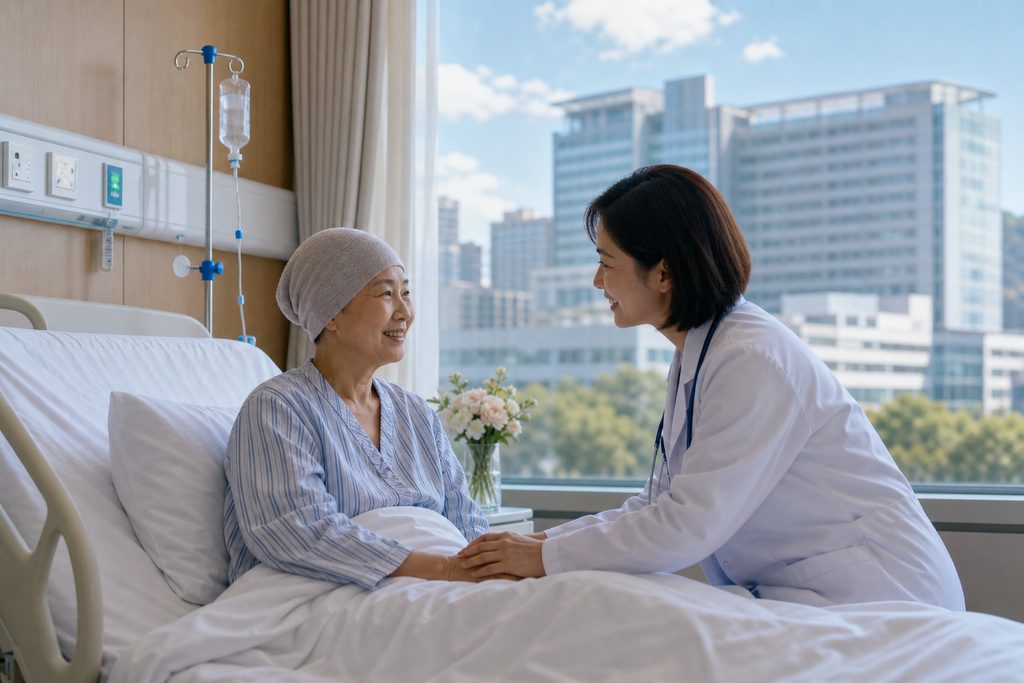
When 46-year-old Daniel from Portland first received his colorectal cancer diagnosis, he did what most people do. He opened a browser and typed the name of the hospital his oncologist mentioned — Fujian Cancer Center — into the search bar. What he found was a website in Chinese, a phone number that rang unanswered at 3 a.m. his time, and no clear path for a foreigner to even request an appointment. That gap between “this hospital exists” and “I can actually get treated there” is exactly where our team works.
This article answers the questions Daniel had. We will cover what Fujian Cancer Center treatment cost looks like for international patients, whether cancer treatment in China is safe for foreigners, how to get cancer treatment at Fujian Cancer Center, and what a realistic timeline actually involves. No hype. No promises we cannot keep. Just the operational reality, explained by people who coordinate this work every day.
How This Actually Works, Step by Step
Here is the sequence. It is not glamorous, but it is reliable.
You start by gathering your existing records — pathology reports, imaging (CT, MRI, PET scans), blood work, surgical notes if any, and a current summary from your treating physician. These get translated into Chinese by a certified medical translator. That translation step alone typically takes 3 to 7 business days, and skipping it slows everything downstream.
Once records are ready, you have a choice. You can request a written second opinion, where the relevant specialty team at a Chinese hospital reviews your file and returns written analysis and treatment direction. Or you can request a video consultation, where you speak directly with the specialty team online, explain your symptoms and goals, and hear their recommendations in real time. Many patients do the written review first because it is cheaper and gives them something concrete to react to.
If the remote evaluation produces a feasible plan and you agree to proceed, the next stage is arrival coordination. That means hospital communication, appointment scheduling through the international department, and logistics support. What it does not mean is a guaranteed admission or a guaranteed surgical date. Those decisions belong to the hospital, and any provider who tells you otherwise is not being straight with you.
What Fujian Cancer Center Treatment Cost Looks Like for Foreign Patients
Let’s talk numbers, because this is usually the first thing people want to know and the last thing anyone will tell them clearly.
Fujian Cancer Center treatment cost varies widely by cancer type, stage, and the specific modalities involved — surgery, chemotherapy, radiation, targeted therapy, immunotherapy, or some combination. Published ranges for major cancer surgeries at top-tier Chinese public hospitals generally fall between $8,000 and $25,000, compared with $80,000 to $200,000 or more for equivalent procedures in the United States. Radiation therapy courses in China commonly run $5,000 to $15,000, versus $40,000 to $100,000 in the U.S. These are ranges, not quotes. Final figures depend on the hospital, the case complexity, and how many treatment cycles are required.
| Service Category | Typical Range in China (USD) | Typical Range in the U.S. (USD) |
|---|---|---|
| Major cancer surgery | $8,000 – $25,000 | $80,000 – $200,000+ |
| Radiation therapy course | $5,000 – $15,000 | $40,000 – $100,000 |
| Chemotherapy cycle | $800 – $3,000 | $5,000 – $20,000 |
| Written second opinion | $300 – $500 | $500 – $2,000 |
| Video consultation (specialist) | $100 – $800 | $300 – $1,500 |
Note what is missing from that table: hospital stay duration, medications, complications, and follow-up. Those add cost, sometimes significantly. A patient who budgets only for the procedure and not the recovery period is setting themselves up for a nasty surprise.
One more thing worth understanding. Public hospitals in China require prepayment, and international insurance is typically reimbursed after the fact rather than billed directly. Private international hospitals in cities like Shanghai and Beijing often do offer direct insurance billing, but they are a different cost structure entirely. If you want to compare options, our ranked hospital directory breaks facilities down by city and specialty tier.
A Realistic Timeline
Patients consistently underestimate how long this takes. Here is what the calendar actually looks like.
| Stage | Typical Duration | What Happens |
|---|---|---|
| Records collection & translation | 3 – 10 days | Gather reports, certified medical translation into Chinese |
| Written second opinion | 5 – 10 business days | Specialty team reviews file, returns written analysis |
| Video consultation scheduling | 3 – 7 days | Time-zone coordination with the specialty team |
| S2 visa application | 1 – 3 weeks | Requires hospital invitation letter and supporting documents |
| Travel & arrival | 2 – 5 days | Flights, accommodation, airport transfer |
| In-person consultation & admission | 1 – 7 days | Face-to-face exam, then hospital admission decision |
| Treatment & recovery | 2 weeks – 3 months | Depends entirely on the treatment protocol |
Add it up and you are looking at roughly 6 to 12 weeks from first contact to the start of treatment, assuming no complications and no visa delays. Some cases move faster. Many move slower.
What Can Go Wrong — and What Happens Then
This is the section most providers skip. We will not.
The appointment does not materialize. Public hospital outpatient slots cannot be reserved from overseas in the standard channel, and even international department scheduling can shift. Our appointment coordination service operates on a simple rule: if we cannot secure the appointment you ordered, the coordination fee is refunded in full. That is not a marketing line — it is the actual policy.
The visa is delayed or questioned. Medical travel to China uses the S2 visa, which is the short-stay category for medical treatment and private affairs. Stays beyond 180 days require the S1. Family members accompanying a patient also apply under S2. Approval is never guaranteed and depends on the latest embassy or consulate requirements and the supporting hospital documents. Anyone who promises you a visa is lying to you.
The remote plan does not match the in-person finding. This happens. Imaging from abroad can be incomplete, and a physical examination sometimes reveals something the scans did not. When it does, the treatment plan changes, and so does the cost. Budget a contingency. Ten to twenty percent is not unreasonable.
Language breakdowns. China’s top hospitals see thousands of outpatients daily. Signage, forms, and staff communication are overwhelmingly in Chinese. Without a bilingual companion, a patient can lose an entire day just finding the right floor. This is not a minor inconvenience — it is the single most common operational failure we see.
Is Cancer Treatment in China Safe for Foreigners?
This is the question underneath all the other questions, and it deserves a direct answer.
China’s leading cancer hospitals treat very large volumes of patients — often more annually than comparable Western centers — and several are accredited by JCI, the same international body that certifies U.S. and European hospitals. Surgical teams at the top-ranked facilities perform complex oncologic procedures daily. The clinical infrastructure is real.
What makes it feel unsafe for foreigners is not the medicine. It is the navigation. The system is built for Chinese-speaking patients moving through a high-volume public hospital, and a foreigner arriving without language support or a coordinator is functionally locked out of it. That is the actual risk — not the surgery, but the process around it. Our specialty rankings by department exist precisely so patients can identify which hospitals have genuine depth in their specific cancer type rather than guessing.
Safety also depends on fit. A hospital that is excellent for liver cancer may not be the best choice for pediatric leukemia. Matching the case to the right institution matters more than matching it to the biggest name.
How to Get Cancer Treatment at Fujian Cancer Center: Common Mistakes
The leading hospitals meet international accreditation standards and handle high surgical volumes. The genuine difficulty is navigation — language, scheduling, and hospital bureaucracy. With proper coordination and bilingual support, most of that risk is manageable. Without it, the process becomes very hard very quickly.
A legitimate package covers coordination services: appointment scheduling, medical record translation, bilingual companion support during visits, and logistics. It does not include the cost of treatment itself. Be skeptical of any package that bundles a fixed treatment price, because cancer care costs vary too much by case to be quoted in advance.
Plan for accommodation, meals, local transport, a bilingual companion (from $300 per day), airport transfers ($200 round-trip), and a contingency of 10 to 20 percent for plan changes. These ancillary costs add up faster than most patients expect.
It happens, and it is not a failure of the process — it is medicine. New findings can shift the protocol and the cost. The hospital will explain the revised plan, and you retain the right to pause and reconsider before committing to any additional treatment.
Your Next Step
The core message is simple: China’s top cancer hospitals are genuinely capable, but the system is not built for foreign patients to walk into unassisted. The gap is navigational, not clinical, and it is bridgeable with the right preparation.
We are a medical concierge service, not a hospital and not a provider of medical care. We do not diagnose, treat, or guarantee outcomes. What we do is translate records, coordinate appointments through official hospital channels, arrange bilingual companions, and guide you through the visa and logistics process so that the medical team can focus on the medicine.
If you are at the beginning of this road and unsure where it leads, a conversation costs nothing. Reach out through our consultation page and tell us what you are facing. We will tell you honestly whether we can help.
This article is for informational purposes only and does not constitute medical advice. Treatment decisions should always be made in consultation with a qualified physician. Costs cited are ranges and vary by hospital and case complexity.
Frequently Asked Questions
Yes. The hospitals used for international patients are JCI-accredited and follow the same international safety standards as top hospitals in the US and Europe. Surgical teams perform high volumes of procedures — often more than their Western counterparts — which studies show leads to better outcomes.
Costs vary by procedure and hospital, but international patients typically save 40-80% compared to US prices — even when factoring in travel and accommodation. A consultation with our team will give you an exact, all-inclusive quote with no hidden fees.
Send us your existing medical reports to get started. We handle everything from hospital selection and appointment scheduling to visa assistance and post-operative recovery planning. Your medical records are reviewed by the specialist before you even book a flight.
For more medical information and treatment options in China, visit chinamedservices.com (China Medical Services).
