Varicose Vein Assessment in China: How to Arrange It Step by Step
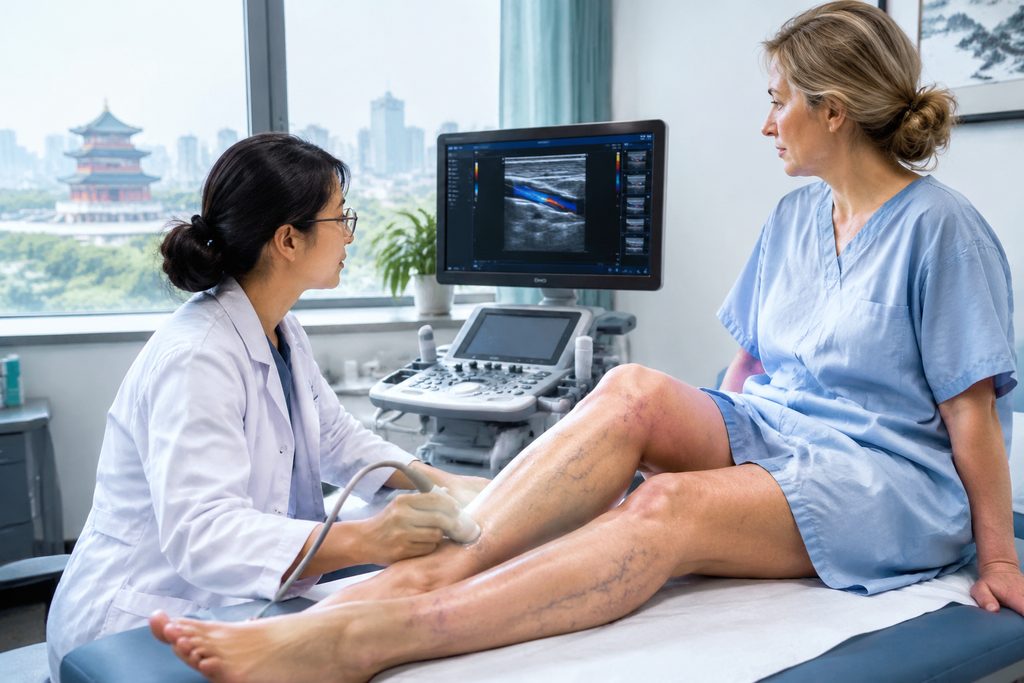
Roughly one in four adults in industrialized countries develops varicose veins at some point, and women are affected about twice as often as men. For many of those people, the condition is cosmetic. For others, it brings aching legs, swelling, skin changes, and a nagging worry about whether something more serious is developing underneath. If you have been searching for a clear way to arrange a varicose vein assessment in China, this guide walks through the real process — what an assessment involves, which hospitals handle it well, what it costs, and where the friction points are.
Here is the honest short version: you cannot simply book a specialist appointment online from overseas the way you would in the US or UK. Chinese public hospitals generally release same-day or next-day registration slots, and surgical scheduling follows an in-person consultation. That single fact reshapes how you plan a medical trip. It does not make the trip impossible. It just means the sequence matters.
Varicose Vein Assessment in China: The Short Answer
A proper assessment takes one to two days on the ground. It combines a physical examination by a vascular surgeon with duplex ultrasound, which maps blood flow, identifies incompetent valves, and rules out deep vein thrombosis. Most patients receive a treatment recommendation the same day. If intervention is needed, it is usually scheduled within days to a few weeks, depending on the hospital and the procedure.
The complication is access. Public hospital outpatient registration is not designed for advance booking from abroad. International departments and VIP channels at major hospitals do allow pre-arranged appointments, but they cost more — typically 1.5 to 2 times the standard fee. That trade-off is the real decision most patients face.
Who This Is Right For — and Who It Isn’t
China’s vascular surgery capacity is genuinely strong. Several hospitals rank among the top 10 nationally for vascular surgery on the Fudan specialty reputation list, and case volumes are enormous. That volume translates into experienced hands.
Typically a good fit:
- Adults with visible varicose veins, leg heaviness, or swelling who want a diagnostic assessment and a treatment plan
- Patients quoted high prices or long waits at home for endovenous laser ablation, radiofrequency ablation, or sclerotherapy
- People combining a vein procedure with a broader health checkup in China
- Patients already traveling to China for another reason who want a vascular opinion while there
Probably not the right call:
- Anyone with an active deep vein thrombosis, a non-healing ulcer with signs of infection, or acute shortness of breath — these need urgent local care, not a planned trip
- Patients who cannot tolerate a long-haul flight; prolonged immobility is itself a clot risk
- People seeking purely cosmetic spider vein removal where a local clinic at home is cheaper and simpler
- Anyone whose insurance only reimburses in-network providers in their home country and who cannot absorb out-of-pocket costs
Being clear about that second list matters more than the first. A vein assessment is not an emergency procedure, and there is no clinical reason to travel internationally for one unless the economics or the expertise genuinely favor it.
The Options, Compared
Before committing to anything, it helps to see the realistic alternatives side by side. The table below reflects general market ranges. Actual figures vary by hospital and case complexity.
| Option | Typical Assessment Cost | Typical Treatment Cost | Wait Time | Language Support |
|---|---|---|---|---|
| US private vascular clinic | $300–$600 | $3,000–$8,000 per leg | 1–3 weeks | Native English |
| UK private clinic | £250–£450 | £2,500–£5,500 per leg | 2–6 weeks | Native English |
| China public hospital, standard channel | $80–$200 | $1,000–$3,000 per leg | Same-day to 1 week | Limited; interpreter needed |
| China public hospital, international/VIP channel | $200–$500 | $2,000–$5,000 per leg | Pre-bookable | English-speaking staff |
| China private international hospital | $300–$700 | $4,000–$9,000 per leg | Pre-bookable | Full English service |
Which column suits you depends on three things: how much you value certainty of scheduling, how comfortable you are navigating a Chinese hospital without English signage, and whether you want the lowest possible price or the smoothest possible experience. Patients optimizing purely for cost go the public standard route. Patients optimizing for predictability go international or private. Neither is wrong.
How to Book a Varicose Vein Assessment in China Without Wasting a Trip
This is the part most guides skip. The sequence below is what actually works.
Step one: get your existing imaging reviewed remotely. If you already have a duplex ultrasound report from home, a Chinese vascular team can review it and tell you whether you are a candidate for endovenous treatment, sclerotherapy, or conservative management. This costs far less than a flight and eliminates the scenario where you arrive and are told nothing can be done.
Step two: confirm the hospital and the channel. Not every hospital with a vascular department has an international office that can pre-book. The ones that do — concentrated in Beijing, Shanghai, Guangzhou, and Chengdu — are the practical targets. You can browse ranked options through our specialty rankings by department or filter by city, for example the Shanghai hospital directory, which is where several of the strongest vascular programs sit.
Step three: lock the appointment before you book flights. This sounds obvious. It is the single most common mistake. Patients book airfare first, arrive, and discover the specialist’s clinic is full for four days.
Step four: plan for the consultation and the procedure to be separate events. Chinese public hospitals require an in-person consultation before scheduling surgery. In practice this means a first visit for assessment and a second for the procedure, though some hospitals compress this into one admission.
What It Costs
Cost is the main reason international patients consider China for vein treatment. The gap is real and large.
An assessment — consultation plus duplex ultrasound — generally runs $80 to $200 in a public hospital standard channel, and $200 to $700 through an international or private channel. Endovenous laser or radiofrequency ablation for a single leg typically falls between $1,000 and $3,000 in the public system, rising to $4,000 to $9,000 at a private international hospital. Sclerotherapy for smaller veins is cheaper, often under $500 per session.
What drives the variance? Hospital tier, whether one or both legs are treated, the number of veins addressed, whether general or local anesthesia is used, and how many nights of admission are required. Most endovenous procedures in China are day cases or single-night stays.
What is usually not included in a quoted figure: pre-operative blood work if done separately, compression stockings, post-procedure medication, and follow-up scans. Ask for an itemized estimate. Public hospitals require prepayment, with insurance reimbursement handled afterward by you. Private international hospitals more often bill insurers directly.
Practical Considerations: Visas, Records, and Follow-Up
For medical travel to China, the applicable short-stay visa category is S2, used for medical treatment and private affairs, subject to the latest requirements from the Chinese embassy or consulate in your country. Accompanying family members apply under the same category. If treatment and recovery will exceed 180 days, S1 applies instead. Note that the M visa is for commercial and trade activity and has nothing to do with medical treatment.
Bring your records in a form a Chinese specialist can use: recent duplex ultrasound images and the written report, a medication list, prior surgical history, and any relevant bloodwork. English is workable at international departments. At standard public clinics it is not, and this is where a bilingual medical companion earns their fee — handling registration, queueing, payment, wayfinding, and translation for the entire visit.
Payment is another practical hurdle. Public hospitals generally do not accept foreign insurance directly and require prepayment by card or cash. Confirm accepted payment methods before you arrive; not every hospital handles international cards smoothly.
Follow-up deserves advance thought. Most endovenous procedures require a duplex scan at roughly one week and again at one to three months to confirm the treated vein has closed. If you will be home by then, arrange in advance for a local vascular clinic to perform those scans, and ask the Chinese team to provide a written procedure summary your local doctor can read.
Frequently Asked Questions
Endovenous laser and radiofrequency ablation are well-established, minimally invasive procedures performed routinely at major Chinese hospitals, and complication rates at high-volume centers are comparable to Western benchmarks. That said, safety depends on the individual hospital, the operator’s volume, and your own health status. Ask how many procedures the treating team performs annually, and disclose all medications — especially blood thinners — during the remote review stage.
Most patients walk within hours of endovenous ablation and return to desk work in two to four days. Strenuous activity and heavy lifting are typically restricted for one to two weeks, and compression stockings are worn for a period your surgeon specifies. Open surgical stripping, now less common, requires a longer recovery of two to four weeks. Your age, the extent of treatment, and whether both legs are done all shift these timelines.
Packages exist but they vary enormously in what they actually cover, and some bundle services you do not need. A more reliable approach is to build the trip from confirmed components: a pre-arranged assessment, a written treatment plan, an itemized cost estimate, and interpretation support. Our team structures arrangements that way rather than selling fixed bundles, because vein treatment is rarely identical between two patients.
This is a genuine possibility, and it is better to know before you travel. Duplex ultrasound occasionally reveals deep venous insufficiency, a clot, or an arterial problem requiring a different treatment path. A remote review of your existing imaging catches most of these cases early. If something unexpected is found during the in-person assessment, the treating physician will explain the revised plan — and you are free to decline treatment and return home.
Your Next Step
Arranging a vein assessment in China is entirely doable, provided you sequence it correctly: remote review first, appointment confirmation second, flights third. The savings are substantial, the vascular expertise is real, and the main obstacle is logistics rather than medicine.
We are China Medical Services, a coordination service — not a hospital, and we do not diagnose or treat anyone. We connect international patients with appropriate Chinese hospitals, arrange written second opinions and video consultations, and provide bilingual accompaniment on the ground. If you would like to know whether a vein assessment in China makes sense for your situation, start with a free consultation and we will tell you honestly, including when the answer is no.
This article is for general information only and does not constitute medical advice. Varicose vein disease should be evaluated by a qualified physician. Costs cited are general market ranges and vary by hospital and case complexity.
For more medical information and treatment options in China, visit chinamedservices.com (China Medical Services).
