Fundus Exam in China: What It Shows and What It Costs
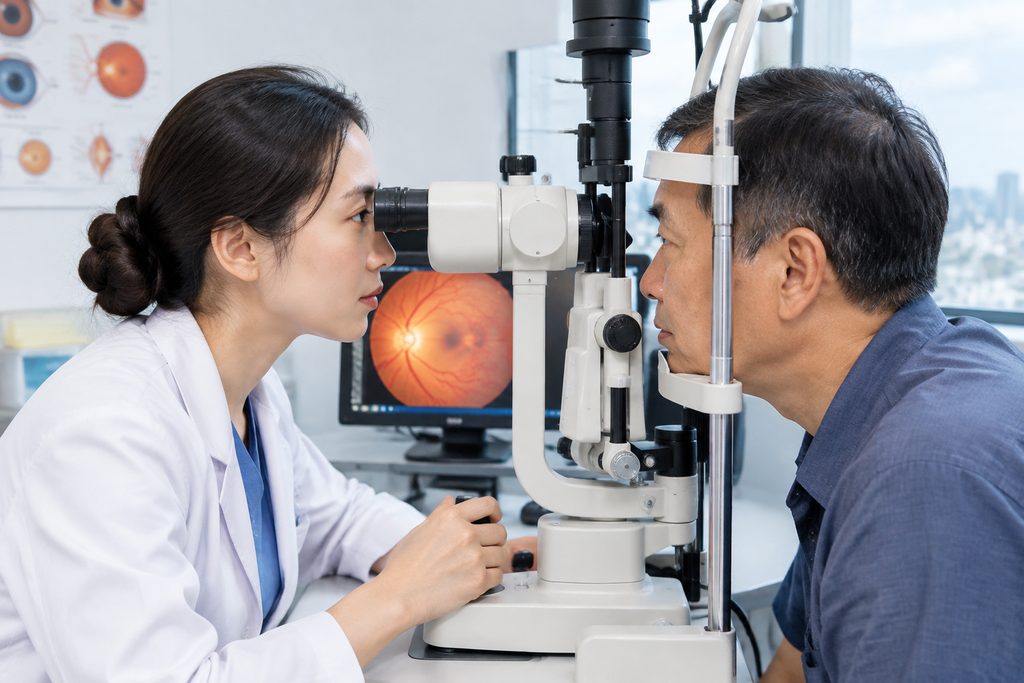
A fundus exam is a photograph of the back of your eye. That is the whole idea, stripped of the Latin. The retina, the optic disc, the macula, and the tiny blood vessels feeding them all sit at the rear interior of the eyeball, and a fundus camera or an ophthalmologist’s lens lets a clinician see that landscape directly — no incision, no radiation, usually no more than a few minutes in the chair.
What it shows can be surprisingly broad. The eye is the only place in the body where blood vessels and nerve tissue are visible without cutting anything open, which is why a fundus exam often flags problems that have nothing to do with vision. Diabetes, high blood pressure, raised intracranial pressure, and several systemic diseases leave fingerprints back there.
For international patients weighing a trip, the practical questions tend to be narrower: what does a fundus exam show, what does it cost in China, and can a foreigner actually get one without a Chinese ID card or a month of waiting? This guide answers those directly, with real price ranges and the honest caveats that come with them.
Fundus Exam in China: The Short Answer
A basic fundus exam in a Chinese public hospital typically runs the equivalent of $15 to $60 out of pocket, and a full dilated retinal imaging session with a specialist reading usually lands between $40 and $150. At private international hospitals, expect $150 to $400 for the same study with English-speaking staff and same-week scheduling.
That is the headline. The complication is access. Public hospital ophthalmology departments in major cities are enormous and busy, walk-in registration is the norm rather than appointment booking, and the queue for a same-day slot can start before dawn. Knowing the price is easy. Getting seen efficiently as a non-Chinese speaker is the part that trips people up.
Who This Is Right For — and Who It Isn’t
A fundus exam is one of the least invasive diagnostic tests in medicine, which makes the eligibility question mostly about whether you need one rather than whether you can tolerate it.
You are likely a good candidate if you:
- Have type 1 or type 2 diabetes and are due for annual retinopathy screening
- Live with hypertension and want to check for hypertensive retinopathy
- Are over 40 and have never had a dilated eye exam
- Have glaucoma suspects in the family, or elevated eye pressure on a prior visit
- Experience new floaters, flashes, or a curtain-like shadow in your vision
- Take hydroxychloroquine or certain other medications with retinal toxicity risk
You should probably not build a trip around this if you:
- Have an acute eye injury, chemical burn, or sudden vision loss — that is an emergency room situation, not a screening appointment
- Cannot tolerate pupil-dilating drops, which blur vision for four to six hours and make driving unsafe
- Are seeking a diagnosis for a condition already managed well at home with no cost or access barrier
That last point matters. If your local ophthalmologist sees you within two weeks and your insurance covers it, flying to China for a screening exam makes little sense. The calculus changes when you are uninsured, facing a six-month specialist wait, or combining the eye exam with other diagnostics on the same trip.
The Options, Compared
Not all fundus exams are the same test, and the price gap between them reflects real differences in equipment, time, and who reads the images.
| Exam Type | What It Captures | Typical China Cost (USD) | Typical US Cost (USD) | Time in Clinic |
|---|---|---|---|---|
| Direct ophthalmoscopy | Optic disc, vessels, macula — clinician’s view only | $15–$40 | $80–$200 | 10–15 min |
| Non-mydriatic fundus photo | 45° digital image, no dilating drops | $25–$70 | $100–$250 | 15–20 min |
| Dilated fundus photography | Wider field, sharper detail, both eyes | $40–$120 | $150–$350 | 30–45 min |
| Optical coherence tomography (OCT) | Cross-sectional retinal layers, macular detail | $60–$180 | $200–$500 | 20–30 min |
| Fundus fluorescein angiography | Dye study of retinal blood flow | $150–$400 | $500–$1,200 | 60–90 min |
Which column fits you depends on your question. Routine diabetic screening rarely needs more than a dilated photo. If a clinician suspects macular degeneration or diabetic macular edema, OCT earns its higher price because it shows retinal thickness that a flat photograph cannot. Angiography is reserved for vascular leakage and blockage questions, and it involves an intravenous dye injection with a small risk of allergic reaction.
What a Fundus Exam Actually Reveals
Yes. Major Chinese hospitals use the same fundus camera and OCT platforms found in Western clinics, from the same global manufacturers. The main safety consideration is the dilating drops, which temporarily blur vision and can trigger a rare angle-closure attack in people with narrow drainage angles. Tell the clinician if you have a history of narrow-angle glaucoma.
At private international hospitals and public hospital international departments, yes — a passport is sufficient for registration. At standard public clinics, you can still be seen, but expect to register in person on the day with no advance booking, and bring a translator or plan for a slower visit.
Diabetic retinopathy screening cost China patients pay ranges from roughly $25 to $70 for a non-mydriatic fundus photo at a public hospital, up to $150 to $400 at a private international facility with specialist interpretation. Annual screening is recommended for most people with diabetes, and the cost is low enough that combining it with a broader health check is often worthwhile.
The ophthalmologist will explain the finding and recommend next steps, which may include OCT, angiography, a retina specialist referral, or coordination with your diabetes or blood pressure care. A fundus image alone does not confirm a diagnosis. If treatment is advised, you are entitled to a second opinion before committing to anything — and getting one remotely, before traveling further, is a reasonable option.
Your Next Step
A fundus exam is quick, inexpensive by Western standards, and genuinely informative — but only if you can get to the right clinic, communicate your history clearly, and understand the report afterward. Those three things, not the imaging itself, are where international patients usually need help.
We are not a hospital and we do not diagnose or treat anything. What our team does is help you find the right department, coordinate an appointment through official hospital channels, arrange a bilingual companion for the visit, and explain what the paperwork means in plain English. If you would like to talk through whether a fundus exam in China fits your situation, start with a free consultation — no pressure, no obligation, just a clearer picture of your options.
This article is for general information only and is not medical advice. Always consult a qualified physician about your individual condition before making treatment decisions.
Frequently Asked Questions
Yes. The hospitals used for international patients are JCI-accredited and follow the same international safety standards as top hospitals in the US and Europe. Surgical teams perform high volumes of procedures — often more than their Western counterparts — which studies show leads to better outcomes.
Costs vary by procedure and hospital, but international patients typically save 40-80% compared to US prices — even when factoring in travel and accommodation. A consultation with our team will give you an exact, all-inclusive quote with no hidden fees.
Send us your existing medical reports to get started. We handle everything from hospital selection and appointment scheduling to visa assistance and post-operative recovery planning. Your medical records are reviewed by the specialist before you even book a flight.
For more medical information and treatment options in China, visit chinamedservices.com (China Medical Services).
