PET-CT in China: What It Shows and Who Needs It Explained
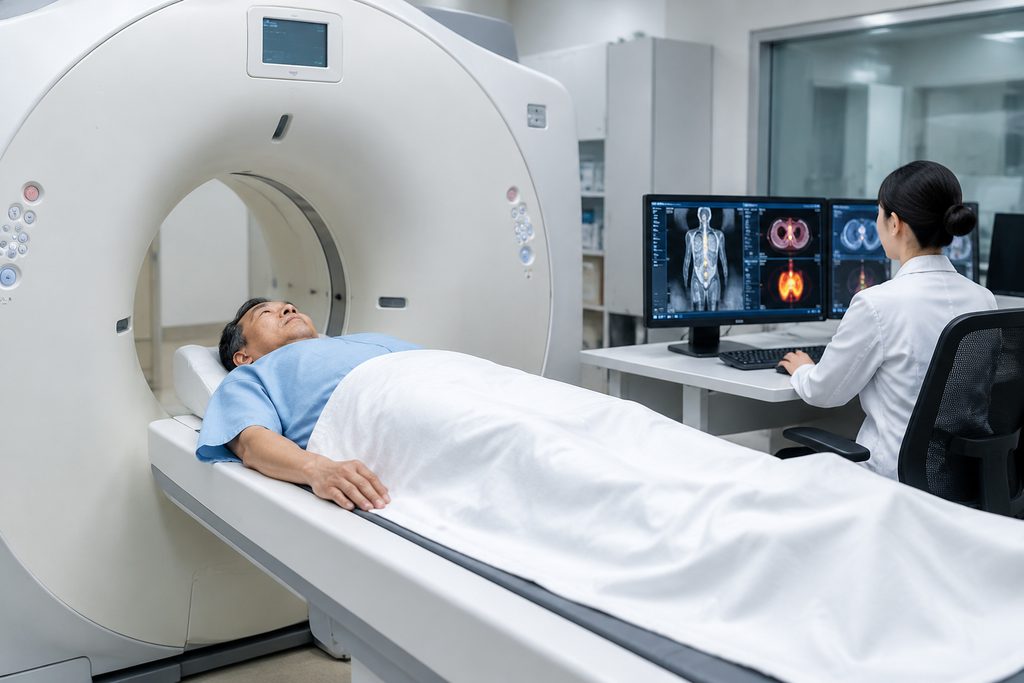
When 47-year-old Elena from Melbourne received a lung nodule finding on a routine chest X-ray, her oncologist in Australia ordered a follow-up PET-CT. The quoted price at a private imaging center near her home: roughly AUD 1,100 out of pocket, with a two-week wait for a slot. A friend mentioned that a PET-CT scan cost China hospitals charge is often a fraction of that — and that top-tier Chinese imaging centers run scans within days, not weeks. Elena’s story is not unusual. Thousands of international patients each year start researching PET-CT in China because they need answers fast, and they need to understand what the scan actually shows before they commit.
This guide walks through what a PET-CT reveals, who genuinely benefits from one, what safety questions matter, and what the realistic logistics look like for a foreign patient. No hype. Just the information you need to make a sound decision.
Key Takeaways
- A PET-CT combines metabolic imaging (PET) with anatomical imaging (CT), detecting abnormal cell activity that CT or MRI alone can miss — particularly useful in oncology staging and recurrence monitoring.
- Pricing at major Chinese hospitals typically runs well below Western private rates, though the exact figure depends on the tracer used, the body region scanned, and whether it is a self-pay or insurance case.
- The biggest practical barrier is not the scan itself — it is navigation. Public tertiary hospitals in China generally do not allow overseas patients to book outpatient imaging directly from abroad without going through an international department or a coordination channel.
- No scan replaces a qualified physician’s interpretation. A PET-CT is a diagnostic tool, not a diagnosis.
The Problem: Wait Times and Costs Put Critical Answers Out of Reach
A patient in the UK on the NHS may wait four to six weeks for a non-urgent PET-CT, according to typical reporting on diagnostic waiting times. In Canada, the median wait for a PET scan has historically stretched past 30 days in several provinces. In the US, the scan itself may be available in days — but the billed charge frequently exceeds $5,000 before insurance adjustments, and deductibles can leave patients paying thousands out of pocket.
For someone with a suspicious lesion, a staging question, or a rising tumor marker after treatment, a month of waiting is not a neutral delay. It is a month of not knowing. That uncertainty affects treatment decisions, family planning, and mental health. The scan is not optional for many of these patients — it is the next required step.
Why China Delivers Results for International Imaging Patients
China’s top hospitals are not a budget alternative with compromised quality. They are high-volume, technology-dense institutions that perform imaging at a scale few countries can match. Here is what that means in practice.
Clinical Volume and Equipment Density
Major Chinese tertiary hospitals operate PET-CT and PET-MRI scanners as routine clinical tools, not scarce resources. A hospital like West China Hospital in Chengdu or Ruijin Hospital in Shanghai handles imaging volumes that would be extraordinary in most Western centers. Higher volume means radiologists and nuclear medicine physicians read more scans per year — and pattern recognition improves with exposure. The Fudan University Hospital Rankings evaluate hospitals across 45 specialties, and nuclear medicine is among the evaluated disciplines, giving patients a transparent way to identify centers with recognized expertise.
Speed From Inquiry to Scan
For self-pay international patients who go through a hospital’s international department or a coordination service, the gap between “I need a scan” and “the scan is done” can compress to days rather than weeks. This is not because Chinese hospitals cut corners — it is because they run imaging suites across extended hours and do not operate under the same referral bottleneck that constrains many Western systems. A patient who arrives with prior imaging on CD or DICOM files and a clear clinical question can often be scanned within 48 to 72 hours of a confirmed appointment.
Cost Structure Without Quality Trade-Offs
Lower prices in China reflect labor economics, equipment utilization rates, and hospital efficiency — not inferior tracers or older machines. Many top-tier hospitals use the same FDG tracers and scanner generations found in Western academic centers. When patients ask whether a PET-CT scan is safe in China, the honest answer is that safety standards at accredited tertiary hospitals mirror international protocols: radiation dose monitoring, tracer quality control, and physician supervision are all part of routine practice. The cost difference is structural, not clinical.
What a PET-CT Actually Shows — and What It Cannot
A PET-CT fuses two imaging methods. The CT component produces detailed anatomical pictures — the “where.” The PET component tracks a radiotracer (usually fluorodeoxyglucose, or FDG) that cells with high metabolic activity absorb more readily. Cancer cells, infection, and inflammation all consume glucose faster than most normal tissue, so they appear as “hot spots.”
That is the core of what does a PET-CT scan show for cancer detection: areas of abnormal metabolic activity that may indicate malignancy, often before structural changes are visible on CT alone. It is particularly valuable for staging — determining whether a cancer has spread — and for restaging after treatment, when scar tissue and residual tumor can look identical on CT.
What it cannot do is confirm a diagnosis by itself. A hot spot can be cancer, but it can also be infection, inflammation, or a benign process. A cold spot does not always mean “no cancer” either — some tumors, particularly certain neuroendocrine and mucinous types, do not take up FDG avidly. Every PET-CT result must be interpreted alongside clinical history, pathology, and other imaging. That is why a written second opinion from a nuclear medicine specialist or oncologist matters as much as the scan itself.
Who Actually Needs a PET-CT — and Who Does Not
PET-CT is not a general screening tool for healthy people. International guidelines, including those from the American College of Radiology and the Society of Nuclear Medicine and Molecular Imaging, do not recommend whole-body PET-CT for asymptomatic individuals with no risk factors. The radiation exposure and the risk of incidental findings — which trigger anxiety and further testing — outweigh any theoretical benefit in that population.
The patients who genuinely benefit fall into recognizable groups:
- Cancer staging and restaging: Confirming whether a known malignancy is localized or has spread, and monitoring response after chemotherapy or radiation.
- Unexplained findings: A lung nodule, an enlarged lymph node, or a lesion that CT or MRI cannot characterize.
- Recurrence surveillance: Rising tumor markers (such as CEA or CA-125) with no clear source on conventional imaging.
- Cardiac and neurological indications: Selected cases of myocardial viability assessment or neurodegenerative evaluation, though these use different tracers and protocols.
- Fever of unknown origin: When infection, inflammation, or occult malignancy is suspected and standard workup has been inconclusive.
If you are asymptomatic, have no personal or strong family history of cancer, and simply want “a full-body check,” a PET-CT is not the right test. A targeted screening program based on your age, sex, and risk profile is more appropriate — and far less radiation.
What It Costs and How to Book PET-CT Scan in China for International Patients
Pricing varies by hospital tier, city, tracer, and whether the scan covers one region or the whole body. The table below gives realistic self-pay ranges at major Chinese hospitals compared with typical Western private rates. These are reference figures only — final quotes come from the hospital after reviewing your case.
| Location / Type | Typical Self-Pay Range (USD) | Notes |
|---|---|---|
| Top-tier public hospital, China (whole-body FDG) | $800 – $1,500 | Varies by city and hospital tier; tracer and protocol affect price |
| Private international hospital, China | $1,800 – $3,500 | English-speaking staff, direct insurance billing in some cases |
| United States (private, self-pay) | $3,000 – $6,000+ | Hospital list prices vary widely; insurance adjustments differ |
| United Kingdom (private) | £1,500 – £2,500 (~$1,900 – $3,200) | NHS wait times separate from private access |
| Australia (private) | AUD 900 – AUD 1,500 (~$600 – $1,000) | Medicare rebate may apply for eligible indications |
For a specific city, the question of how much does PET-CT cost in Shanghai depends on whether you use a public tertiary hospital’s international department or a private international facility. Shanghai’s top public hospitals generally sit at the lower end of the range above; private international hospitals in the city sit higher but offer English-language navigation and insurance coordination.
Booking as an international patient is where most people hit a wall. Public hospitals in China typically do not accept overseas self-referrals for outpatient imaging. You need a hospital medical card, a registration, and often a physician’s order. The workable paths are: (1) contact the hospital’s international department directly and ask whether they accept foreign self-pay imaging patients; (2) use a coordination service that handles registration, medical card creation, and appointment scheduling on your behalf; or (3) go through a private international hospital that routinely serves foreign patients.
Practical Considerations: Safety, Logistics, and Follow-Up
Radiation exposure from a PET-CT is real but bounded. A typical whole-body FDG PET-CT delivers an effective dose in the range of 10 to 25 mSv, depending on the protocol and the CT settings used for attenuation correction. For context, natural background radiation exposure averages about 2.4 mSv per year. The scan is justified when the clinical question is serious enough that the diagnostic benefit outweighs the radiation risk — which is a conversation between you and your physician, not a decision to make from a webpage.
The tracer itself, FDG, is a radiolabeled glucose analog with a short half-life of about 110 minutes. It leaves your system quickly. Allergic reactions are rare. The main preparation requirement is fasting for four to six hours before the scan and avoiding strenuous exercise for 24 hours, since muscle activity can create misleading uptake.
Visa logistics: for medical treatment in China, the applicable short-stay category is the S2 visa, which covers medical treatment and private affairs. The M visa is for commercial and trade activities and is not a medical visa. Requirements change, so verify current documentation with your nearest Chinese embassy or consulate and secure the supporting hospital documents they request. Accompanying family members typically apply under the same S2 category.
Payment at public hospitals is generally upfront for international self-pay patients, with insurance reimbursement handled afterward in your home country. Private international hospitals more often offer direct billing with select insurers. Keep every receipt and the full imaging report — reimbursement claims require them.
After the scan, follow-up matters more than the image itself. A PET-CT report without a specialist’s interpretation is just data. If you return home, arrange for your treating physician to review the Chinese report alongside the DICOM images. If you need a formal written second opinion from a Chinese specialist before traveling, that can be arranged remotely — our team can walk you through how a written second opinion works and what records to send.
Frequently Asked Questions
At accredited tertiary hospitals, yes — safety protocols for tracer quality, radiation dose, and physician supervision follow international standards. The radiation exposure is comparable to PET-CT anywhere else. The more relevant question is whether the scan is clinically justified for your situation, which only your physician can determine.
Generally no. Public hospitals in China require a medical card and a registration, and they typically do not accept overseas self-referrals for outpatient imaging. You either contact the hospital’s international department directly, use a private international hospital, or work with a coordination service that handles registration and scheduling. We do not guarantee a specific appointment, but we can coordinate the request and refund the coordination fee if the appointment cannot be secured.
Sometimes, but not automatically. Most insurers require pre-authorization for imaging abroad, and reimbursement is based on your policy’s terms. Public hospitals in China usually require upfront payment from international self-pay patients; you then submit receipts and reports for reimbursement. Check with your insurer before booking, and ask specifically whether they cover diagnostic imaging performed outside your home country.
At most Chinese hospitals, a preliminary report is available within 24 to 48 hours, and a finalized report with specialist interpretation typically within two to three business days. If you need a formal written second opinion from a senior specialist, that adds time depending on the department’s schedule. Plan for at least a week on the ground if you want the scan and a face-to-face specialist review in one trip.
Incidental findings are common and are not automatically bad news — many turn out to be benign. But they do require follow-up. This is exactly why a PET-CT should be ordered with a clear clinical question and read by a specialist who can put the result in context. If something unexpected appears, the next step is usually a targeted biopsy or additional imaging, not immediate treatment.
Your Next Step
A PET-CT is a powerful tool when it answers a real clinical question — and a source of unnecessary anxiety and radiation when it does not. If you are considering one in China, the sensible path is to clarify the question first, then identify a hospital with the right expertise, then handle the logistics. Our team at China Medical Services connects international patients with 340+ top-ranked hospitals across 37 cities, handles appointment coordination, medical card registration, and bilingual support on the ground. We are not a hospital and we do not provide diagnoses — we help you navigate a system that can be hard to enter alone. If you would like to discuss whether a PET-CT in China makes sense for your situation, start with a free consultation and we will walk through the options with you, no pressure and no obligation.
This article is for informational purposes only and does not constitute medical advice. Always consult a qualified physician regarding your individual health situation. Prices cited are estimates and vary by hospital, city, and case complexity.
For more medical information and treatment options in China, visit chinamedservices.com (China Medical Services).
