Lab Tests in China: Home Sample Collection for International Patients
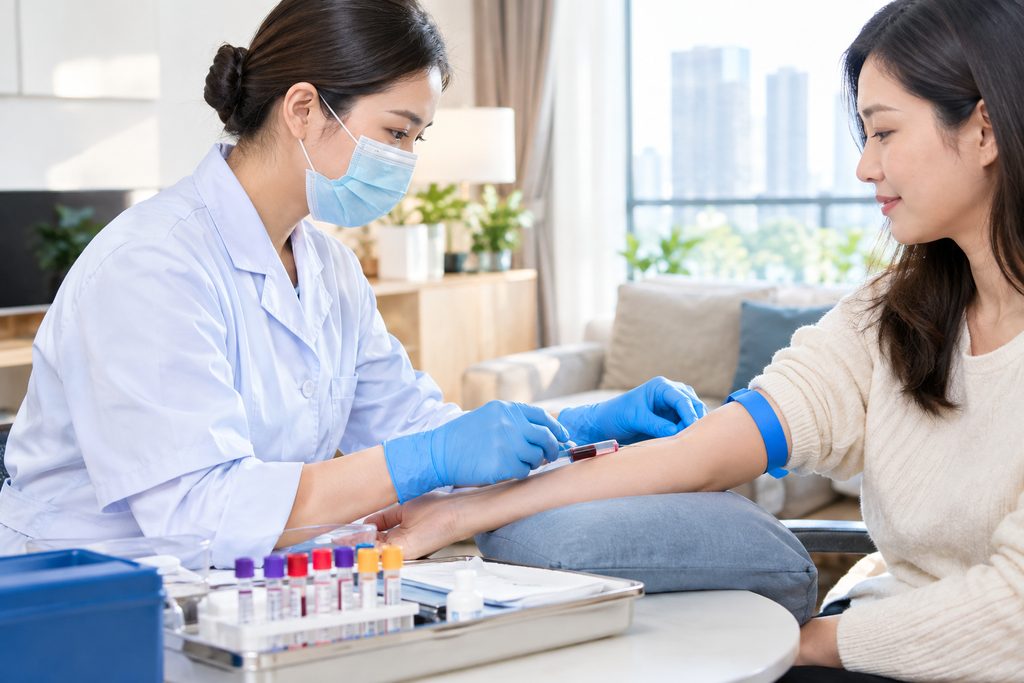
When 44-year-old Sarah from Seattle moved to Shanghai for a two-year work assignment, she assumed routine bloodwork would be simple. Her thyroid medication needed monitoring every three months, but the public hospital near her apartment required a pre-dawn queue, a registration card she couldn’t read, and a return trip three days later just to collect a printed report. A colleague mentioned something she hadn’t considered: private clinics that send a phlebotomist to your apartment. The sample is drawn at your kitchen table. Results arrive by email, often in English, sometimes within 24 hours. That single discovery reshaped how she managed her health for the rest of her stay.
If you’re an expat, a long-stay visitor, or a medical traveler in China, understanding what lab tests in China cost — and how the home collection model actually works — can save you hours, confusion, and a surprising amount of money. Here’s what you need to know before you book anything.
Lab Tests in China: The Short Answer
Home sample collection for blood tests in China typically costs between $30 and $150 depending on the panel, the city, and whether you use a private international clinic or a public hospital’s VIP channel. A basic complete blood count (CBC) might run $15–$30 at a public hospital; a comprehensive metabolic panel with home visit through a private clinic often lands between $80 and $200. Turnaround is usually 24–72 hours for standard panels, with some private labs offering same-day results for an added fee.
The caveat: “home collection” is not a universal service in China. Public hospitals — even the top-tier ones — rarely send phlebotomists to private residences. The home-visit model is almost entirely the domain of private international clinics, third-party lab platforms, and a handful of premium hospital international departments. Knowing which category you’re dealing with determines both your price and your experience.
Who This Is Right For — and Who It Isn’t
Home collection makes sense for a specific slice of people. It’s not for everyone, and being honest about that matters.
Good candidates:
- Expats and long-stay visitors who need routine monitoring (thyroid, diabetes, cholesterol, liver function)
- Patients on medication who require regular bloodwork but can’t easily navigate a Chinese public hospital
- Families with young children or elderly relatives for whom a clinic trip is genuinely difficult
- Medical travelers doing pre-surgical screening who want convenience before a hospital appointment
- Anyone who needs results in English and doesn’t want to coordinate a translator for a simple blood draw
Who should skip it:
- Patients needing urgent or emergency diagnostics — go directly to a hospital
- Anyone requiring specialized testing (bone marrow, complex genetic panels, certain hormone dynamics) that only hospital labs can process
- People whose insurance only reimburses public hospital receipts — private clinic invoices may not qualify
- Patients who need a physician to interpret results in person the same day; home collection gives you data, not a diagnosis
The Options, Compared
There are three realistic paths for bloodwork in China. Each has a different cost profile, language experience, and level of hassle.
| Option | Typical Cost (Basic Panel) | Home Visit? | English Results | Turnaround | Best For |
|---|---|---|---|---|---|
| Public hospital (standard queue) | $10–$40 | No | Rarely | 1–3 days | Budget-conscious, Mandarin-capable patients |
| Public hospital international/VIP department | $60–$150 | Sometimes | Usually | 24–48 hours | Patients wanting hospital-grade labs with English support |
| Private international clinic | $80–$250 | Yes, standard | Yes | 24–72 hours | Expats, families, anyone prioritizing convenience |
| Third-party lab platform (app-based) | $30–$120 | Yes, in major cities | Varies | 24–48 hours | Tech-savvy users in Shanghai, Beijing, Shenzhen |
Which column suits you depends on one question: how much is your time worth? If you can read Chinese, navigate a hospital app, and don’t mind a morning queue, the public route is dramatically cheaper. If your Chinese is limited or your schedule is tight, the private clinic premium buys real relief. For patients already working with a top-ranked Chinese hospital through an international department, the VIP channel often strikes the best balance.
How Does Home Sample Collection Work in China?
The mechanics vary by provider, but the general flow is consistent. You book through an app, a clinic’s English-language website, or a coordinator. You choose a panel — or a doctor orders one. You select a time window, usually 6 AM to 10 AM for fasting tests. A phlebotomist arrives at your address with sterile equipment, draws the sample, labels it, and transports it to a licensed lab. Results come back by email, app, or a pickup option.
A few details that trip people up:
- Fasting requirements. Most lipid and glucose panels require 8–12 hours of fasting. Book a morning slot and skip breakfast.
- Address verification. Some providers only serve certain districts. A private lab test in Shanghai with home visit may cover Pudong and Puxi but not outlying suburbs.
- ID requirements. You’ll typically need your passport. Some platforms also ask for a Chinese phone number.
- Payment. WeChat Pay and Alipay dominate. International credit cards work at private clinics but rarely on third-party apps.
One more thing worth knowing: the phlebotomist is usually a trained technician, not a nurse or doctor. That’s fine for a routine draw. For difficult veins or pediatric draws, ask ahead whether a nurse can be assigned.
What Lab Tests in China Cost — and What Drives the Variance
Prices swing widely. A CBC at a public hospital in Chengdu might cost $12. The same test through a private clinic in Shanghai with a home visit could be $90. The gap isn’t arbitrary.
What pushes the price up:
- Home visit logistics (transport, scheduling, technician time)
- English-language reporting and customer support
- International accreditation (JCI, CAP) at private labs
- Faster turnaround — same-day or 12-hour results
- Bundled panels that include more markers than you may need
What keeps it low:
- Public hospital volume pricing
- No home visit — you go to the lab
- Standard turnaround (2–3 days)
- Chinese-language reporting only
For patients comparing broader treatment costs, our guide to specialty departments and their top hospitals breaks down how lab work fits into a larger diagnostic picture.
Is Home Blood Testing in China Reliable?
This is the question that matters most, and the honest answer is: it depends entirely on the lab, not the collection method.
China’s top-tier hospital labs and JCI-accredited private labs operate to international standards. Many participate in external quality assessment programs. The sample itself doesn’t degrade because it was drawn at your apartment — provided the phlebotomist follows proper protocol (correct tube type, proper mixing, timely transport, temperature control).
Where reliability breaks down is at the margins: unlicensed pop-up services, labs without accreditation, or providers who cut corners on cold-chain transport for sensitive tests. A basic CBC is robust. A hormone panel or a coagulation study is more fragile.
How do you vet a provider? Ask three questions. Which lab processes the sample? Is that lab CAP or ISO 15189 accredited? Can they show you a sample report format? A legitimate provider answers all three without hesitation.
Practical Considerations: Booking, Records, and Follow-Up
If the sample is processed by an accredited lab, yes. The collection method doesn’t determine accuracy — the lab does. Ask which lab handles your sample and whether it holds CAP or ISO 15189 accreditation. For routine panels, reliability is generally high. For specialized or time-sensitive tests, a hospital lab may be the safer choice.
Basic panels with home visit typically run $80–$150 through private clinics. Comprehensive panels or specialized tests can reach $200–$300. Public hospital labs are cheaper ($10–$40) but rarely offer home collection. Prices vary by city — Shanghai and Beijing trend higher than Chengdu or Xi’an.
Home collection services provide results, not diagnoses. If something is flagged, you’ll need a physician to interpret it. Private clinics often offer follow-up consultations; public hospitals require a separate appointment. For international patients, coordinating this follow-up is often the hardest part — and where a bilingual medical companion can help bridge the gap.
Your Next Step
Home sample collection in China is a genuinely useful option for expats, long-stay visitors, and medical travelers who need routine bloodwork without the friction of a public hospital visit. It’s not cheaper than the public route, and it’s not a replacement for clinical judgment. But for the right person in the right situation, it turns a half-day ordeal into a 20-minute appointment at your own table.
China Medical Services is not a hospital and does not provide medical diagnoses. We’re a coordination service that helps international patients navigate China’s healthcare system — from hospital selection and appointment booking to bilingual accompaniment and lab logistics. If you’re unsure where to start, a free consultation is the simplest way to get clarity. No pressure, no commitment — just a conversation about what you need.
Frequently Asked Questions
Yes. The hospitals used for international patients are JCI-accredited and follow the same international safety standards as top hospitals in the US and Europe. Surgical teams perform high volumes of procedures — often more than their Western counterparts — which studies show leads to better outcomes.
Costs vary by procedure and hospital, but international patients typically save 40-80% compared to US prices — even when factoring in travel and accommodation. A consultation with our team will give you an exact, all-inclusive quote with no hidden fees.
Send us your existing medical reports to get started. We handle everything from hospital selection and appointment scheduling to visa assistance and post-operative recovery planning. Your medical records are reviewed by the specialist before you even book a flight.
For more medical information and treatment options in China, visit chinamedservices.com (China Medical Services).
