Sedated Gastroscopy in China: How It Works, What It Costs
Key Takeaways
- Sedated gastroscopy cost China-wide typically runs $250–$800 at top public hospitals, versus $1,500–$4,000 in the United States for the same diagnostic procedure.
- China’s highest-volume endoscopy centers perform tens of thousands of scopes annually, which is exactly why complication rates stay low.
- The hard part is not the procedure — it is getting an appointment as a foreigner. Most public hospital outpatient slots cannot be reserved from overseas in advance.
- You will need an S2 visa, a hospital that accepts international patients, and a clear understanding that sedation here is usually deep sedation, not general anesthesia.
The Problem: You Need a Scope, and the Wait Is Brutal
A gastroscopy takes fifteen minutes. Getting one can take months.
In the UK, the National Health Service target for urgent suspected cancer referrals is two weeks — but routine diagnostic endoscopy waits regularly stretch past eight to twelve weeks in many trusts. In Canada, median wait times for a diagnostic endoscopy have been reported in the range of 40 to 90 days depending on province. In the US, the wait is shorter but the bill is not: a sedated upper endoscopy without biopsy commonly lands between $1,500 and $4,000 before insurance, according to widely cited national cost surveys.
And the symptoms that trigger the referral — persistent reflux, difficulty swallowing, unexplained weight loss, a family history of stomach cancer — do not politely wait twelve weeks. Neither does the anxiety.
That combination of cost and delay is why a growing number of international patients are looking at China. Not because it is exotic. Because it is fast, technically strong, and dramatically cheaper.
What Sedated Gastroscopy Actually Means
Let’s strip the jargon first.
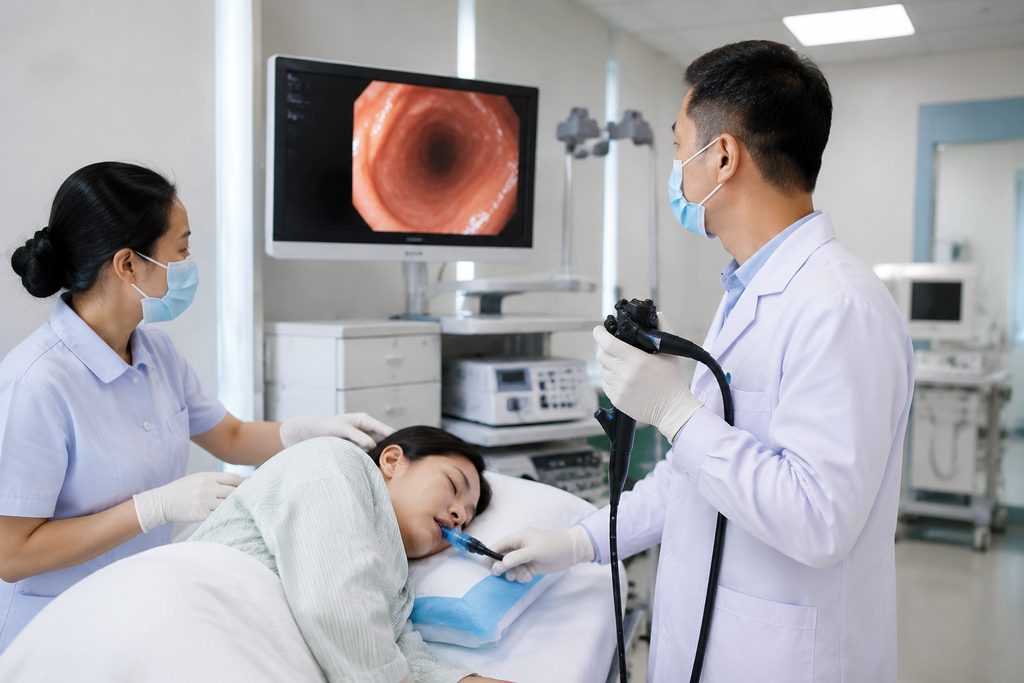
A gastroscopy — also called an upper endoscopy or EGD — is a thin flexible tube with a camera passed through your mouth to look at your esophagus, stomach, and the first part of your small intestine. Sedated means you are given intravenous medication so you are relaxed and sleepy, not awake and gagging.
There is a spectrum here, and it matters:
- Conscious sedation — you are drowsy but rousable. Used in some Western outpatient settings.
- Deep sedation — you are asleep and unlikely to remember the procedure. This is the standard at most Chinese tertiary hospitals, typically using propofol, often with an anesthesiologist present.
- General anesthesia — reserved for complex therapeutic cases, not routine screening.
Most foreign patients who ask for “sedated gastroscopy” in China end up with deep sedation. That is generally a good thing. It is also why the procedure is done in a dedicated endoscopy suite with monitoring, not in a corridor.
Why China Delivers Results Here
Three structural reasons, and none of them are marketing.
Clinical Volume That Most Western Centers Cannot Match
China has among the highest gastric cancer incidence rates in the world, which means its endoscopy units are not occasional users of the technology — they are high-volume operators. A major tertiary hospital in Shanghai or Beijing may run 100 to 300 endoscopies per day across its endoscopy center. Individual senior endoscopists at these institutions frequently perform several thousand procedures per year.
Volume matters for a simple reason: early-stage lesions are found by eyes that have seen thousands of them. Chinese endoscopists trained in magnifying endoscopy and narrow-band imaging are often exceptionally good at detecting subtle mucosal changes that a lower-volume operator might miss.
Technology and Efficiency at Scale
High-resolution scopes, narrow-band imaging (NBI), blue laser imaging, and endoscopic ultrasound are standard equipment at top-tier Chinese hospitals. So is the workflow: you arrive, you register, you are scoped, you recover, you leave — often within a single morning.
Compare that to the fragmented Western pathway where the consultation, the scheduling, the procedure, and the pathology follow-up happen across different buildings on different days.
Cost Advantage Without a Quality Trade-Off
Here is the honest structural explanation. Chinese hospital pricing is set by government fee schedules, not by insurance-negotiated rates. Anesthesia drug costs are lower. Physician compensation, while rising, is not comparable to US levels. And the sheer throughput spreads fixed equipment costs across far more patients.
None of that means the scope is cheaper. It means the system is cheaper to run.
Sedated Gastroscopy Cost China: Real Numbers
Prices vary by hospital tier, city, sedation type, and whether biopsies or polypectomy are performed. Here is a realistic range based on what international departments at Chinese tertiary hospitals typically quote foreign patients.
| Service | Typical Price in China (USD) | US Comparison (USD) |
|---|---|---|
| Diagnostic sedated gastroscopy, no biopsy | $250 – $500 | $1,500 – $2,500 |
| Gastroscopy with biopsies and pathology | $400 – $800 | $2,000 – $4,000 |
| Gastroscopy + colonoscopy same session | $700 – $1,400 | $3,000 – $6,000 |
| Pre-procedure consultation (international dept.) | $50 – $150 | $200 – $400 |
| Pre-anesthesia assessment and labs | $80 – $200 | $300 – $800 |
Two caveats. First, these are ranges — the final quote depends on the hospital and case complexity. Second, international department pricing at public hospitals typically runs 1.5 to 2 times the standard Chinese outpatient rate, because you are paying for English-speaking staff, faster scheduling, and a smoother process.
Private international hospitals like United Family or Jiahui sit at the upper end or above, but they offer direct insurance billing and a Western-style experience.
Is Sedated Gastroscopy Safe in China?
This is the question every patient asks, usually in a slightly nervous voice. It deserves a direct answer.
Sedated endoscopy is a well-established procedure worldwide, and the complication profile is similar wherever it is performed competently. The serious risks — perforation, significant bleeding, aspiration, adverse reaction to sedation — are rare. Published international data puts perforation risk for diagnostic upper endoscopy at roughly 1 in 10,000 to 1 in 20,000. Cardiopulmonary events related to sedation are the more common concern, which is why monitoring standards matter.
At top Chinese tertiary hospitals, the standards are high. Anesthesiology involvement is routine. Vital sign monitoring is continuous. Recovery areas are staffed.
What should you verify before booking?
- Does the hospital have a dedicated anesthesiology team for endoscopy, not just a nurse pushing propofol?
- Is there a written pre-procedure assessment covering your cardiac and respiratory history?
- What is the plan if a polyp is found — is therapeutic endoscopy available in the same session?
- Is pathology processed on-site, and how long until results?
If a hospital cannot answer those four questions clearly, keep looking.
How to Book a Gastroscopy Appointment in Beijing or Shanghai
Not through the standard public outpatient channel — that requires an in-person consultation first. Through a hospital’s International Department, coordination in advance is often possible, though the final decision on sedation and scheduling rests with the treating physician. Nothing about admission or a specific date can be guaranteed in advance.
Sedation carries added considerations for patients with cardiac or respiratory conditions, which is precisely why a pre-anesthesia assessment exists. At a capable hospital, that assessment determines whether you need modified sedation, anesthesia support, or a different approach entirely. Be fully honest about your history. Withholding information is the single most dangerous thing you can do.
Diagnostic and therapeutic endoscopy often happen in the same session at Chinese tertiary hospitals. Small polyps can be removed immediately. Larger findings may require a separate procedure. You will receive a written report and, if biopsies were taken, pathology results typically within three to seven days.
No. A structured package is convenient but not required. What actually matters is choosing a hospital with an international department, having your records translated, and arranging interpretation for the day of the procedure. Some patients handle this independently. Others prefer coordination support. Both are legitimate choices.
Your Next Step
Sedated gastroscopy in China is a fast, safe, and cost-effective option — provided you pick the right hospital and understand that the public booking system was not designed with foreign patients in mind. That gap is the real obstacle, not the procedure itself.
We are not a hospital and we do not provide diagnoses. We are a coordination service: we help international patients identify appropriate hospitals, arrange written second opinions or video consultations before travel, coordinate appointments through official international departments, and provide bilingual medical companions on the ground. If you would like to understand your options before committing to anything, you can start with a free consultation — no pressure, no obligation, just a clearer picture of what is possible.
Frequently Asked Questions
Yes. The hospitals used for international patients are JCI-accredited and follow the same international safety standards as top hospitals in the US and Europe. Surgical teams perform high volumes of procedures — often more than their Western counterparts — which studies show leads to better outcomes.
Costs vary by procedure and hospital, but international patients typically save 40-80% compared to US prices — even when factoring in travel and accommodation. A consultation with our team will give you an exact, all-inclusive quote with no hidden fees.
Send us your existing medical reports to get started. We handle everything from hospital selection and appointment scheduling to visa assistance and post-operative recovery planning. Your medical records are reviewed by the specialist before you even book a flight.
For more medical information and treatment options in China, visit chinamedservices.com (China Medical Services).
