Bioimpedance Analysis in China: How It Works and What It Costs
Bioimpedance Analysis in China: How It Works and What It Costs
You have probably seen the ads. A sleek clinic promises to map your body fat, muscle, hydration, and cellular health in ninety seconds flat. Then you read the fine print and wonder whether the numbers mean anything at all. Fair question. Bioimpedance analysis cost China clinics quote varies wildly, from a $15 add-on at a public hospital to several hundred dollars inside a private international health checkup package. The price gap has almost nothing to do with the technology itself. It has everything to do with where you are standing, who is operating the machine, and whether anyone explains the output in a language you understand.
Here is the part most articles skip: bioimpedance analysis is not one test. It is a family of measurements, and the device sitting in a shopping mall is not the same instrument a nephrologist uses to set dry weight for a dialysis patient. Knowing the difference matters before you pay for anything.
How This Actually Works, Step by Step
Strip away the branding and the process is short.
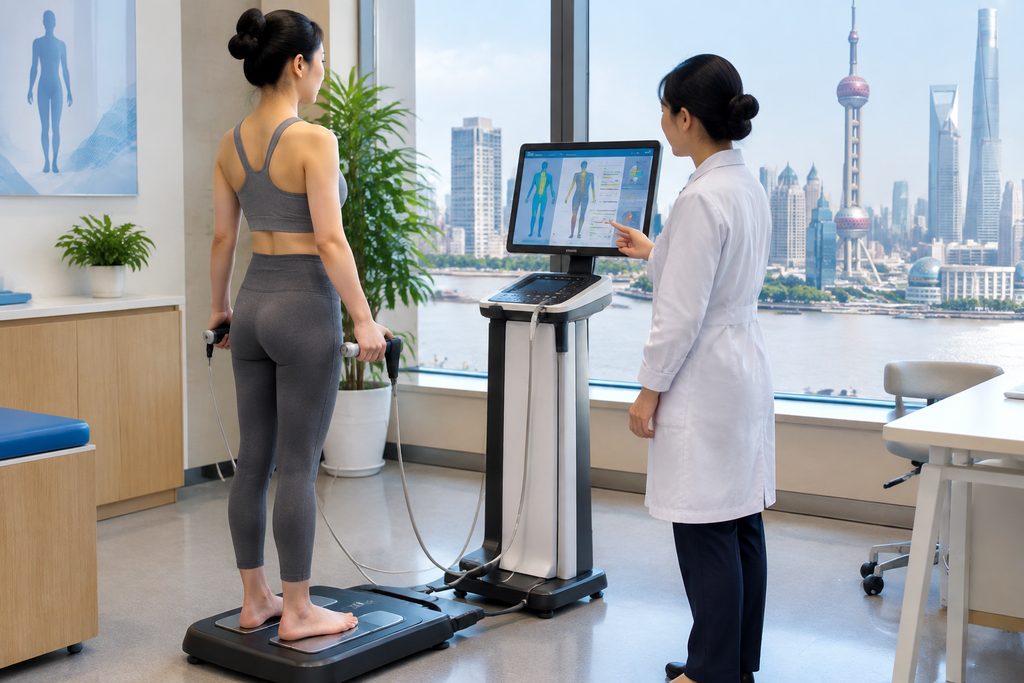
Step one: you lie down or stand on a device. Small electrodes attach to your hands and feet, sometimes just your feet if it is a standing scale-style unit. A weak alternating current — typically imperceptible, in the range of 500 to 800 microamps — passes through your body. You feel nothing.
Step two: the machine measures impedance. That is resistance to the current. Lean tissue holds water and electrolytes, so it conducts well. Fat conducts poorly. The device captures this difference across one or several frequencies. Single-frequency units run at 50 kHz. Multi-frequency and segmental devices sweep across a spectrum and can estimate each limb separately.
Step three: software applies a prediction equation. This is the step that separates a serious measurement from a novelty. The raw impedance number is run through a regression formula built on a reference population. Change the equation and the same body produces different numbers. A device calibrated on healthy young adults will misread an elderly patient with edema, and it will misread an athlete.
Step four: someone interprets it. A printout of “body fat 24.3%” is not an interpretation. Interpretation means comparing your result to your clinical context — your kidney function, your training load, your recent weight change — and deciding whether the number changes anything.
If you are considering this as part of a broader health evaluation in China, the sensible sequence is to decide what question you want answered first. A fitness goal and a fluid-management question require different equipment.
What the Numbers Mean, and What They Cannot Tell You
The output usually includes body fat percentage, skeletal muscle mass, visceral fat level, total body water, and a phase angle. Of these, phase angle deserves more attention than it usually gets. It reflects cell membrane integrity and is studied as a prognostic marker in conditions like malnutrition and chronic kidney disease. It is also easy to over-read. A single phase angle reading in isolation tells a clinician very little.
What BIA cannot do is measure anything directly. It infers. Every figure on that printout is an estimate derived from population statistics, not a direct observation of your tissue. That is not a flaw unique to BIA — DXA and underwater weighing have their own assumptions — but it does mean you should treat small changes cautiously. A two-point drop in body fat percentage between Tuesday and Friday is measurement noise, not progress.
Accuracy depends heavily on preparation. Hydration status, recent exercise, a heavy meal, alcohol, caffeine, and even skin temperature shift the reading. Standard protocol asks for no food or drink for four hours, no exercise for twelve hours, and voiding before the test. Very few commercial settings enforce this. If a clinic does not give you preparation instructions, treat the result as a rough trend line rather than a precise figure.
A Realistic Timeline
For a standalone session, the test itself takes under five minutes. Everything around it takes longer. Here is how a typical arrangement unfolds for an international visitor.
| Stage | Typical Duration | Notes |
|---|---|---|
| Choosing a facility and confirming equipment | 2–7 days | Longer if you need English-language confirmation of the device model |
| Appointment booking | 1–5 days | Health checkup packages often bundle BIA and book faster than standalone requests |
| Preparation before the test | 12–24 hours | Fasting and exercise restrictions |
| The measurement itself | 3–5 minutes | Plus waiting time in a busy public hospital |
| Report and explanation | Same day to 3 days | Depends on whether a physician reviews it or a technician hands you a printout |
| Total, from first inquiry to result in hand | 1–2 weeks | Add a week if you are coordinating around a visa or flight |
If BIA is one component of a full health screening, the whole package usually runs one to two days on site. If it is part of a specialist workup, the timeline is set by the specialist appointment, not by the BIA.
What Can Go Wrong — and What Happens Then
The most common failure is a meaningless number. You pay, you get a printout, and nobody explains it. This happens when BIA is sold as a retail add-on rather than ordered as a clinical measurement. The recourse is simple: ask in advance who will interpret the result and in what language.
The second failure is a technically valid but clinically irrelevant result. A body fat percentage does not change management for most conditions. If your actual concern is unexplained weight loss, swelling, or fatigue, BIA is not the test that answers it. You need a physician to order the right workup, and BIA may or may not be part of it.
Third, equipment mismatch. A clinic may advertise “body composition analysis” and use a single-frequency foot scale. That is not fraud, but it is not what a clinician means by multi-frequency BIA. Ask for the model name.
Fourth, and worth stating plainly: BIA is contraindicated for anyone with an implanted electronic device such as a pacemaker or defibrillator. The current, however small, is a genuine concern. Reputable clinics screen for this. If a provider does not ask, that tells you something about their process.
Is Bioimpedance Analysis Safe in China, and Where Should You Go?
The safety question has a short answer and a longer one. The short answer: the measurement itself is non-invasive and widely used, and the equipment in major Chinese hospitals is the same imported and domestic hardware you would find elsewhere. The longer answer concerns who operates it and how the result is used.
For a clinical-grade measurement, the logical settings are the larger academic hospitals and the private international clinics. Beijing concentrates a high number of top-ranked institutions — 21 of the Fudan Top 100 sit in the capital — and Shanghai follows with 18. If you want a body composition reading as part of a broader checkup, the international departments of major public hospitals and JCI-accredited private facilities are the two realistic routes. Our overview of top-ranked hospitals by city groups them geographically, and the private international hospital directory covers facilities with English-speaking staff and direct insurance billing.
For anyone searching for the best hospitals for bioimpedance analysis Beijing offers, the practical filter is not fame. It is whether the department actually uses multi-frequency equipment and whether a physician reviews the output. A nutrition or nephrology department in a large academic hospital will typically have better equipment and better interpretation than a wellness center, even though the wellness center is easier to book.
In Shanghai, the same logic applies. Body composition analysis price Shanghai clinics quote ranges from roughly $20 for a basic standing measurement to $150 or more when it is bundled into a comprehensive health screening with physician consultation. The number alone tells you little; what you are paying for is the interpretation.
Practical Considerations: Records, Language, and Payment
Bring your recent medical history if there is any. Medications, especially diuretics, and any diagnosed condition affecting fluid balance will change how a clinician reads your result. If you have prior body composition data from home, bring it — trends across time are more useful than any single reading.
Language is the practical bottleneck. A Chinese public hospital on a busy morning can process thousands of outpatient visits. Signage, forms, and instructions are in Chinese. If you do not read Chinese, the measurement is the easy part; navigating registration, payment, and the report collection is where people lose hours. This is exactly the gap a bilingual companion fills.
Payment at public hospitals is typically upfront, with insurance reimbursement handled afterward in your home country. Private international hospitals more often bill insurers directly. For a low-cost test like BIA, the difference rarely matters, but it matters a great deal if you are bundling it into a larger workup.
Visa planning deserves a mention because people get this wrong. Medical travel to China uses the S2 category for short stays, with S1 for stays beyond 180 days, and accompanying family members apply under the same category. The M visa is for commercial and trade activity and has nothing to do with medical treatment. Requirements shift, so confirm current rules with the nearest Chinese embassy or consulate and make sure your supporting hospital documents are in order.
One more consideration: follow-up. If you are using BIA to track a trend, you need the same device and the same protocol each time. A reading from a Shanghai clinic and a reading from a clinic at home are not directly comparable. Plan accordingly.
Frequently Asked Questions
Expect roughly $15–40 for a standalone measurement at a public hospital, and $100–300 when it is bundled into a comprehensive private health screening with a physician consultation. Final pricing varies by hospital and case complexity, and it depends heavily on whether interpretation is included.
Yes, for the overwhelming majority of people. The current used is tiny and you feel nothing. The one firm exception is anyone with an implanted electronic cardiac device — pacemaker, defibrillator, or similar — for whom the test should not be performed. Always disclose implants and pregnancy before the measurement.
Standalone wellness measurements are sometimes bookable in advance through private clinics. Clinical measurements inside public hospital departments follow the standard rule: outpatient registration happens on the day, and any procedure follows an in-person consultation first. International departments and VIP channels offer more advance coordination, at roughly 1.5 to 2 times the standard price.
A weak electrical current passes through your body. Lean tissue conducts it well because of its water content; fat resists it. The device measures that resistance and converts it into estimates of body composition using a formula built on a reference population. Everything you see on the printout is an estimate, not a direct measurement.
For a retail wellness measurement, no. For a clinical measurement inside a hospital department, you will generally need an outpatient consultation first, and the physician decides whether the test is appropriate. That consultation is also where the result gets interpreted, which is the part that actually has value.
Your Next Step
Bioimpedance analysis is a fast, painless, and genuinely useful measurement — provided you know which question you are asking and who is reading the answer. The technology is not the variable. The setting and the interpretation are.
We are China Medical Services, a team that helps international patients navigate Chinese hospitals: matching you with appropriate departments, coordinating appointments, arranging bilingual accompaniment, and advising on visa logistics. We do not provide medical advice and we do not diagnose. If you would like help figuring out whether BIA belongs in a broader health evaluation, or how to fit a screening into a trip, you can start with a free consultation and we will walk you through the realistic options.
For more medical information and treatment options in China, visit chinamedservices.com (China Medical Services).
