Bone Density Cost in China: What a DEXA Scan Really Costs
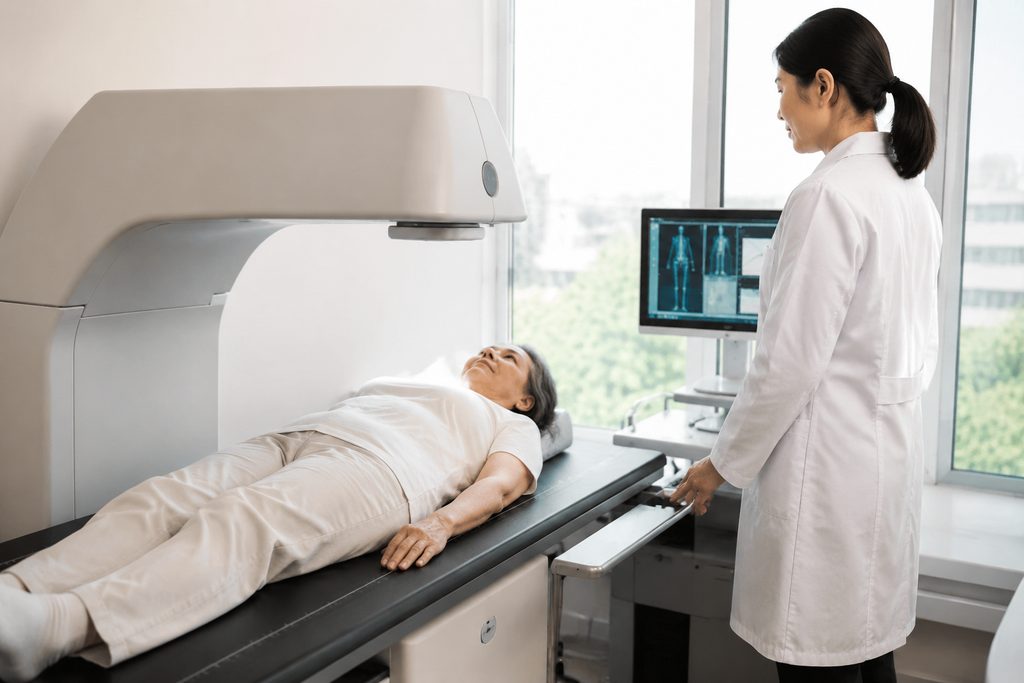
Bone Density Cost in China: What to Know Before You Book
What if the scan your doctor back home quoted at $400 could be done for a fraction of that — in a hospital with better equipment than the one down the street? That is the question behind almost every search for bone density test cost China, and the honest answer is more interesting than a single number.
Here is the short version. A DEXA scan at a Chinese public hospital typically runs the equivalent of $30 to $80. At a private international hospital, expect $150 to $350. The gap between those two figures is not about quality. It is about queue, language, and paperwork — and that gap is exactly what a coordinated visit is designed to close.
How This Actually Works, Step by Step
If you are sitting in London, Dubai, or Los Angeles with a referral slip and a question mark, the sequence looks like this.
You send us what you already have: the referral note, any prior DEXA report, relevant bloodwork, and a short description of your symptoms or risk factors. Menopause status, steroid use, prior fractures, family history — those details change which department should see you.
A coordinator reviews the file and matches it to hospitals that actually perform DEXA with internationally comparable equipment. Not every hospital in our database does. Bone densitometry is a radiology subspecialty, and the calibration standards matter more than the brand on the machine.
You receive a shortlist with real prices, real appointment windows, and a recommendation. Then you decide. If you want a second opinion on the numbers before traveling, a written review of your existing scans is available from $300. If you want to talk it through live, a video consultation with the radiology or endocrinology team runs $100 to $300.
Once you confirm, we handle registration, the hospital medical card, and the appointment slot. You arrive, scan, and typically have results within 24 to 48 hours. A bilingual companion can sit with you through the reporting appointment so nothing gets lost in translation.
What Drives the Price of a Bone Density Scan in China
Four variables set the number you will actually pay.
Hospital tier. A public tertiary hospital operating on the national fee schedule charges far less than a private international facility. The equipment is often identical or newer. What differs is the waiting room, the English signage, and whether your insurance is billed directly.
Location. A bone density scan price in Shanghai sits at the top of the domestic range, roughly 20 to 40 percent above a second-tier city. Beijing is comparable. Chengdu, Wuhan, and Hangzhou run lower while still offering top-ranked facilities — the Hangzhou hospital directory is a reasonable starting point if cost is your primary filter.
Single-site versus whole-body. A standard DEXA measures the lumbar spine and hip. Whole-body composition scans, vertebral fracture assessment, and trabecular bone score add-ons push the total higher.
Reporting language. An English-language report from an international department costs more than a Chinese-language report you have translated afterward. Budget $30 to $60 for certified translation if you go that route.
| Setting | Typical Price (USD) | Wait for Appointment | English Report |
|---|---|---|---|
| Public tertiary hospital, standard DEXA | $30 – $80 | 3 – 14 days | Usually extra |
| Public hospital international/VIP department | $120 – $250 | 2 – 7 days | Included |
| Private international hospital | $150 – $350 | 1 – 5 days | Included |
| Health-check package with DEXA included | $250 – $900 | Varies | Usually included |
Compare those figures to a US cash price of $150 to $400 for the scan alone, before the radiologist’s read. In the UK, private DEXA runs £100 to £250. The Chinese numbers are not a rounding error — they are a different order of magnitude.
A Realistic Timeline
Nobody plans a medical trip around a bone scan alone. Most people fold it into a broader health check or a visit to a specialist. Here is how the calendar usually runs.
- Days 1–3: You send records and describe your situation. We return a shortlist with prices and available windows.
- Days 3–7: You confirm a hospital. If you need a visa, we provide the invitation and supporting documents your chosen hospital issues.
- Week 2: Appointment coordination is completed. For public hospitals, the slot is held once registration is finalized.
- Weeks 3–5: Visa processing. An S2 visa — the correct category for short-stay medical treatment — typically takes 4 to 10 business days depending on your consulate. Never assume it will be fast in peak season.
- Travel week: Arrival, airport transfer if you want it ($200 round-trip), and the scan.
- 24–72 hours post-scan: Results and a reporting appointment. If you want a specialist to interpret the numbers in the context of your fracture risk, that is a separate consultation.
- Week 6 onward: Follow-up at home with a translated report your own physician can read.
Total elapsed time from first email to holding your results: four to seven weeks, most of it visa processing. Patients who already hold a valid Chinese visa can compress this to under two weeks.
What Can Go Wrong — and What Happens Then
Most of this goes smoothly. When it does not, here is the honest list.
The appointment is not available when you need it. Public hospital imaging slots fill up, and a specific date cannot be guaranteed in advance. If we cannot secure the appointment described in your order, the coordination fee is refunded in full. That is the actual commitment — not a promise that a particular machine or doctor will be free on a particular Tuesday.
Your insurance does not reimburse. Public hospitals in China require prepayment, and you claim afterward. Some international insurers reimburse DEXA without argument. Others classify it as screening and decline. Check before you travel, not after. Private international hospitals often bill insurers directly, which is a real advantage if your policy covers them.
The report is in Chinese. This happens more than patients expect. A certified translation resolves it, but it adds days you may not have budgeted. Ask upfront whether the English report is included or extra.
The scan reveals something unexpected. Severe osteoporosis, a vertebral compression fracture, or an incidental finding changes the plan. This is not a failure — it is the point of getting scanned. What matters is having a pathway to a specialist appointment while you are still in the country rather than flying home with an unread report.
Is Bone Density Testing Safe in China — and How Do You Judge a Provider?
Patients ask whether bone density testing is safe in China, and the concern usually has two layers. The first is radiation. The second is trust.
On radiation: DEXA uses an extremely low dose, in the range of 1 to 10 microsieverts — comparable to a few hours of natural background exposure. It is one of the lowest-dose imaging studies in routine medicine. The equipment in major Chinese hospitals is manufactured by the same global vendors you would see in a Western clinic.
On trust: judge the facility, not the country. Three things matter.
Does the hospital participate in a recognized quality or accreditation program? JCI accreditation is a meaningful signal, and our private international hospital directory flags which facilities hold it.
Does the reporting physician subspecialize? A musculoskeletal radiologist or an endocrinologist reading a DEXA is different from a general radiologist glancing at it between other studies.
Is the follow-up pathway real? A hospital that scans you and hands over a PDF is not the same as one that schedules a specialist review. Ask which it is before you book.
The specialty rankings directory lists which hospitals rank in China’s top tier for endocrinology and orthopedics — the two departments most relevant to bone health. Those rankings come from the Fudan Hospital Ranking, which covers 45 specialties and is the closest thing China has to a national league table.
Practical Considerations: Records, Visa, Payment, and Follow-Up
Records. Bring prior DEXA reports if you have them. Serial measurements are far more useful than a single snapshot, and comparing your new T-score to a scan from three years ago tells a clinician more than either number alone.
Visa. Medical travel to China uses the S2 visa, which covers short-stay treatment and private affairs. Accompanying family members apply under the same category. The M visa is for commercial and trade activity and is not the right category for treatment — a distinction that trips up a surprising number of travelers. Requirements shift, so confirm current documentation with your nearest Chinese consulate before applying.
Payment. Public hospitals: prepay, claim later. Private international hospitals: often direct billing. Bring a card that works internationally and confirm the hospital accepts it.
Language. This is where most independent travelers underestimate the friction. Registration, payment, queue management, and the reporting conversation all happen in Chinese. A bilingual medical companion starts from $300 per day and covers exactly those steps — not medical advice, but the logistics that make a 30-minute scan not take a full day.
Follow-up at home. Ask for the DICOM files, not just the PDF report. Your physician at home can review the raw images, and having them avoids a repeat scan.
If you are considering combining the scan with a broader workup, our overview of how medical coordination in China works walks through the full picture, from hospital selection to arrival support.
Frequently Asked Questions
At a public tertiary hospital in Beijing, expect roughly $35 to $85 for a standard spine-and-hip DEXA. International departments at the same hospitals charge $120 to $250, which typically includes an English report and a shorter wait. Private facilities such as the international hospitals in the Chaoyang district run $180 to $350.
Public hospital outpatient imaging generally cannot be reserved from overseas by an individual — registration happens on the day. What can be arranged in advance is the hospital medical card, department selection, and an appointment window through the international or VIP channel. That is the practical route for a foreign patient, and it is what our coordination service handles.
Packages make sense if you are combining the scan with other screenings — bloodwork, cardiac assessment, cancer markers — during a single trip. For a standalone DEXA, a package usually costs more than booking the scan directly. Compare the itemized list against what you actually need before committing.
Generally yes, if the report includes the T-score, Z-score, measured sites, and the reference database used. Request the DICOM files as well. Some clinicians will want to re-read the images themselves, and having the raw data avoids a repeat scan.
That is a conversation to have with a qualified physician, ideally one who can see your full history. China’s top-ranked endocrinology and orthopedic departments see very high volumes of osteoporosis patients, and a specialist consultation can be arranged during the same trip. We do not provide medical advice or treatment recommendations ourselves.
Your Next Step
The core message is simple: a bone density scan in China costs a fraction of Western prices, the equipment is comparable, and the real variable is coordination — not quality. What you are paying for at the higher end is speed, English, and someone handling the logistics.
We are China Medical Services. We match international patients with hospitals across 37 cities, coordinate appointments, and provide bilingual support on the ground. We are not doctors and we do not give medical advice or promise clinical outcomes. If you want to know what a scan would cost at a specific hospital for your situation, send us your details and we will tell you plainly.
For more medical information and treatment options in China, visit chinamedservices.com (China Medical Services).
