Painless Gastroscopy in China: What to Expect and What It Costs
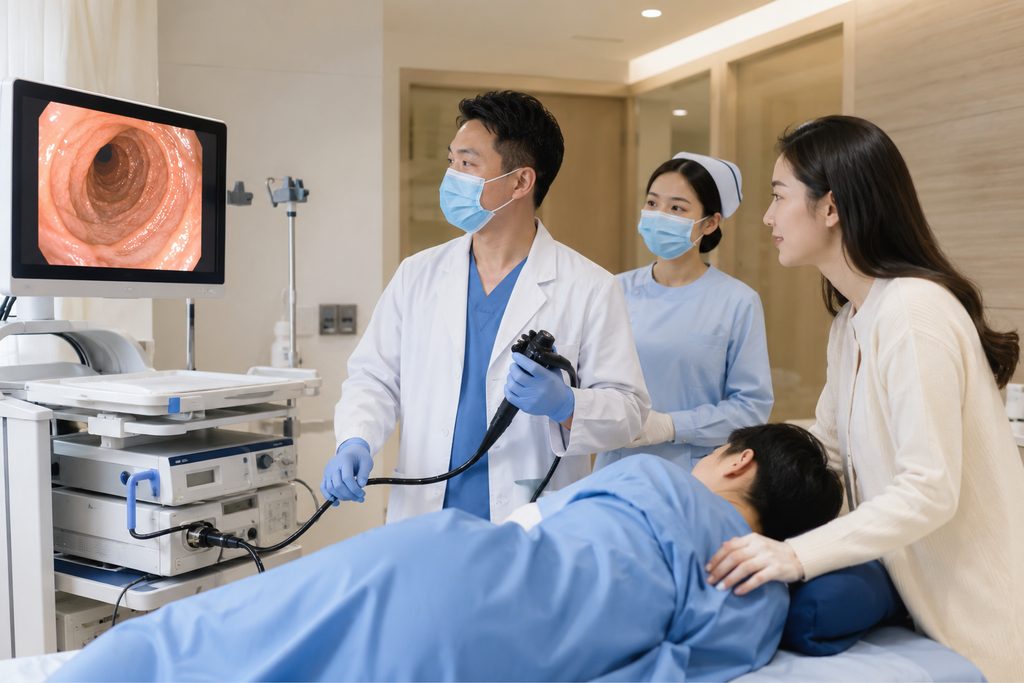
Painless Gastroscopy in China: What to Expect
When 54-year-old David from Melbourne started noticing a dull ache under his ribs that wouldn’t go away, his GP in Australia told him he needed a gastroscopy. Then came the quote: roughly AUD 2,800 out of pocket, plus a six-week wait for a private gastroenterologist. A colleague mentioned that a painless gastroscopy cost China a fraction of that — and could be arranged within days. David didn’t know where to start. Neither do most patients who land on this page.
So let’s walk through it properly. What “painless” actually means, what the procedure involves at a Chinese hospital, what you’ll pay, and where the hidden friction points are.
What “Painless” Gastroscopy Actually Means
A gastroscopy (also called upper endoscopy) is a thin flexible tube with a camera passed through the mouth to examine the esophagus, stomach, and first part of the small intestine. The “painless” version means the patient is sedated — usually with intravenous midazolam, propofol, or a combination — so they sleep through the 5 to 15 minute procedure and remember nothing afterward.
This is not a Chinese invention. Sedated endoscopy is standard in the US, UK, and Australia. What differs in China is the volume. Top-tier Chinese hospitals perform endoscopies at a scale Western hospitals rarely match — some large tertiary centers run dozens of procedure rooms simultaneously, which is one reason the per-case cost stays low and appointment lead times stay short.
Two sedation options exist at most Chinese hospitals:
- Conscious sedation — you’re drowsy but technically responsive. Cheaper, faster recovery.
- Deep sedation / anesthesia-assisted — an anesthesiologist manages your airway while you sleep. This is what most international patients choose.
If you have sleep apnea, significant heart disease, or a BMI above 40, the anesthesia team will want a pre-procedure assessment. That’s normal and not a red flag.
Painless Gastroscopy Cost China: The Real Numbers
Here’s where the conversation gets concrete. At a top-tier public hospital in Beijing or Shanghai, a standard sedated gastroscopy typically runs between $250 and $600 USD all-in — that includes the endoscopy fee, sedation, anesthesia monitoring, and a basic pathology report if biopsies are taken.
At a private international hospital like United Family or Jiahui, expect $800 to $1,500 USD for the same procedure with English-speaking staff, direct insurance billing, and a more hotel-like environment.
| Location | Typical Cost (USD) | Wait Time |
|---|---|---|
| Top public hospital, China | $250 – $600 | 2 – 7 days |
| Private international hospital, China | $800 – $1,500 | 1 – 3 days |
| United States (insured, out-of-pocket portion) | $800 – $2,500 | 2 – 6 weeks |
| United States (uninsured, full price) | $2,500 – $6,000 | 2 – 6 weeks |
| United Kingdom (private) | £1,200 – £2,500 | 2 – 4 weeks |
| Australia (private) | AUD 1,800 – 3,200 | 3 – 8 weeks |
These figures vary by hospital and case complexity. If polyps are removed, if the procedure takes longer than expected, or if you need additional imaging on the same day, the total moves up. A hospital that quotes you a single flat number without asking about your history is not giving you a real estimate.
How This Actually Works, Step by Step
Understanding the sequence matters more than the price, because Chinese public hospitals don’t operate like Western clinics. You cannot simply book a gastroscopy online from overseas and show up. The pathway looks like this:
Step 1 — Send your records. You share your existing reports: prior endoscopies, blood work, imaging, medication list, and a short summary of symptoms. Our team translates these into Chinese and prepares a case file.
Step 2 — A specialist reviews the file. A gastroenterologist at the relevant hospital reviews whether a gastroscopy is actually indicated, whether sedation is appropriate for you, and whether any pre-procedure tests are needed. This usually comes back within 2 to 5 business days.
Step 3 — You receive a written opinion or video consultation. A written second opinion runs $300–$500. A video consultation with the specialty team runs $100–$300 at a standard international department, or $500–$800 with a top specialist. Multidisciplinary review, if needed, is $1,500–$2,000.
Step 4 — Appointment coordination. If you decide to proceed, we handle registration, medical card creation, and scheduling through the hospital’s official international or VIP channel. Coordination starts from $300, and if we can’t secure the appointment shown in your order, that fee is refunded in full.
Step 5 — You arrive, and a bilingual companion meets you. This is the part patients underestimate. A large Chinese tertiary hospital may see 10,000+ outpatients in a single day. Registration, payment, pharmacy, and endoscopy suite are on different floors with different queues. Our bilingual medical companion handles check-in, queueing, payment, wayfinding, and translation throughout — from $300 per day.
Step 6 — Procedure and results. The gastroscopy itself takes 5 to 15 minutes. You rest in a recovery area for 30 to 60 minutes. Preliminary findings are usually explained the same day; biopsy pathology takes 3 to 7 working days.
Is Painless Gastroscopy Safe in China?
This is the question every patient asks, and it deserves a straight answer. Sedated endoscopy carries the same baseline risks everywhere: aspiration, reaction to sedatives, minor bleeding after biopsy, and — rarely — perforation. Published complication rates for diagnostic upper endoscopy sit well under 1% in experienced hands, and Chinese tertiary centers performing thousands of procedures annually fall within international norms.
What actually varies is not the medicine. It’s the communication.
If you don’t speak Mandarin and you walk into a public hospital alone, you will struggle to explain your medication history, understand the consent form, or ask what the endoscopist saw. That’s an information risk, not a clinical one — and it’s the single most common reason international patients have a bad experience. A bilingual companion closes that gap.
Three practical safety checks before you commit:
- Confirm the hospital has a dedicated anesthesia team for endoscopy, not just a nurse-administered sedative.
- Ask whether pre-procedure blood work (coagulation panel, infectious disease screen, ECG if you’re over 60) is included.
- Make sure someone can reach you by phone for 24 hours after sedation. You cannot drive or fly immediately afterward.
A Realistic Timeline
Here’s what the calendar actually looks like for a patient starting from scratch overseas. Ranges, not best cases.
| Stage | Time Needed | Notes |
|---|---|---|
| Records collection & translation | 2 – 5 days | Longer if reports are in a non-English language |
| Specialist written review | 2 – 5 business days | Video consultation adds scheduling time |
| Hospital appointment slot | 2 – 10 days | Public VIP channel faster than standard clinic |
| S2 visa application | 4 – 10 business days | Depends on your local Chinese embassy or consulate |
| Flights & accommodation | 3 – 14 days | Book refundable where possible |
| Arrival to procedure | 1 – 3 days | Buffer for jet lag and any pre-op testing |
| Pathology results | 3 – 7 working days | Can often be sent to you after you fly home |
Total realistic window from first contact to procedure: two to five weeks. Anyone promising you a gastroscopy in China within 72 hours of first email is either using a private hospital with immediate availability or glossing over the visa step.
What Can Go Wrong — and What Happens Then
Honest failure modes, because you deserve to know them before you book a flight.
The specialist says you don’t need the procedure. This happens more than you’d expect. Maybe your symptoms point to something else, or a prior endoscopy was recent enough that repeating it adds little. You’ve spent $300–$500 on the opinion and saved a trip. That’s a good outcome, even if it doesn’t feel like one.
The appointment slot you wanted isn’t available. Top specialists have full schedules. If we can’t secure the appointment shown in your order, the coordination fee is refunded in full. We don’t substitute a different doctor without your agreement.
Your visa is delayed. S2 applications are subject to the latest embassy and consulate requirements and supporting hospital documents. We can provide the documentation hospitals issue for medical travel, but no one can guarantee approval or timing. Build a buffer.
Sedation isn’t appropriate for you. If the anesthesia assessment flags a risk — uncontrolled hypertension, severe sleep apnea, certain cardiac conditions — the team may recommend an unsedated procedure or a different approach. This is a clinical decision, and it’s the right one.
Biopsies come back needing follow-up. If pathology shows something requiring treatment, you’ll want to discuss next steps with the same team. Staying in China longer is one option; carrying records home to your local gastroenterologist is another. Both are legitimate.
Best Hospital for Gastroscopy in Shanghai — and How to Choose Anywhere
Shanghai has a deep bench. Hospitals in Shanghai include several ranked among China’s top centers for gastroenterology, alongside international private hospitals with English-speaking staff and direct insurance billing.
But “best” depends on what you need. A routine screening gastroscopy and a complex case involving Barrett’s esophagus or suspected early gastric cancer call for different settings.
How to evaluate any hospital for this procedure:
- Volume matters. A center performing thousands of endoscopies yearly has seen your variation before.
- Check for advanced imaging. Chromoendoscopy, narrow-band imaging, and magnifying endoscopy detect early lesions that standard white-light scopes miss.
- Ask who does the sedation. An anesthesiologist present beats a nurse-administered sedative for anything beyond the simplest case.
- Confirm the reporting language. You want a written report in English, or a translated version you can hand to your doctor at home.
Our department directory lists top-ranked hospitals by specialty, including gastroenterology, so you can compare centers before deciding. For a broader view of what’s available, the ranked hospital database groups facilities by city and tier.
Practical Considerations: Records, Visa, Payment, Follow-Up
Records. Bring everything. Prior endoscopy images, not just reports. Medication list with generic names. Allergy history. If you’ve had abdominal surgery, the operative note helps.
Visa. Medical travel to China uses the S2 visa with a notation for medical treatment purposes. Stays beyond 180 days require S1. Accompanying family members apply for S2 as well. Note that the M visa is for commercial and trade activities only — it is not a medical visa, despite what you may read elsewhere.
Payment. Public hospitals require prepayment; you file with your insurer afterward. Private international hospitals often bill your insurance directly. Bring a card that works internationally and confirm the hospital accepts it before you arrive.
Insurance. Call your insurer before you travel. Some cover overseas elective procedures; many don’t. Get any pre-authorization in writing.
Follow-up at home. Ask for your endoscopy images on a USB drive or disc, plus the written report. Your local gastroenterologist can work from those. Arrange a follow-up appointment before you leave China if possible.
Recovery. No driving for 24 hours after sedation. No flying for at least 24 hours, and longer if you had a complex procedure. Sore throat for a day or two is normal. Persistent chest pain, fever, or vomiting blood is not — seek care immediately.
Frequently Asked Questions
The procedure itself takes 5 to 15 minutes. Add 30 to 60 minutes in recovery as the sedation wears off. From walking into the endoscopy suite to walking out, plan on roughly 1.5 to 2 hours total.
Yes, at accredited hospitals with proper anesthesia support. Complication rates for diagnostic upper endoscopy are low worldwide, and Chinese tertiary centers operate within international standards. The bigger risk for foreign patients is communication — not being able to explain your history or understand the findings. A bilingual companion addresses that directly.
Start with a remote review. Send your records, get a specialist opinion on whether the procedure is indicated, then coordinate the appointment through the hospital’s international or VIP channel. You cannot book a public hospital gastroscopy directly from abroad — the appointment has to go through the hospital’s official registration process.
A useful package covers the procedure, sedation and anesthesia monitoring, pre-procedure blood work, and a written report. Be cautious with any package that bundles sightseeing or hotel nights into a medical quote — those are separate costs, and mixing them makes it hard to see what you’re actually paying for the medicine.
Most top-tier hospitals with international departments provide English reports on request. If not, translation can be arranged. Biopsy pathology takes 3 to 7 working days, and results can often be forwarded to you after you return home.
Your Next Step
A painless gastroscopy in China is straightforward, fast, and — at public tertiary hospitals — a fraction of what you’d pay in the US, UK, or Australia. The complexity isn’t the procedure. It’s the logistics around it: records, visa, appointment channels, and language.
We’re China Medical Services. We connect international patients with 340+ top-ranked hospitals across 37 cities, and we handle the coordination, translation, and bilingual accompaniment that makes the process work. We don’t provide medical care, and we never promise a specific clinical outcome.
If you’d like to know whether a gastroscopy makes sense for your situation, and what it would realistically cost, start with a free consultation. No obligation, no pressure — just a clear answer.
This article is for general information only and is not medical advice. Always consult a qualified physician about your individual condition before making treatment decisions.
For more medical information and treatment options in China, visit chinamedservices.com (China Medical Services).
