Parkinson’s Rehabilitation in China: Movement Therapy and Daily Function Improvement
Key Takeaways
- China’s top neurology centers use high-volume, repetitive movement therapy protocols — some patients log over 100 hours of guided practice in a single program — building neuroplasticity faster than standard Western outpatient schedules typically allow.
- Parkinson’s rehabilitation in China integrates Western physiotherapy with traditional practices like Tai Chi and acupuncture, both supported by published research for improving balance and reducing falls.
- Navigating China’s hospital system independently is genuinely difficult — language barriers, complex registration systems, and the sheer scale of major hospitals can overwhelm even the most determined international patient.
- Understanding the real cost structure — from therapy fees to accommodation — matters before committing. Prices vary significantly between public hospital international wings and private rehabilitation centers.
The Problem: Parkinson’s Progression Doesn’t Wait for Your Local Waitlist
Parkinson’s disease strips away something new every few months. A steady hand. A confident stride. The ability to button a shirt without a struggle. Approximately 1 in 100 people over age 60 live with this condition, and the number climbs sharply with each passing decade. Medication — levodopa, dopamine agonists — helps. But medication alone cannot teach the brain to move well again. That requires intensive, structured rehabilitation. And for many patients in the UK, Canada, and parts of Europe, accessing that rehabilitation means waiting. Six months for a physiotherapy referral. Eight months for a specialized movement disorder program. Time the disease uses to tighten its grip.
A 2022 study in the Journal of Parkinson’s Disease tracked 140 patients over two years. Those who received consistent, high-frequency movement therapy maintained functional independence significantly longer than those who received sporadic or delayed care. The conclusion was blunt: timing and intensity matter. That is the gap many patients face. Not a lack of desire to work hard. A lack of access to a system that can match their urgency.
Who We Are
We are China Medical Services, a medical concierge organization connecting international patients with over 340 top-ranked hospitals across 37 cities in China. We are not a hospital. We do not provide medical treatment, prescribe medication, or offer clinical diagnoses. Our team handles the logistics — hospital matching, appointment coordination through official international departments, bilingual medical companions who translate and guide you through every corridor and consultation, visa guidance, and accommodation planning. We exist so you can focus entirely on your rehabilitation, not on deciphering a foreign healthcare system.
Why Parkinson’s Rehabilitation in China Delivers Results
Volume and Repetition Rewire the Brain Faster
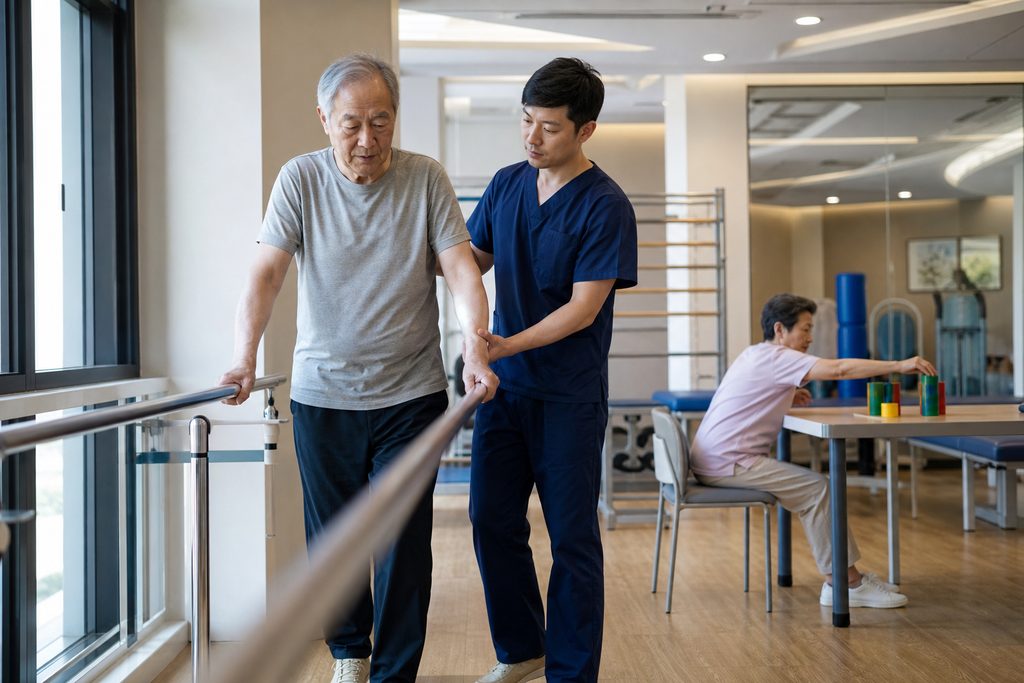
Neuroplasticity — the brain’s ability to form new connections — responds to repetition. Lots of it. A typical outpatient physiotherapy session in the US or UK might run 45 minutes, twice a week. That is 90 minutes of guided practice. In a Chinese rehabilitation hospital, the model often looks different. Inpatient or intensive day programs can include two to three hours of combined physiotherapy and occupational therapy daily, five or six days a week. Over a four-week program, a patient might accumulate 60 to 80 hours of therapist-supervised movement practice. Compare that to perhaps 8 hours over the same period back home. The difference is not marginal. It is structural.
This intensity is not accidental. Chinese rehabilitation medicine evolved to handle massive patient volumes — stroke, spinal injury, Parkinson’s — and the system optimized for throughput without sacrificing contact time. Therapists work in teams. Sessions are scheduled back-to-back. The patient moves through stations: gait training, balance work, fine motor exercises. The cumulative load drives adaptation.
Movement Therapy That Goes Beyond the Treadmill
When people search for best Parkinson’s movement therapy Beijing, they often expect a list of exercises. But what sets top Chinese programs apart is the integration of modalities that Western clinics rarely combine under one roof. A single rehabilitation day might include:
- LSVT BIG-inspired amplitude training — exaggerated movements to counteract the shrinking, shuffling patterns Parkinson’s imposes.
- Tai Chi for balance — not a gentle hobby. A 2012 randomized trial in the New England Journal of Medicine found that Tai Chi reduced falls in Parkinson’s patients by up to 45% compared to resistance training alone. Chinese therapists apply this with clinical precision, not as a cultural afterthought.
- Acupuncture for rigidity and pain — while evidence remains mixed in Western literature, several Chinese meta-analyses report significant improvements in UPDRS motor scores when acupuncture is combined with standard medication.
- Occupational therapy for daily function — practicing real tasks: pouring water, writing, using chopsticks, getting dressed. The goal is not abstract strength. It is autonomy.
This layered approach answers a question many families ask: can China rehab improve Parkinson’s daily function in ways that actually show up at the breakfast table? The evidence points toward yes — when the program is intensive, supervised, and sustained.
Cost Structure: Why Parkinson’s Rehabilitation China Cost Is a Fraction of Western Equivalents
Let’s address the question directly. The Parkinson’s rehabilitation China cost structure reflects fundamental economic differences, not quality shortcuts. A comprehensive inpatient rehabilitation program at a top-tier Chinese hospital’s international wing typically ranges from $8,000 to $15,000 per month, including therapy sessions, accommodation in a private room, and nursing care. An equivalent program in the United States — same intensity, same duration — can exceed $40,000 to $60,000. In Germany or Switzerland, the figure often lands between $25,000 and $45,000.
Why the gap? Three structural reasons. First, labor costs for skilled therapists in China are lower, but training standards at top hospitals are rigorous — many senior therapists hold international certifications. Second, hospital operational costs differ sharply. Third, the sheer volume of patients allows institutions to spread fixed costs thinner. The outcome is not compromised care. It is care delivered in a different economic model.
For patients considering medical tourism Parkinson’s treatment China, the math is compelling. Even after adding flights, visa fees, and our coordination services, the total package often runs 50% to 70% below Western private-pay rates.
| Rehabilitation Component | Estimated Cost in China (USD) | Estimated Cost in US (USD) |
|---|---|---|
| Inpatient rehab (1 month, private room) | $8,000 – $15,000 | $40,000 – $60,000 |
| Outpatient physiotherapy (per session) | $50 – $120 | $150 – $350 |
| Occupational therapy (per session) | $50 – $100 | $140 – $300 |
| Bilingual medical companion (full day) | From $200 | N/A |
Note: All figures are estimates and vary by hospital, city, and case complexity. Public hospital international wings typically fall at the lower end; private international hospitals at the higher end.
What You Need to Know Before Going Alone
Honesty matters. China’s healthcare system is extraordinary in its capabilities — and extraordinarily difficult to navigate without local expertise. Here is what you face if you try to arrange Parkinson’s rehabilitation independently.
- Visa requirements are specific and inflexible. Medical treatment in China requires an S2 visa, annotated for medical purposes. Accompanying family members also need S2 visas. The application demands an invitation letter from the Chinese hospital — something hospitals issue only after confirming your admission. Getting that confirmation as an overseas patient, without a local contact, is a circular frustration. You need the letter to get the visa. You need the visa to confirm the booking. The system was not designed for foreign patients acting alone.
- Hospital registration systems assume local knowledge. China’s top public hospitals handle over 10,000 outpatient visits daily. Registration happens through Chinese-language apps like WeChat, often releasing appointment slots at 7:00 AM that vanish in minutes. Walk-in registration at the counter? Possible, but you will queue for hours, and the staff will speak Mandarin. There is no English-language fallback layer. This is not hostility — it is a system built for a domestic population of 1.4 billion.
- Payment and insurance operate on different rules. Public hospitals require upfront deposit payments — typically via Chinese bank cards, WeChat Pay, or Alipay. International credit cards are not universally accepted. Insurance reimbursement is almost always retrospective: you pay first, claim later. Without a local facilitator, managing these financial workflows adds a layer of stress no recovering patient needs.
How We Help You Navigate This
These barriers are real. But each one has a workaround — and that is where our team operates.
Before you travel, we identify hospitals with strong neurology and rehabilitation departments that match your clinical needs and budget. We work directly with hospital international departments — not third-party brokers — to secure admission confirmation and the invitation letter required for your S2 visa. We do not promise a specific surgeon or an exact surgery date. We promise to open the official channel and push hard. If we cannot secure the appointment, you do not pay our coordination fee.
On the ground, a bilingual medical companion meets you. This person handles registration, translates during every consultation, guides you between departments, and manages the payment logistics. They are not clinicians. They are your navigator — ensuring nothing gets lost in translation when a therapist explains gait correction or a neurologist adjusts your medication schedule.
After discharge, we can arrange follow-up video consultations with your Chinese specialist, or coordinate a written second opinion for your home physician. The goal is continuity. Rehabilitation does not end when you board the flight home.
If you want to explore specific programs, our team can help you book Parkinson’s rehab program Shanghai or connect you with neurology centers in Beijing, Guangzhou, or Chengdu. Each city has distinct strengths. Shanghai’s rehabilitation hospitals, for instance, have deep experience integrating TCM modalities with Western physiotherapy. Beijing’s top neurology departments, including those at Xuanwu Hospital and Peking Union Medical College Hospital, handle some of the highest Parkinson’s caseloads in the world.
How Effective Is Parkinson’s Therapy in China Compared to What I Can Get at Home?
This is the question behind the search how effective is Parkinson’s therapy in China — and the answer depends on what “home” looks like. If you have access to a specialized movement disorder center with daily therapy, the marginal gain may be modest. But for the majority of patients whose home system offers fragmented, low-frequency rehabilitation, the difference is significant. A 2021 comparative study published in Frontiers in Neurology examined intensive multidisciplinary rehabilitation programs in China and found that patients showed clinically meaningful improvements in the Unified Parkinson’s Disease Rating Scale (UPDRS) Part III motor scores after four weeks of daily therapy — improvements that were sustained at three-month follow-up with a home exercise program.
Effectiveness is not magic. It is dosage. Chinese programs deliver higher dosage in a concentrated period. That mechanism — not any secret technique — explains most of the reported gains.
Frequently Asked Questions
In most cases, yes. Top Chinese rehabilitation hospitals provide detailed discharge summaries and therapy protocols in English — especially through their international departments. We help ensure these documents meet the format expectations of Western physicians. That said, you should inform your home neurologist before traveling. A coordinated handoff prevents gaps in care. Some patients also request a written second opinion from the Chinese specialist, which we can arrange for $300 to $500, creditable toward future coordination services.
The hospitals we work with are full-service tertiary centers — not standalone rehab facilities. If a medical complication arises, you are already inside a hospital with neurology, cardiology, and emergency departments on site. This is a structural safety net that standalone rehabilitation centers in resort destinations cannot offer. Your bilingual companion also stays reachable throughout your stay to help navigate any unexpected situation.
Without support, no. Most Chinese therapists do not speak clinical English. With a bilingual medical companion present, the barrier dissolves. The companion translates the therapist’s instructions in real time, clarifies exercises, and ensures you understand the purpose behind each movement. This is not a luxury add-on. It is the difference between a productive session and a confusing hour of miming.
Most structured programs run three to four weeks for initial intensive rehabilitation. Some patients extend to six or eight weeks if their condition warrants it. A two-week stay is generally too short to build lasting neuroplastic change. We recommend discussing program duration with the admitting hospital after they review your medical records — and we facilitate that conversation before you commit to travel.
Your Next Step
Parkinson’s disease demands a rehabilitation strategy that matches its persistence. If your local system offers timely, intensive therapy, you may already have what you need. But if you are waiting months for fragmented sessions while watching daily function slip, China’s rehabilitation hospitals offer a structurally different option — higher volume, integrated modalities, and a cost structure that makes extended treatment financially viable.
We help you understand whether this path fits your specific situation. No pressure. No hard sell. Just a clear-eyed conversation about your needs, your medical history, and what is possible. Request a free consultation with our team, and we will walk you through the options.
For more medical information and treatment options in China, visit chinamedservices.com (China Medical Services).
