DEXA Scan in China: What to Expect, Costs, and Top Clinics
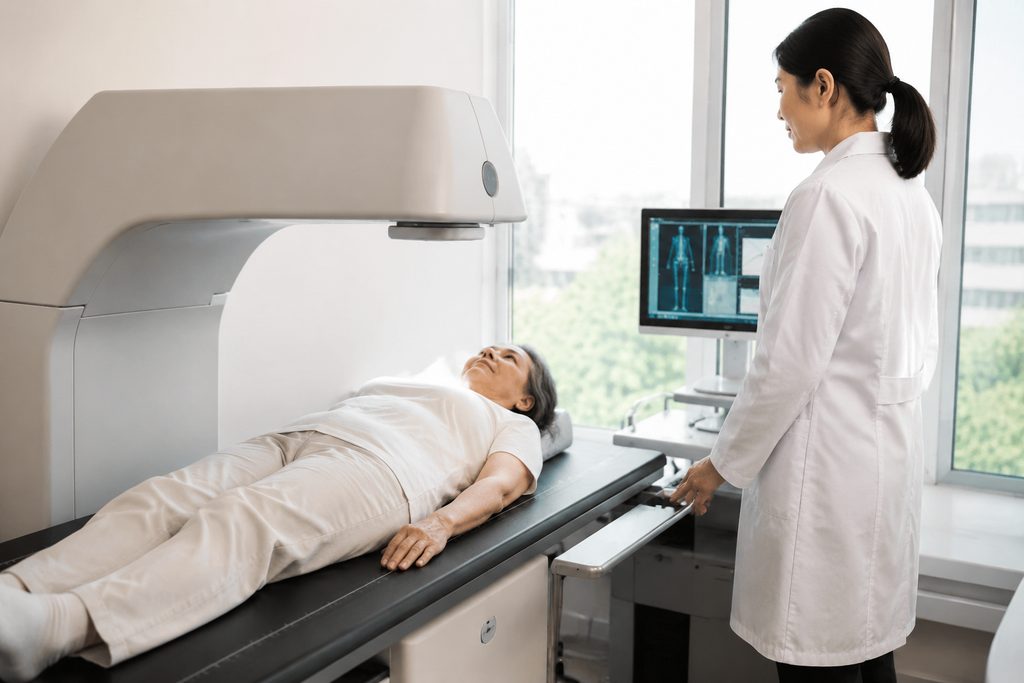
When 58-year-old Sarah from Oregon was told she needed a bone density test, she did what millions of Americans do: she called her insurance company. The quote she received was $385 out-of-pocket. A friend mentioned that she was planning a trip to Shanghai anyway. Curious, Sarah looked into getting the scan there. The dexa scan cost China providers charge? Between $40 and $120 at a top-tier public hospital. She was stunned.
That price gap is real. But it comes with a catch that most articles won’t tell you. Navigating a Chinese hospital as a foreigner without help is genuinely difficult. The savings are real, but so is the complexity. This guide walks you through exactly what to expect, what you’ll pay, and how to decide if it’s worth it for you.
DEXA Scan in China: The Short Answer
A DEXA scan in China at a top-ranked public hospital typically costs $40–$120. At a private international hospital, expect $150–$350. The scan itself takes 10–20 minutes, results are usually ready within 24–48 hours, and the technology is identical to what you’d find in the US or Europe — same manufacturers, same calibration standards.
So the procedure is cheap and fast. The hard part is everything around it: getting an appointment, finding the right department, and communicating with staff who may not speak English. That’s where the real friction lives.
Who This Is Right For — and Who It Isn’t
Bone density scanning isn’t for everyone. Here’s a straight assessment.
You’re likely a good candidate if:
- You’re a postmenopausal woman or a man over 65 with risk factors for osteoporosis
- You’re already in China for work, travel, or another medical procedure and want to add a scan
- You have a documented history of fractures or long-term steroid use
- You’re uninsured or underinsured in your home country and the out-of-pocket cost is prohibitive
- You need a follow-up scan and your last one was 2+ years ago
You should probably not pursue this if:
- You have no other reason to be in China. A $40 scan doesn’t justify a $1,200 flight.
- You need a diagnosis, not just a scan. A DEXA produces numbers, not answers. You still need a physician to interpret them.
- You weigh over 300 pounds (136 kg). Most DEXA tables have weight limits. Confirm before booking.
- You’ve had recent contrast dye injections or nuclear medicine studies. These can interfere with accuracy. Wait 7–14 days.
- You’re pregnant. DEXA uses very low radiation, but it’s generally avoided during pregnancy unless medically necessary.
The Options, Compared
Here’s how China stacks up against other common destinations for a DEXA scan. Prices reflect typical out-of-pocket costs for self-paying patients.
| Location | Typical Cost (USD) | Wait Time | English Support | Results Turnaround |
|---|---|---|---|---|
| US (hospital outpatient) | $150–$400 | 1–3 weeks | Native | 24–72 hours |
| US (standalone clinic) | $75–$200 | Same day–1 week | Native | Same day–48 hours |
| UK (NHS) | Free (if eligible) | 4–12 weeks | Native | 1–2 weeks |
| China (top public hospital) | $40–$120 | 1–5 days | Limited | 24–48 hours |
| China (private international) | $150–$350 | Same day–2 days | Full | 24–48 hours |
| Thailand (private hospital) | $80–$200 | 1–3 days | Good | 24–48 hours |
If you’re already in Asia, China’s public hospital pricing is hard to beat. If you need full English service and same-day convenience, the private international hospitals are competitive with US standalone clinics. The middle ground — a top public hospital’s international department — often offers the best balance of price and communication support.
Finding the Best DEXA Scan Clinic in Shanghai (and Elsewhere)
Shanghai is where most international patients start. The city has more than a dozen hospitals with DEXA equipment, but quality varies. The best dexa scan clinic Shanghai offers will typically be found in one of three settings.
Top public hospitals with international departments. These are the Fudan-ranked institutions — the top 5% of China’s 35,000+ hospitals. They have the newest equipment and the most experienced radiologists. The trade-off is crowds. A public hospital can see 10,000+ outpatients in a single day. Without someone guiding you through registration, payment, and department navigation, the experience can be overwhelming.
Private international hospitals. Facilities like United Family, Jiahui, and Parkway serve expatriates and medical travelers. English-speaking staff, JCI accreditation, and direct insurance billing are standard. You’ll pay more, but the process feels familiar to anyone used to Western healthcare.
Specialty orthopedic and endocrinology centers. Some hospitals have dedicated bone health clinics with DEXA on-site. These are often the fastest option because the scan and the specialist consultation happen in the same visit.
For a city-by-city breakdown of top-ranked hospitals, our directory of China’s top hospitals groups facilities by city and specialty ranking.
What It Costs: The Full Picture
The dexa scan cost China patients actually pay depends on several variables. The scan fee itself is only part of the equation.
- Scan fee (public hospital): $40–$120
- Scan fee (private international): $150–$350
- Physician consultation to interpret results: $15–$80 (public) or $100–$250 (private)
- Registration and administrative fees: $5–$20
- Translation of the report into English: $30–$80 if not already bilingual
A dexa scan price Beijing hospital quote might be slightly higher than a smaller city, but the difference is usually under $30. What drives the variance more than geography is the hospital tier. A top-tier public hospital in Beijing or Shanghai will charge more than a provincial hospital, but the equipment and expertise are also more reliable.
How Accurate Is a DEXA Scan?
This is the question that matters most. How accurate is a dexa scan, really?
The answer: quite accurate, when performed correctly. DEXA has a precision error of roughly 1–2% at the spine and hip. That means if your bone density reading is 0.850 g/cm², a repeat scan on the same machine might give 0.835 or 0.865. This is well within acceptable clinical limits.
But accuracy depends on several factors. The technologist’s positioning technique matters. So does the machine’s calibration. And so does the patient — movement during the scan, recent contrast studies, or metal implants in the scan area can all skew results.
China’s top hospitals use the same Hologic and GE Lunar machines found in American and European clinics. The calibration standards are set by the same international manufacturers. A scan at a Fudan-ranked hospital is not meaningfully different from one at a US academic medical center.
What can differ is the interpretation. A T-score of -2.5 means osteoporosis regardless of where the scan was performed. But the clinical context — your age, fracture history, medication use — shapes what that number means for you. That’s why a consultation with a specialist matters as much as the scan itself.
Is a DEXA Scan Safe in China?
Is a dexa scan safe in China? Yes. The technology is identical to what’s used worldwide. The radiation dose is extremely low — typically 1–10 microsieverts, which is less than a chest X-ray and roughly equivalent to a few hours of natural background radiation.
Safety concerns about Chinese healthcare usually center on three things: sterility, equipment maintenance, and regulatory oversight. At top-ranked hospitals, all three meet international standards. These institutions treat millions of patients annually and are subject to rigorous government inspection. Many hold JCI accreditation.
The bigger safety issue for foreign patients is not the machine. It’s communication. If you can’t explain your medical history or understand the technologist’s instructions, the scan quality can suffer. That’s a logistics problem, not a safety one — but it’s worth solving.
How to Book a DEXA Scan in China
Here’s the part most guides gloss over. You generally cannot book a DEXA scan at a Chinese public hospital from overseas in advance. Walk-in registration is the norm. You show up, queue, register, pay, and wait.
That’s changing at international departments, where appointment coordination is possible. But the standard public pathway still requires being physically present.
If you want to book dexa scan China appointments ahead of time, you have two realistic options. First, go through a private international hospital that accepts online booking. Second, work with a coordination service that can navigate the hospital’s international department on your behalf.
The documents you’ll need are straightforward: your passport, any prior DEXA reports, and a list of current medications. If you have a referral letter from your home physician, bring it — it helps the Chinese specialist understand why the scan was ordered.
Understanding Your Results
DEXA results come as T-scores and Z-scores. The T-score compares your bone density to a healthy 30-year-old of the same sex. The Z-score compares you to others your age.
A T-score of -1.0 or above is normal. Between -1.0 and -2.5 is osteopenia. At -2.5 or below, it’s osteoporosis. These thresholds are the same everywhere in the world. A Chinese radiologist and an American one will read the same scan the same way.
What differs is what happens next. In China, you’ll typically receive a printed report within 24–48 hours. If you want a specialist to explain it, you’ll need a separate consultation appointment. At private hospitals, the radiologist or an endocrinologist often reviews results with you directly.
Frequently Asked Questions
At private international hospitals, yes. At public hospitals, it’s difficult but not impossible. Some international departments have English-speaking staff. Without that, you’ll need a translator or a bilingual companion to handle registration, payment, and communication with the technologist.
Almost certainly not directly. Most insurers require pre-authorization for overseas care and have specific network requirements. You’ll likely pay out of pocket and file for reimbursement afterward. Some international health plans do cover treatment at JCI-accredited hospitals in China. Check your policy before assuming anything.
At most hospitals, 24–48 hours. Private international hospitals often deliver results within 24 hours. If you need a specialist consultation to interpret the results, add another day or two for scheduling. Plan for at least three days in the city if you want the full cycle completed.
DEXA scans don’t diagnose cancer or other serious diseases. They measure bone mineral density. If your results indicate osteoporosis, the next step is a treatment plan — usually medication, calcium and vitamin D supplementation, and lifestyle changes. If you’re already in China, you can consult with an endocrinologist or rheumatologist at the same hospital. If you’re planning to return home, bring the report to your regular physician.
No. A $40–$120 scan doesn’t justify international travel on its own. But if you’re already in China for business, tourism, or another medical procedure, adding a DEXA scan is inexpensive and efficient. The value proposition changes entirely when the scan is part of a broader trip.
Your Next Step
A DEXA scan in China is fast, affordable, and technically equivalent to what you’d receive anywhere in the developed world. The savings are real. The logistics are the variable.
China Medical Services is not a hospital and we don’t provide medical diagnoses. We’re a coordination service that helps international patients navigate China’s healthcare system — from hospital selection to appointment booking to bilingual accompaniment on the day of your visit. If you’d like to explore whether a scan in China fits your situation, you can start with a free consultation. No pressure, no obligation — just a conversation about what’s possible.
For more medical information and treatment options in China, visit chinamedservices.com (China Medical Services).
